
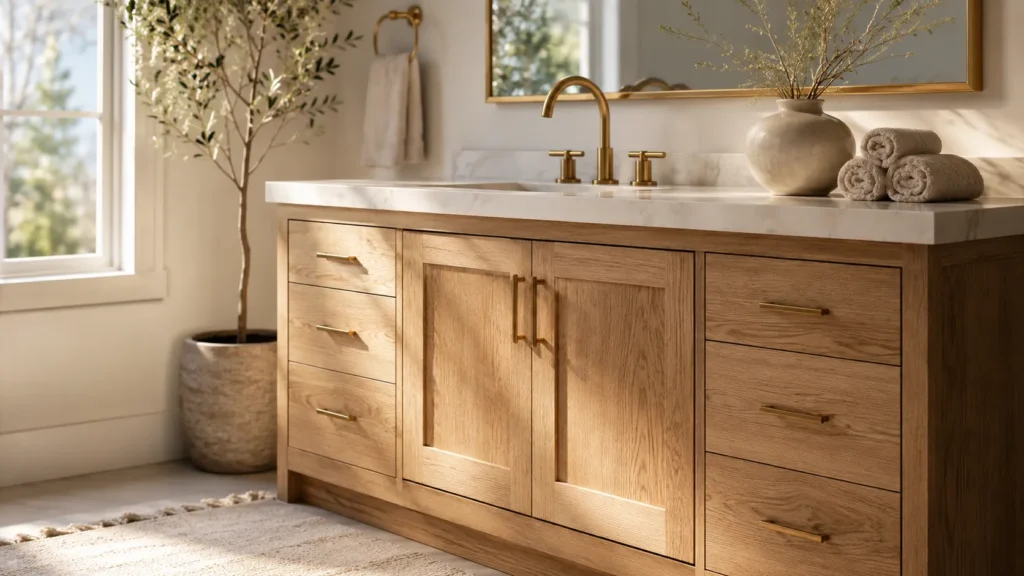
If there’s one material I keep coming back to in nearly every bathroom project, it’s white oak. There’s something about that warm, straight grain that just makes a bathroom feel intentional like it was designed, not just decorated. Right now, white oak vanities are showing up everywhere from Modern Farmhouse homes in Nashville to sleek Japandi-inspired condos in Seattle, and honestly, it makes total sense. Unlike trendy painted finishes that date quickly, white oak has this quiet staying power that works across styles, budgets, and bathroom sizes. Whether you’re doing a full gut renovation or just swapping out an old vanity, I think you’re going to find something here that genuinely clicks for your space.
My Design Notes
A few years back, I was working on a master bath renovation for a client in Denver’s Wash Park neighborhood. She had her heart set on a white oak floating vanity, and I was completely on board. We sourced a gorgeous wire-brushed cabinet, paired it with unlacquered brass fixtures and a honed Calacatta countertop. It looked like something straight out of a design magazine. About three months after installation, she called me. The wood near the sink had developed dark water rings because the finish we used wasn’t rated for high-splash zones. My contractor and I fixed it, but that little lesson cost her $800 and cost me two days of rework. Ever since that project, I specify marine-grade or conversion varnish finishes on every single white oak vanity I install in a bathroom. It’s a small detail that most people overlook, and it makes all the difference between a vanity that lasts 20 years and one that disappoints you in 20 weeks.
Stunning White Oak Vanity Designs That Bring Timeless Elegance to Any Bathroom
1. The Classic Floating White Oak Vanity
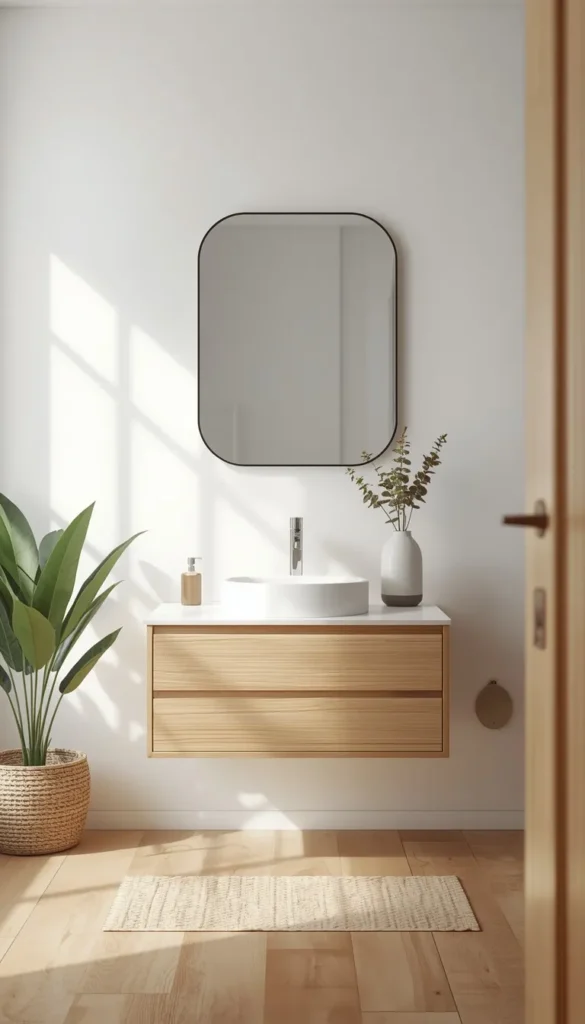
If I had to pick one white oak vanity style that works in almost every bathroom, this would be it. A floating vanity mounted directly to the wall with no legs touching the floor instantly makes your bathroom feel larger, cleaner, and more intentional. The gap between the cabinet and the floor creates that visual breathing room that cramped bathrooms desperately need. I’ve installed floating white oak vanities in everything from tiny 5×8 guest baths to sprawling master suites, and every single time, the homeowner stands back and says the same thing: “Why didn’t we do this sooner?”
What makes white oak work so well in this format is the grain. It’s tight, straight, and calm it doesn’t compete with your tile or your fixtures. It just anchors the whole room quietly.
A quick trick I’ve learned is to mount the vanity at 34 to 36 inches from the floor instead of the standard 32. That extra height feels more like a piece of furniture than a builder-grade cabinet, and taller homeowners will thank you every single morning.
2. White Oak with Matte Black Hardware
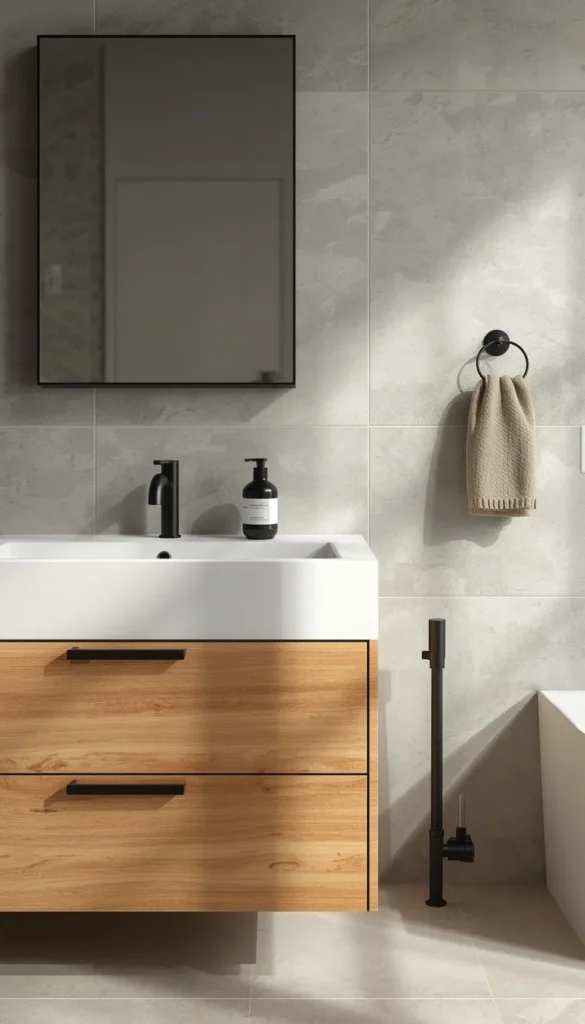
This combination is one of those pairings that looks like it shouldn’t work on paper but absolutely does in real life. The warm honey tones of white oak against crisp matte black pulls, faucets, and towel bars creates this bold, graphic contrast that feels very current without being trendy. I’ve seen this done beautifully in modern industrial lofts in Chicago and in newer construction homes in Austin, and the energy is completely different in each space but the pairing holds up in both.
One thing to watch out for here is overdoing the black. If your tile is dark, your mirrors are black-framed, and your light fixtures are black, adding matte black hardware can push the whole room into heavy territory. My rule of thumb: let the white oak be the warm anchor, use matte black as the punctuation, and keep everything else light and neutral.
Works especially well with:
- Large format white or light grey tile
- Concrete-look porcelain floors
- Simple rectangular undermount sinks
3. White Oak with Brushed Brass
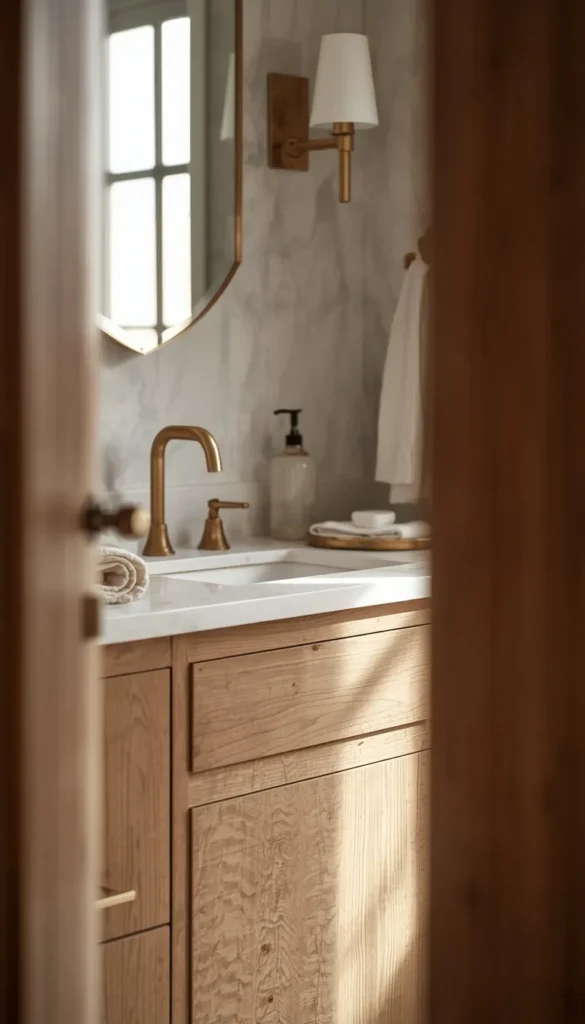
There’s a reason this pairing keeps showing up on every design mood board right now. Brushed brass and white oak share the same warm undertones, and when they meet in a bathroom, the result feels genuinely luxurious without trying too hard. This is the combination I reach for most often when a client tells me they want their bathroom to feel like a boutique hotel. It has that quality.
The key is brushed, not polished. Polished brass can read as dated or overly formal. Brushed brass is softer, more organic, and it actually hides water spots far better which in a bathroom is a very real, very practical concern.
This look pairs beautifully with a honed marble or quartzite countertop. The matte surface of the stone plays off the soft sheen of the brass in a way that feels collected and intentional rather than matchy-matchy.
4. Double Sink White Oak Vanity for the Master Ensuite
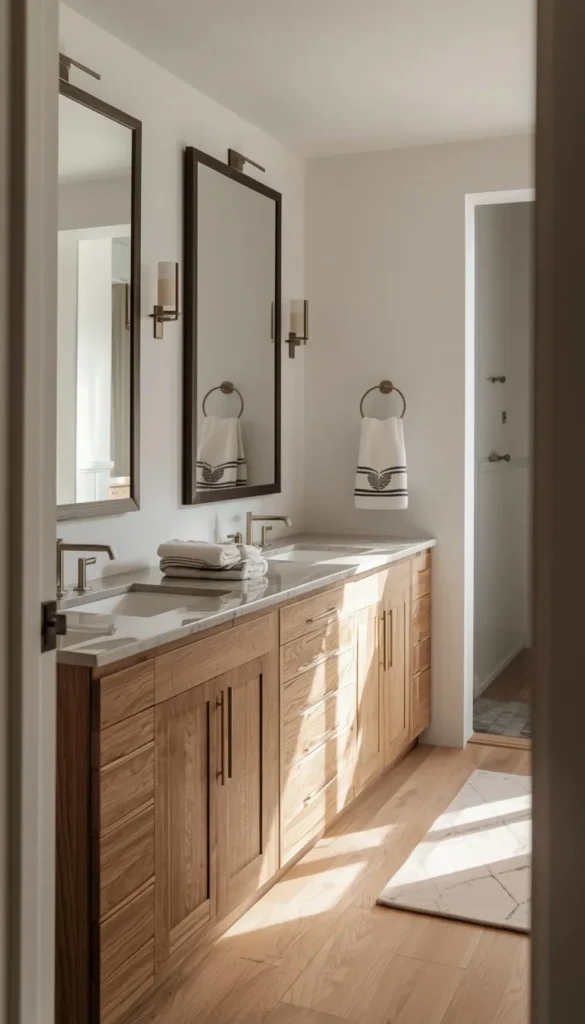
If you’re renovating a master bathroom and you have the wall space, a double sink white oak vanity is one of the best investments you can make in your home. Not just aesthetically though it does look incredible but practically. Sharing a single sink with a partner every morning is one of those small daily frustrations that adds up fast. Two sinks solves that problem permanently.
For a double vanity, I typically recommend going no shorter than 60 inches wide. Anything smaller and the two sinks feel crowded, and you lose the counter space that makes the whole setup functional. White oak works especially well here because a long run of that warm grain wood creates a natural focal point in the room without needing much else.
A few things worth considering before you commit:
- Make sure your plumbing rough-in can accommodate two drain locations
- Plan for at least 12 to 14 inches of counter space between the two sinks
- Consider two separate mirrors rather than one long one it reads more custom and gives each person their own zone
Are you leaning toward a floating white oak vanity or a floor-mounted one for your bathroom and what’s making you lean that way?
5. The Japandi Style White Oak Vanity
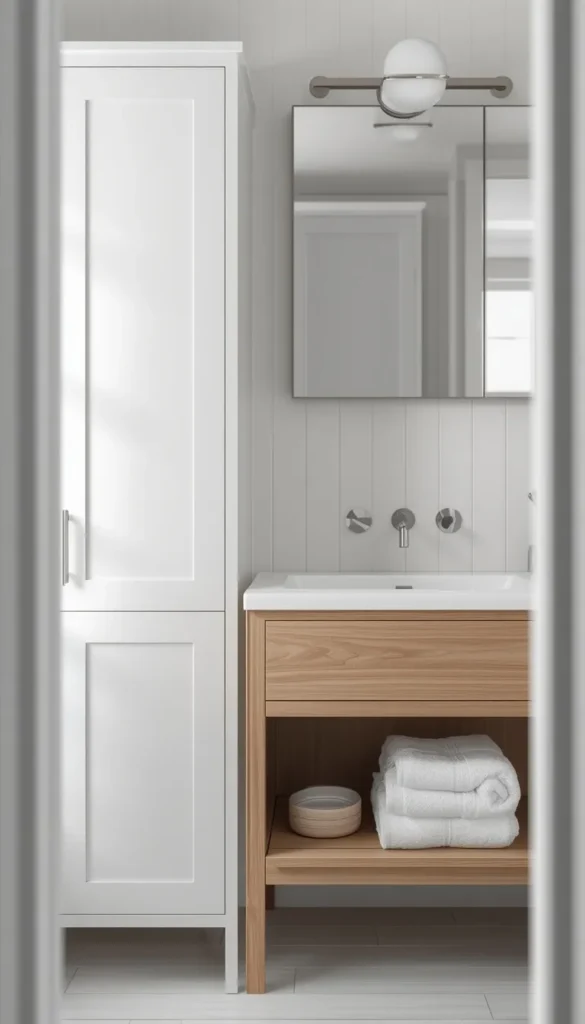
Japandi is the design philosophy that came out of merging Japanese minimalism with Scandinavian functionality, and white oak might just be its perfect material. I’ve been incorporating this aesthetic into more and more US projects over the last two years, and the client response has been overwhelming. People are tired of busy bathrooms. They want calm. They want intentional. Japandi delivers exactly that.
A true Japandi white oak vanity has almost no ornamentation. Flat slab doors with integrated pulls or small recessed handles, a simple undermount sink, and nothing on the counter that doesn’t need to be there. The beauty is entirely in the material itself the grain of the oak, the texture of the stone top, the negative space around the vanity.
What makes this style work in an American bathroom specifically is pairing it with warm whites rather than cool ones. Warm white walls, natural linen towels, a round ceramic vessel or undermount sink, and maybe a single branch of dried pampas in the corner. That’s the whole look. And it photographs beautifully, which matters if you’re planning to sell.
6. Scandinavian White Oak Bathroom with Open Shelving
Scandinavian design has always had a deep love affair with natural wood, and white oak fits right into that tradition. What separates a Scandi-inspired vanity from other wood styles is the emphasis on light, airiness, and functional storage that’s also beautiful to look at. Open shelving is a big part of that equation.
I’ve noticed that American homeowners are sometimes nervous about open shelving in a bathroom. The concern is always the same: it’ll look cluttered. And yes, it absolutely can if you don’t edit ruthlessly. But when you do, it’s stunning. Rolled white towels, a small ceramic soap dish, maybe a potted succulent. That’s all you need.
A quick trick here is to choose a white oak vanity with one closed cabinet section and one open shelf section. You get the best of both worlds hidden storage for the things you don’t want to see, and a styled open shelf for the things you do.
Works beautifully with:
- Soft white or light greige wall tile
- Polished nickel or brushed chrome fixtures
- Simple round or rectangular frameless mirrors
Top 6 White Oak Vanity Idea
| Idea | Estimated Price | Maintenance |
|---|---|---|
| Classic Floating Vanity | $800 – $2,500 | Low |
| Japandi Style Vanity | $1,200 – $3,500 | Low |
| Double Sink Master Vanity | $1,500 – $4,000 | Medium |
| White Oak with Quartz Top | $900 – $2,800 | Low |
| Budget IKEA Hack with Oak Fronts | $700 – $1,750 | Low |
| Luxury Custom with Integrated Sink | $3,500 – $8,000+ | Medium |
7. Rustic Modern White Oak with Zellige Tile Backsplash
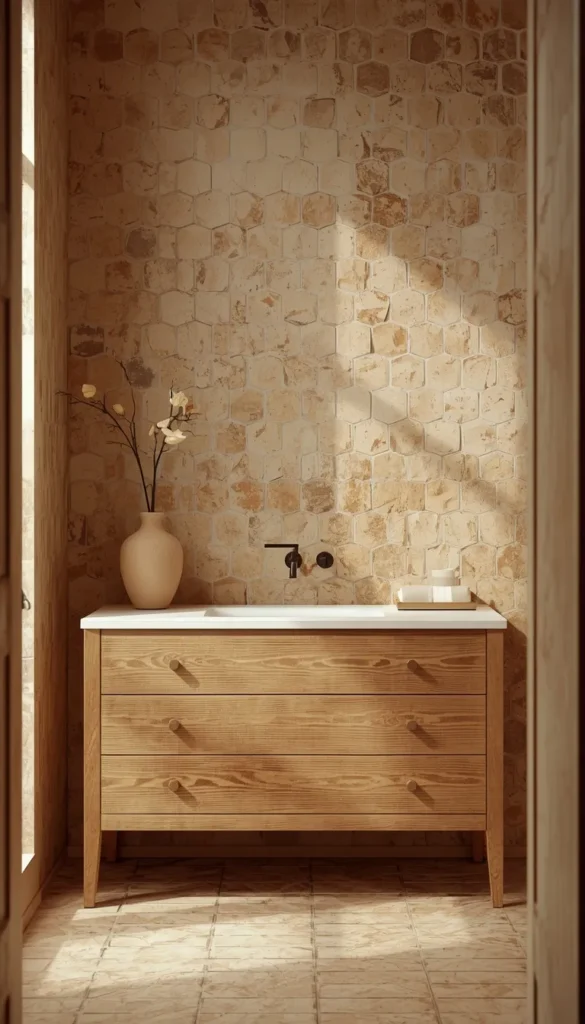
This is one of my personal favorites, and it’s a combination I don’t see talked about enough. Zellige tile that handmade Moroccan ceramic with the slightly irregular surface and gorgeous light-catching quality paired with a white oak vanity creates this incredibly rich, layered look that feels both rustic and completely sophisticated at the same time.
The slight imperfection of the zellige actually enhances the natural grain of the white oak rather than competing with it. Both materials have character. Both have texture. And together they create a bathroom that feels genuinely one of a kind, like it evolved organically rather than being pulled from a catalog.
Color-wise, I love warm cream or soft sage zellige behind a natural white oak vanity. If you want more drama, a deep terracotta or dusty blue zellige with wire-brushed white oak is a combination that will stop people in their tracks. One thing to factor into your budget though zellige tile is not cheap. You’re typically looking at $25 to $45 per square foot installed, but even a small backsplash area behind the vanity makes a massive visual impact without breaking the bank.
8. White Oak Vanity with Quartz Countertop
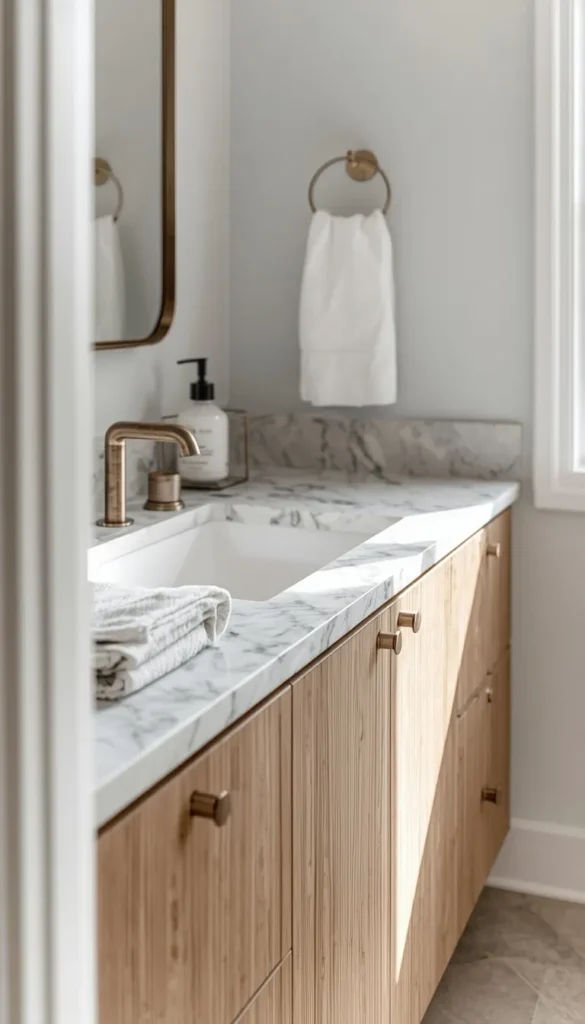
If you’re looking for the most practical, durable, and low-maintenance countertop to pair with your white oak vanity, quartz is your answer. Full stop. I recommend it constantly to clients who love the look of marble but have kids, pets, or just a realistic sense of how their household actually operates.
Quartz is non-porous, which means it won’t stain from toothpaste, makeup, or the inevitable hair dye incident. It doesn’t need sealing. It holds up to daily moisture without complaint. And visually, a white or light grey quartz with subtle veining against warm white oak looks just as elegant as natural stone sometimes more so, because the consistency of the pattern lets the wood grain do the talking.
The one thing I always tell clients is to avoid quartz with very bold, dramatic veining when pairing it with white oak. The wood already has its own visual texture, and two busy patterns competing for attention tends to make the whole vanity feel restless. Keep the quartz calm and let the oak shine.
Which finish feels more like your style natural white oak, whitewashed, or wire-brushed and which room are you thinking of putting it in?
9. White Oak Vanity with Vessel Sink
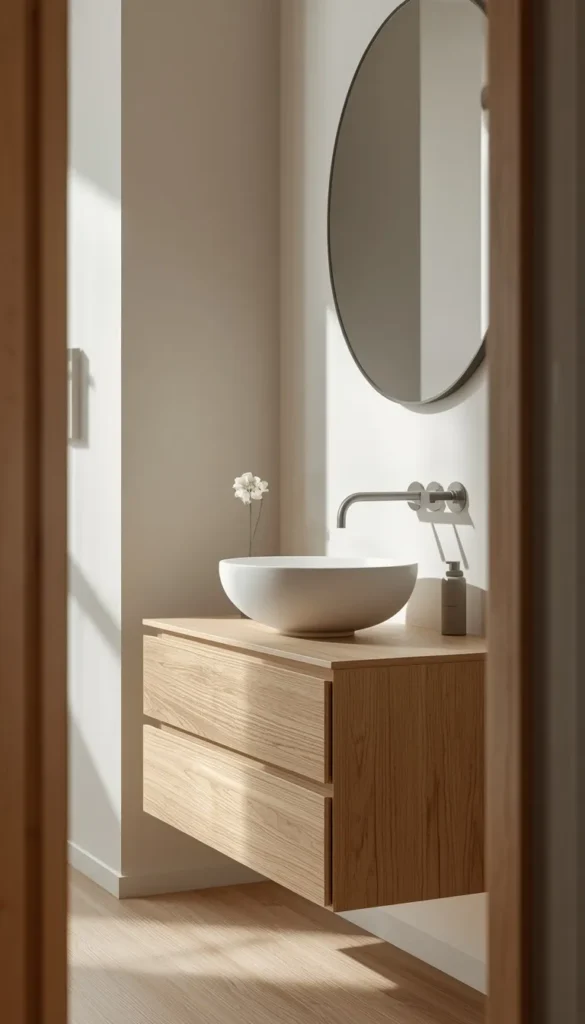
There’s something unexpectedly editorial about a vessel sink sitting on top of a white oak vanity. It’s a combination that reads almost sculptural like the sink is a deliberate design object rather than just a functional necessity. I started specifying this pairing more often after a project in Portland where my client wanted her powder bath to feel like a gallery moment. We chose a matte white ceramic vessel sink on a low-profile white oak cabinet, and honestly, it was one of the most striking bathrooms I’ve ever put together.
The practical side of vessel sinks is worth being honest about though. They sit higher than undermount sinks, which means your vanity cabinet needs to be shorter typically 28 to 30 inches rather than the standard 34. For taller homeowners, that can feel a bit awkward over time. Also, the area around the base of a vessel sink tends to collect water and soap residue, so the white oak surface directly beneath it needs a really solid waterproof finish.
When this look works, it really works. Just go in with clear eyes about the maintenance reality.
10. Small Bathroom White Oak Vanity Under 36 Inches
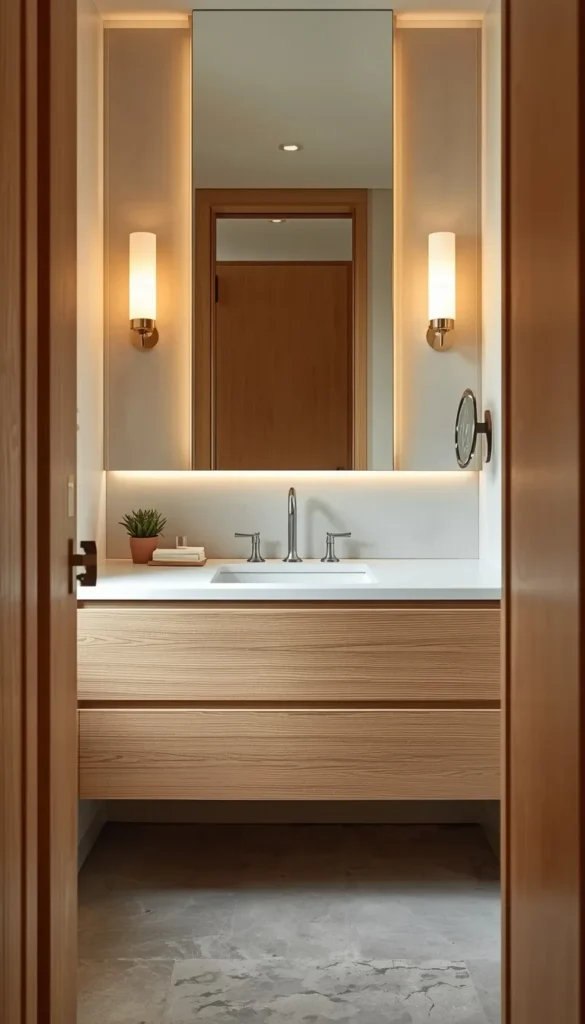
A small bathroom does not have to mean a sad bathroom. I’ve designed some of my most creative spaces in rooms under 50 square feet, and white oak is genuinely one of the best materials for making a compact bathroom feel warm and considered rather than cramped and forgotten.
For small bathrooms, I always steer clients toward a single sink vanity in the 24 to 36 inch range with a combination of one or two drawers and a small cabinet below. Drawers are everything in a small space they give you far more accessible storage than a cabinet with a door and a single shelf inside.
A few small bathroom white oak vanity rules I live by:
- Choose a floating mount to visually open up the floor space
- Pair with a large frameless mirror that extends a few inches wider than the vanity on each side
- Keep the countertop simple a thin profile white quartz or a concrete-look surface keeps things from feeling heavy
White oak in a small bathroom also benefits from good lighting more than almost any other material. A warm-toned sconce on either side of the mirror will make that grain glow in a way that feels intentional and cozy rather than dim and tight.
11. White Oak Farmhouse Vanity with Shaker Doors
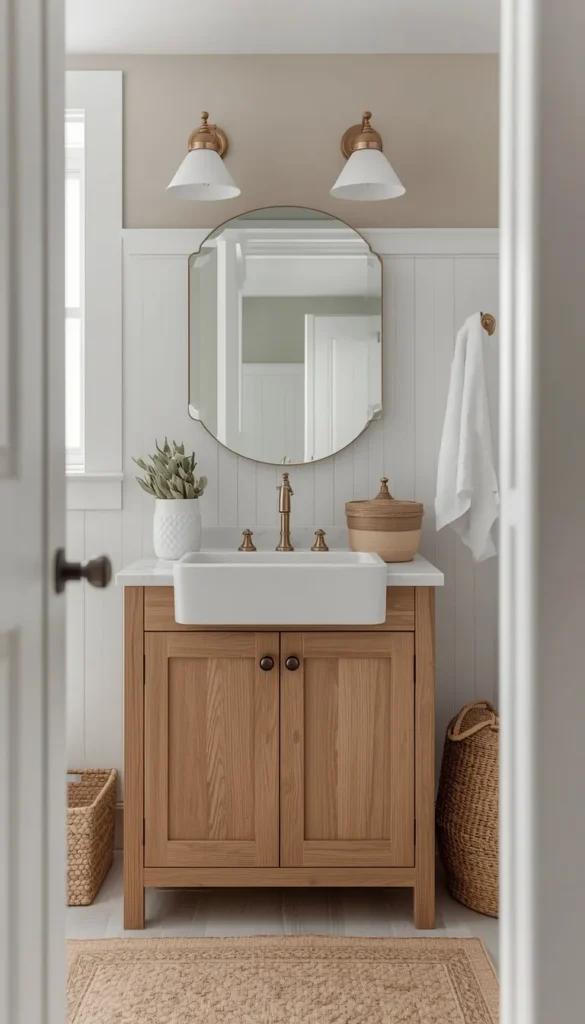
The Modern Farmhouse bathroom is still one of the most requested styles I work with across the US, and white oak with shaker door fronts is absolutely the sweet spot of that aesthetic. Shaker doors with their simple recessed panel and clean frame have been around for centuries because they work. They’re not trendy. They’re just right.
What makes white oak shaker vanities feel current rather than country is all in how you style around them. Pair with matte black fixtures and subway tile for a crisp, modern farmhouse feel. Or go warmer with brushed brass faucets, a farmhouse apron sink integrated into the vanity, and white beadboard wainscoting above. Both directions work beautifully.
One thing I genuinely love about this style is the price accessibility. Shaker door white oak vanities are widely available at mid-range price points from retailers like Home Depot, Wayfair, and RH you don’t have to go fully custom to get a great result here. A solid shaker vanity in the $800 to $1,800 range, upgraded with better hardware and a quality countertop, can look like it cost three times as much.
12. Transitional Style White Oak with Marble Countertop
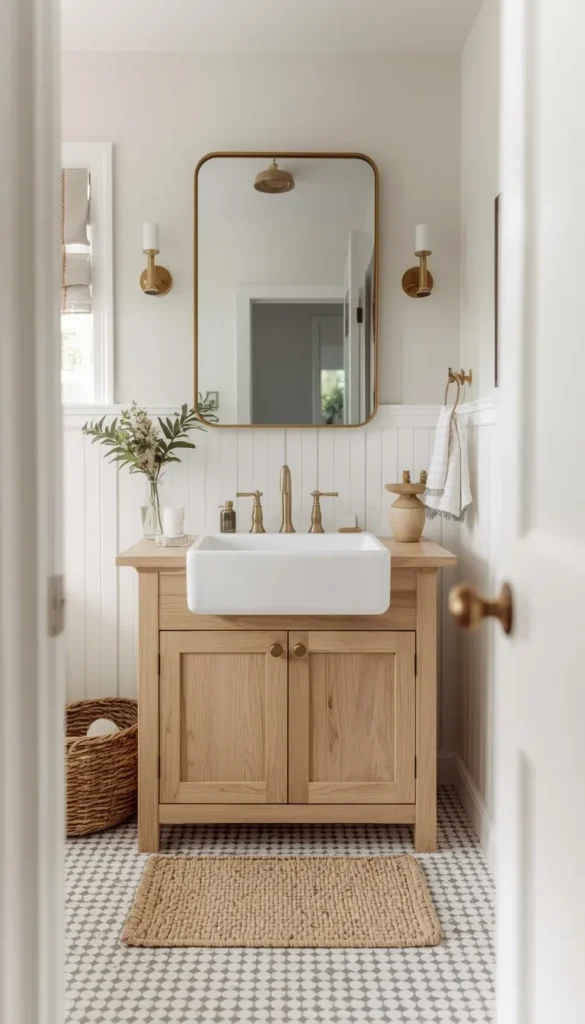
Transitional design is the style that most American homeowners actually live in, even if they don’t call it that. It sits comfortably between traditional and contemporary not too minimal, not too ornate. And white oak with a marble countertop is one of the cleanest expressions of that balance I know.
The warmth of the oak softens the coolness of marble beautifully. I’ve paired white oak vanities with Carrara, Calacatta, and Statuario marble tops, and each combination has its own personality. Carrara reads soft and classic. Calacatta feels more luxurious and bold. Statuario is the most dramatic of the three, with those sweeping grey veins that turn a simple vanity into a statement piece.
The honest reality about marble though and I feel like I’d be doing you a disservice if I didn’t say this is that it requires sealing once or twice a year and it will etch if you leave acidic products like certain cleansers or even toothpaste sitting on it too long. If that sounds like too much upkeep for your lifestyle, a marble-look quartzite gives you nearly identical beauty with a fraction of the maintenance. Your white oak vanity will look just as stunning either way.
13. White Oak Vanity with Open Shelving Below
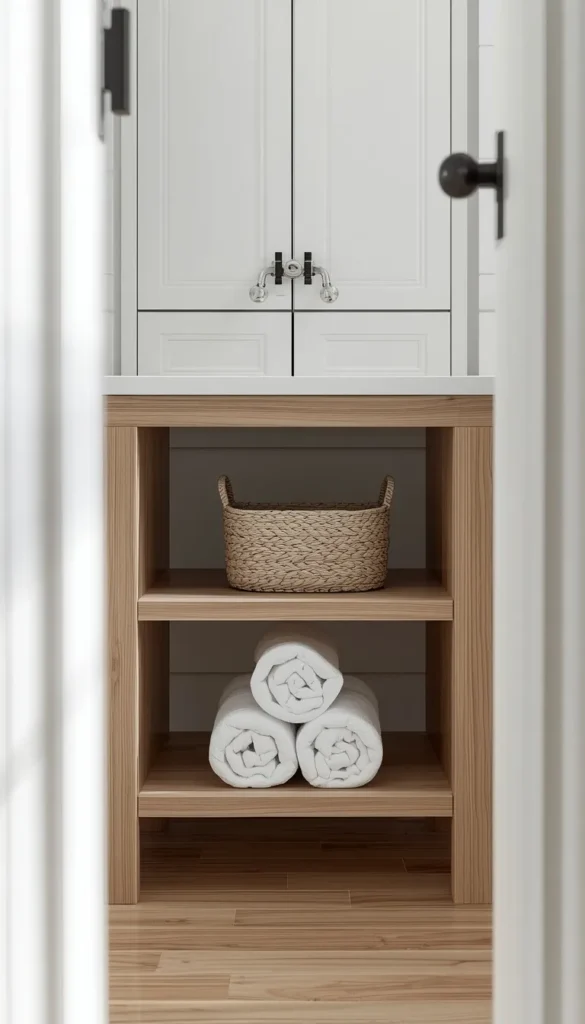
Open shelving below a vanity is one of those design choices that splits people right down the middle. Some homeowners see it and immediately think “yes, that’s exactly the airy, relaxed look I want.” Others panic at the thought of their under-sink clutter being on full display. I’ve worked with both types of clients, and here’s what I’ve learned it’s not really about the shelving. It’s about how committed you are to keeping it styled.
When it’s done well, a white oak vanity with open shelves below is genuinely one of the most beautiful bathroom configurations you can achieve. The wood grain flows continuously from the cabinet face down through the shelf structure, creating this seamless organic quality that closed cabinet doors simply can’t replicate. It feels like furniture. Real, considered, beautifully crafted furniture sitting in your bathroom.
What I tell every client who wants this look is to plan their shelf styling before they commit. Decide exactly what will live there rolled towels, a small basket for extra toiletries, a ceramic candle. Then stick to it. The shelf isn’t a landing zone. It’s a display.
Works best in:
- Master bathrooms with enough counter storage elsewhere
- Bathrooms with a consistent, edited aesthetic overall
- Spaces where the plumbing can be neatly concealed or deliberately exposed as a design feature
14. Whitewashed Oak Vanity for a Coastal Bathroom
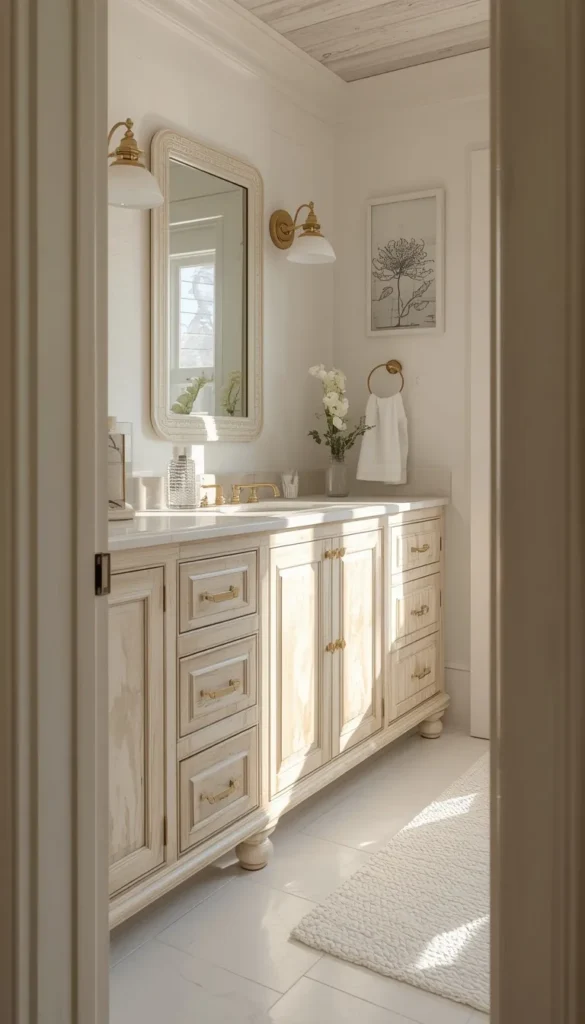
If you live anywhere near the coast or you just want your bathroom to feel like you do a whitewashed white oak vanity is one of the most effortless ways to get there. The whitewashing process lightens the natural grain of the oak without completely obscuring it, leaving this soft, sun-bleached quality that feels relaxed and genuinely coastal without resorting to seashell accessories and nautical rope accents.
I worked on a beach house renovation in the Outer Banks of North Carolina a couple of years back where the homeowners wanted every room to feel like a natural extension of the landscape outside. In the master bath, we used a whitewashed oak double vanity with unlacquered brass fixtures that we knew would patina over time, a honed white limestone countertop, and large format white tile with a barely-there texture. The whole room felt like warm sand and sea air. It was one of those projects I still think about.
The finish on a whitewashed vanity does require a little more attention than a natural oak finish. Because the whitewash layer sits on top of the grain, any water damage or scratching tends to be more visible. A good quality water-based polyurethane topcoat over the whitewash is non-negotiable in a bathroom environment.
Are you working with a tight budget on this renovation or going all-in on a custom build and what’s the one feature you absolutely refuse to compromise on?
15. Wire Brushed White Oak for an Industrial Organic Feel
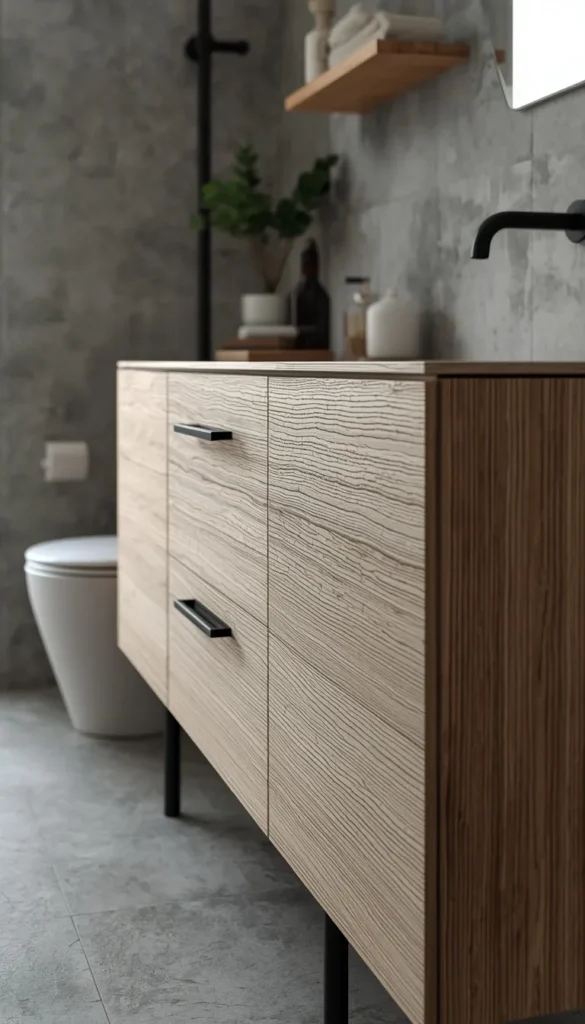
Wire brushing is a finishing technique where the softer grain of the wood is mechanically removed, leaving behind a slightly textured, tactile surface that catches light beautifully and hides everyday wear remarkably well. It’s one of my favorite white oak finishes for bathrooms precisely because it’s both gorgeous and practical a combination that’s harder to find than you’d think.
The texture adds a layer of visual depth that flat-sanded oak simply doesn’t have. Run your hand across a wire-brushed white oak panel and you can actually feel the grain. That tactile quality makes the vanity feel more substantial, more handcrafted, more considered. In a bathroom that’s otherwise quite minimal, a wire-brushed white oak vanity gives the room enough visual interest to stand on its own without needing much else.
This finish pairs exceptionally well with:
- Concrete or stone look porcelain tile
- Matte black or dark bronze hardware
- Exposed pipe fixtures for a deliberately industrial edge
One thing worth knowing wire-brushed surfaces can be slightly harder to clean in the grooves if you use thick creams or products near the sink. A quick wipe with a damp cloth right away handles it easily, but it’s worth keeping in mind if your countertop habits lean messy.
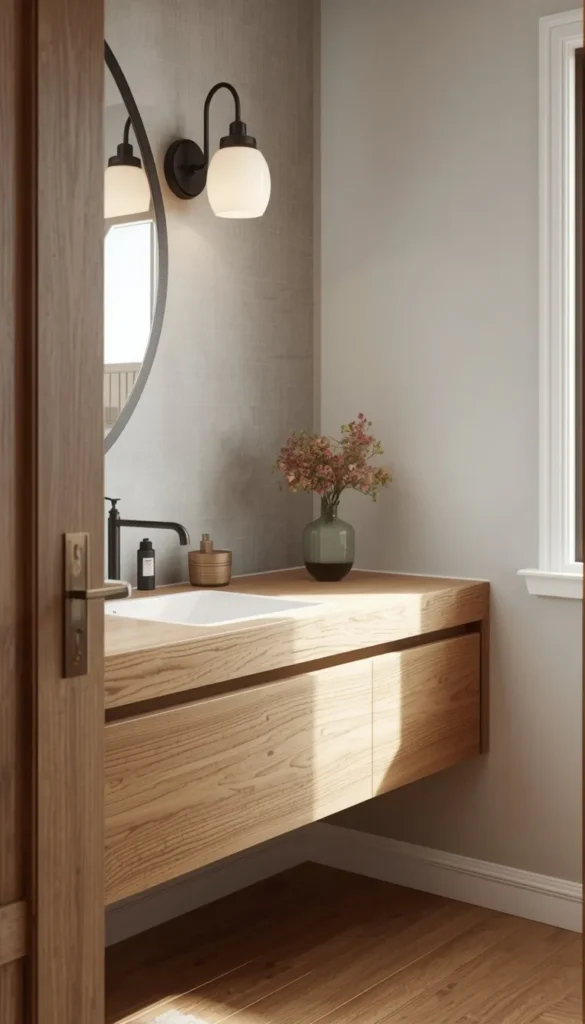
16. White Oak Makeup Vanity and Sit Down Statio
.
This is a feature I’ve seen requested more and more frequently over the last few years, and honestly it makes complete sense. A dedicated sit-down makeup area built into or adjacent to your white oak vanity setup elevates the entire morning routine from a rushed, hunched-over experience into something that actually feels like self-care.
The way I typically approach this in a bathroom design is by extending the white oak countertop on one end to create a knee clearance zone usually about 18 to 20 inches wide with a drawer below for makeup storage and a wall-mounted light source at face level rather than overhead. Overhead lighting alone is the enemy of good makeup application. A warm sconce or a lighted mirror at eye level changes everything.
What makes white oak particularly beautiful in this application is that the vanity and the makeup station feel like one continuous, intentional piece of furniture rather than an afterthought. The grain runs through the whole thing and ties it together visually. If you’re doing a bathroom renovation from scratch and you have even a modest amount of extra wall space, I genuinely think this is one of the highest value additions you can make to the design. Your future self will agree.
If you could steal one idea straight from this list and put it in your bathroom tomorrow, which one would it be and why
17. Budget Friendly White Oak Vanity
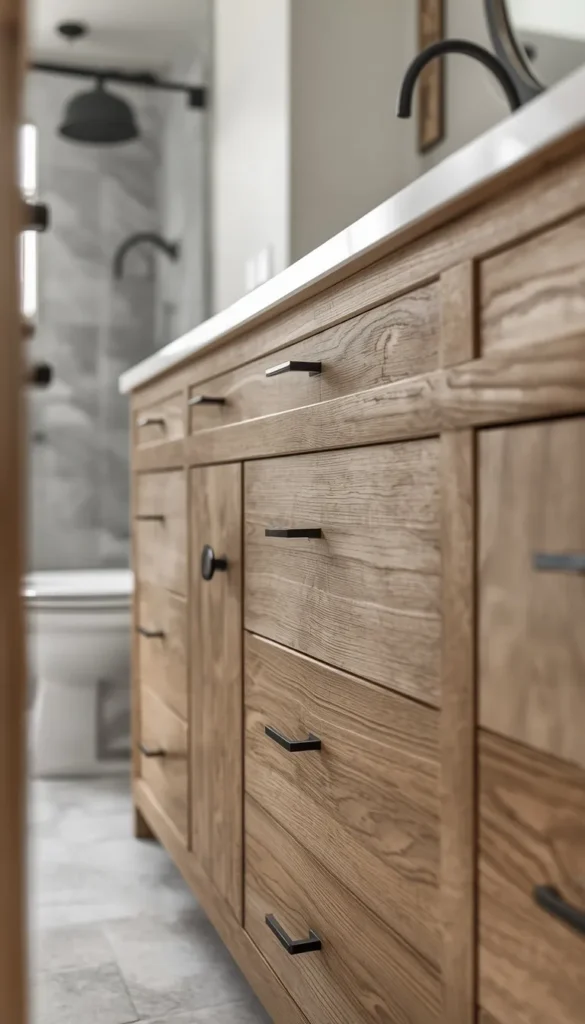
Let me be straightforward with you here you do not need to spend $4,000 on a custom vanity to get the white oak look in your bathroom. One of the most popular and genuinely impressive budget approaches I’ve seen homeowners pull off is the IKEA GODMORGON hack with real white oak replacement fronts from companies like Semihandmade, Reform, or Plykea. The result looks completely custom. Nobody walks into that bathroom and thinks “oh that’s IKEA.” They think “who did your renovation?”
The way it works is simple. You buy the IKEA base cabinet and drawer unit, which gives you the bones solid construction, soft-close drawers, and a modular system that’s been refined over decades. Then you swap out the standard IKEA door and drawer fronts for real white oak slab or shaker fronts from a third party supplier. Add a quality countertop even a butcher block or a basic quartz swap the hardware for something with weight and finish, and you have a bathroom vanity that looks like it belongs in an Architectural Digest feature.
Realistic budget breakdown for this approach:
- IKEA base cabinet: $200 to $400 depending on size
- White oak replacement fronts: $300 to $700 depending on supplier and size
- Countertop: $150 to $500 for quartz or butcher block
- Hardware upgrade: $50 to $150
Total investment: roughly $700 to $1,750 for a vanity that reads as high-end custom. That’s a gap worth knowing about.
18. Luxury Custom White Oak Vanity with Integrated Sink
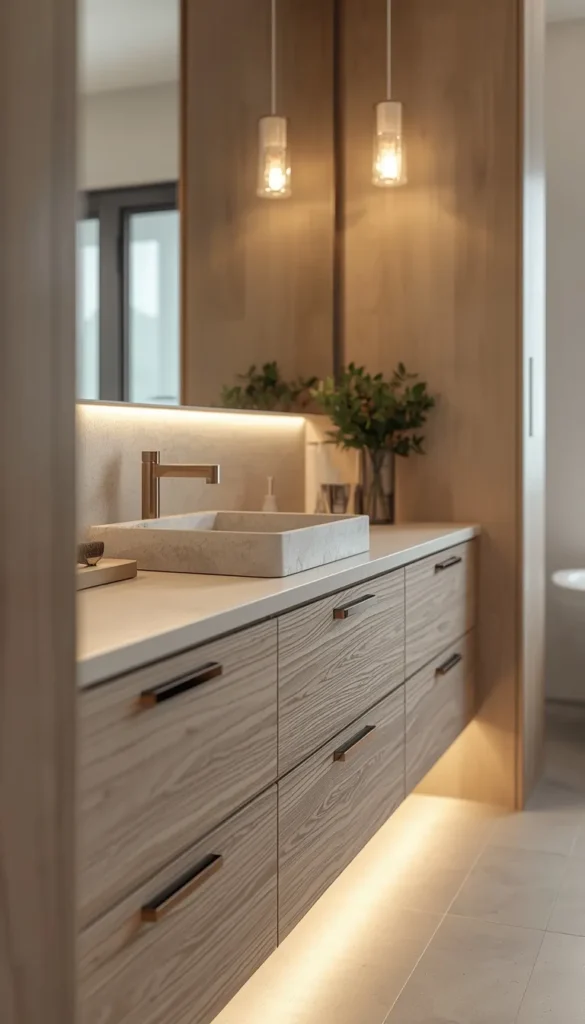
This is where white oak truly gets to show off everything it’s capable of. A fully custom white oak vanity with an integrated sink where the basin is carved directly into a stone or solid surface countertop that sits flush with the cabinet is one of the most refined bathroom features you can invest in. There are no seams between the sink and the counter. No caulk lines to clean around. No visual interruption of any kind. Just one continuous, sculptural surface sitting on top of that beautiful oak millwork below.
I’ve specified this configuration in high-end renovations across Colorado, California, and the Pacific Northwest, and the reaction is always the same. Homeowners walk in during the final reveal and go completely quiet for a moment. That silence is the best compliment a design can get.
The white oak cabinetry on a custom piece like this is typically built by a local millwork shop or a high-end cabinet maker, and the level of detail available is extraordinary. Integrated LED underlighting beneath the cabinet. Soft-close drawers with full extension slides. Custom interior organizers sized exactly for your products. Finger-pull grooves routed directly into the wood instead of separate hardware. Every detail considered and executed with intention.
What does it cost? Honestly, a fully custom white oak vanity with integrated stone sink typically runs between $3,500 and $8,000 or more depending on your market, the complexity of the design, and your choice of stone. That’s a real number and I’m not going to minimize it. But in a primary bathroom that you use twice a day, every single day, the quality of that experience compounds over time in a way that cheaper options simply can’t match. This is one of those investments that tends to age beautifully rather than dating itself, and that matters enormously for long-term home value.
Your Quick Styling Guide
By Budget
Starter ($700 – $1,800)
- IKEA hack with real white oak fronts is your best move
- Pair with quartz or butcher block to keep costs down
- Upgrade the hardware it’s the cheapest way to look custom
Investment ($2,500 – $8,000+)
- Go fully custom with a local millwork shop
- Prioritize an integrated sink it’s the detail that separates good from extraordinary
- Splurge on the countertop; honed marble or quartzite ages beautifully with white oak
By Lifestyle
Busy Families & High-Traffic Bathrooms
- Choose wire-brushed finish it hides everyday wear better than any other option
- Pair with quartz, not marble no sealing, no stress
- Stick to closed cabinet storage; open shelves need constant editing to look intentional
Minimalists & Design-Forward Homeowners
- Japandi or floating vanity style, always
- Flat slab doors with integrated pulls no visible hardware cluttering the lines
- One countertop material, one hardware finish, nothing competing for attention
Small Spaces
- 24 to 36 inch floating vanity, full stop
- Drawers over cabinet doors for smarter storage access
- Keep tile, countertop, and walls in the same tonal family to visually expand the room
Open Layouts & Master Ensuites
- Double sink vanity at 60 inches minimum
- Add a dedicated sit-down makeup station if wall space allows
- This is where brushed brass and a marble top genuinely earn their price tag
Frequently Asked Questions
Is white oak better than other woods for a bathroom vanity?
Yes, and the grain structure is why. White oak’s closed pores make it naturally more moisture-resistant than walnut or red oak. Seal it correctly and it genuinely outperforms most wood species in a humid environment.
How long does a white oak bathroom vanity last?
Easily 15 to 25 years with proper sealing and basic care. The finish matters more than the wood itself — a marine-grade topcoat is the difference between a vanity that ages beautifully and one that warps within two years.
Can I paint or refinish a white oak vanity later?
Yes. White oak takes stain, paint, and refinishing exceptionally well. If your style shifts down the road, a light sand and fresh coat gives you essentially a brand new vanity without replacing the cabinet.
What size white oak vanity works best for a small bathroom?
The 30-inch single sink floating vanity is my go-to. It gives you enough counter space to function without eating the floor plan, and the wall-mounted install makes even a 5×7 bathroom feel noticeably larger.
Does white oak vanity add resale value to a home?
It does especially in the $400,000 and up market. Natural wood vanities photograph well, appeal to a wide range of buyers, and signal quality craftsmanship in a way that painted MDF simply cannot.
Conclusion
Your bathroom doesn’t have to be a full renovation to feel completely different. Swapping out one tired vanity for a white oak piece even a budget-friendly IKEA hack with real wood fronts changes the entire energy of the room. You’ll notice it every single morning. That’s not a small thing. Your home is where you reset, recharge, and start your day, and it deserves materials that actually make you feel something when you walk in. So pick one idea from this list that made you stop scrolling. Order a wood sample. Pull up a contractor’s number you’ve been sitting on. Just take one step today, because that’s genuinely how every great bathroom renovation starts not with a big budget, but with a decision.
