20 Sleek Minimalist Bathroom Ideas for 2026
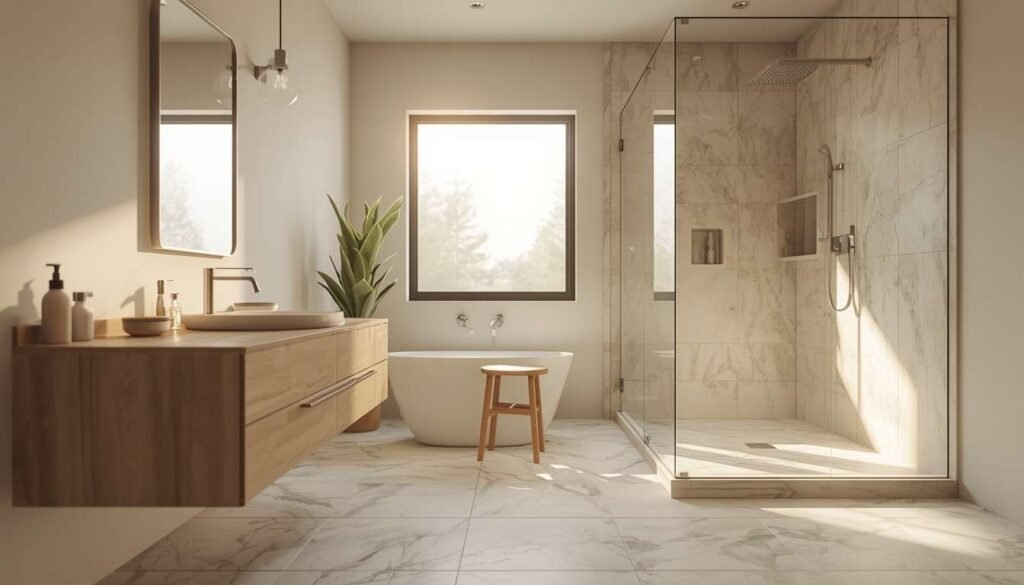
Your bathroom is the one room in your home that can either set the tone for your entire day or quietly drain your energy before it even begins. Most people don’t realize how much a cluttered, uninspired bathroom affects their mood until they finally walk into one that feels calm, clean, and completely intentional. Minimalist bathroom design is not about living with less for the sake of it. It’s about keeping only what works, choosing materials that last, and creating a space that actually feels like yours. If you’ve been saving inspiration photos for months and wondering where to even begin, this guide was written exactly for you.
My Design Notes
“A client in Austin, Texas came to me last spring with a 68-square-foot master bathroom that she called ‘the most chaotic room in the house.’ Two kids, one vanity, zero storage. She’d been pinning spa bathrooms for years but assumed the look was out of reach. We didn’t gut the room. We didn’t move a single wall. What we did: replaced the chunky vanity with a floating one, added a recessed medicine cabinet, switched the shower curtain to a frameless glass panel, and repainted with Benjamin Moore ‘White Dove.’ Total spend: $2,200. She texted me two weeks later saying she stands in there an extra five minutes every morning just because it feels good.”
20 Sleek Minimalist Bathroom Ideas That Will Transform Your Space
1. Start With a Subtractive Edit Before You Buy Anything
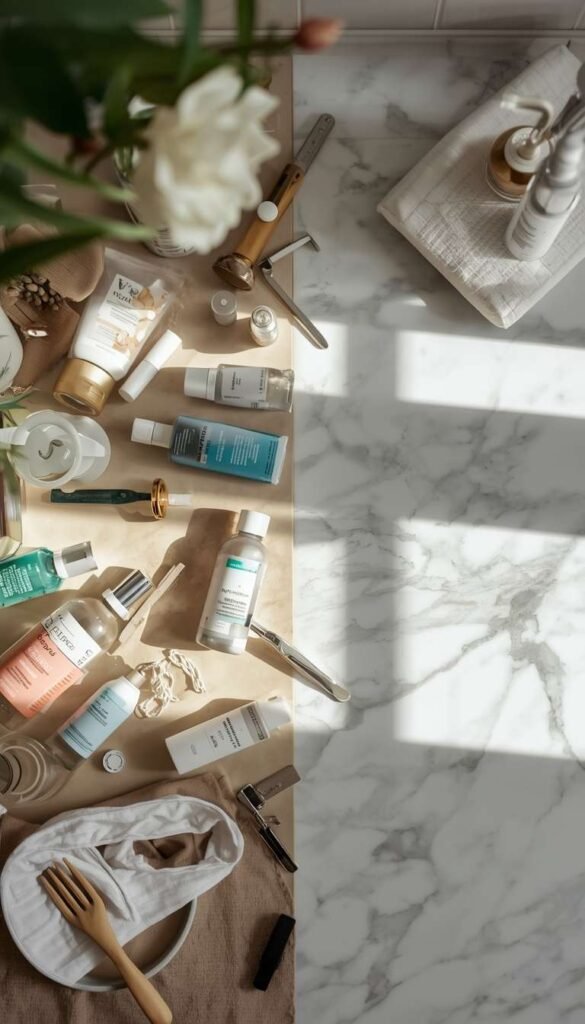
I want to say this loudly, because every other minimalist bathroom article skips it entirely: don’t spend a single dollar until you’ve removed things first. Most bathrooms don’t need more storage solutions. They need fewer items that require storing. Before you shop, pull everything out from under your sink, off your counters, and out of your shower caddy. Lay it all on the floor. You’ll likely discover four half-used face washes, two dead razors, and a loofah you forgot you owned.
The goal of a minimalist bathroom isn’t a specific aesthetic it’s intentionality. Once you strip the space down, you’ll often find the bones of a beautiful bathroom were already there, just buried. This one step, done before anything else, will save you hundreds of dollars and make every idea on this list land harder.
2. Go All White But Choose the Right White
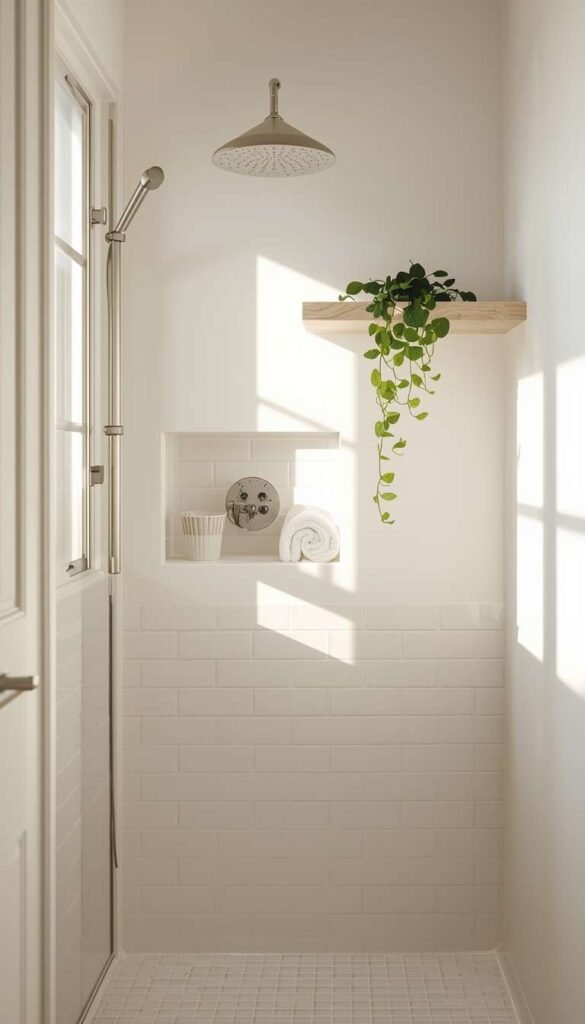
An all-white bathroom is the most classic expression of minimalism, and it works in practically every American home style from Modern Farmhouse in Nashville to a sleek condo in Chicago. But here’s what nobody tells you: not all whites are created equal, and picking the wrong one can make your bathroom look dingy, cold, or oddly yellow under certain lighting.
In my experience, the undertone is everything. For bathrooms with warm, south-facing natural light, a white with slight warm undertones like Benjamin Moore’s White Dove (OC-17) feels soft and inviting. For bathrooms with cooler north-facing light or lots of chrome fixtures, a brighter, slightly cooler white like Sherwin-Williams Alabaster (SW 7008) tends to balance things out beautifully. One quick trick I’ve learned over years of doing this: always test your paint in the actual bathroom at different times of day before committing. Whites shift more dramatically than any other color.
3. The Floating Vanity Trick That Makes Any Bathroom Feel Bigger
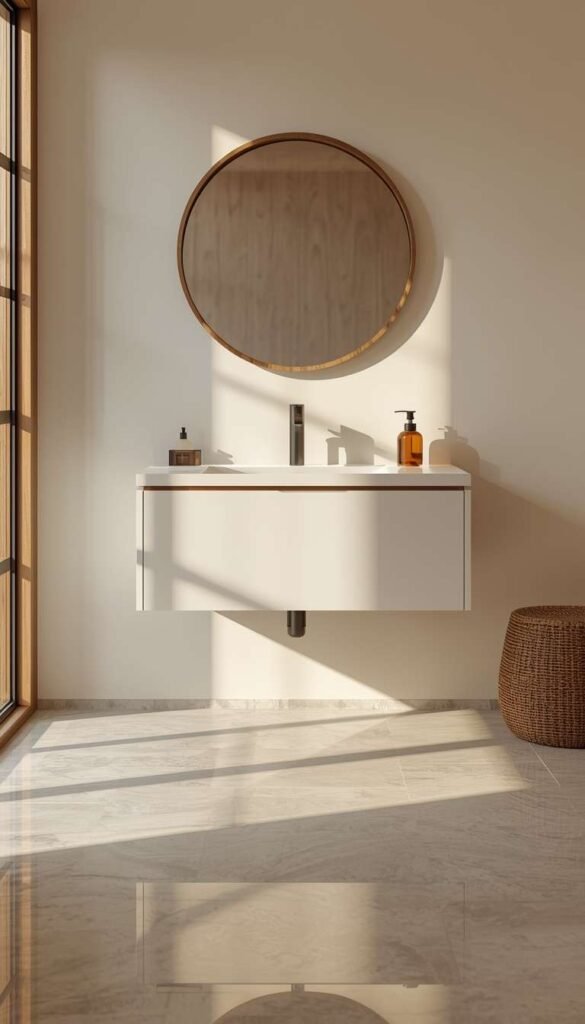
If there’s one single upgrade I recommend to almost every client working with a smaller bathroom, it’s swapping a floor-mounted vanity for a floating one. The visual effect is immediate your eye travels all the way to the baseboard uninterrupted, which makes the floor feel longer and the room feel airier. It’s one of those moves that photographs beautifully and feels even better in person.
A few things worth knowing before you commit:
- Height matters more than most people realize. Standard vanity height is 32 inches, but floating vanities installed at 34 to 36 inches feel more ergonomic for most adults and look more custom.
- Budget range in the US market: Entry-level floating vanities start around $300 to $400 at IKEA or Home Depot. Mid-range options from brands like Fresca or Virtu run $600 to $1,200 and offer significantly better hardware and finish quality.
- One thing to watch out for: make sure your plumber confirms the wall has proper blocking before installation. A floating vanity needs solid support behind the drywall, and skipping this step is an expensive mistake to fix later.
4. Large Format Tiles: The One Investment That Pays Off Every Time
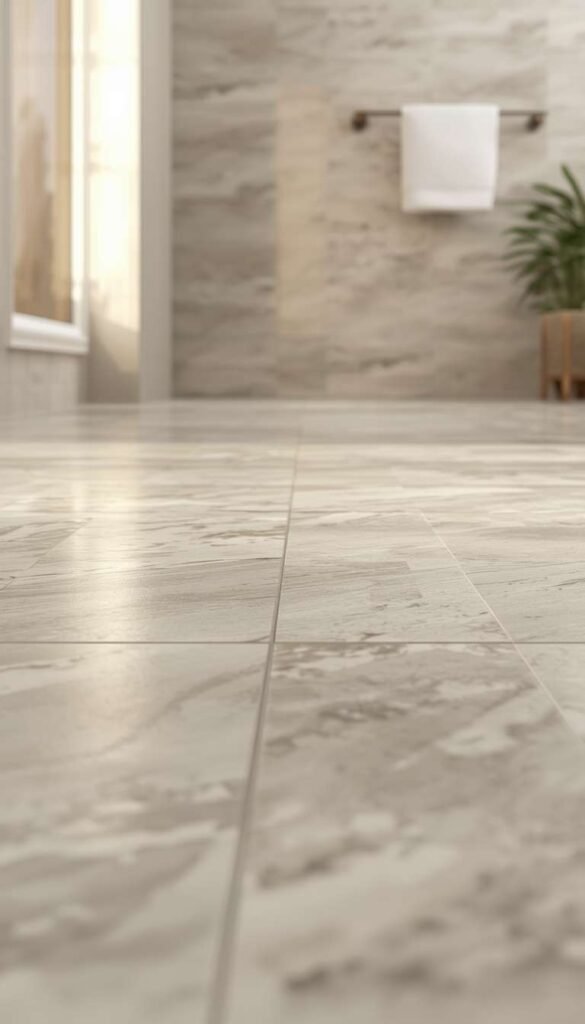
I’ve specified a lot of tile in my career, and if I had to choose one material decision that consistently delivers the biggest visual return, it’s going all-in on large-format tiles. We’re talking 24×24 or even 24×48 inch slabs on the floor and walls. The reason they work so well in a minimalist bathroom is simple: fewer grout lines mean a more seamless, uninterrupted surface and that visual quietness is exactly what the style is built on.
Beyond aesthetics, there’s a deeply practical benefit that nobody talks about enough. Fewer grout lines mean dramatically less scrubbing. If you’ve ever spent a Sunday afternoon attacking bathroom grout with a toothbrush, you already understand why this matters. Large format tiles in a rectified porcelain or marble-effect finish are also incredibly durable and hold up well to the humidity swings of an American bathroom through all four seasons. Yes, they cost more upfront typically 20 to 40 percent more than standard tiles but the cleaning time you save over five years makes it one of the smartest investments in a minimalist remodel.
5. Black and White Done Right and Where Beginners Go Wrong
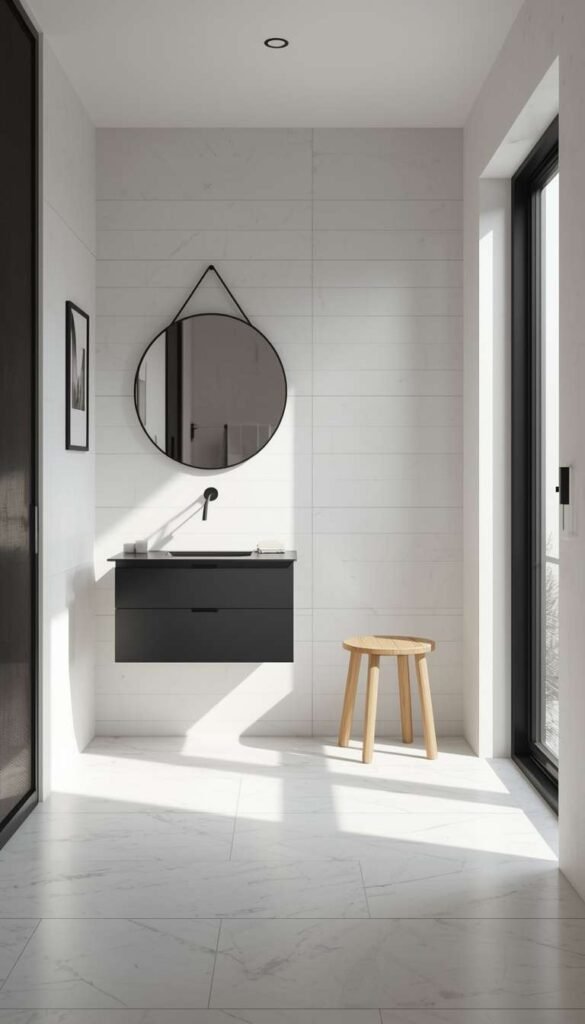
The black and white bathroom is a classic for a reason. It’s crisp, it’s confident, and when it’s executed well, it looks like something straight out of an Architectural Digest feature. But I’ve seen this palette go sideways more times than I can count usually because someone went 50/50 on both colors and ended up with a space that feels more like a chess board than a serene retreat.
The ratio I always work with is 70/20/10. Seventy percent white or near-white as your dominant surface color, twenty percent black as your grounding anchor, and ten percent of a warm neutral or natural material to keep it from feeling stark. In practice, that might look like white walls and floor tiles, a black vanity and window frame, and a warm white oak mirror or a small wooden stool to soften the contrast. That last ten percent is what separates a bathroom that feels designed from one that just feels dramatic.
One thing to watch out for is matte black fixtures. They look stunning in photos but do show water spots and mineral deposits more visibly than brushed finishes. If you live in an area with hard water which covers a large portion of the US Midwest and Southwest brushed black or dark gunmetal tends to be a more forgiving and equally stylish choice.
Which of these 20 ideas are you most tempted to try first the floating vanity, the large-format tiles, or something smaller like a plant and a new mirror?
6. Warm Wood Accents and Which Woods Actually Survive Humidity
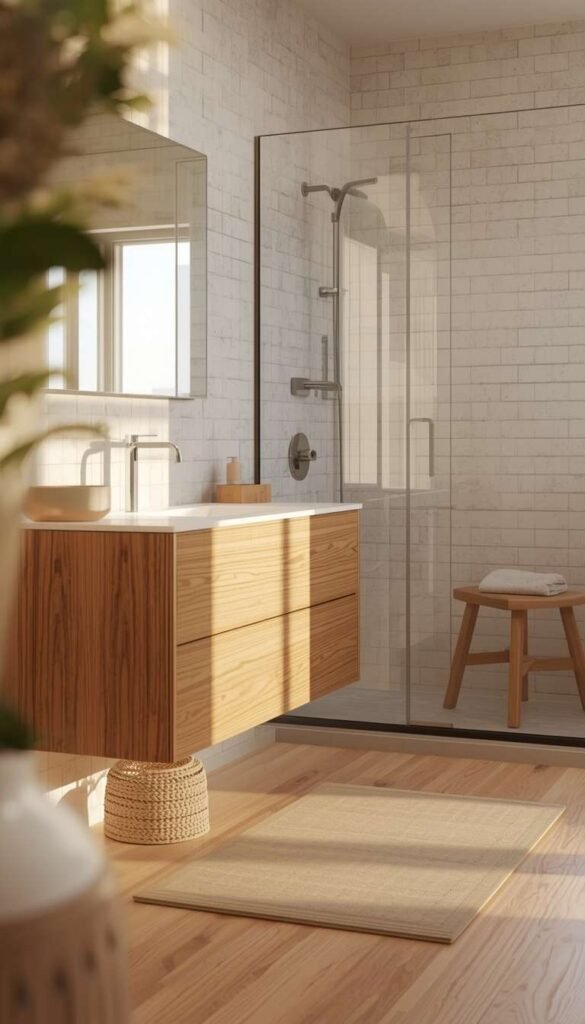
Wood in a bathroom always raises eyebrows. Clients ask me constantly whether it’s a practical choice or just a Pinterest fantasy. My honest answer: it depends entirely on the species and the finish. The right wood, treated correctly, can live beautifully in a bathroom for decades. The wrong wood will warp, crack, and look terrible within two years.
Here’s a quick breakdown of what actually holds up:
- Teak is the gold standard. It has a naturally high oil content that makes it highly water-resistant, which is why you see it on boat decks and outdoor furniture. In a bathroom, teak vanities and shower stools age gracefully and develop a warm patina over time.
- White oak is my personal favorite for vanities in transitional and Japandi-style bathrooms. When properly sealed, it handles humidity well and brings that warm, organic quality that makes a minimalist space feel livable rather than clinical.
- Bamboo is affordable and sustainable, but it needs to be strand-woven bamboo specifically the compressed, high-density kind. Standard bamboo flooring in a bathroom is asking for trouble.
Avoid pine, MDF with thin veneer, and anything marketed as “wood-look” laminate for wet areas. They won’t survive, and replacing them every few years defeats the whole point of intentional, lasting design.
Top 6 Minimalist Bathroom Ideas:
| Idea | Estimated Price | Maintenance |
|---|---|---|
| Floating Vanity | $300 – $1,200 | Low |
| Large Format Tiles | $5 – $15 per sq. ft. | Low |
| Frameless Glass Enclosure | $800 – $2,500 | Medium |
| Wet Room Conversion | $3,000 – $8,000 | Medium |
| Freestanding Soaking Tub | $600 – $3,500 | High |
| Japandi Style Refresh | $500 – $2,000 | Low |
7. Japandi Style for the American Home: A Practical Guide
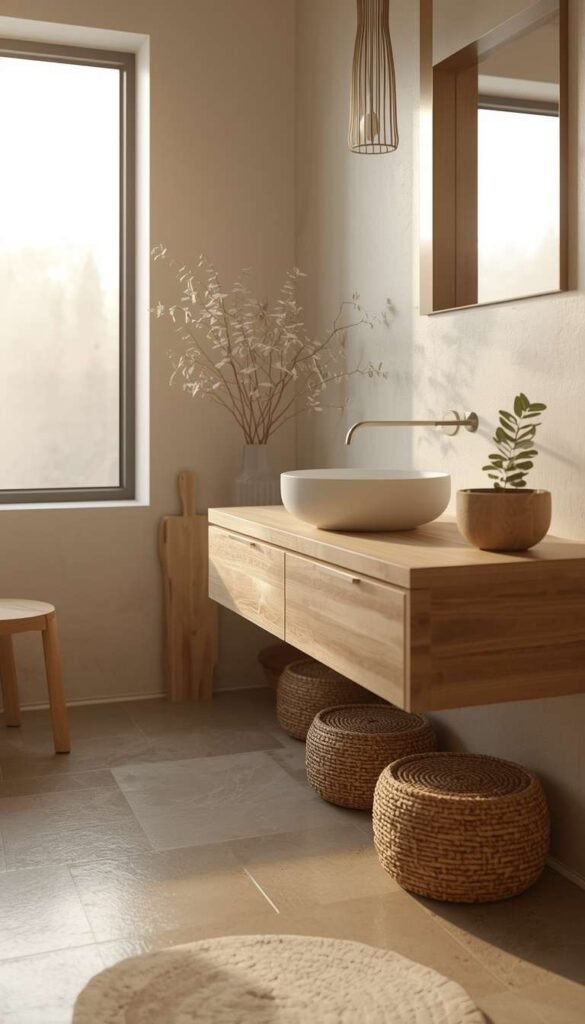
Japandi is the design world’s favorite mashup right now a blend of Japanese wabi-sabi philosophy and Scandinavian hygge sensibility and it translates beautifully into a minimalist bathroom. The core idea is warmth through restraint. Natural materials, muted tones, and a deliberate slowness to the space. It’s the design equivalent of a deep breath.
What I love about bringing Japandi into American homes is that it doesn’t require imported furniture or a complete renovation. The aesthetic lives in the details. A white oak floating vanity. Honed stone or concrete-effect tiles in warm greige tones. A simple ceramic vessel sink. One small wooden stool in the corner. Woven storage baskets tucked below the vanity. The palette tends to hover in warm whites, soft taupes, clay, and charcoal — colors that feel grounded and calm without being cold.
A quick trick I’ve learned when working with American clients on this style: resist the urge to add too much. The most common mistake is layering in too many “Japandi-adjacent” accessories until the space starts to feel busy again. Pick three natural materials maximum, keep your decor to two or three objects, and let the negative space do the heavy lifting. Emptiness, in this context, is not a design flaw — it’s the point.
8. Scandinavian Minimalism on a Budget
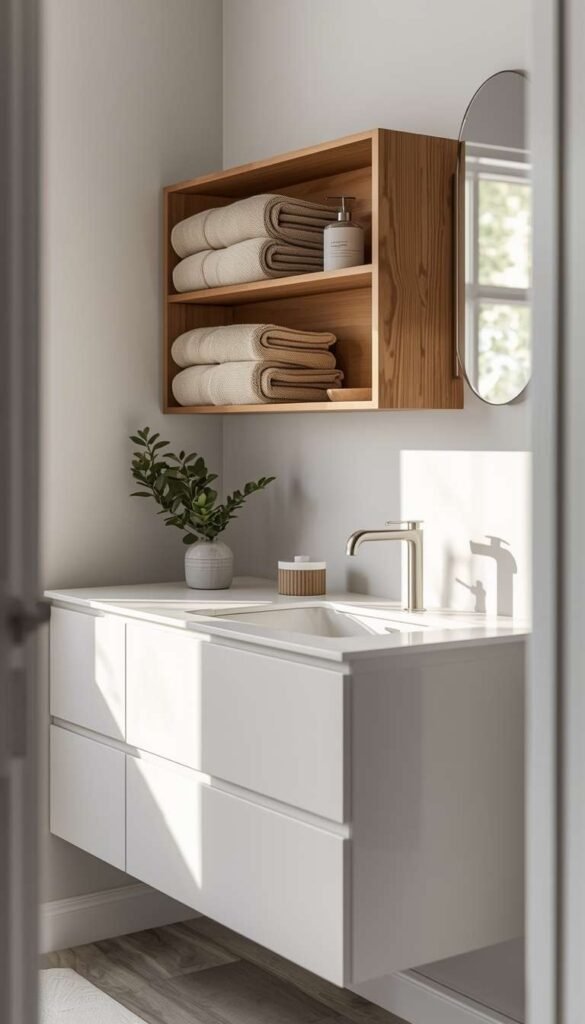
True Scandinavian design is rooted in the idea that beautiful, functional objects should be accessible to everyone — which makes it, genuinely, one of the most budget-friendly aesthetics you can pursue. The palette is simple: whites, soft grays, warm woods, and the occasional muted sage or dusty blue. The materials are honest and unfussy. And the overall effect is incredibly livable.
The good news for American homeowners is that you don’t need to shop Scandinavian brands to get this look. Here’s where I consistently find the best pieces at the right price:
- IKEA’s GODMORGON and HEMNES vanity lines are genuinely excellent starting points for a Scandi minimalist bathroom. The GODMORGON floating vanity in white gloss or walnut effect, paired with an ODENSVIK sink, runs under $400 and looks far more expensive than it is.
- Target’s Threshold and Studio McGee collection has quietly become one of the best sources for affordable Scandi-adjacent bathroom accessories think ceramic soap dispensers, simple cotton bath mats, and clean-lined toothbrush holders.
- McGee & Co. sits at the mid-range and offers pieces that genuinely bridge the gap between budget and luxury without screaming “I bought this online.”
The one splurge I always encourage even on a tight budget is good towels. A set of fluffy, oversized white or oatmeal-toned towels folded neatly on an open shelf does more for a Scandinavian bathroom’s aesthetic than almost any other single item. It’s a $60 to $80 investment that changes the entire feel of the room.
9. The Triangle Rule for Minimalist Bathrooms
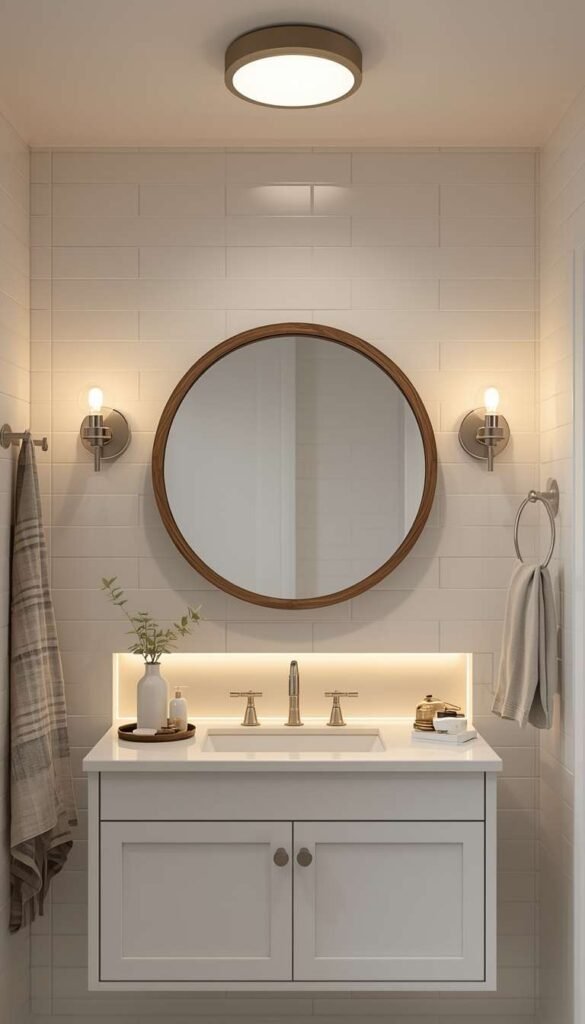
Lighting is the single most underestimated element in bathroom design. I’ve walked into beautifully tiled, perfectly edited minimalist bathrooms that felt completely wrong and nine times out of ten, bad lighting was the culprit. A single overhead can light casting shadows directly onto your face is not a lighting plan. It’s a horror movie set.
The approach I use with every client is what I call the triangle rule: three light sources working together to cover the space without any one of them doing all the heavy lifting.
- Vanity lighting goes on either side of the mirror at eye level not above it. Side-mounted sconces at roughly 60 to 65 inches from the floor eliminate the unflattering under-eye shadows that overhead vanity bars create. This placement is also far more functional for grooming tasks.
- Ambient lighting handles the overall illumination of the room. A sleek flush-mount or a recessed light grid works well here. In a minimalist bathroom, a single statement flush-mount pendant can also serve as a subtle focal point without adding visual noise.
- Accent lighting is the layer most people skip entirely. A LED strip light tucked behind a floating vanity or inside a shower niche adds depth and that warm, spa-like glow that makes the space feel intentional rather than purely functional.
The overall color temperature matters enormously too. Stick to bulbs in the 2700K to 3000K range for a warm, flattering light that complements natural materials like wood and stone. Anything above 4000K starts to feel like a dentist’s office.
10. Statement Mirror Zero Clutter: How to Choose the Right One
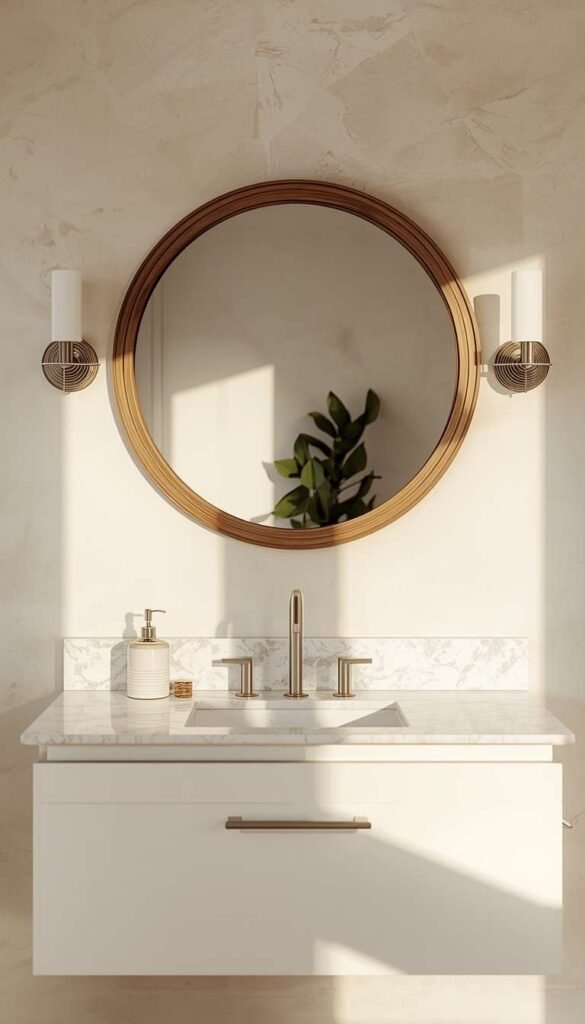
The mirror is often the most overlooked design decision in a bathroom, treated as an afterthought when it should actually be one of the first things you choose. In a minimalist bathroom specifically, the mirror carries a lot of visual weight it’s frequently the only decorative object on the wall, which means it needs to earn its place.
Shape is the first decision, and it’s more psychological than most people realize. Round mirrors soften a space that’s already full of hard angles tiles, vanity edges, door frames and they’ve become the signature look of warm minimalism and Japandi-style bathrooms across the US. Rectangular mirrors feel more structured and are better suited to contemporary or transitional minimalist spaces where clean lines are the priority.
Sizing is where I see the most mistakes. A mirror that’s too small looks timid and makes the whole vanity feel unresolved. A quick formula I use: your mirror should be no wider than your vanity and ideally somewhere between 70 and 90 percent of the vanity’s width. For a 48-inch double vanity, that puts you in the 34 to 43 inch range for a single mirror or two individual mirrors, one above each sink, for a more tailored look.
Are you starting your minimalist bathroom journey from scratch, or are you working with a space that just needs a good edit and a few smart swaps?
11. The Hidden Storage Moves Designers Actually Use
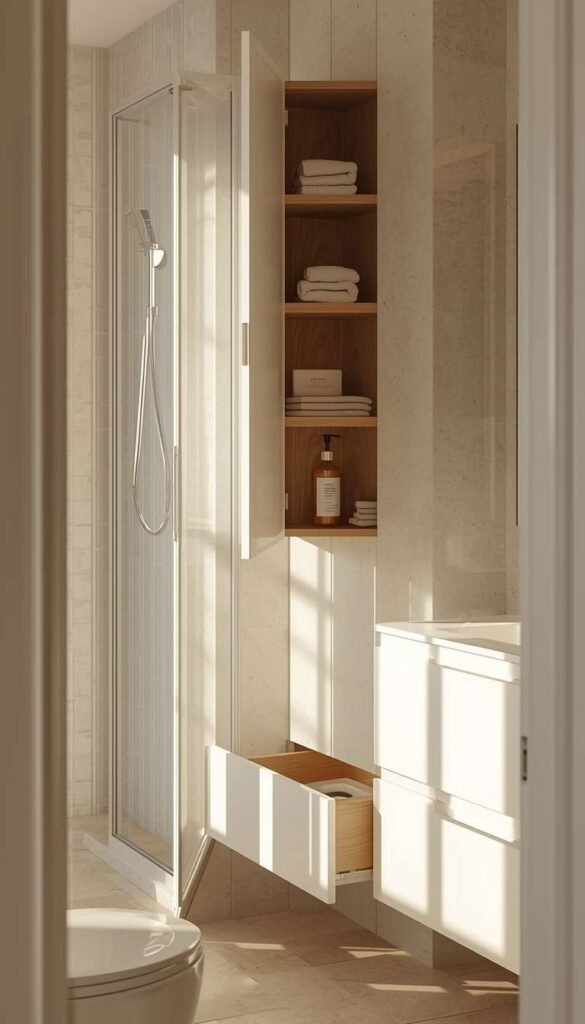
Here’s a truth that most bathroom inspiration articles conveniently ignore: minimalism is only possible when storage is genuinely solved. A beautifully edited countertop doesn’t happen by magic it happens because everything that used to live on that counter has been given a better home somewhere else. The secret is finding storage that disappears into the design.
Recessed medicine cabinets are my first recommendation for almost every client. They mount flush with the wall, eliminate the need for a separate mirror, and offer far more storage than they appear to from the outside. Quality options from brands like Robern or Kohler start around $300 and top out well above $1,000, but there are solid mid-range options from American Standard and similar brands in the $150 to $350 range that work beautifully in a minimalist context.
Two more moves worth knowing:
- Recessed shower niches built directly into the tile wall during a remodel eliminate every shower caddy, corner basket, and suction-cup shelf that visually clutters a shower space. If you’re already retiling, adding one costs very little extra in labor.
- Toe-kick drawers installed beneath a floating vanity use dead space that would otherwise collect dust bunnies. They’re invisible until you need them and hold a surprising amount extra toilet paper, hair tools, cleaning supplies.
12. Glass Shower Enclosures Versus Wet Rooms: Which Is Right for You
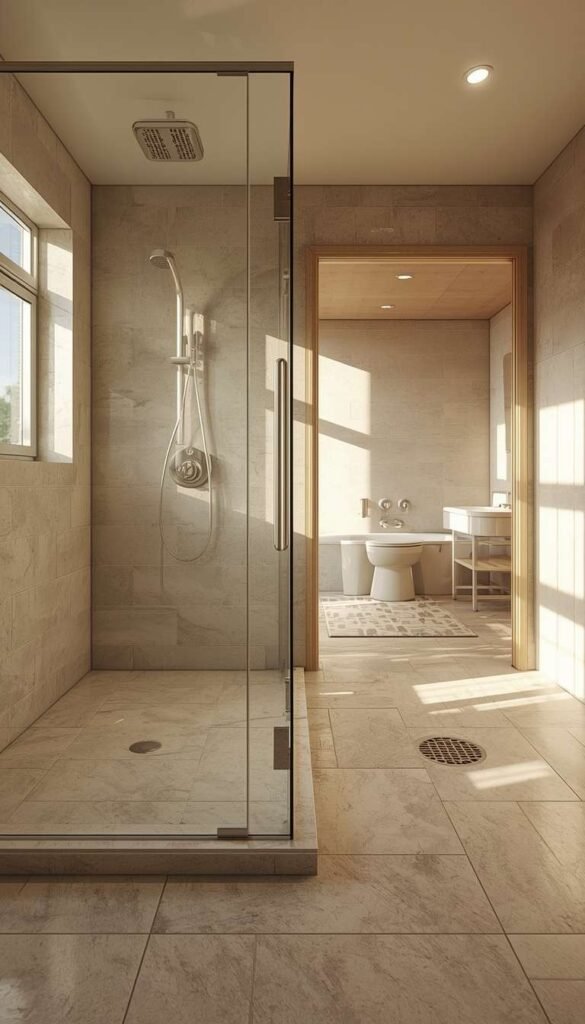
This is one of the questions I get asked most often by clients renovating a minimalist bathroom, and the honest answer is that both options are genuinely beautiful but they suit different lifestyles and different budgets in ways that don’t always get discussed openly.
A frameless glass enclosure is the more accessible choice. It keeps the water contained, retains heat well, and gives you that clean, seamless look that reads as very intentional in a minimalist space. Costs in the US typically run from $800 to $2,500 depending on the size and the thickness of the glass. One thing to watch out for: glass shower doors require consistent squeegee maintenance to stay looking pristine. Hard water deposits on glass are relentless, and in a minimalist bathroom where the shower is often a visual focal point, streaky glass is very noticeable.
A wet room where the shower has no enclosure at all and the entire floor is waterproofed and sloped to a drain is the more dramatic, architectural choice. It feels incredibly luxurious and opens up the visual space significantly. The tradeoff is cost and complexity. A proper wet room requires professional waterproofing, a full floor replacement, and thoughtful ventilation planning. Budget $3,000 to $8,000 or more for a well-executed wet room in most US markets. It also tends to feel cooler, so radiant floor heating is worth factoring into the budget if you live anywhere with cold winters.
13. Minimalist Bathroom Plants That Won’t Die on You
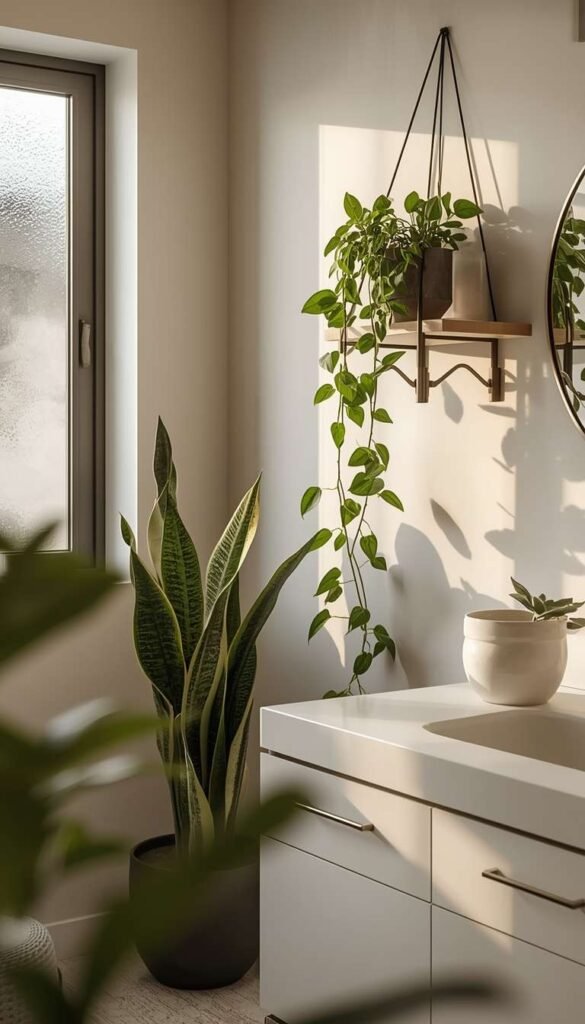
Let me be straightforward about something: not every plant belongs in a bathroom. I’ve watched clients carefully style a gorgeous minimalist space and then place a fiddle leaf fig in the corner a plant that needs bright indirect light and consistent airflow inside a windowless bathroom with zero ventilation. It was dead in three weeks. The space looked worse than before they started.
The right plants, though, do something genuinely special in a minimalist bathroom. They introduce the one element that no tile or fixture can replicate living, breathing organic warmth. The trick is matching the plant to your specific bathroom conditions before you fall in love with how it looks.
Here’s what actually thrives:
- Snake plants (Sansevieria) are the most forgiving option in existence. Low light, infrequent watering, high humidity tolerance. If your bathroom has a small window or no window at all, this is your plant. They also grow tall and sculptural, which suits a minimalist aesthetic beautifully.
- Pothos trail elegantly from a high shelf or the top of a medicine cabinet and genuinely seem to prefer neglect. They’re also incredibly affordable usually under $10 at most garden centers and home improvement stores across the US.
- Air plants (Tillandsia) require no soil at all, which makes them the ultimate minimalist plant. Display them in a simple ceramic bowl or hang them from a small wall hook. They absorb moisture from the air, making bathrooms one of their preferred environments.
Keep the pot simple. A clean white or matte black ceramic pot does the job. Anything with a busy pattern or a decorative glaze competes with the calm you’re trying to build.
14. Texture Over Pattern: How to Add Visual Interest Without Clutter
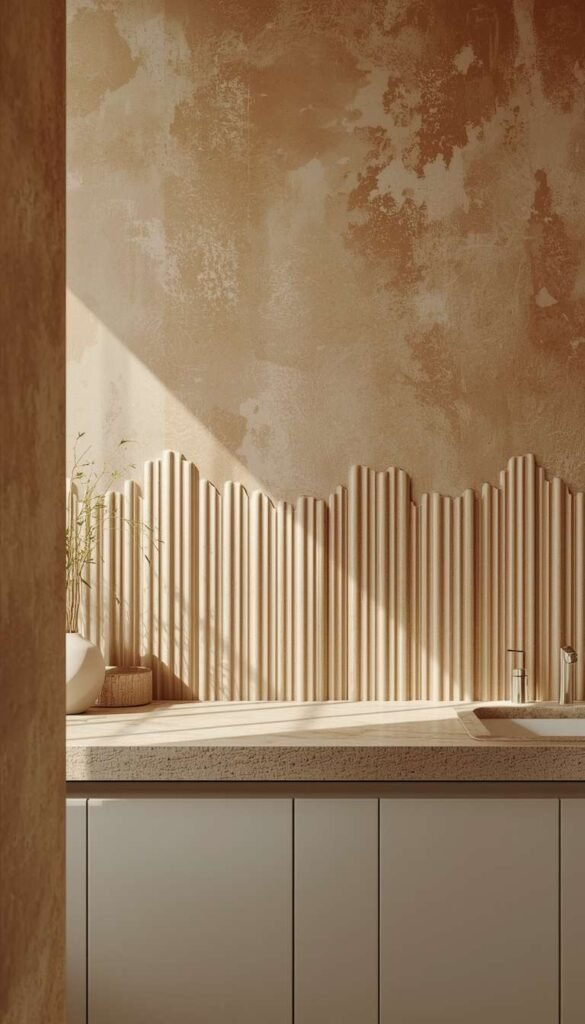
One of the biggest misconceptions I encounter about minimalist bathrooms is that they have to be visually flat just smooth white surfaces from floor to ceiling with nothing to engage the eye. That version of minimalism does exist, but it takes an extremely confident hand to pull off, and honestly, most people find it uncomfortable to live with after the first month.
The approach I consistently prefer and recommend is using texture instead of pattern to create depth and warmth. Texture engages the eye without demanding attention. It adds dimension without adding visual noise. And in a minimalist space, that distinction is everything.
Limewash paint is having a major moment in American interiors right now and for good reason. It creates a soft, mottled, almost ancient-looking finish on walls that photographs beautifully and feels incredibly warm in person. Brands like Portola Paints and Roman Clay by Bauwerk are widely available in the US and can be applied over existing drywall without a full renovation. The cost per gallon runs higher than standard paint typically $60 to $90 but a single accent wall in a bathroom requires very little product.
Fluted tiles are another texture-forward choice I’ve been specifying a lot recently. The vertical ridges catch light differently throughout the day, giving a wall genuine visual movement without introducing any color or pattern. They work especially well on a vanity backsplash or as a full shower wall treatment in a warm white or soft greige tone.
15. Neutral Color Palettes That Won’t Go Stale by 2026
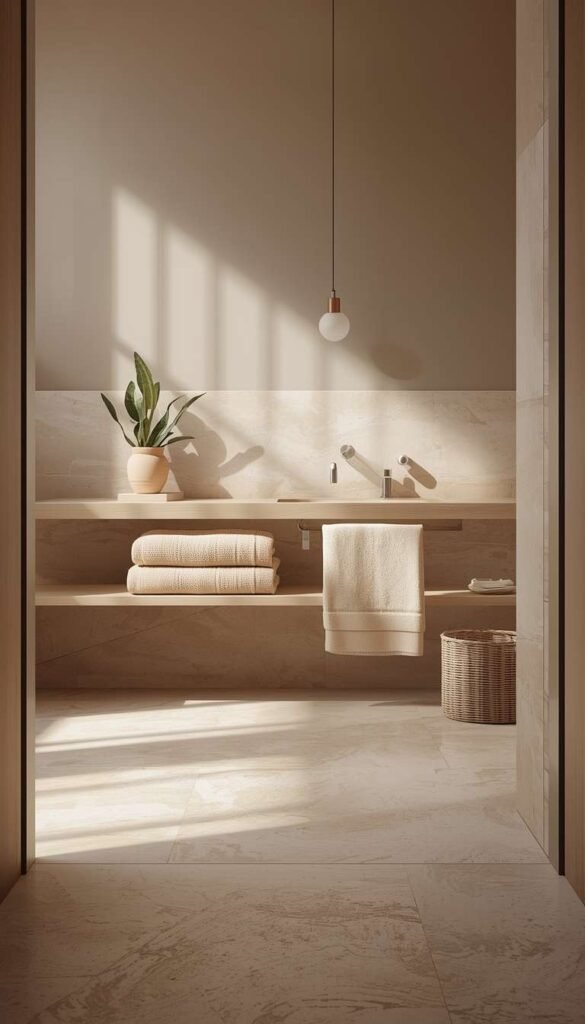
Trends move fast in the design world, and I’ve seen enough homeowners repaint perfectly good rooms because they chased a color that peaked and faded within two years. When a client asks me for a minimalist bathroom palette that will feel as relevant five years from now as it does today, I steer them away from anything that’s currently “having a moment” and toward colors with genuine staying power.
The palettes I trust completely right now:
- Warm whites and soft creams will never date. Benjamin Moore White Dove, Sherwin-Williams Alabaster, and Farrow & Ball’s All White have been reliable for decades and will continue to be. They work with wood, stone, metal, and almost every fixture finish.
- Warm greige — that perfect blend of gray and beige sits in a sweet spot that feels neither cold nor fussy. Sherwin-Williams Accessible Beige (SW 7036) and Benjamin Moore Pale Oak (OC-20) are two I return to consistently for bathroom walls and large-format tile selections.
- Soft clay and terracotta tones are deeper and moodier but still grounded in the natural palette that minimalism favors. These work particularly well in Japandi and organic modern bathrooms and feel far more timeless than the greens and blues that have dominated social media recently.
One practical note: always order tile samples and paint swatches together and view them in your actual bathroom lighting before finalizing anything. Colors behave completely differently under warm incandescent light versus cool daylight, and a palette that looked perfect on your phone screen can feel entirely wrong on the wall.
If you could change just one thing about your bathroom today the lighting, the clutter, the color, or the fixtures what would it be and why?
16. Small Apartment Bathroom: Here Is What Actually Works
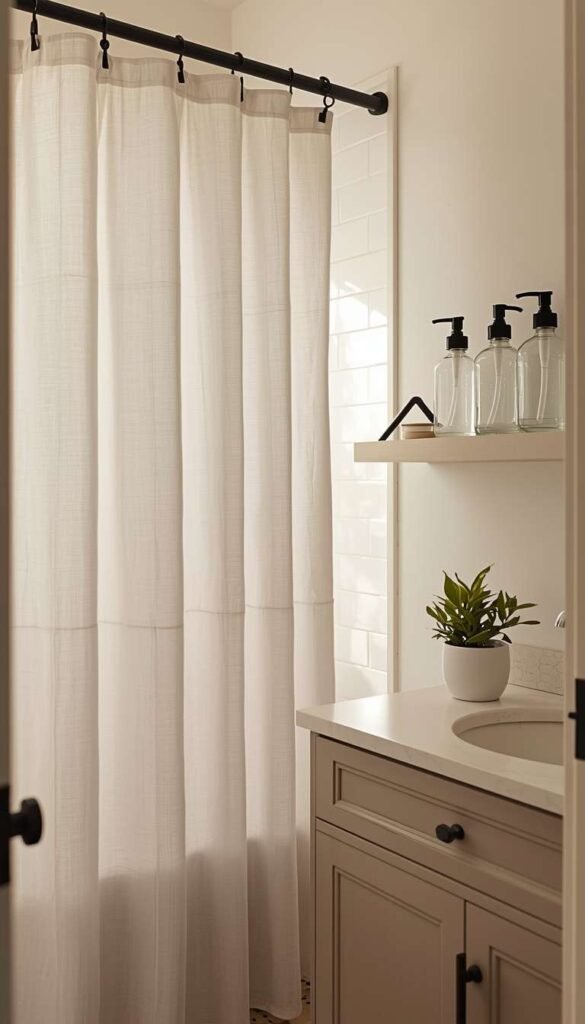
Apartment bathrooms present a unique design challenge that most minimalist bathroom articles completely ignore you usually can’t retile, can’t move plumbing, can’t replace fixtures, and definitely can’t knock down walls. So when I work with renters who want a minimalist bathroom, the entire approach shifts toward what I call impact without intervention.
The single most effective renter-friendly upgrade I’ve found is replacing a builder-grade shower curtain with a clean, weighty linen or cotton curtain in white or warm oatmeal. A $30 curtain swap paired with matching rings in a brushed nickel or matte black finish instantly elevates the entire bathroom. It takes fifteen minutes and leaves no trace when you move out.
A few more moves that require zero landlord permission:
- Decant your products. Replace the parade of colorful plastic bottles on your shower shelf with a set of matching pump dispensers in clear glass or matte ceramic. This single change does more for a minimalist bathroom aesthetic than almost any other under-$50 decision.
- Add a small floating shelf using Command strips rated for bathroom use. A single shelf at eye level holds a plant, a candle, and one decorative object which is genuinely all a minimalist bathroom needs.
- Swap the hardware. In many apartments, cabinet knobs and drawer pulls are replaceable without damaging anything permanently. Matte black or brushed brass hardware on a dated vanity can completely change its personality.
17. Minimalist Hardware: The Finishing Touch Most People Get Wrong
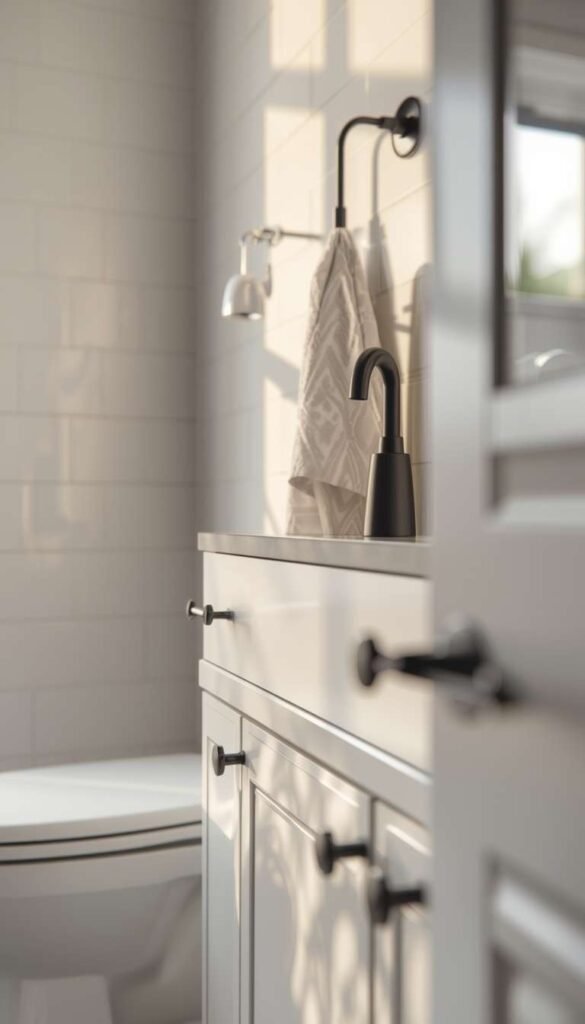
Hardware is the jewelry of a bathroom. It’s the last thing most people think about and the first thing a designer notices when they walk into a space. I’ve seen stunning minimalist bathrooms completely undermined by mismatched finishes a brushed nickel faucet paired with a polished chrome towel bar and a matte black toilet paper holder, all in the same room. It looks accidental, and in a minimalist space where every detail is exposed, accidental is the enemy.
The rule I follow without exception: commit to one finish and carry it through every metal surface in the room. Faucet, towel bar, toilet paper holder, robe hook, cabinet pulls, shower head all of it. This single discipline creates a level of cohesion that makes even a modest bathroom feel professionally designed.
Now, which finish to choose in 2026? Here’s my honest take:
- Matte black remains strong and suits contemporary and Japandi minimalist bathrooms beautifully. The caveat I always share with clients is water spot visibility in hard water areas it requires wiping down more frequently than brushed finishes to stay looking sharp.
- Brushed nickel is the most forgiving finish in daily use. It hides water spots, resists tarnishing, and works with virtually every tile and vanity color. It’s not the most exciting choice, but it’s the one I’ve never seen a client regret five years later.
- Unlacquered brass is having a genuine moment and I understand why it develops a living patina over time that feels warm and collected rather than perfectly polished. The reality check: it will darken and shift in color, which some people love and others find alarming when they see it happening. Know which camp you’re in before you commit.
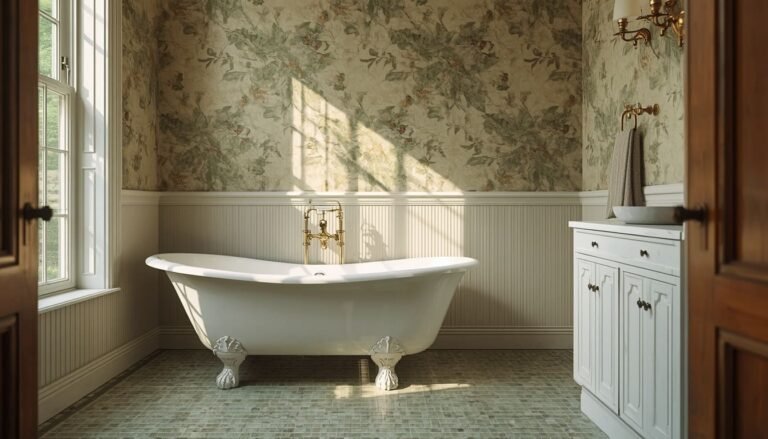
18. The Freestanding Tub Fantasy Versus Reality
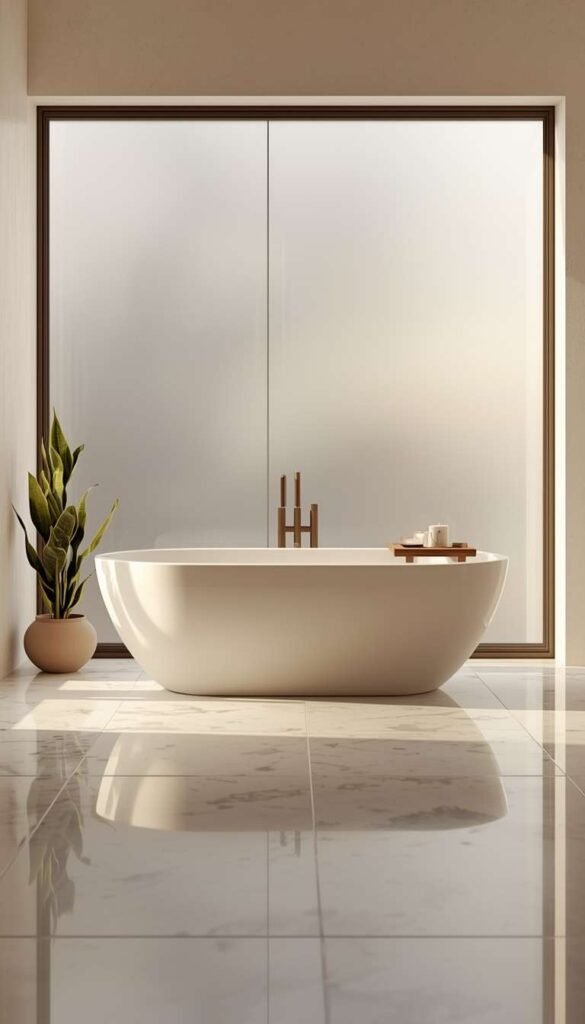
I need to talk about freestanding tubs honestly, because they are one of the most aspirational elements in minimalist bathroom design and also one of the most misunderstood purchases a homeowner can make. They look absolutely incredible in photos. A sculptural soaking tub floating in front of a large window, surrounded by nothing but clean tile and soft light it’s the image that sells entire bathroom renovations.
But here’s what those photos don’t show you.
Freestanding tubs require significantly more floor space than they appear to need. The tub itself might be 55 to 67 inches long, but you need clearance on all sides for comfortable use and cleaning typically at least 6 inches on each side and 18 inches at the foot. In a bathroom under 100 square feet, a freestanding tub often crowds the space to the point where the minimalist aesthetic collapses entirely.
Cleaning underneath and behind a freestanding tub is genuinely awkward. The gap between the tub base and the floor collects dust, hair, and moisture, and reaching it requires either a long-handled tool or getting down on the floor. In a pristine minimalist bathroom, that gap becomes the most high-maintenance spot in the room.
That said, if your bathroom can genuinely accommodate one and your lifestyle includes actual long soaking baths rather than just the fantasy of them a freestanding tub in a simple oval or rectangular form is one of the most beautiful focal points minimalist design offers. My recommendation for the US market at a reasonable price point: look at brands like Woodbridge, ANZZI, and Kingston Brass before jumping straight to the designer names. Quality is surprisingly comparable at a fraction of the cost.
19. Minimalist Bathroom Decor: The Rule of Three That Works Every Time
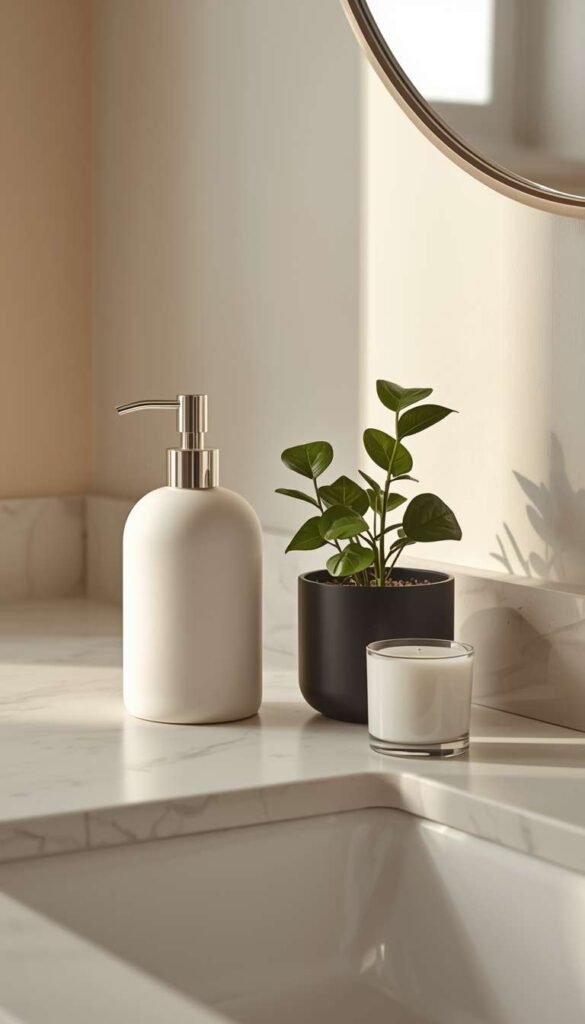
Decor in a minimalist bathroom is not about filling space. It’s about punctuating it. The entire point of a well-edited minimalist bathroom is that the materials, the fixtures, and the architecture do the heavy lifting — and decor plays a supporting role, not the lead. When I style a minimalist bathroom for a client reveal, I almost always land in the same place: three objects, thoughtfully chosen, carefully placed.
The formula is simple. One functional object, one natural element, one personal touch.
The functional object might be a beautiful ceramic soap dispenser or a clean-lined tray corralling a few countertop essentials. It earns its place because it’s used every day it just happens to look good doing it. The natural element is almost always a plant or a small vase with a single stem or branch of something organic. It introduces life and softness without demanding attention. The personal touch is the wildcard a small framed photograph, a single scented candle in a vessel you love, or a sculptural object that means something to you. It’s what keeps a minimalist bathroom from feeling like a hotel room rather than a home.
What I tell every client: once you have your three objects in place, step back and look at the room. If your eye goes to the objects first rather than the overall space, you have too much. Remove one and look again. The goal is a room where the first impression is calm, and the details reveal themselves slowly.
20. Luxury Minimalist Look for Under $500: A Real Shopping Guide
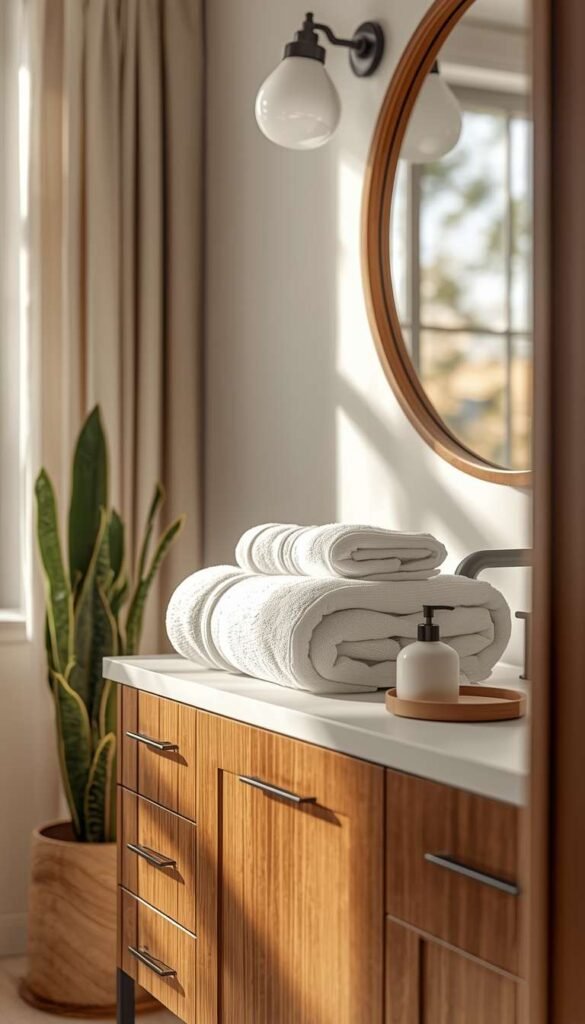
This is the section I wish every minimalist bathroom article included, because inspiration without a budget framework is just a mood board. The truth is that the luxury minimalist look clean lines, cohesive materials, that effortless spa-like calm is very achievable in the US market without spending thousands of dollars, if you know exactly where to put your money.
Here’s how I’d allocate a $500 refresh budget for maximum visual impact:
- $80 to $100 on towels. A set of oversized, high GSM towels in white or warm linen from brands like Parachute, Brooklinen, or even Target’s Threshold Performance line will immediately elevate the entire room. Fold them neatly on an open shelf or roll them in a simple basket.
- $60 to $80 on a matching soap and accessory set. A ceramic soap dispenser, a small tray, and a toothbrush holder in a unified finish matte white, soft stone, or warm clay replace the visual chaos of mismatched plastic containers instantly.
- $150 to $200 on a new mirror or light fixture. This is your highest-impact single purchase. A round wood-framed mirror from McGee & Co., Article, or CB2 in the $120 to $180 range changes the personality of the entire vanity wall. Alternatively, replacing a builder-grade light bar with a pair of simple wall sconces in a consistent finish delivers the same level of transformation.
- $80 to $120 on a plant and pot. A tall snake plant or trailing pothos in a clean matte ceramic pot — sourced from a local nursery or even Trader Joe’s adds the organic warmth that separates a styled minimalist bathroom from a sterile one.
- Remaining $50 to $80 on small hardware swaps. New cabinet pulls, a better toilet paper holder, or a sleek robe hook in your chosen finish. Small purchases, enormous cohesion payoff.
Are you team all-white minimalist, warm Japandi neutrals, or moody black and white and does your current bathroom even come close to the vibe you actually want?
Your 2 Minute Decision Map
By Budget
Starter Minimalist (Under $500)
- Swap your shower curtain for a linen or weighted cotton panel
- Decant products into matching ceramic or glass dispensers
- Add a round wood-framed mirror from Target or McGee & Co.
- Buy one great plant in a clean matte pot
- Replace cabinet hardware in a single consistent finish
Investment Minimalist ($1,000 and Up)
- Install a floating vanity with proper wall blocking
- Go large-format tile on floors and walls for seamless flow
- Upgrade to a frameless glass shower enclosure
- Add recessed niches and a built-in medicine cabinet
- Consider a wet room layout if space and budget allow
By Lifestyle
Busy Households and Families
- Choose brushed nickel fixtures they hide water spots effortlessly
- Skip white grout opt for pre mixed gray or charcoal grout instead
- Large-format tiles mean fewer grout lines and less weekly scrubbing
- Avoid freestanding tubs undermount or alcove styles are far easier to clean around
The True Minimalist
- Commit to the rule of three for all decor one functional object, one plant, one personal touch
- Choose a wet room or frameless enclosure for the cleanest visual line
- Invest in unlacquered brass or matte black hardware for long-term character
- Let negative space work resist filling every shelf and surface
Frequently Asked Questions
What is the most budget-friendly way to get a minimalist bathroom without renovating?
Start by removing, not buying. Decant your products, swap your shower curtain, and replace mismatched hardware with one consistent finish. Most clients spend under $150 and see an immediate difference.
How do I keep a white minimalist bathroom looking clean without scrubbing it daily?
Choose large-format tiles with minimal grout lines and a matte or honed finish on surfaces. Squeegee your shower glass after every use and it stays pristine with almost zero extra effort.
Is a minimalist bathroom a good idea for a family with kids?
Yes, but material choices matter more than aesthetics here. Skip white grout, avoid freestanding tubs, and choose brushed nickel over matte black fixtures they forgive hard water and little handprints far better.
What paint colore works best for a minimalist bathroom with no natural light?
Warm whites outperform cool whites every time in low-light bathrooms. Benjamin Moore White Dove or Sherwin-Williams Alabaster both reflect light softly without turning yellow or feeling flat on the wall.
How many decorative items should a minimalist bathroom actually have?
Three is the magic number. One functional object like a soap dispenser, one natural element like a plant, and one personal touch. Anything beyond that starts competing with the calm you’re building.
Conclusion
Your Minimalist Bathroom Is Closer Than You Think Your bathroom is the first space you walk into every morning and the last one you leave at night. That matters more than most people give it credit for. You don’t need a full renovation, a designer budget, or a Pinterest perfect starting point you just need one decision today. Clear one shelf. Order one paint sample. Swap one thing out. That’s genuinely how the best bathroom transformations I’ve seen actually started. The space you want is not as far away as it feels right now.