24 Cozy Cottage Bathroom Ideas for Timeless Country Charm
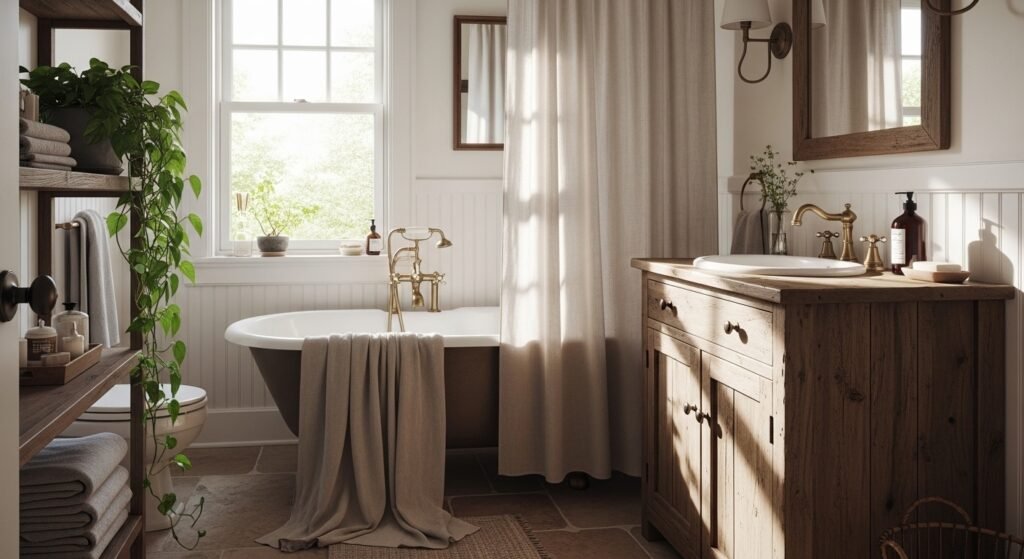
There’s something about a cottage bathroom that makes you want to slow down, breathe deeper, and actually enjoy the space you’re in. I’ve designed dozens of bathrooms across the US, and nothing wins hearts quite like that worn-in, wildflower-and-whitewash feeling that cottage style delivers so effortlessly. Whether you’re working with a cramped 50-square-foot powder room in a Tennessee bungalow or a generous primary bath in a New England farmhouse, these cottage bathroom ideas will meet you exactly where you are. From clawfoot tubs and shiplap walls to vintage hardware and soft linen curtains, I’ve pulled together 24 of my favorite looks — each one backed by real styling advice, honest budget notes, and the kind of practical tips that actually hold up in daily life.
My Design Notes
A few years back, I worked with a young couple in Franklin, Tennessee who had a 48-square-foot bathroom that was, honestly, depressing. Fiberglass tub, builder-grade vanity, zero personality. Their total budget was $3,200 — DIY labor included. We leaned fully into cottage style and it was one of the best decisions we made together. I chose beadboard panels painted in Sherwin-Williams Oyster White, tracked down a gorgeous salvaged mirror from a Nashville antique mall for $45, and ordered a soft linen shower curtain that pulled the whole room together for under $60. When we were done, their guests couldn’t stop talking about that bathroom. That project stuck with me because it proved something I now tell every single client: cottage style doesn’t care about square footage or budget. It rewards layering, patience, and an honest eye for materials that have a little story to tell. That’s exactly the spirit behind every idea in this article.
24 Mastering the Art of Cozy Cottage Bathrooms: Stunning Country Inspired Design Secrets for Timeless Charm
1. Soft White Cottage Retreat
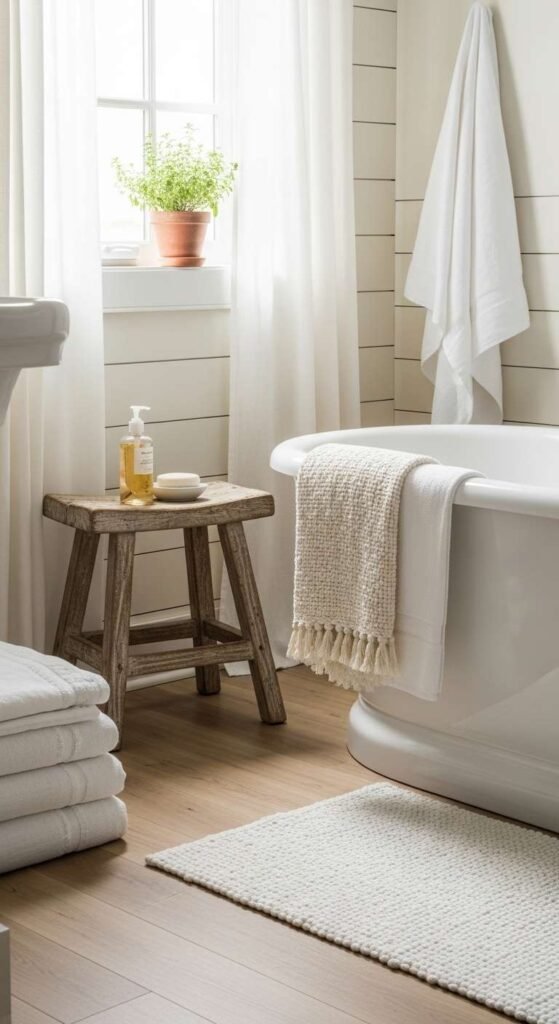
If there’s one look I come back to again and again, it’s the all-white cottage bathroom done right. And I mean right — not sterile, not cold, but layered with texture so the white actually feels warm. Think shiplap walls paired with a creamy linen shower curtain, a worn wood stool beside the tub, and a small potted herb on the windowsill. That’s the difference between a white bathroom and a cottage bathroom.
The trick is to vary your whites. Bright white trim against an off-white wall against a warm ivory towel — those subtle shifts keep the eye moving and the space feeling alive. I always tell my clients: if everything matches perfectly, it looks like a showroom. If it almost matches, it looks like a home.
One thing to watch out for here is grout. White tile with white grout is stunning on day one and a maintenance headache by month six, especially in a busy family bathroom. If you love the look, go for it — just seal the grout twice a year and keep a grout pen handy for touch-ups.
Budget note: You can pull off a soft white cottage retreat for as little as $400 to $800 in accessories and paint alone, without touching a single tile.
2. Vintage Clawfoot Tub Charm
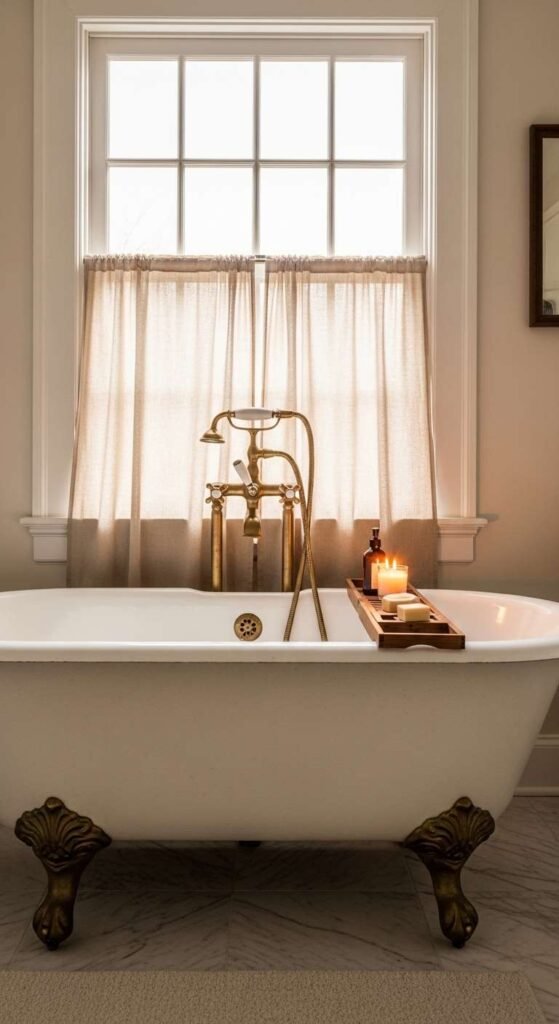
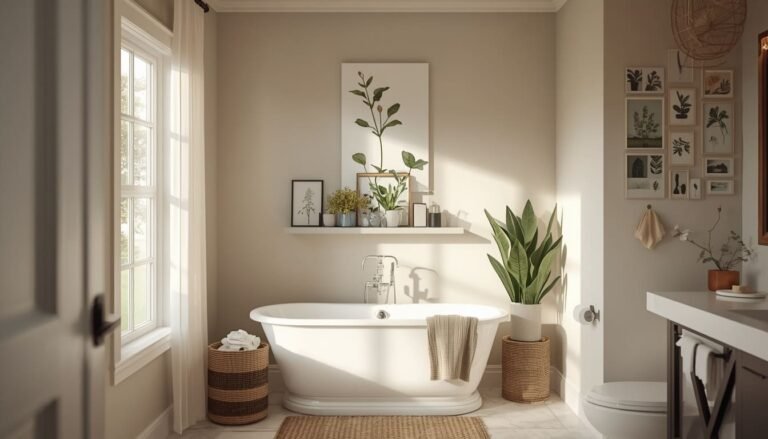
Nothing says cottage bathroom quite like a clawfoot tub sitting in the middle of the room like it owns the place. And honestly? It does. I’ve installed these in everything from 1920s craftsman bungalows in Portland to newer construction homes in suburban Georgia where the owners simply wanted that old-soul feeling — and every single time, the tub becomes the room.
A quick trick I’ve learned over the years: you don’t need to spend $2,000 on a brand-new reproduction. Check Facebook Marketplace, Craigslist, and your local architectural salvage yard first. I’ve seen genuine cast iron clawfoot tubs sell for $150 to $400 in need of a good cleaning and a fresh coat of exterior enamel spray paint. Have it professionally reglazed on the interior — usually $300 to $500 — and you have a showpiece for half the cost of new.
A few things to keep in mind before you commit:
- Cast iron is extraordinarily heavy. Make sure your floor can handle the load, especially in older homes.
- Freestanding tubs require floor-mounted plumbing, which adds to installation costs.
- If you have small kids, the high sides can be tricky at bath time.
That said, for a couple or a household that loves a long soak on a Sunday afternoon, there is simply no better investment in cottage charm.
3. Floral Wallpaper Delight
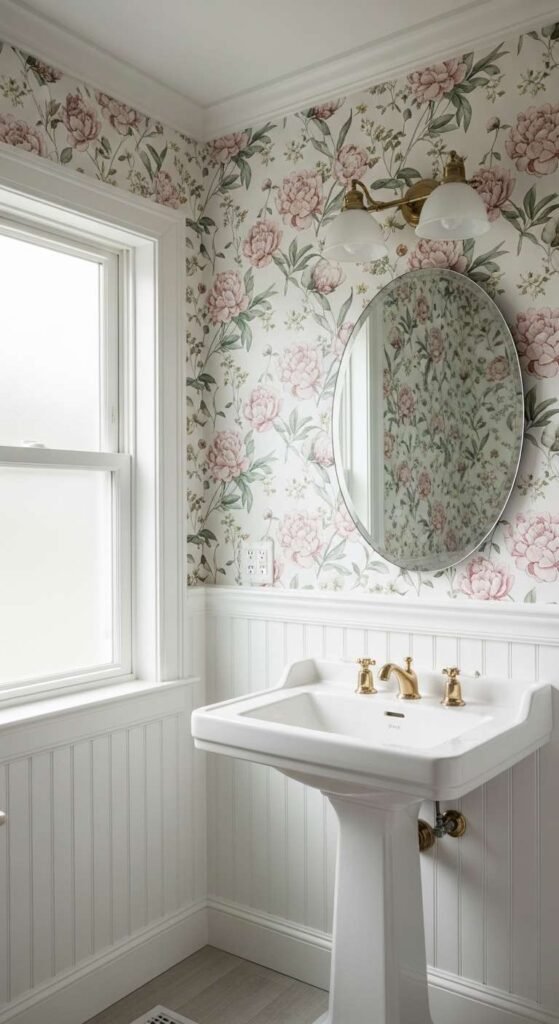
I’ll be honest with you — wallpaper used to scare me. The prep work, the seams, the commitment. But floral wallpaper in a cottage bathroom has completely won me over, and here’s why: bathrooms are small. You’re not wallpapering a living room. The square footage is manageable, the impact is enormous, and if you ever change your mind, removal is far less painful in a 60-square-foot room than anywhere else in the house.
For cottage style, I gravitate toward botanical prints — trailing vines, oversized peonies, soft watercolor wildflowers. Brands like Rifle Paper Co., Spoonflower, and even Walmart’s better online selections carry gorgeous options at every price point. Pair a floral wallpaper with simple white beadboard below a chair rail and suddenly your bathroom looks like it belongs in a Vermont bed and breakfast.
One thing to watch out for is moisture. Always choose a wallpaper rated for bathrooms or kitchens, and make sure your ventilation fan is actually doing its job. A beautiful floral wall can bubble and peel within a year if the humidity isn’t managed properly. That’s a lesson learned the hard way on a project I did in coastal South Carolina — stunning paper, inadequate fan, unhappy client.
4. Rustic Wood Vanity Warmth
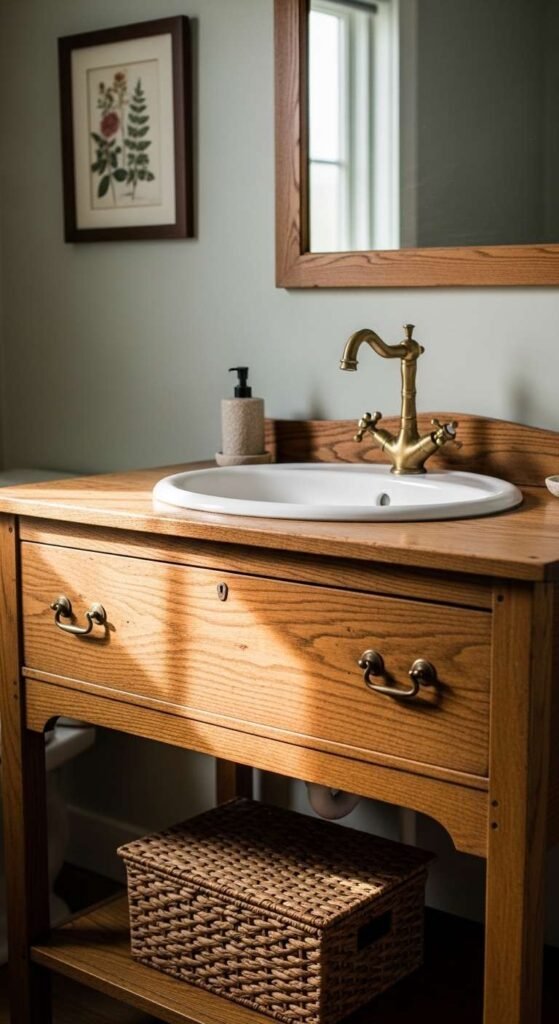
The vanity is the hardest-working piece of furniture in any bathroom, and in a cottage space, it’s also your biggest style statement. A rustic wood vanity — whether that’s a genuine antique dresser converted with a vessel sink, or a newer piece built to look reclaimed — brings immediate warmth that no white shaker cabinet can replicate.
I love the dresser-to-vanity conversion approach for clients on a budget. Here’s how I typically approach it:
- Find a solid wood dresser at an estate sale or thrift store ($40 to $150 is realistic).
- Have a plumber cut the plumbing through the back or bottom — most charge $150 to $250 for a straightforward conversion.
- Seal every exposed wood surface with a water-resistant polyurethane finish. Do not skip this step.
The result looks like a $1,500 custom vanity and costs a fraction of that. A quick trick I always use: add unlacquered brass hardware to the drawers. It ages beautifully over time, developing a patina that only makes the whole piece look more authentic and collected.
Which of these cottage bathroom ideas feels most like you — the soft white retreat, the vintage clawfoot tub, the rustic wood vanity, or the floral wallpaper wall?
5. Cozy Cottage Textiles
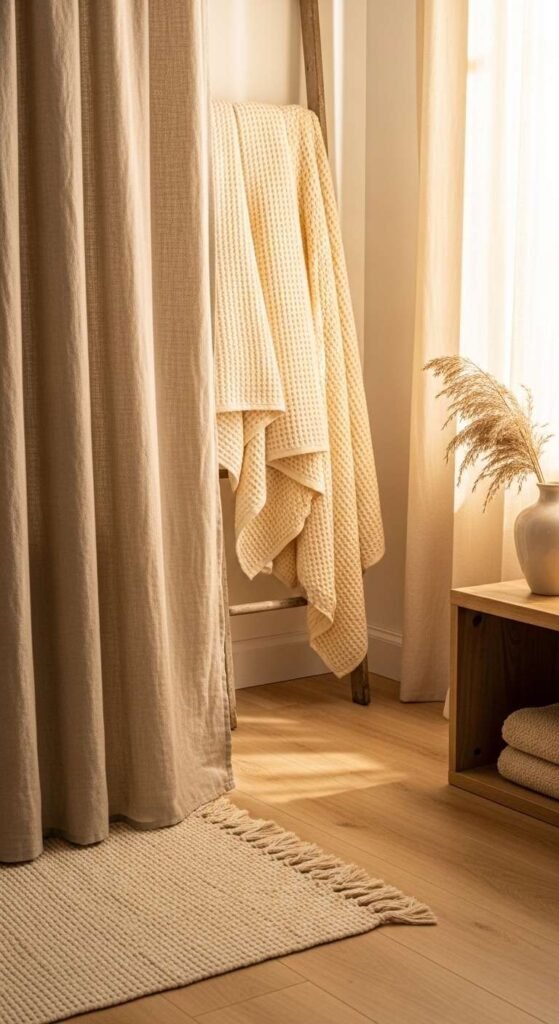
People underestimate textiles in a bathroom. They’ll spend thousands on tile and fixtures and then throw up a cheap polyester shower curtain that undercuts every good decision they made. In a cottage bathroom, textiles are where the coziness actually lives. They’re the difference between a bathroom that looks designed and one that feels lived-in and loved.
My go-to starting point is always the shower curtain. A thick, floor-length linen curtain in natural white or soft flax instantly elevates the entire room. Pair it with a chunky cotton bath mat, a waffle-weave hand towel in a complementary tone, and maybe a small fringed basket for rolled washcloths on the shelf. Suddenly the room has layers. It has texture. It breathes.
One thing to watch out for is mildew. Natural linen and cotton are beautiful but they need airflow to stay fresh. Always run your exhaust fan during and after showers, and wash bath mats weekly. If you have a north-facing bathroom with limited ventilation, I’d lean toward a linen-look fabric that’s actually a polyester blend — you get the visual warmth without the moisture headache.
Budget reality: A full textile refresh — shower curtain, mat, towels, and a few accessories — can run as little as $80 to $150 if you shop Target, Amazon, or HomeGoods. That’s one of the highest-impact, lowest-cost moves in cottage decorating.
6. Shiplap Wall Elegance
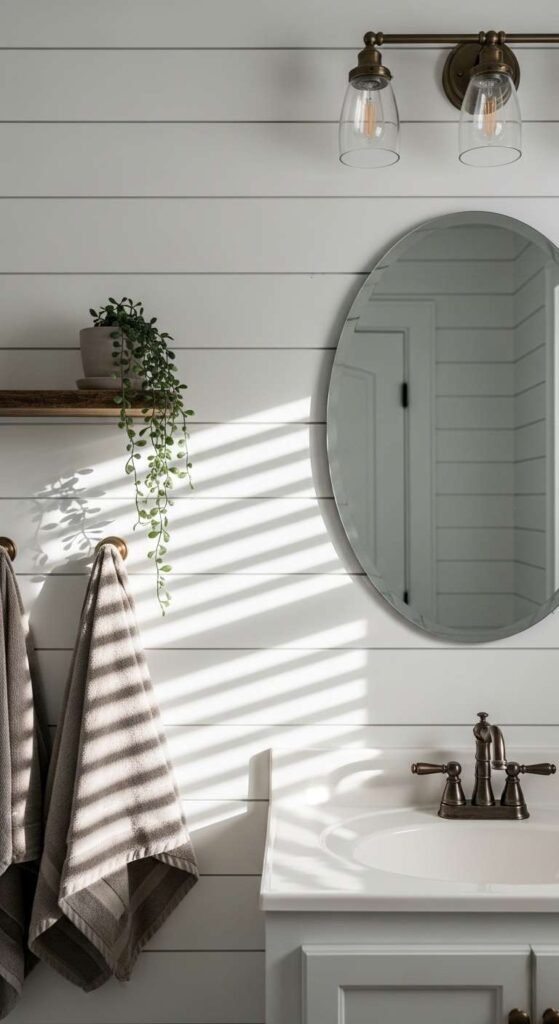
Shiplap has become so associated with a certain HGTV aesthetic that some designers have started dismissing it. I haven’t. When it’s done right — scaled properly, painted in the right tone, and paired with the right fixtures — shiplap in a cottage bathroom feels genuinely timeless rather than trendy.
The key decision is orientation. Horizontal shiplap makes a narrow bathroom feel wider. Vertical shiplap draws the eye upward and adds perceived height to a low-ceiling space. I used vertical shiplap in a tiny 45-square-foot bathroom in a 1940s home in Asheville, North Carolina, painted in Benjamin Moore’s Whitestone, and that room felt twice its actual size.
A few things worth knowing before you start:
- Real wood shiplap needs to be primed and sealed thoroughly in bathroom environments. Any moisture that sneaks behind the boards can cause warping over time.
- MDF shiplap is cheaper and more moisture-resistant but doesn’t hold up well if it ever gets wet from a leak. Real pine or cedar is worth the extra cost in a bathroom.
- If you’re renting or want a commitment-free version, peel-and-stick shiplap panels have genuinely improved in quality over the last few years.
Finished with a simple matte white paint and some vintage-style sconce lighting, shiplap is one of those cottage elements that never looks dated — it just looks like the house was always that way.
Here is the summary table:
| Idea | Estimated Price | Maintenance |
|---|---|---|
| Soft White Cottage Retreat | $400 – $800 | Medium |
| Vintage Clawfoot Tub Charm | $450 – $900 | Medium |
| Rustic Wood Vanity Warmth | $200 – $600 | High |
| Farmhouse Sink Simplicity | $400 – $1,200 | Low |
| Shiplap Wall Elegance | $300 – $900 | Low |
| Neutral Stone Flooring | $800 – $2,500 | Medium |
7. Antique Mirror Accents
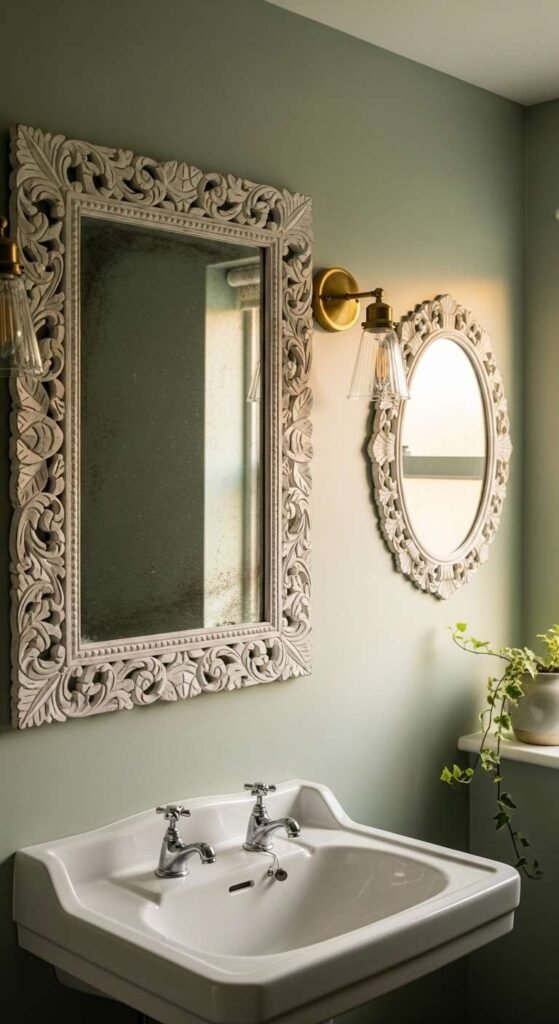
A great mirror can do more for a cottage bathroom than almost any other single element. I’ve seen $12,000 bathroom renovations that fell completely flat because the mirror was an afterthought, and I’ve seen $800 budget refreshes that looked genuinely stunning because someone found the right antique mirror at a flea market and hung it with confidence.
For cottage style, I look for mirrors with these qualities:
- Ornate carved wood frames in white, gold, or naturally weathered finishes
- Slightly foxed or aged glass that gives a soft, romantic reflection
- Irregular shapes — arched tops, oval frames, or asymmetrical vintage finds
A quick trick I’ve learned is to layer mirrors. One large statement mirror above the vanity paired with a smaller decorative mirror on an adjacent wall creates depth and visual interest that a single mirror never achieves. Estate sales, Facebook Marketplace, and Etsy’s vintage section are genuinely the best sources. I’ve never paid more than $75 for a mirror that looked like it cost $400.
One thing to watch out for: very ornate gilded frames can feel more baroque than cottage if the rest of the room is simple. Ground an elaborate mirror with humble surroundings — plain white walls, simple fixtures — and it sings. Surround it with too much decoration and it competes.
8. Soft Pastel Color Palette
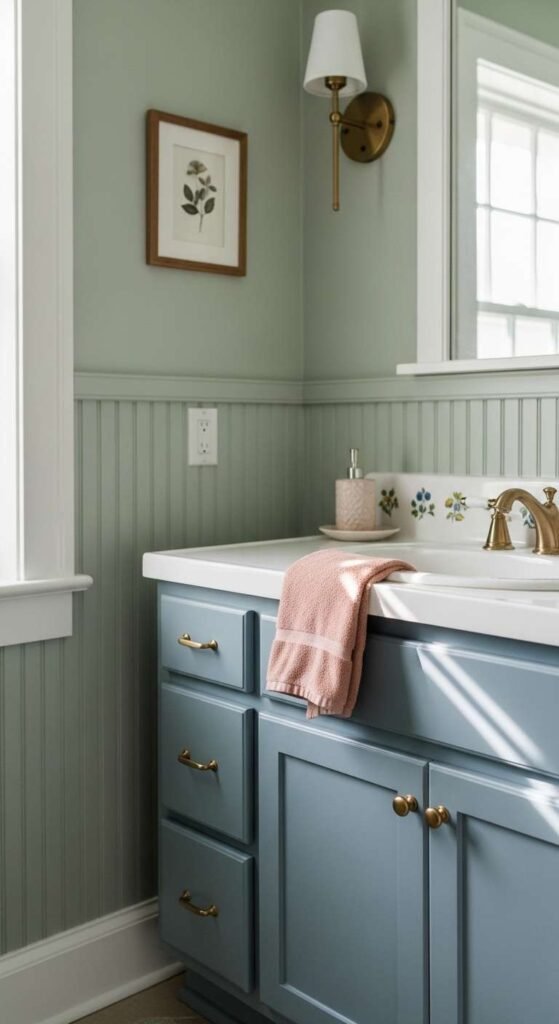
Cottage bathrooms and soft pastels are a natural match, and yet I see so many homeowners hesitate at the paint counter, second-guessing themselves into another gallon of greige. Let me give you permission to go there. A blush pink, a soft robin’s egg blue, a barely-there lavender — these colors have been anchoring cottage interiors for over a century because they work. They’re calm. They’re flattering. And in a bathroom, where good light and a good mood actually matter, they genuinely improve your mornings.
My personal favorites for the US market right now are Muted Sage by Behr, which reads almost like a neutral in north-facing bathrooms, and Pale Blush from Sherwin-Williams, which is warm enough to avoid feeling cold even in a windowless space. If you’re nervous about committing to color on all four walls, start with just the vanity. A soft green or dusty blue vanity against white walls is a classic cottage move that’s easy to repaint if your taste shifts.
The honest reality is that very pale pastels show water spots, toothpaste splatter, and soap residue more visibly than a mid-tone or white wall. Wipe-clean eggshell or satin finish is non-negotiable here — flat paint in a bathroom is always a mistake, no matter how beautiful it looks in the can.
9. Open Shelving with Country Charm
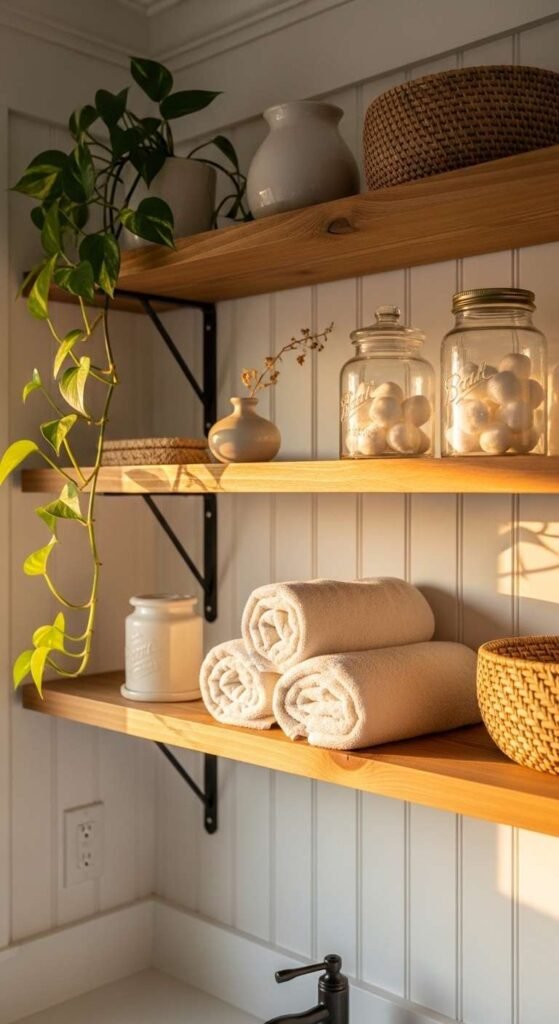
Open shelving in a cottage bathroom is one of those ideas that looks effortlessly styled in photos and requires a little more intention in real life. But when you get it right, it’s genuinely one of the most charming and functional moves you can make in this space. I’m a firm believer in open shelves for cottage bathrooms specifically because they force you to be intentional about what you keep out — and that restraint is exactly what makes the room feel curated rather than cluttered.
For materials, I always steer clients toward solid wood brackets and shelves rather than metal floating systems. A simple pine shelf with hand-forged iron brackets, sealed with a matte polyurethane, hits that sweet spot between rustic and refined. Style it with a mix of practical and pretty:
- Rolled linen towels in a neutral tone
- A small ceramic vase with a single dried stem
- A vintage glass jar repurposed as a cotton ball holder
One thing to watch out for is dust and moisture accumulation on open shelves directly above the toilet or adjacent to the shower. Things get grimy faster than you’d expect. I recommend keeping truly decorative items — ceramics, artwork, candles — away from high-splash zones and reserving those spots for practical items you rotate and replace regularly.
10. Vintage Inspired Lighting
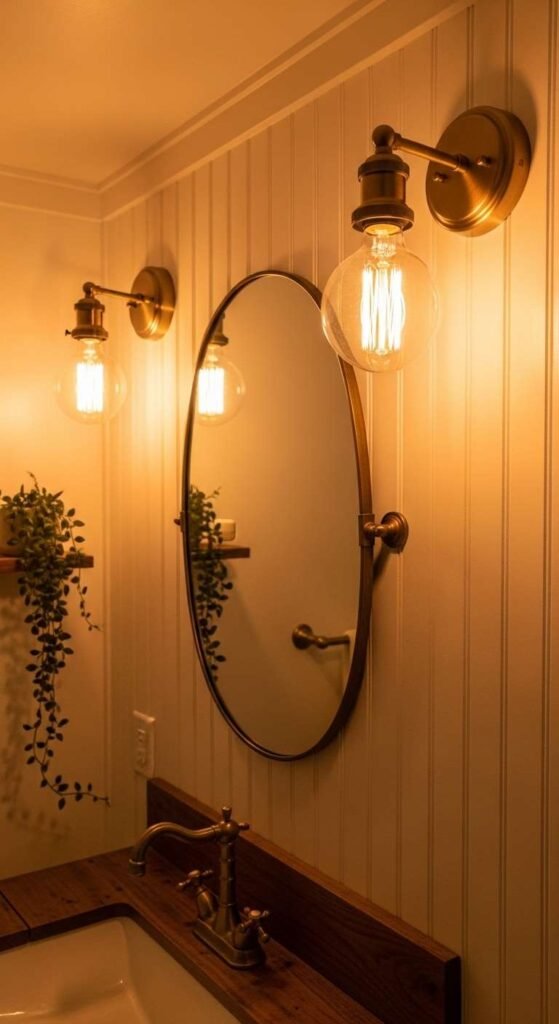
Lighting is the most underrated element in any bathroom design, and in a cottage bathroom it carries enormous weight. The wrong fixture can make a beautifully styled room feel like a hospital hallway. The right one wraps the whole space in warmth and makes even a simple vanity look intentional and considered.
For cottage style, I gravitate toward a few specific fixture types that consistently deliver:
- Schoolhouse globe sconces in brushed brass or oil-rubbed bronze
- Exposed filament bulbs in warm 2700K color temperature
- Simple lantern-style vanity bars that nod to old farmhouse utility lighting
A quick trick I’ve learned over years of bathroom projects: always mount vanity sconces at eye level on either side of the mirror rather than above it. Above-mirror lighting casts unflattering shadows downward across the face. Side-mounted sconces at roughly 60 to 65 inches from the floor give the most even, flattering light — and in a cottage bathroom they also look far more elegant and intentional.
Wayfair, Rejuvenation, and even the Etsy vintage lighting section carry wonderful options. You don’t need to spend $300 per sconce to get that warm, old-soul glow. I’ve sourced gorgeous schoolhouse fixtures for $45 each that looked like they came straight out of a 1920s Vermont general store.
Are you starting your cottage bathroom from scratch, or are you giving an existing space a little character refresh?
11. Wicker and Rattan Accents
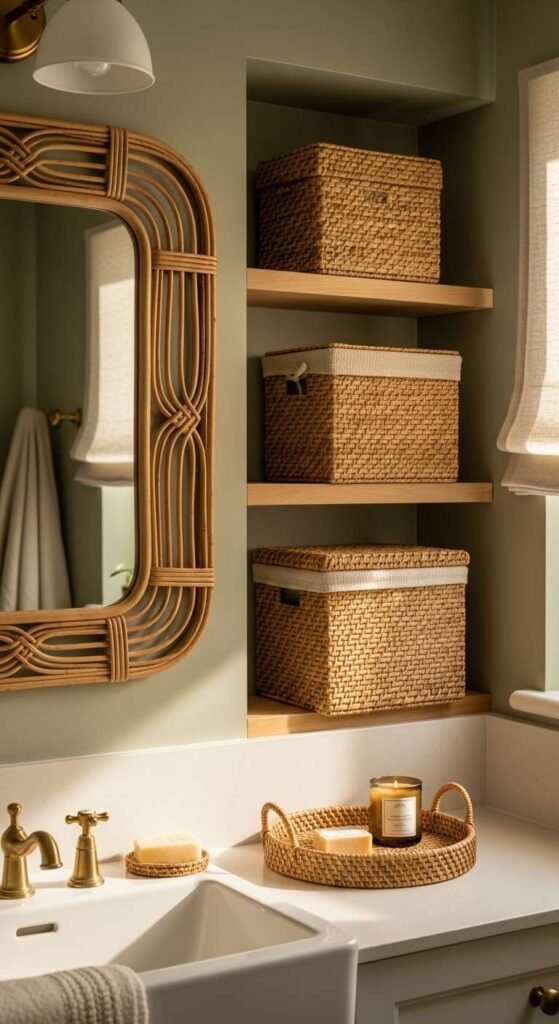
There is something deeply satisfying about bringing natural woven textures into a bathroom. Wicker and rattan accents — a small laundry hamper, a magazine basket beside the tub, a rattan mirror frame, a woven tray on the vanity — add that layer of organic warmth that no painted or tiled surface can replicate on its own. In cottage style specifically, these materials feel completely at home because they carry that same unpretentious, nature-connected spirit the whole aesthetic is built on.
I used a set of three graduated wicker baskets on open shelving in a bathroom project in Charleston, South Carolina, and they became the most-commented-on element in the entire room. Guests assumed they were expensive. They came from HomeGoods for a combined $34.
One thing to watch out for is placement. Wicker and rattan do not love prolonged direct moisture exposure. Keep them away from the shower splash zone and off damp floors. A rattan hamper sitting on wet tile will start to smell and deteriorate within months. Style them in drier zones — beside the vanity, near the door, or on shelving above the waterline — and they’ll last beautifully for years.
12. Farmhouse Sink Simplicity
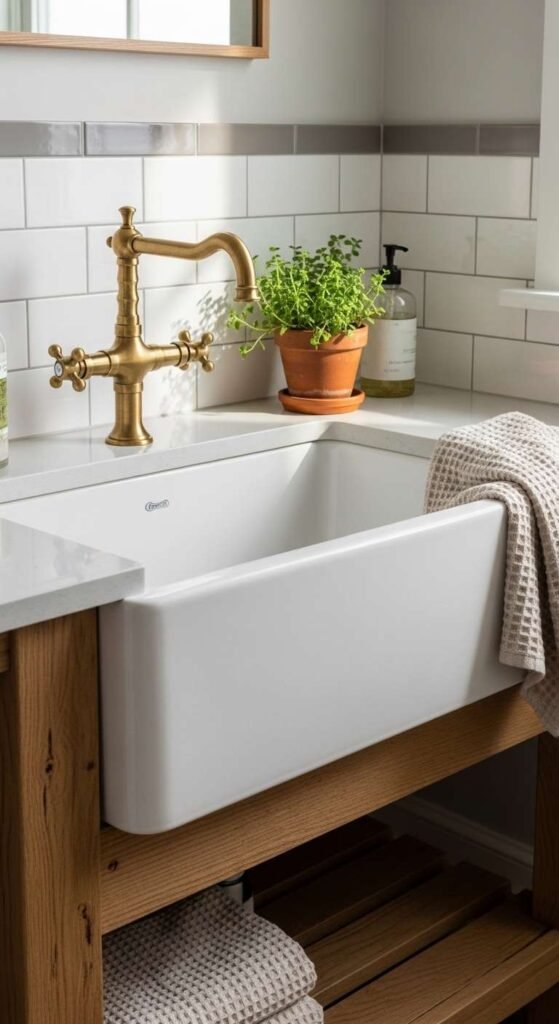
The apron-front farmhouse sink is one of those fixtures that completely changes the character of a bathroom the moment it goes in. It’s substantial. It’s honest. It has a presence that a standard undermount basin simply cannot match. And in a cottage bathroom, that presence feels exactly right — like the sink has always been there, has always been useful, and has no interest in being anything other than what it is.
I’ve specified farmhouse sinks in cottage bathrooms more times than I can count, and the questions I get asked most often are always about practicality. So let me address those directly:
- Fireclay farmhouse sinks are the gold standard for durability and that authentic cottage look. They resist chips and stains far better than cast iron.
- Standard farmhouse sinks designed for kitchens can absolutely be adapted for bathroom vanities — just confirm the basin depth works with your plumbing rough-in.
- Budget-conscious option: IKEA’s HAVSEN apron sink paired with a custom or repurposed wood vanity base gives you 80% of the look for about 30% of the cost.
The honest reality is that an apron-front sink requires a custom or semi-custom vanity cabinet to accommodate its depth — standard bathroom vanity boxes won’t work. Factor that into your budget planning from the start, and you’ll avoid one of the most common and costly mid-project surprises I see homeowners run into.
13. Soft Linen Shower Curtains
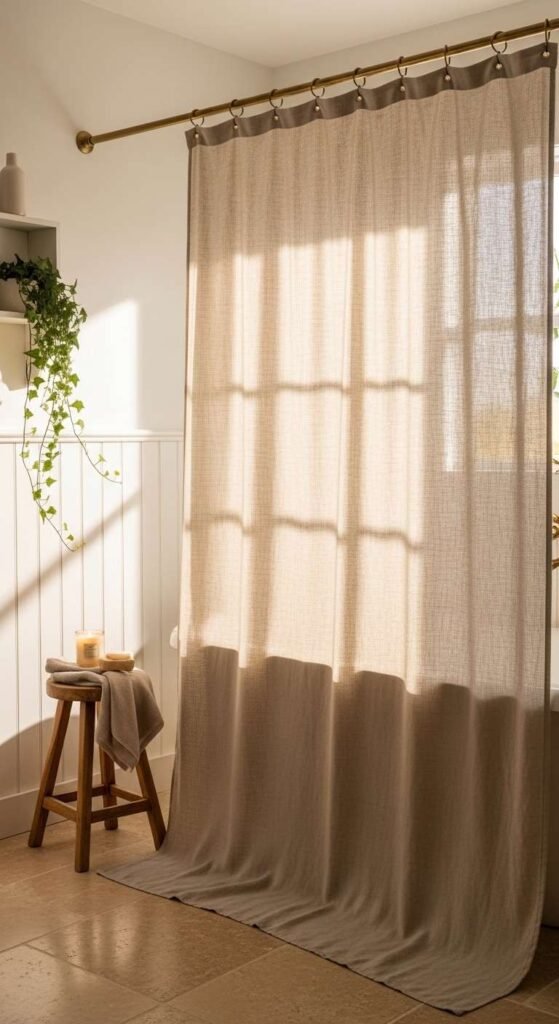
If I had to pick one single accessory that delivers the most cottage charm per dollar spent, a soft linen shower curtain would win every time. It’s that immediate. The moment a stiff, shiny polyester curtain comes down and a floor-length linen panel goes up, the entire bathroom shifts. The light filters through it differently. The folds hang more naturally. The whole room exhales.
For cottage bathrooms I always recommend going longer than standard. A 72-inch curtain that just grazes the floor reads as casual and considered at the same time — that slightly relaxed pooling at the bottom is intentional, not sloppy. Natural undyed linen, soft white, or a warm oatmeal tone work beautifully against almost every cottage color palette.
A quick trick I’ve relied on for years: use clip rings instead of standard curtain rings. They’re easier to remove for washing and they give the curtain header a slightly more casual, gathered look that feels authentically cottage rather than hotel-polished.
One thing to watch out for is weight. A genuine linen curtain gets heavy when wet, especially if it catches shower spray regularly. Make sure your tension rod or ceiling-mounted track is rated for the load. A rod that sags or slips ruins the entire effect and can damage your walls over time.
14. Exposed Wood Beams
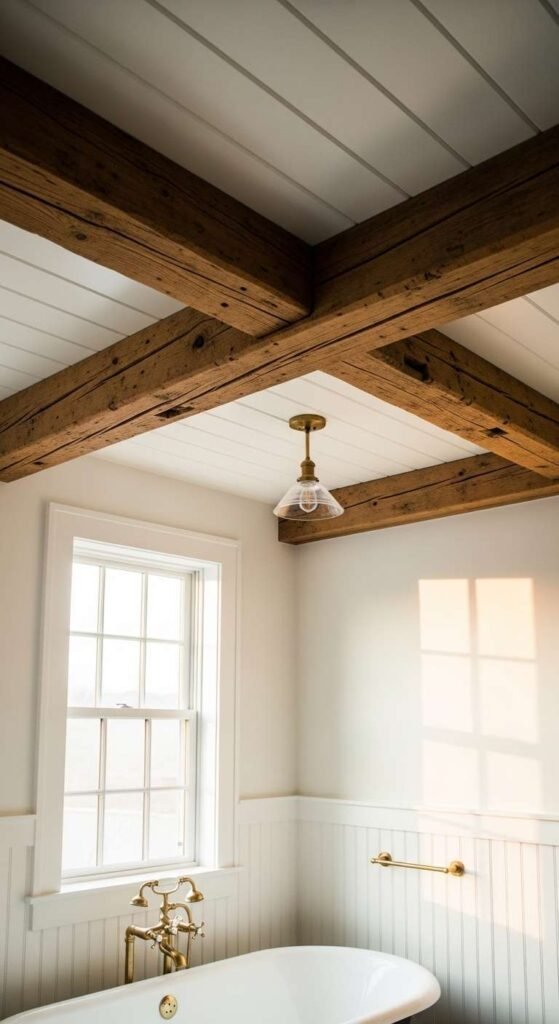
Exposed wood beams in a cottage bathroom stop people in their tracks. Every single time. I’ve had clients tell me that their bathroom ceiling became the thing their dinner guests talked about all evening — not the custom tile, not the clawfoot tub, the ceiling. There is something about raw, aged wood overhead that makes a small bathroom feel anchored and storied in a way that no other element quite achieves.
Now, genuine reclaimed barn beams are the dream — and if you have access to them, use them. My Franklin, Tennessee project used century-old boards from a friend’s torn-down barn, and one of them still had initials carved into it from decades past. That kind of history cannot be manufactured. But I also want to be honest with you about the alternatives because not everyone has a barn connection:
- Box beams built from 1×6 pine boards and mounted over a hidden structural support are nearly indistinguishable from solid beams once stained and installed.
- Faux polyurethane beams from companies like Direct Colums or Woodland Creek have improved dramatically in quality and now fool even experienced eyes at normal ceiling height.
- A single beam centered over the tub or vanity makes more visual impact than you’d expect and costs far less than a full ceiling treatment.
One thing to watch out for is moisture sealing. Any real wood installed in a bathroom ceiling needs to be properly sealed against humidity — unsealed wood above a shower will warp, darken, and eventually harbor mold. Two coats of a water-based polyurethane before installation and one refresh coat every three to four years keeps everything looking beautiful and structurally sound.
15. Vintage Hardware Details
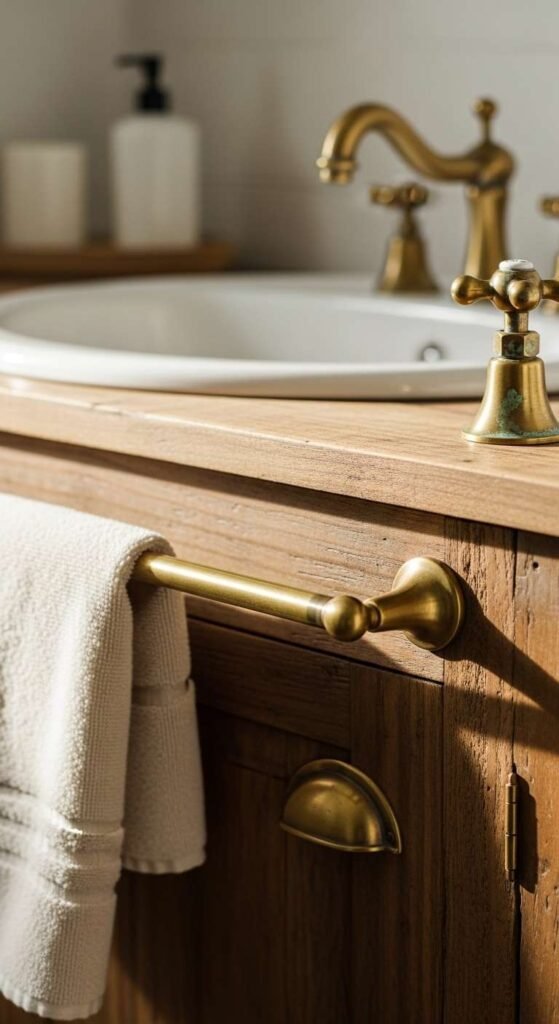
Hardware is the jewelry of a bathroom. It’s the detail that ties everything together or, when it’s wrong, quietly undermines every good decision you made everywhere else. In cottage bathrooms specifically, hardware choices carry enormous weight because this aesthetic is built on authenticity — and nothing breaks that authenticity faster than a brushed nickel towel bar on an otherwise perfectly curated vintage space.
My hardware recommendations for cottage bathrooms are pretty consistent across projects:
- Unlacquered brass ages beautifully and develops a warm patina that looks more authentic over time rather than less
- Oil-rubbed bronze works especially well in darker, moodier cottage schemes with deep green or navy walls
- Aged copper pairs perfectly with clawfoot tubs and exposed wood elements for a genuinely old-world feel
A quick trick I’ve used on budget projects: you don’t need to replace every hardware piece at once. Start with the towel bar and the faucet — those two pieces are the most visible and have the most impact. Match them first, then work outward to cabinet pulls, toilet paper holder, and robe hooks as budget allows.
One thing to watch out for is mixing too many metal tones. Two complementary metals in one bathroom — say brass and aged bronze — can feel intentionally layered and sophisticated. Three or more different metals in a small space starts to feel chaotic and unresolved. Pick your dominant metal and let it lead.
What’s the one thing about your current bathroom that bothers you most — the lighting, the storage, the color, or the overall vibe?
16. Freestanding Vanity Charm
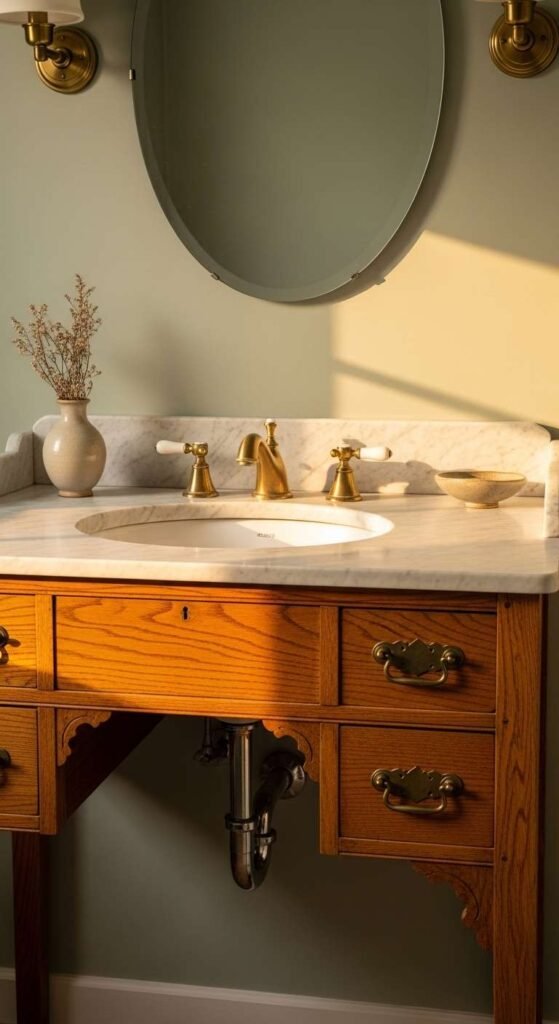
A freestanding vanity brings something to a cottage bathroom that built-in cabinetry simply cannot — the feeling that the room was furnished rather than constructed. It looks like someone chose that piece deliberately, lived with it somewhere else first, and brought it into the bathroom because it belonged there. That sense of collected history is absolutely central to what makes cottage style feel so warm and personal.
The options here range from genuine antique furniture conversions to purpose-built freestanding vanities designed to look furniture-like, and both approaches work beautifully depending on your budget and your patience for DIY.
I worked on a primary bathroom in Savannah, Georgia where we used a genuine 1890s oak washstand sourced from an antique dealer for $220. We had a local plumber fit a undermount basin into the marble top that was already there, added unlacquered brass fixtures, and sealed the wood thoroughly. The result was breathtaking — and completely unique. No one else in the world has that vanity in their bathroom.
One thing to watch out for with true antique conversions is drawer functionality. Once plumbing runs through the interior of a piece, some drawers become non-functional. Plan your storage layout before committing to a specific piece, and make sure the drawers you lose aren’t the ones you were counting on for daily use.
17. Neutral Stone Flooring
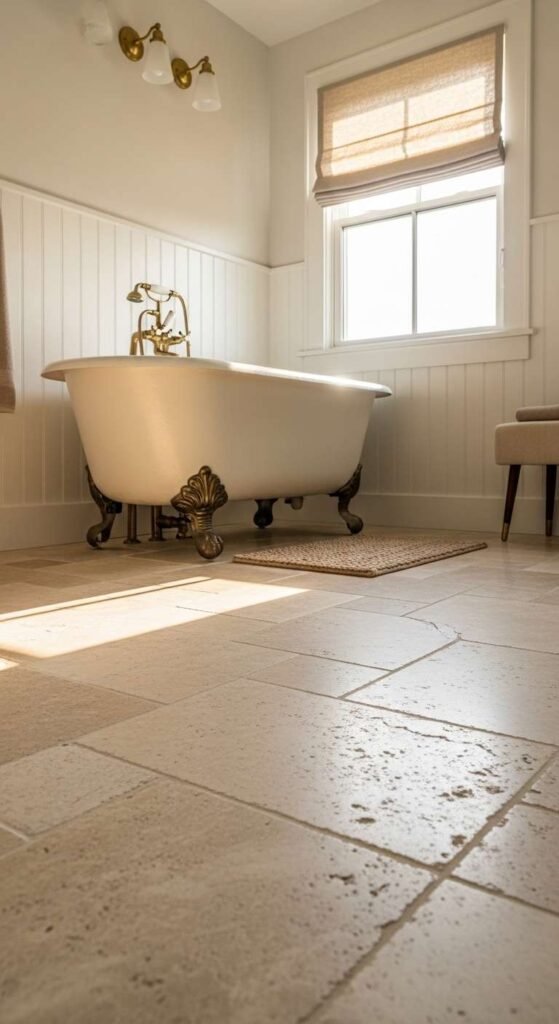
Stone flooring in a cottage bathroom is one of those investments that pays emotional dividends every single morning. The moment your feet hit cool, genuine stone — whether that’s slate, travertine, limestone, or tumbled marble — the room feels grounded in a way that ceramic tile or vinyl simply cannot replicate. There’s a weight and an honesty to natural stone that aligns perfectly with everything cottage style stands for.
For cottage bathrooms specifically, I steer clients away from highly polished stone and toward honed or tumbled finishes. A honed travertine in a warm ivory tone, for instance, looks like it’s been walked on for a hundred years — in the best possible way. It doesn’t show water spots. It doesn’t look precious or formal. It just looks real.
A quick trick I’ve relied on across multiple projects: if genuine stone is outside your budget, large-format porcelain tiles that mimic natural stone have become extraordinarily convincing. The key is choosing a tile with visible variation in the pattern — avoid anything that repeats obviously. Home Depot’s TrafficMaster line and Floor & Decor’s porcelain stone-look options are genuinely impressive at a fraction of natural stone pricing.
One thing to watch out for is sealing. Natural stone in a bathroom needs to be sealed before grouting and resealed annually. Unsealed travertine or limestone will absorb water, soap, and product residue and stain in ways that are difficult or impossible to reverse. It’s a five-minute maintenance task once a year that protects a significant investment — put it on your calendar and don’t skip it.
18. Cottage Inspired Tile Patterns
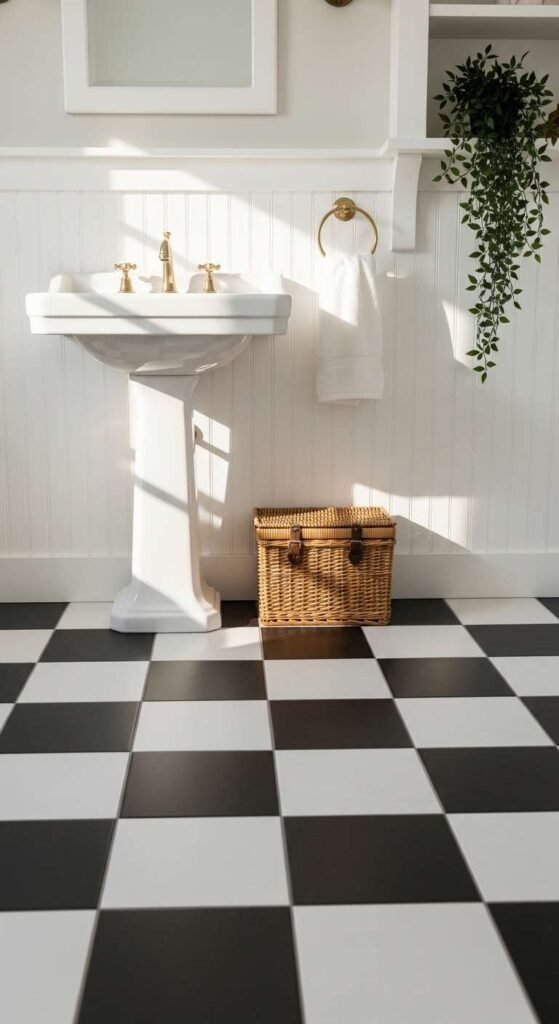
The right tile pattern can do as much storytelling as any antique or architectural detail in a cottage bathroom. And I mean that sincerely. A well-chosen tile — whether it’s a hand-painted Talavera, a classic black and white checkerboard, a soft subway tile laid in a herringbone pattern, or encaustic cement tiles with a faded floral motif — carries the entire visual narrative of the room on its surface.
For cottage style in American homes, these are the patterns I return to most consistently:
- Black and white checkerboard floors in 4×4 or 6×6 inch tiles — timeless, graphic, and genuinely period-correct for homes built between 1900 and 1950
- Handmade-look subway tiles with slight variation in surface texture and color — far more interesting than perfectly uniform factory tiles
- Encaustic cement tiles in muted geometric or floral patterns for a European cottage feel that works beautifully in older American craftsman homes
I used a checkerboard floor in a recent bathroom project — Edward Martin’s marble-look porcelain in a classic black and white pattern — and it anchored the entire cottage scheme more powerfully than anything else in the room. The homeowner told me six months later that she still smiles every time she walks in.
One thing to watch out for is scale. In a very small bathroom, large bold tile patterns can overwhelm the space and make it feel busy rather than charming. A general rule I follow: the smaller the room, the smaller or simpler the tile pattern. Save the large dramatic encaustic tiles for bathrooms with at least 60 to 70 square feet of floor space.
19. Soft Natural Lighting
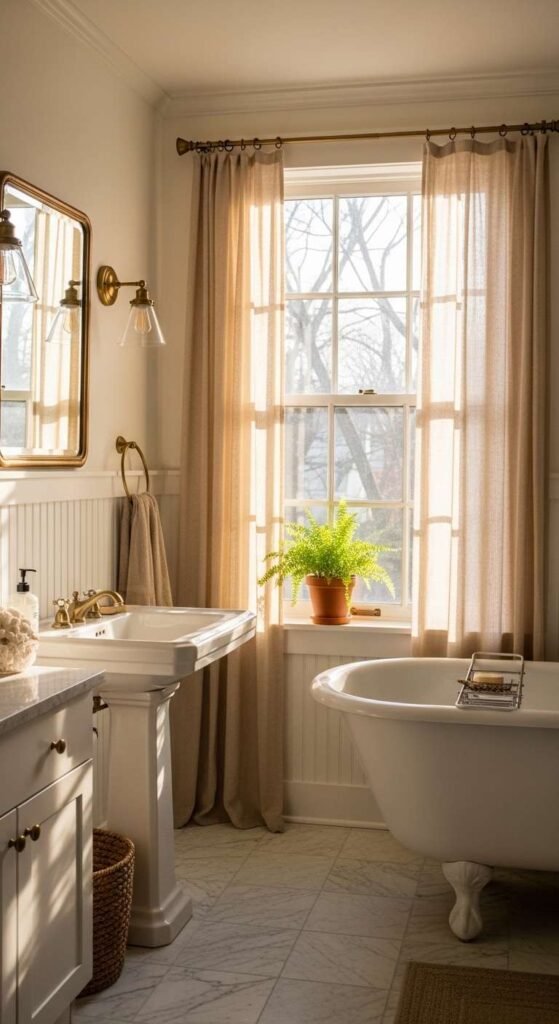
Natural light in a cottage bathroom is something worth protecting fiercely and enhancing thoughtfully. I’ve walked into stunning cottage bathroom renovations that felt oddly flat and lifeless — and nine times out of ten the culprit was lighting. Either the window was covered too heavily, the artificial lighting was too cool in color temperature, or both. Getting light right in a cottage bathroom isn’t complicated, but it does require intention from the start.
If your bathroom has even one window, treat it as your greatest asset. A simple white linen Roman shade or a set of cafe-style shutters that cover only the bottom half of the window gives you privacy without sacrificing that gorgeous wash of natural light across the walls. I used cafe shutters in a cottage bathroom project in coastal Maine and the way the afternoon light came through the upper glass and landed on the white beadboard walls was genuinely beautiful — soft, warm, and constantly shifting through the day.
For rooms with no windows or very limited natural light, the solution is layered artificial lighting that mimics natural warmth. Always choose bulbs in the 2700K to 3000K color temperature range — anything cooler starts to feel clinical and harsh. Combine an overhead source with side-mounted vanity sconces and you eliminate the flat, shadowless quality that makes windowless bathrooms feel so uninspiring.
One thing to watch out for is the temptation to over-curtain a cottage bathroom window in the name of charm. Heavy drapes and layered valances can look beautiful in a larger space but in a small cottage bathroom they eat light and make the room feel smaller and darker than it needs to be. Keep window treatments light, simple, and sheer wherever possible.
20. Vintage Storage Cabinets
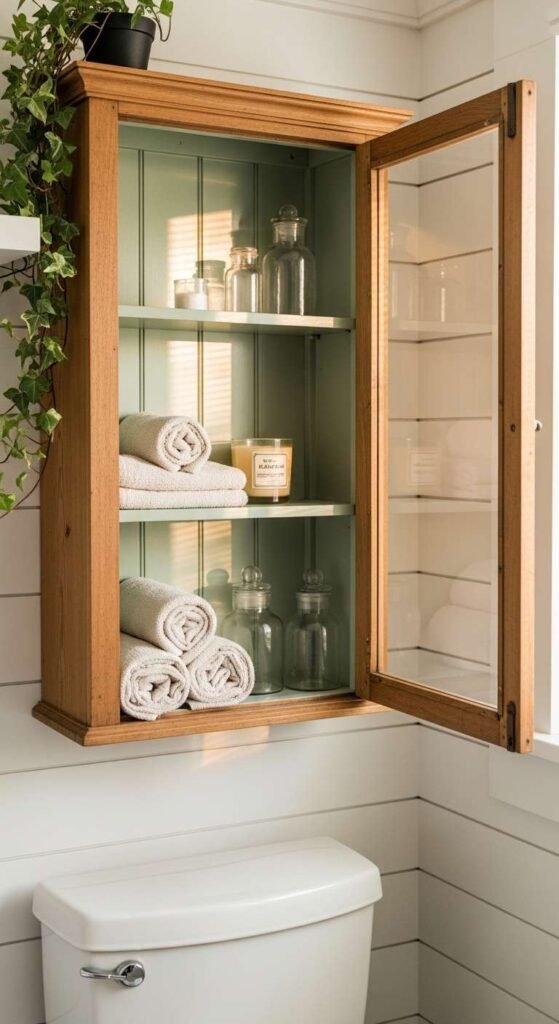
Storage is the unglamorous backbone of every successful bathroom design, and in a cottage space the challenge is making that storage feel like part of the story rather than an afterthought. A standard white medicine cabinet or a builder-grade linen closet insert will never do that. But a vintage apothecary cabinet, a repurposed kitchen hutch, or an antique pie safe mounted above the toilet? Those pieces earn their place in a cottage bathroom the moment they go up.
I love the above-toilet wall space in cottage bathrooms because most homeowners leave it completely empty or hang something forgettable there. It’s actually prime real estate. A small vintage cabinet with glass doors — the kind you find at estate sales for $30 to $80 — mounted securely to the wall above the toilet provides meaningful storage for extra towels, toiletries, and candles while adding a genuine piece of character to the room.
A quick trick I’ve used on several projects: paint the interior back panel of a glass-front cabinet in a contrasting color — a soft sage green inside a white cabinet, or a dusty blue inside a natural wood piece. It’s a tiny detail that looks intentional and considered and costs nothing beyond a small amount of leftover paint.
One thing to watch out for is weight and wall anchoring. Vintage cabinets are often heavier than they look, particularly older solid wood pieces. Always anchor into wall studs rather than drywall anchors alone, and if you have any doubt about the structural integrity of an antique piece, have a carpenter reinforce the back panel before mounting. A cabinet that falls off a bathroom wall is a genuine safety hazard.
21. Soft Green Cottage Tones
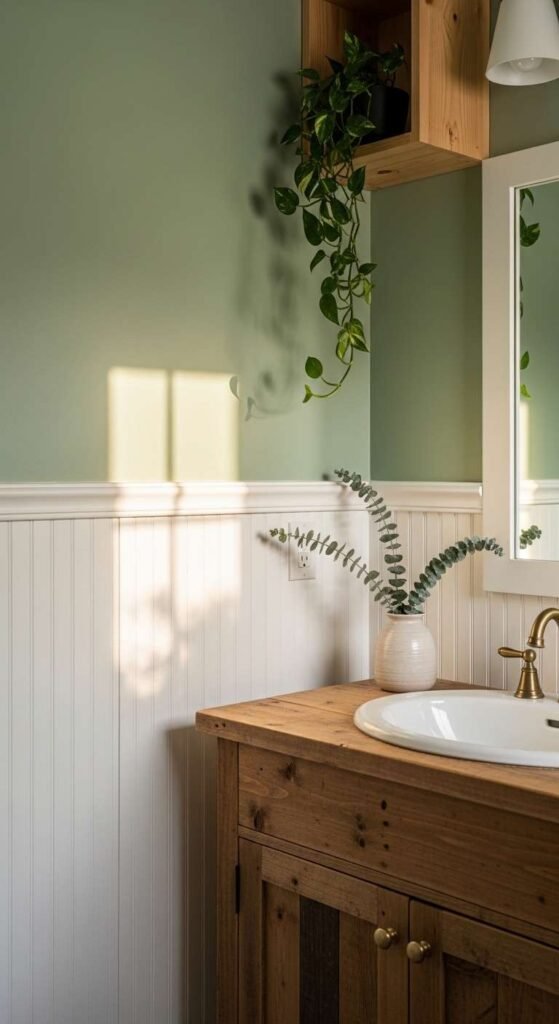
Green is having a genuine moment in American interior design right now, and cottage bathrooms are where it looks most completely at home. Not the bright, saturated greens of a bold maximalist scheme — I’m talking about the soft, dusty, nature-adjacent greens that feel like you bottled the color of a shaded garden just after rain. Sage, eucalyptus, moss, celadon, willow. These tones bring an organic calm to a bathroom that no other color family quite matches.
I’ve used soft green in cottage bathrooms more than any other color over the past several years, and the results are consistently stunning. My current favorites for US clients are Sherwin-Williams Wandering Willow, which reads warm and herbal in natural light, and Benjamin Moore’s Saybrook Sage, which has just enough grey in it to feel sophisticated rather than sweet. Both play beautifully with unlacquered brass hardware, natural wood vanities, and white beadboard.
One thing to watch out for is undertones. Green paint can shift dramatically depending on your light source. A color that looks perfectly muted and serene in the paint store can read almost yellow in a south-facing bathroom or distinctly blue-grey in a north-facing one. Always test a large swatch — at least 12 by 12 inches — on your actual wall and live with it through a full day before committing. That one extra step has saved my clients from expensive repaints more times than I can count.
If budget wasn’t a factor at all, which single splurge from this list would you choose first — the clawfoot tub, the stone flooring, the exposed wood beams, or the antique vanity conversion?
22. Vintage Ladder Towel Rack
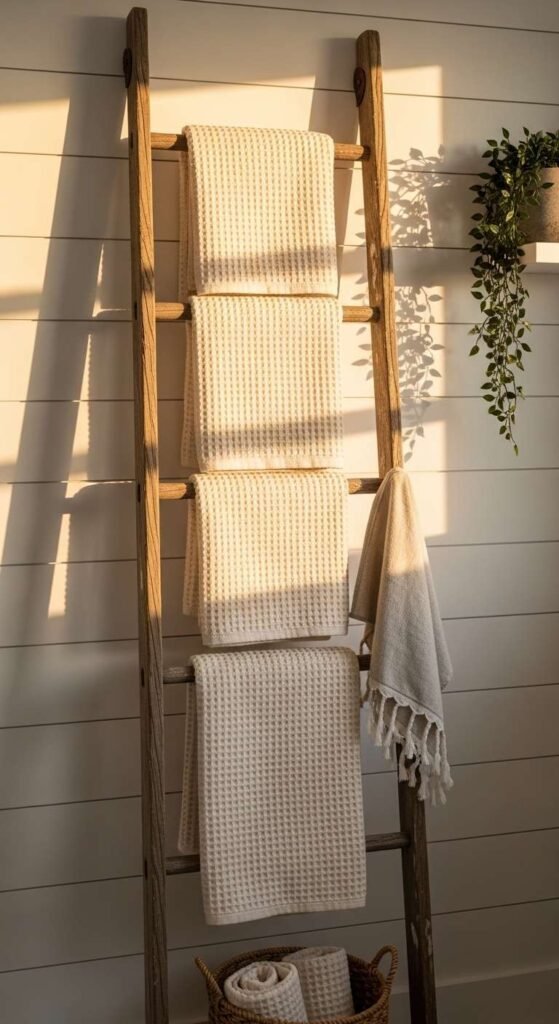
The vintage ladder towel rack is one of those cottage bathroom ideas that manages to be completely practical and genuinely beautiful at the same time — which in my experience is a combination worth celebrating whenever you find it. A simple wooden ladder leaned against the wall or mounted at a slight angle takes up almost no floor space, holds four to six towels comfortably, adds instant vertical visual interest, and costs next to nothing if you source it right.
I found a weathered oak ladder at a barn sale in rural Virginia for $18. Sanded it lightly, applied a single coat of dark walnut stain, let it dry overnight, and leaned it in the corner of a client’s cottage bathroom the following morning. It looked like it had always been there. That’s the magic of this particular idea — it has zero pretension. It’s just a ladder doing its job beautifully.
For a slightly more refined version, consider a wall-mounted teak or bamboo ladder with evenly spaced rungs — several Etsy makers produce these in custom sizes for under $120. If you want to go full DIY, a simple pine ladder built from 1×3 boards with wooden dowel rungs can be assembled in an afternoon for under $25 in materials.
One thing to watch out for is stability. A leaning ladder in a household with young children or pets needs to be secured to the wall with a simple hook-and-eye mechanism at the top. An unsecured ladder that tips forward onto a child is a serious safety concern, and it’s a five-minute fix that too many people skip because the ladder looks better without visible wall hardware.
23. Cozy Window Nooks
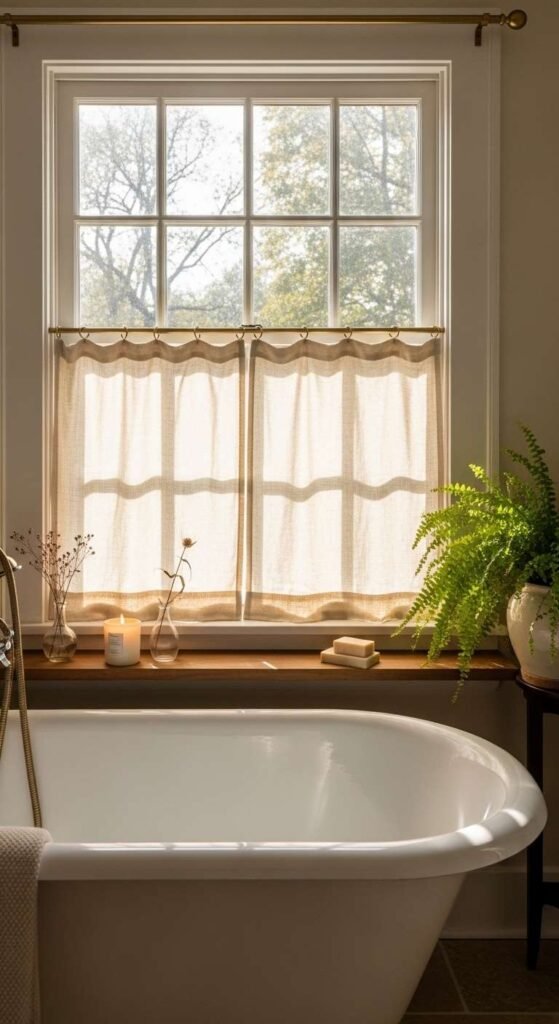
A window nook in a cottage bathroom is one of those architectural gifts that some homes have and others have to create — and either way, it’s worth every bit of effort. There is something deeply satisfying about a clawfoot tub positioned directly beneath a window, or a small upholstered bench tucked into a bay window alcove where you can sit and dry off in a patch of morning sunlight. These moments of deliberate coziness are exactly what separates a cottage bathroom from every other style.
If your bathroom already has a window positioned above or beside the tub, you’re halfway there. Dress it simply — cafe curtains on a brass rod, or a Roman shade in natural linen that you can raise fully during your soak. Add a small tray on the windowsill with a candle, a bud vase, and a bar of good soap. That’s it. The window does the rest.
For bathrooms without a natural nook, I’ve created the feeling architecturally on several projects using these approaches:
- Building a simple window seat platform beside an existing window using plywood and a custom cushion in an indoor-outdoor fabric
- Adding deep window casing and a wide sill to an existing window to create a functional ledge wide enough for plants and candles
- Positioning a freestanding tub near the window even if it isn’t directly beneath it — the visual connection to the outside is enough to create that nook feeling
One thing to watch out for is privacy. A beautiful window nook loses all its charm if you feel exposed every time you use it. Frosted window film applied to the lower half of the glass is my preferred solution — it’s inexpensive, removable, looks clean and intentional, and maintains full light transmission while providing complete privacy from street level.
24. Cottage Bathroom with Floral Accents
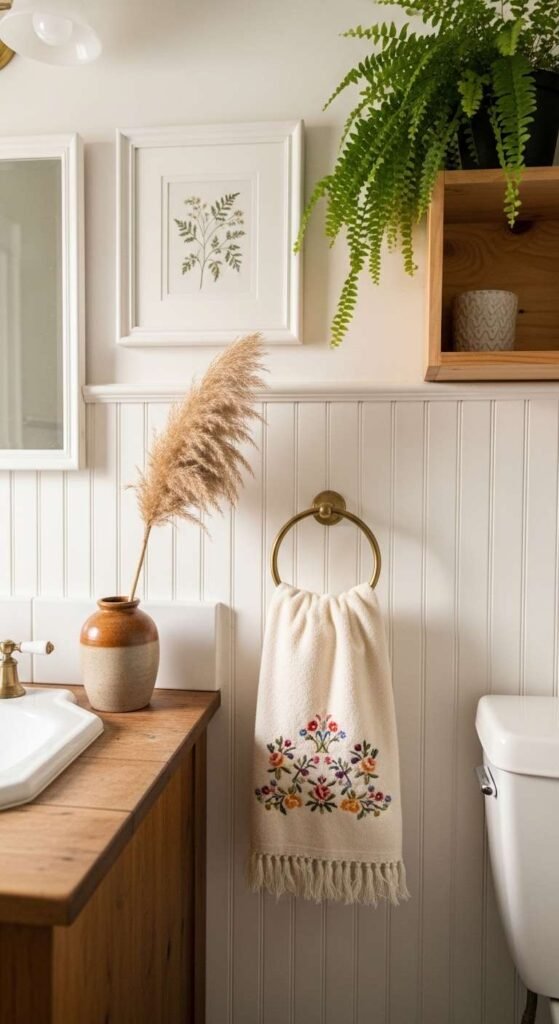
Floral accents are the finishing touch that pulls a cottage bathroom from nicely decorated into genuinely enchanting. And I want to be clear about what I mean by accents here — I’m not talking about going full English garden on every surface. I mean the considered, restrained use of floral motifs and actual botanicals that give the room its final layer of life and personality without tipping into fussiness.
The most effective floral accents I use in cottage bathrooms tend to be small in scale but high in placement. A single stem of dried pampas grass in a stoneware vase on the vanity. A framed botanical print above the toilet in a simple white frame. A floral embroidered hand towel folded neatly on the edge of the tub. A small potted trailing plant — pothos, ivy, or string of pearls — on a high shelf where it catches the light and softens the corner.
Real plants deserve a special mention here because they do something no artificial floral accent can replicate — they bring genuine life into the room. Bathrooms with natural light and adequate humidity are actually wonderful environments for certain plants. My top recommendations for cottage bathrooms specifically are:
- Pothos — nearly indestructible, trails beautifully from shelves
- Boston fern — loves humidity, looks deeply cottage and lush
- Peace lily — thrives in low light and filters bathroom air naturally
One thing to watch out for is the line between charming and cluttered. Floral accents work because they’re selective. The moment every surface has a floral element competing for attention the room stops feeling curated and starts feeling chaotic. My rule is simple: choose three floral accent points in the room and stop there. Let those three moments breathe, and the overall effect will be far more powerful than a dozen competing details ever could be.
Your 2 Minute Cottage Bathroom Decision Map
By Budget
Cottage on a Budget (Under $500)
- Swap your shower curtain for floor-length linen
- Paint beadboard in Sherwin-Williams Wandering Willow
- Source a vintage mirror from Facebook Marketplace or estate sales
- Add wicker baskets and a ladder towel rack for instant charm
- Refresh hardware with unlacquered brass pulls and hooks
Cottage Investment Piece ($500 and Above)
- Install a genuine clawfoot tub with professional reglazing
- Lay encaustic cement or natural travertine stone flooring
- Commission a dresser-to-vanity antique conversion with vessel sink
- Add exposed wood beams using reclaimed barn timber
- Fit an apron-front fireclay farmhouse sink with custom vanity base
By Lifestyle
Busy Families with Kids and Pets
- Choose honed stone or porcelain tile over polished surfaces
- Skip white grout — go warm grey or sand tone instead
- Avoid delicate linen curtains near the shower splash zone
- Mount ladder towel racks securely to the wall — always
- Keep open shelving simple and high, out of little hands’ reach
Empty Nesters and Slow Living Enthusiasts
- Invest in the clawfoot tub — you’ll actually use it
- Layer floral wallpaper with botanical prints and real plants
- Create a genuine window nook beside the tub for morning light
- Go full vintage with antique mirrors, brass hardware, and aged wood
- Let the room be a little indulgent — you’ve earned it
Frequently Asked Questions
What makes a bathroom look like a cottage style?
The core elements are natural materials, vintage-inspired fixtures, and layered textures. Think beadboard walls, a clawfoot tub, unlacquered brass hardware, and soft linen textiles working together.
How much does a cottage bathroom renovation cost in the USA?
The average cost runs $2,500 to $8,000 depending on scope. DIY-heavy projects with salvaged pieces can come in well under $3,000 while full fixture replacements push toward the higher end.
What colors work best for a cottage bathroom?
Soft whites, sage greens, and dusty pastels are your safest bets. Sherwin-Williams Wandering Willow and Benjamin Moore Saybrook Sage are two I recommend constantly to clients across the US.
Can I achieve cottage style in a small bathroom?
Yes, and honestly small bathrooms suit cottage style better than large ones. Vertical shiplap, a pedestal sink, a leaning ladder rack, and one strong wallpaper wall can completely transform even a 40-square-foot space.
What flooring is best for a cottage bathroom?
Honed travertine, tumbled marble, or a classic black and white checkerboard porcelain tile all work beautifully. Avoid high-gloss finishes — they show every water spot and feel too polished for the cottage aesthetic.
Conclusion
Your cottage bathroom doesn’t need a massive budget or a complete gut renovation to feel like a completely different space. Pick one idea from this list — just one — and act on it this week. Order that linen shower curtain, grab a paint sample of Wandering Willow, or spend a Saturday morning at your local estate sale hunting for the perfect vintage mirror. I promise you, that first small step has a way of snowballing into the bathroom you’ve always wanted. So tell me — which of these 24 cottage bathroom ideas are you starting with, and are you working with a tight budget or ready to make a bigger investment?