
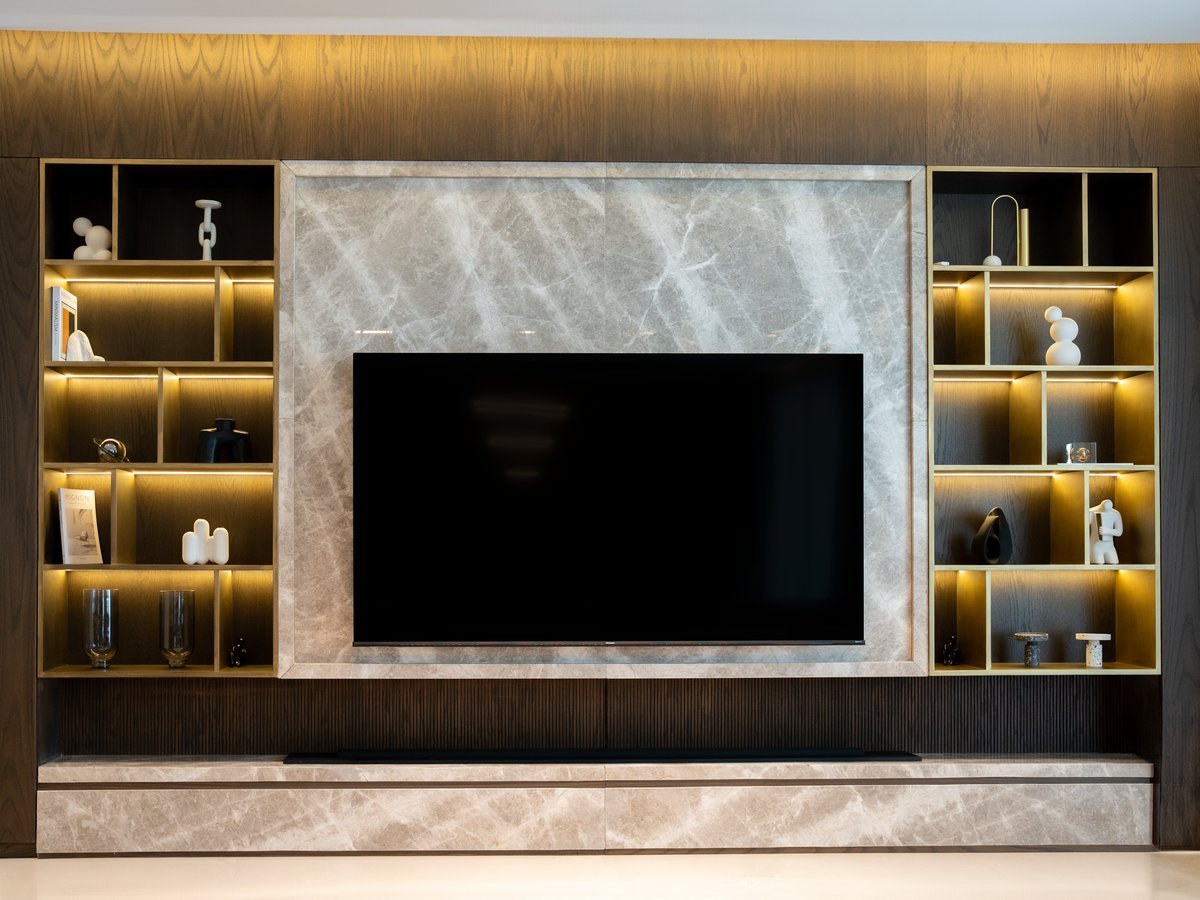
The TV wall is the hardest-working wall in the house, yet most living rooms treat it as an afterthought — a screen on a stand, a tangle of cables, and nothing else. These living room tv wall ideas fix that. Whether you want a full built-in media wall or a paint-only weekend project, the best living room tv wall ideas combine three things: the screen at the right height, cables you never see, and styling that makes the TV look intentional even when it is off.
Below are 40 living room tv wall ideas in six groups — panels, built-ins with smart storage, floating setups, gallery styling, fireplace combos, and renter-friendly options. Every idea lists style, effort, and cost, and the guide ends with a mounting-height guide, a planning checklist, and an FAQ.
Quick-Pick Table
Short on time? Scan the table, note the numbers you like, and jump straight to them. Every one of these living room tv wall ideas is detailed in full below.
| Idea # | Name | Style | Effort | Cost |
|---|---|---|---|---|
| 1 | Wood Slat Accent TV Wall | Warm modern | Moderate | $$ |
| 2 | Fluted & 3D Panel TV Wall | Contemporary | Moderate | $$ |
| 3 | Board-and-Batten TV Wall | Transitional | Moderate | $ |
| 4 | Picture-Frame Moulding TV Wall | Classic | Easy | $ |
| 5 | Stone Slab TV Feature Wall | Natural luxe | Hard | $$$ |
| 6 | Marble-Look Porcelain Panel Wall | Luxe modern | Hard | $$$ |
| 7 | Limewash & Plaster TV Wall | Soft organic | Easy | $ |
| 8 | Wallpaper Backdrop TV Wall | Patterned | Easy | $ |
| 9 | Full-Wall Built-In Media Wall | Custom joinery | Hard | $$$ |
| 10 | Symmetrical Shelving Towers | Balanced classic | Moderate | $$ |
| 11 | Closed Cabinets Below the Screen | Clean storage | Moderate | $$ |
| 12 | Alcove & Chimney-Breast Media Unit | Period-smart | Moderate | $$ |
| 13 | Hidden Cable Management System | Invisible tech | Easy | $ |
| 14 | Media Wall With a Desk Nook | Work-from-home | Moderate | $$ |
| 15 | Low Credenza Wall | Mid-century | Easy | $$ |
| 16 | Corner Media Unit | Space-saving | Easy | $ |
| 17 | Floating Console TV Wall | Minimalist | Moderate | $$ |
| 18 | Floating Back Panel With LED | Sleek modern | Moderate | $$ |
| 19 | Frame TV Art Look | Gallery disguise | Easy | $$$ |
| 20 | Sliding & Concealed Panel TV Wall | Hidden screen | Hard | $$$ |
| 21 | Dark Accent Backdrop Wall | Moody cinema | Easy | $ |
| 22 | Cable-Free Minimalist TV Wall | Ultra minimal | Easy | $ |
| 23 | TV on an Easel Stand | Studio style | Easy | $$ |
| 24 | Art Cluster Around the Screen | Eclectic gallery | Easy | $ |
| 25 | Picture Ledges Flanking the TV | Layered | Easy | $ |
| 26 | Shelves-and-Art Mix | Collected | Easy | $ |
| 27 | Mirror & Sconce Framing | Elegant | Moderate | $$ |
| 28 | Plant-Framed TV Wall | Biophilic | Easy | $ |
| 29 | Symmetrical Decor Pairs | Formal balance | Easy | $ |
| 30 | TV Above the Fireplace | Classic combo | Moderate | $$ |
| 31 | Side-by-Side Fireplace & TV | Dual focal | Moderate | $$ |
| 32 | Electric Fireplace Media Wall | Modern insert | Moderate | $$ |
| 33 | Linear Fireplace Under the TV | Contemporary | Hard | $$$ |
| 34 | Mantel Styling With a TV | Decorated hearth | Easy | $ |
| 35 | Paint-Only Feature Wall | Colour block | Easy | $ |
| 36 | Peel-and-Stick Panel Wall | Faux texture | Easy | $ |
| 37 | No-Drill TV Stand Wall | Renter basic | Easy | $ |
| 38 | Flat-Pack Media Unit Hack | Budget custom-look | Moderate | $ |
| 39 | Fabric & Curtain Backdrop | Soft layered | Easy | $ |
| 40 | LED Backlight Glow Wall | Ambient tech | Easy | $ |
Panelled & Textured TV Walls
Texture makes a screen look designed rather than parked. These eight living room tv wall ideas wrap the TV in wood, stone, plaster, or pattern — and most hide cables behind the finish, half the battle won before you style a single shelf.
1. Wood Slat Accent TV Wall
Style: Warm modern | Best for: Contemporary and Scandi living rooms | Price feel: Mid-range
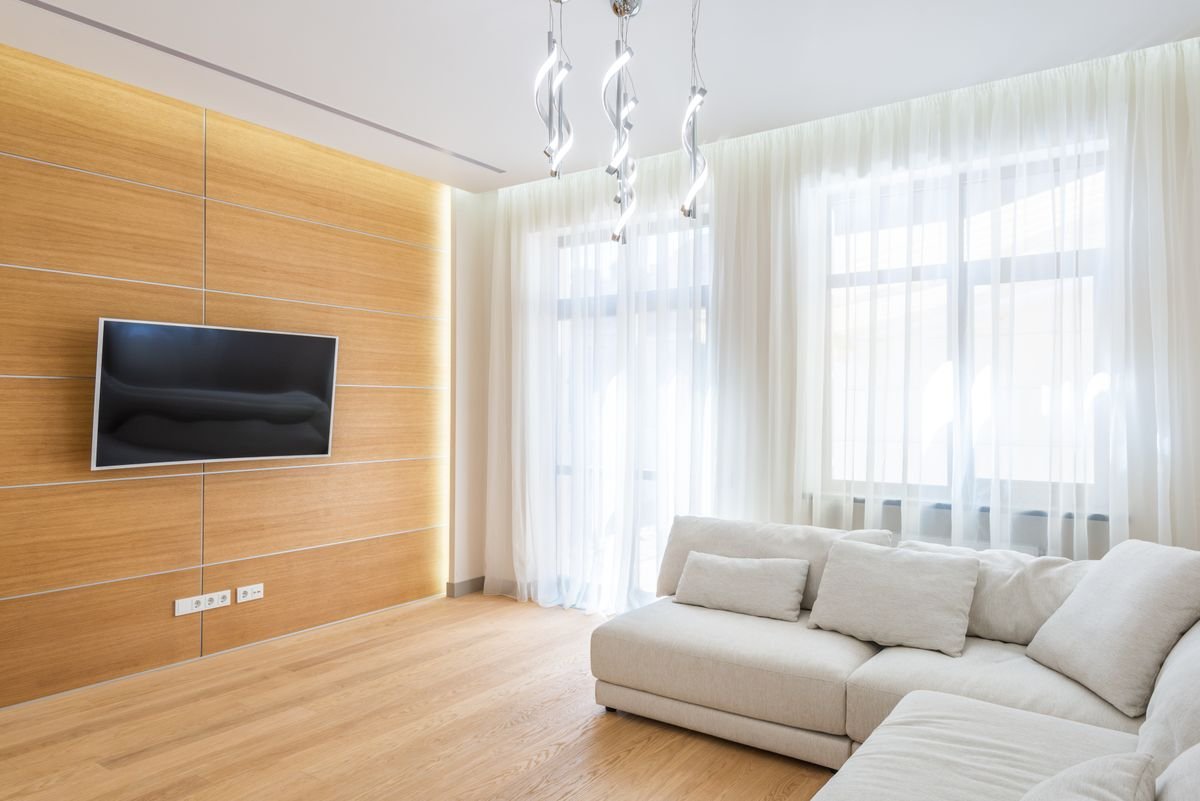
What it is: Vertical timber slats — oak, walnut, or felt-backed acoustic panels — run floor to ceiling behind the screen. In the photo, the mounted TV sits flat against a wooden wall and the grain does all the decorating. Of all the living room tv wall ideas in this guide, slats are the most searched for a reason: they add architecture, soften echo, and hide every cable behind the battens.
How to do it:
- Cover the full wall, or a panel 12–20 inches wider than the TV
- Fix battens first, and run cables inside the cavity before cladding
- Mount the TV bracket through the slats into the studs — never into slats alone
- Keep the screen center about 42 inches from the floor for seated viewing
- Finish raw timber with matte hardwax oil so fingerprints wipe off easily
Pro tip: Acoustic slat panels with felt backing calm an echoey open-plan room — style and sound treatment in one.
Avoid this: Avoid high-gloss finishes on slats; they reflect the screen and cheapen the look instantly.
2. Fluted & 3D Panel TV Wall
Style: Contemporary texture | Best for: Modern apartments and new-builds | Price feel: Mid-range
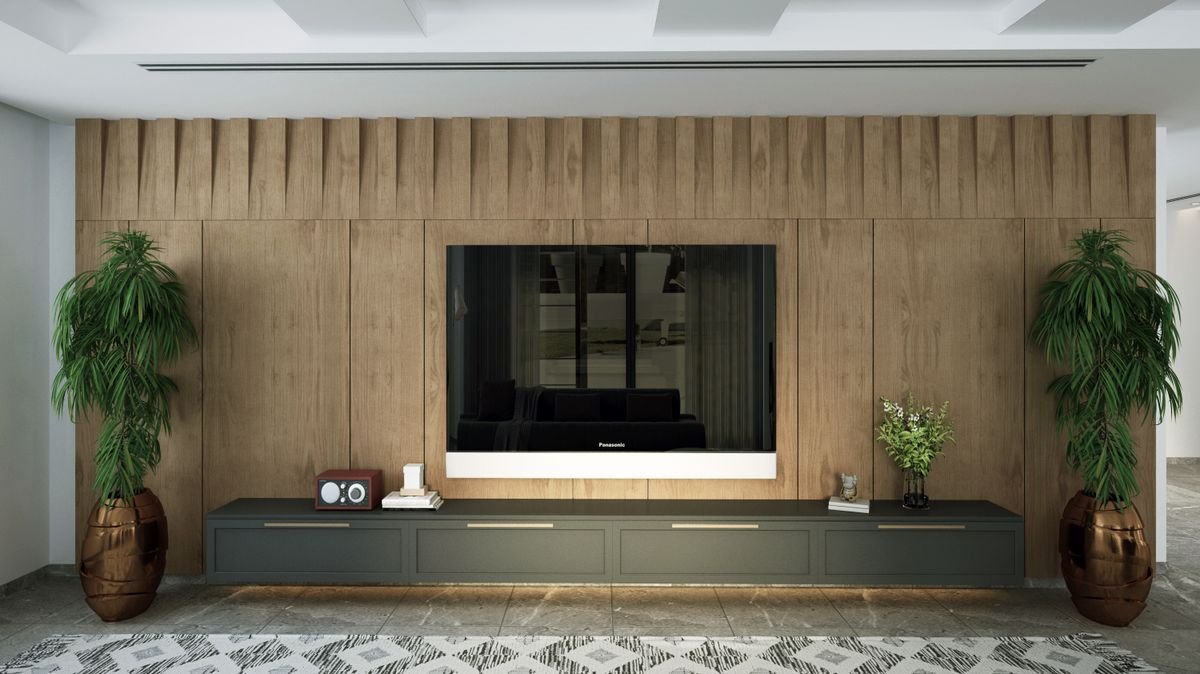
What it is: Fluted MDF, PVC, or gypsum panels with narrow vertical grooves — or geometric 3D panels — turn a flat wall into a ridged backdrop. The photo shows how a ribbed wooden wall makes a plain black screen look like architecture. It is one of the most forgiving living room tv wall ideas: panels come in standard sheets and glue or screw straight over an ugly wall.
How to do it:
- Choose panel width so no groove line lands behind the screen edge
- Paint panels before hanging the TV — grooves are miserable to paint around a screen
- Fix the bracket through the panel into studs
- Add a shadow gap or slim trim where the panel run ends
Pro tip: Run fluting only behind the TV and console — a defined panel reads as furniture, not cladding.
Avoid this: Avoid busy 3D patterns on a wall that also holds art and shelves; texture plus clutter fights the screen.
3. Board-and-Batten TV Wall
Style: Transitional grid | Best for: Traditional and farmhouse-leaning rooms | Price feel: Budget
What it is: Thin battens fixed in a grid over drywall, then painted one colour with the wall, give flat rooms instant panelled character for the price of a few trim lengths. The TV hangs inside one grid rectangle, framed by the geometry. Painted deep green, navy, or warm white, it reads far more expensive than it is — perfect for the classic end of living room tv wall ideas.
How to do it:
- Plan the grid so one rectangle centers exactly where the screen will hang
- Use 2.5–3.5 inch wide MDF battens, glued and pinned, with every joint caulked
- Space battens 16–24 inches apart to echo the stud pattern for easy bracket fixing
- Paint wall, battens, and skirting in one finish — satinwood hides seams best
Pro tip: A shiplap-style horizontal version works too — run boards horizontally behind the screen for a cottage feel with the same low cost.
Avoid this: Avoid glossy paint; it shows every batten seam and joint under TV light.
4. Picture-Frame Moulding TV Wall
Style: Classic elegance | Best for: Formal living rooms and period homes | Price feel: Budget
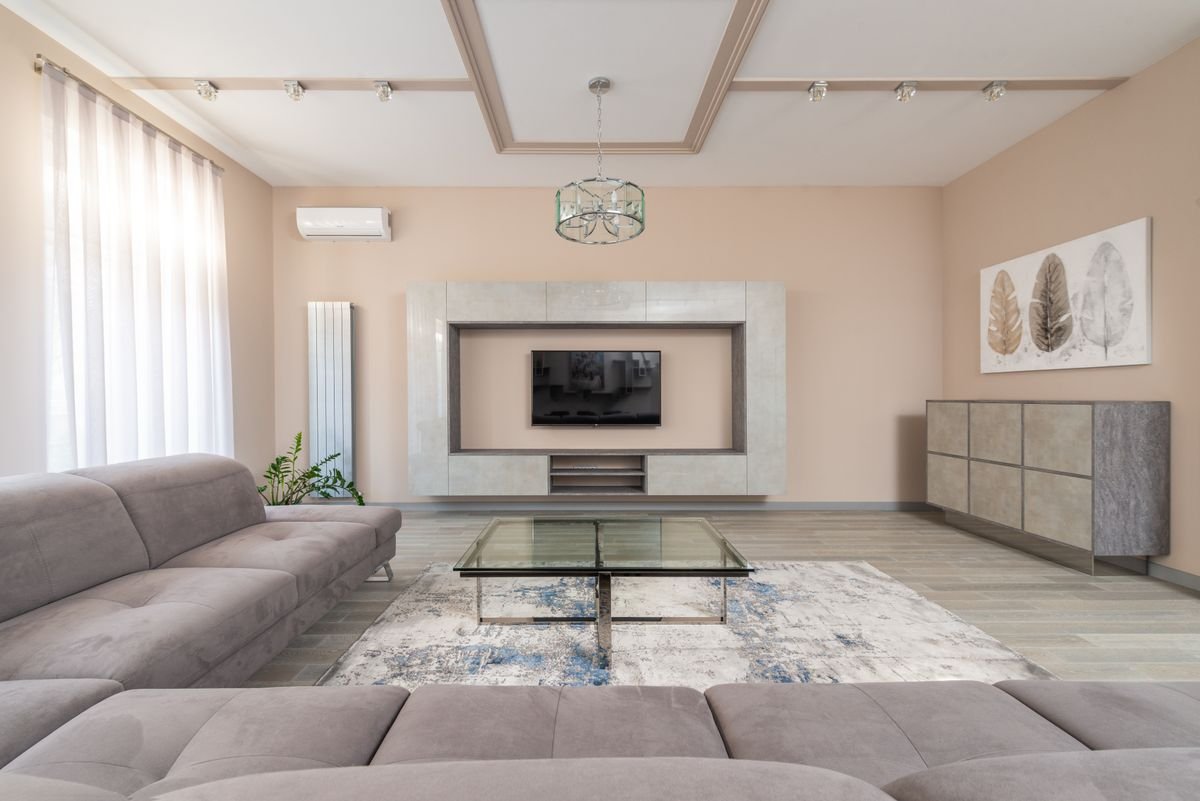
What it is: Decorative trim mouldings form flat rectangular “frames” on the wall — wainscoting’s language, applied at full height. One large frame outlines the TV; smaller matching frames balance the sides. In the photo, empty frames show how strong the effect is before the screen even goes up. It is among the cheapest living room tv wall ideas per square foot, and suits rooms where slats feel too modern.
How to do it:
- Size the central frame 6–10 inches larger than the TV on all sides
- Keep side frames level with the central frame’s top and bottom
- Use pre-primed moulding, mitre corners, and fill gaps
- Paint everything — wall, moulding, skirting — one colour for the panelled effect
Pro tip: Add a slim picture light or two sconces inside the side frames for instant evening elegance.
Avoid this: Avoid ornate moulding profiles in a small room — choose a slim, simple bead so the wall stays calm.
5. Stone Slab TV Feature Wall
Style: Natural luxe | Best for: Statement walls and open-plan spaces | Price feel: Premium
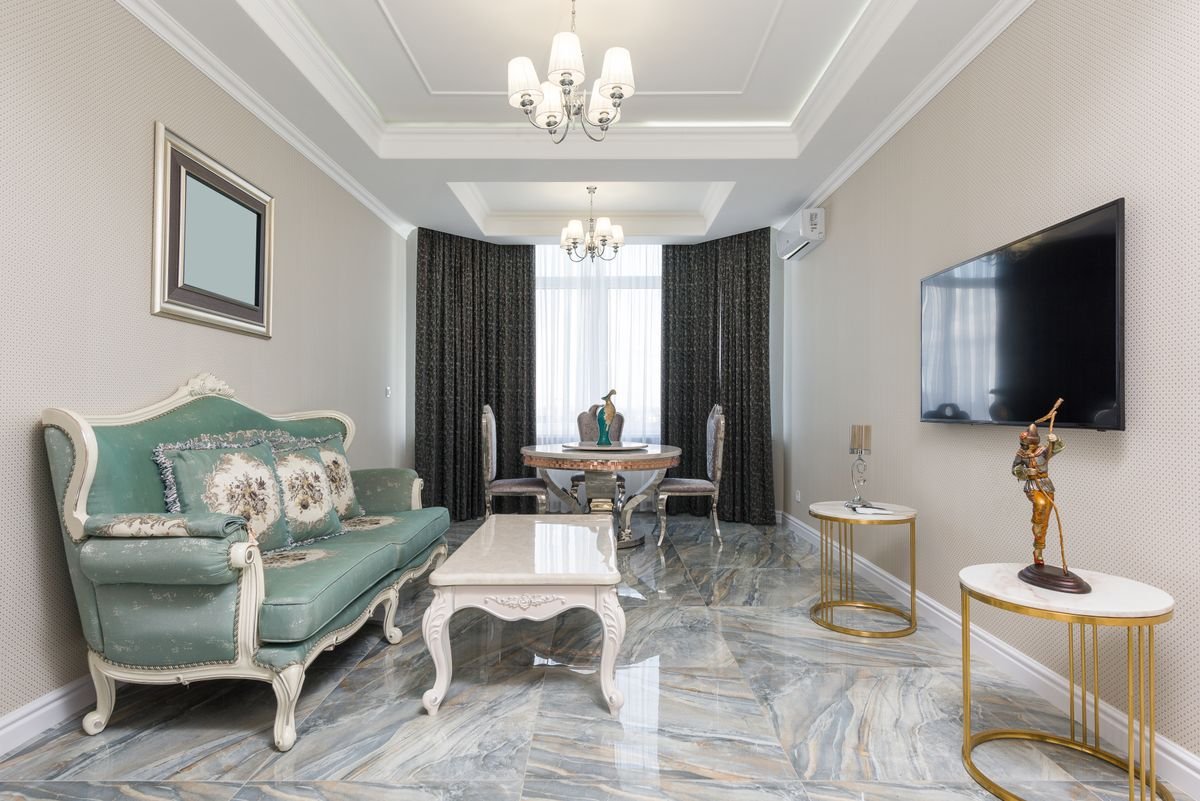
What it is: A full-height slab of travertine, slate, quartzite, or stone veneer turns the TV wall into the room’s landscape. The screen floats on it, and the texture carries the wall with zero extra decor. In the photo, a stone fireplace wall with a mounted TV shows the effect at hearth scale. Stone is the heavyweight of living room tv wall ideas — literally — so structure matters more than styling here.
How to do it:
- Use stone veneer (about 1 inch thick) instead of full slabs on drywall partitions
- Fix the bracket to studs or masonry before the stone is fitted
- Pre-plan a recessed power and HDMI box behind the screen position
- Seal porous stone (travertine, slate) so dust and fingerprints lift off
Pro tip: Book-matched veneer panels, where the grain mirrors at the seam, give a boutique-hotel finish for less than solid slab.
Avoid this: Avoid drilling into fitted stone to move a bracket later — measure twice, because stone does not forgive.
6. Marble-Look Porcelain Panel Wall
Style: Luxe modern | Best for: Glossy, hotel-style interiors | Price feel: Premium
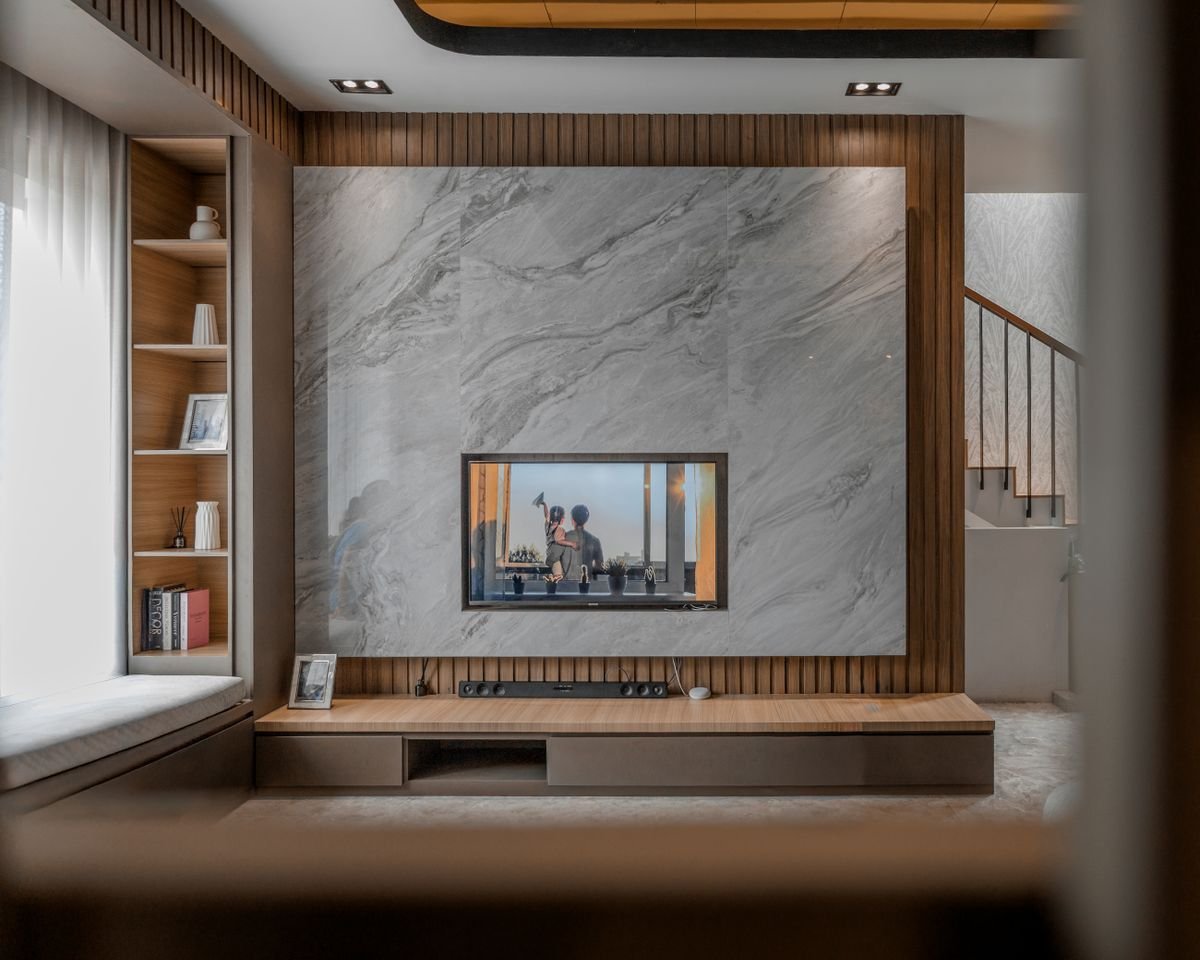
What it is: Large-format porcelain slabs printed with marble veining give you the marble wall without the weight or price. Panels run floor to ceiling, often book-matched so veins mirror across the screen. The photo’s marble wall with a large TV is exactly the look. Among luxury living room tv wall ideas, porcelain wins on maintenance too: it never needs sealing and wipes clean.
How to do it:
- Use large slabs (48×96 inches or more) to keep grout lines off the screen
- Hire a tiler experienced with large-format panels
- Set the bracket and cable box before tiling, tiles cut around them
- Choose a matte or satin finish to keep screen reflections down
Pro tip: Continue the same porcelain onto a low media console top for a joined-up, custom look.
Avoid this: Avoid high-gloss polished panels opposite a window — daytime glare will fight every programme.

7. Limewash & Plaster TV Wall
Style: Soft organic | Best for: Calm, earthy, Mediterranean-leaning rooms | Price feel: Budget
What it is: Two coats of limewash or a trowelled plaster finish give the TV wall a cloudy, hand-made texture. No panels, no joinery — just a big brush and a weekend. The photo’s light, soft-toned living room shows how gentle the effect is behind a screen. It pairs beautifully with linen sofas and pale wood.
How to do it:
- Apply limewash in loose X strokes with a block brush, wet edge to wet edge
- Use two coats in slightly different tones for depth without pattern
- Mount the TV only after the finish cures (about 48 hours)
- Keep the palette warm — clay, sand, bone — so the black screen feels grounded
Pro tip: Limewash is re-paintable in a day; it is the lowest-commitment textured finish on this list.
Avoid this: Avoid Venetian plaster with a high sheen behind the screen — the polished patches reflect light unevenly.
8. Wallpaper Backdrop TV Wall
Style: Patterned backdrop | Best for: Plain boxes that need personality | Price feel: Budget
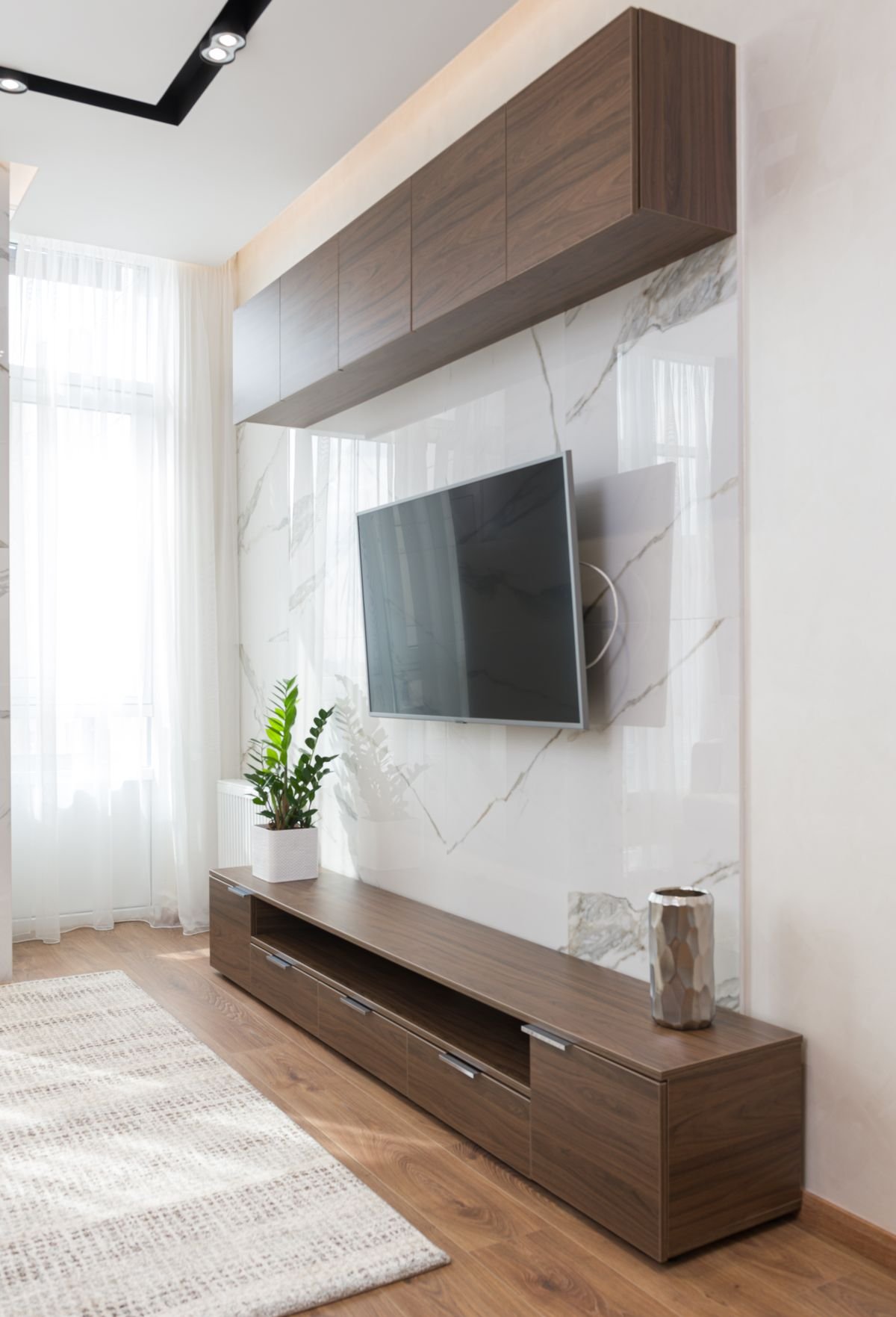
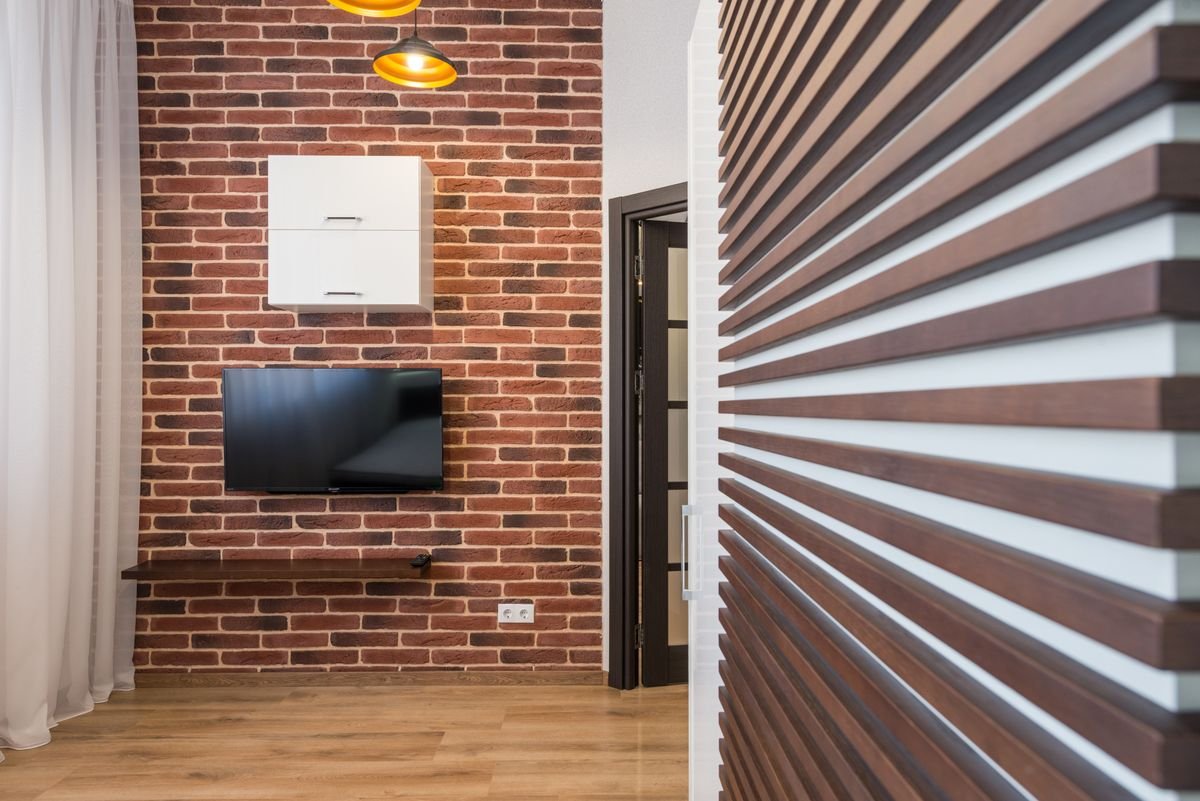
What it is: One wall of patterned or mural wallpaper behind the TV gives instant architecture to a blank room. The trick is scale: a large, calm pattern reads as texture from the sofa, while small busy prints vibrate against the screen. The photo’s brick-textured backdrop shows the principle — pattern behind, screen floating calmly in front. For patterned living room tv wall ideas, wallpaper is the fastest transformation there is.
How to do it:
- Choose large-scale or tonal patterns; test a sample for a day
- Paper the full wall, so edges land in corners, not mid-wall
- Hang paper before mounting; mark studs lightly in pencil first
- Pull one colour from the paper for cushions and a throw
Pro tip: Grasscloth adds texture and pattern together, and its matte fibres never reflect the screen.
Avoid this: Avoid metallic or foil papers directly behind the TV — they glitter in your peripheral vision all evening.
Built-In Media Walls & Smart Storage
If clutter is your real problem, joinery is the answer. These living room tv wall ideas build storage into the wall itself — closed cabinets for the mess, open shelves for the pretty things, a planned route for every cable — so the wall looks calm from every seat.
9. Full-Wall Built-In Media Wall
Style: Custom joinery | Best for: Family rooms with lots of gear | Price feel: Premium
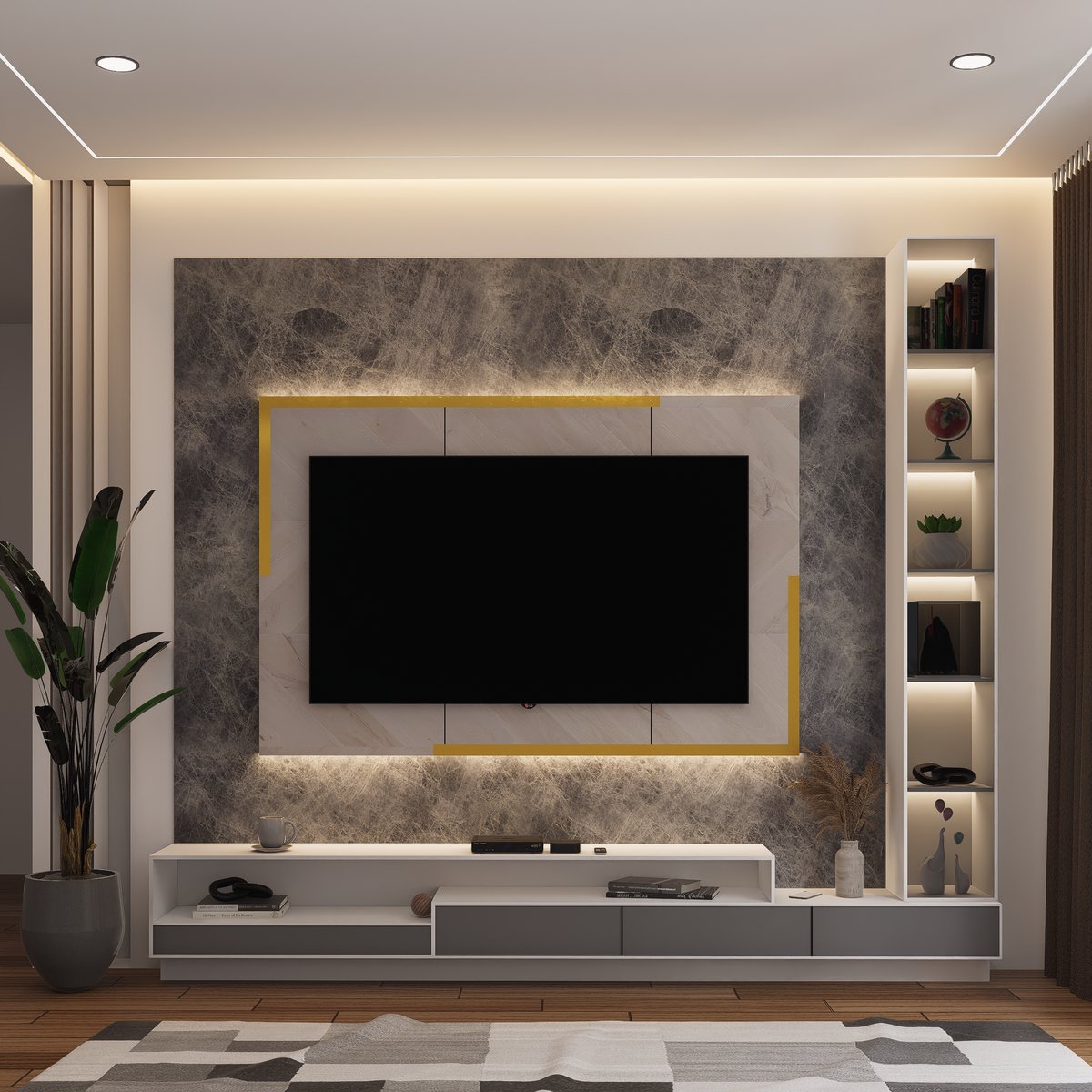
What it is: A carpenter-built wall of cabinets, shelves, and a central TV bay running the full width, often the full height, of the wall. Everything has a home: consoles, games, routers, and speakers. The photo’s LED-lit shelved wall shows the effect at its best. It is the flagship of living room tv wall ideas, and the one that adds real resale polish.
How to do it:
- Size the TV bay with 4 inches of clearance around a future 75-inch screen
- Put closed storage low (to about 30 inches), open shelves above
- Build in a cable chase and a ventilated cabinet for consoles — gear needs air
- Add 4–6 sockets inside the cabinet run so nothing plugs in visibly
- Paint built-ins the wall colour for a calm, architectural finish
Pro tip: LED strips under each shelf, on a dimmer, turn storage into an evening feature.
Avoid this: Avoid filling every open shelf; leave a third empty or the wall reads as storage, not design.
10. Symmetrical Shelving Towers
Style: Balanced classic | Best for: Centered fireplaces and formal layouts | Price feel: Mid-range
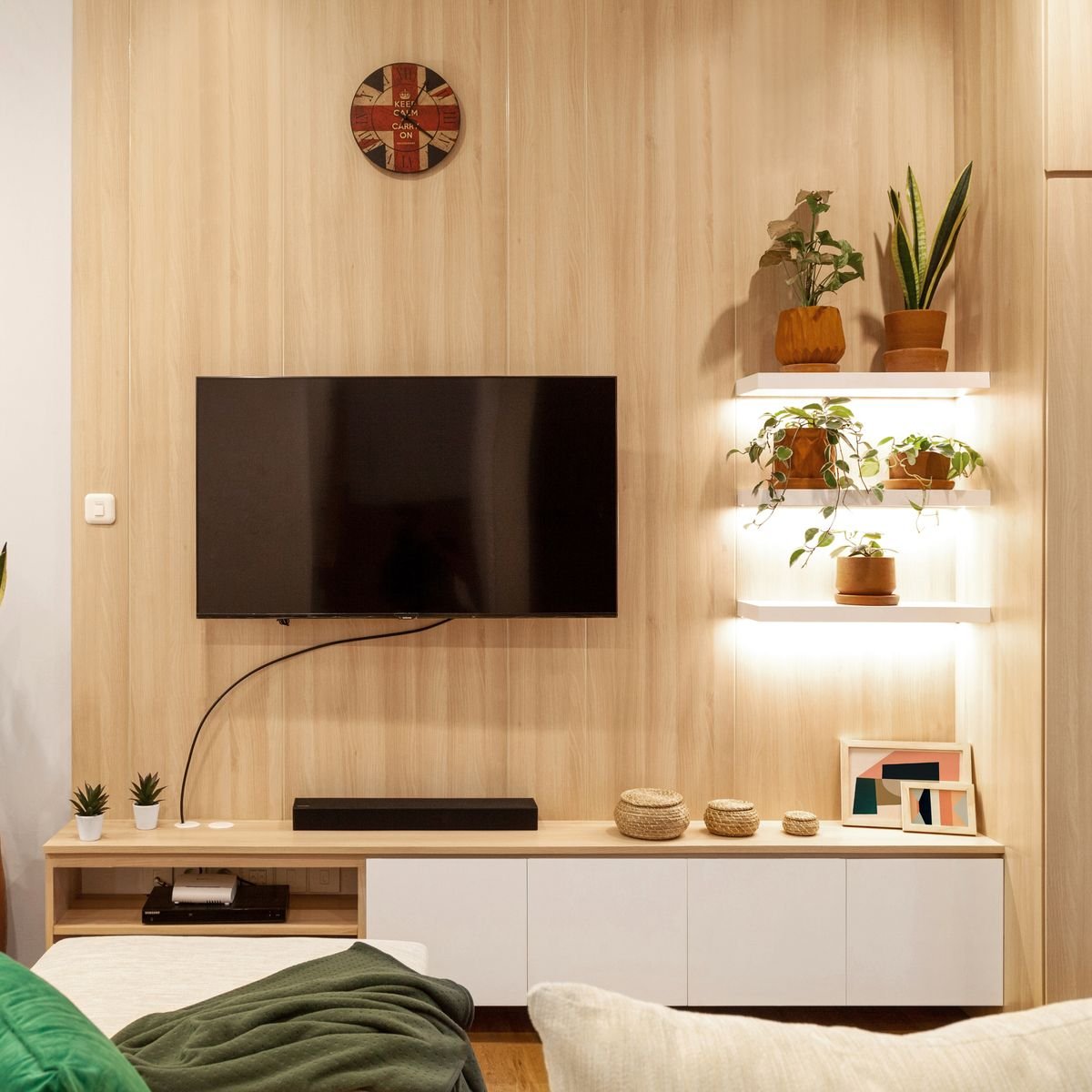
What it is: Two matching bookcases or shelf towers flank the screen in perfect balance. Built-in, flat-pack, or vintage — what matters is the mirror-image rhythm. In the photo, wooden shelves around a wall-mounted TV show the framing at work. Symmetry calms a wall full of rectangles better than any other arrangement.
How to do it:
- Keep towers the same width (24–36 inches) and finish
- Leave a 2–4 inch breathing gap between each tower and the screen edge
- Style both sides alike: books low, objects mid, one plant high
- Anchor tall towers to the wall studs — loaded shelves are top-heavy
Pro tip: A low cabinet bridging the towers under the TV unifies the whole arrangement.
Avoid this: Avoid towers taller than the picture rail or cornice line; they crowd the ceiling.
11. Closed Cabinets Below the Screen
Style: Clean storage | Best for: Minimalists with maximal stuff | Price feel: Mid-range
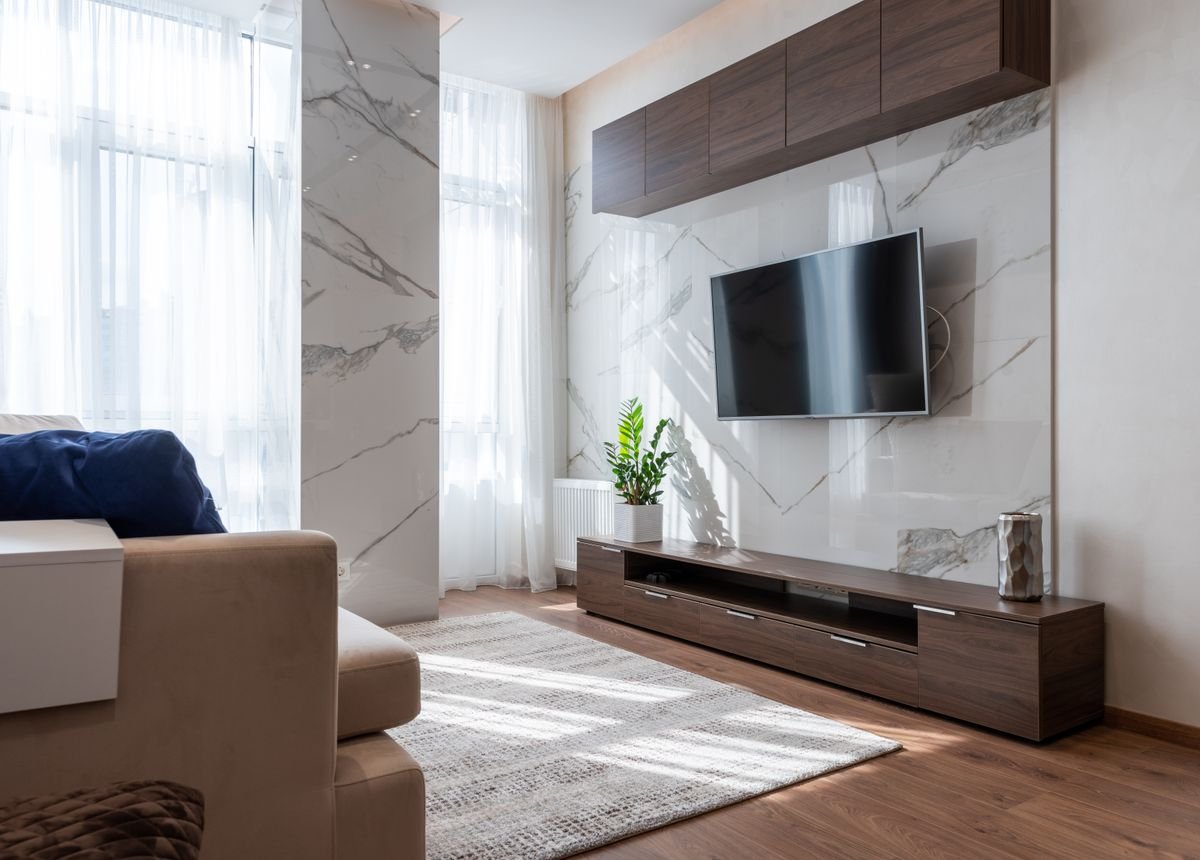
What it is: The screen hangs on a calm wall while closed cabinets beneath swallow every console, remote, and charger. Doors hide; the wall breathes. The photo — a TV between wooden cabinets, sofa opposite — shows how tidy it feels. Of all living room tv wall ideas, busy households rate this highest a year later: nothing ever needs “tidying” before guests arrive.
How to do it:
- Run cabinets 16–24 inches deep and at least the TV’s width
- Keep the TV bottom edge 4–6 inches above the cabinet top
- Choose a mesh-front door for the cabinet holding the media box
- Drill a cable port in the cabinet back and one behind the TV
Pro tip: Push-to-open doors keep the run looking like panelling, not furniture.
Avoid this: Avoid solid doors in front of infrared remotes’ receivers unless you add a repeater — the box will ignore you.
12. Alcove & Chimney-Breast Media Unit
Style: Period-smart | Best for: Victorian and Edwardian layouts | Price feel: Mid-range
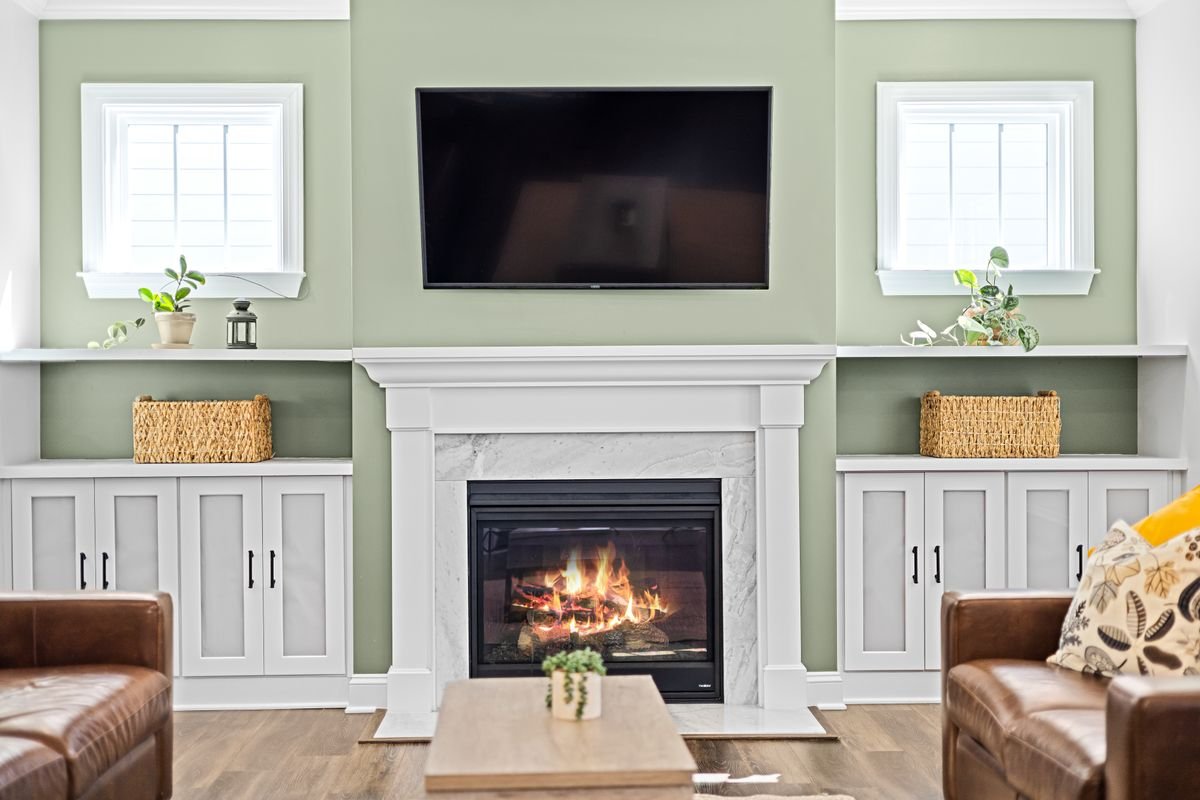
What it is: Period homes give you a chimney breast with an alcove each side — and most people waste all three. Mount the TV on the breast (or in an alcove on an articulated arm); fill the alcoves with shelves above, cupboards below. The photo’s fireplace-and-TV room shows the classic bones. The alcoves become libraries; the breast becomes the screen wall.
How to do it:
- Measure alcove depth (often 12–16 inches); size cupboards to sit flush
- Use chunky shelves in the alcoves, stained to match the floor
- If the TV sits on the chimney breast, check the heat guidance below
- Run power to the alcoves — period rooms rarely have sockets where you need them
Pro tip: Paint alcove backs a shade deeper than the walls; books and objects pop.
Avoid this: Avoid mounting into a chimney breast without checking the flue position — drill into brick, never into the flue void.
13. Hidden Cable Management System
Style: Invisible tech | Best for: Anyone whose cables currently dangle | Price feel: Budget
What it is: Not a look but the system behind every good-looking one: an in-wall cable kit or surface raceway carrying power and HDMI from screen to console, out of sight. In the photo, a clean minimalist wall with a mounted TV shows the result — no wires, anywhere. Treat this as step zero of all living room tv wall ideas: decide the cable route before panels, paint, or cabinets.
How to do it:
- Use a rated in-wall power kit — never run a plain power cord inside the wall
- Place one plate behind the TV, the other behind the console
- Pull one spare HDMI and a draw string through the channel for future gear
- Renters: use a paintable surface raceway down the wall’s least-seen edge instead
Pro tip: Label both ends of every cable — future troubleshooting takes seconds.
Avoid this: Avoid bundling power and HDMI tightly on long runs; separation avoids hum.
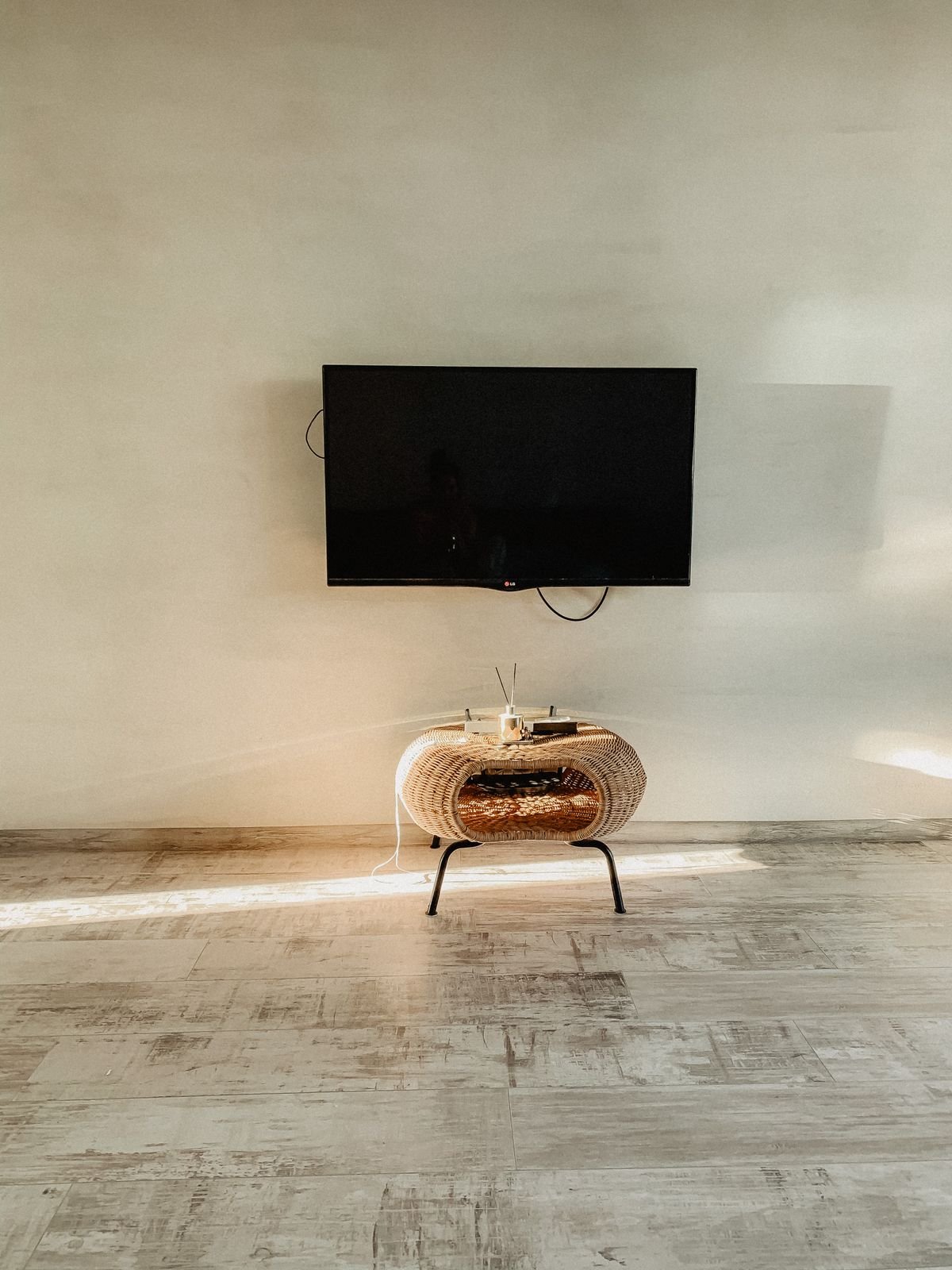
14. Media Wall With a Desk Nook
Style: Work-from-home | Best for: One-room living and spare-room doubles | Price feel: Mid-range
What it is: One stretch of the media wall steps down into a desk: a worktop, a task lamp, and shelves serving both zones. The screen doubles as a second monitor by day. In the photo, a room combining desk, sofa, and TV shows the layout in miniature. It is the pragmatic pick among living room tv wall ideas for homes with no separate office.
How to do it:
- Set the desk top at 29–30 inches high and at least 20 inches deep
- Keep the desk at one end of the wall so the TV stays the visual center
- Add a cable tray under the desk and a second socket run at desk height
- Use a stool or armless chair that tucks fully under the desk at night
Pro tip: A fold-down desk flap hides the work zone for evenings and weekends.
Avoid this: Avoid placing the desk chair’s back to the room’s main walkway — you will be bumped all day.
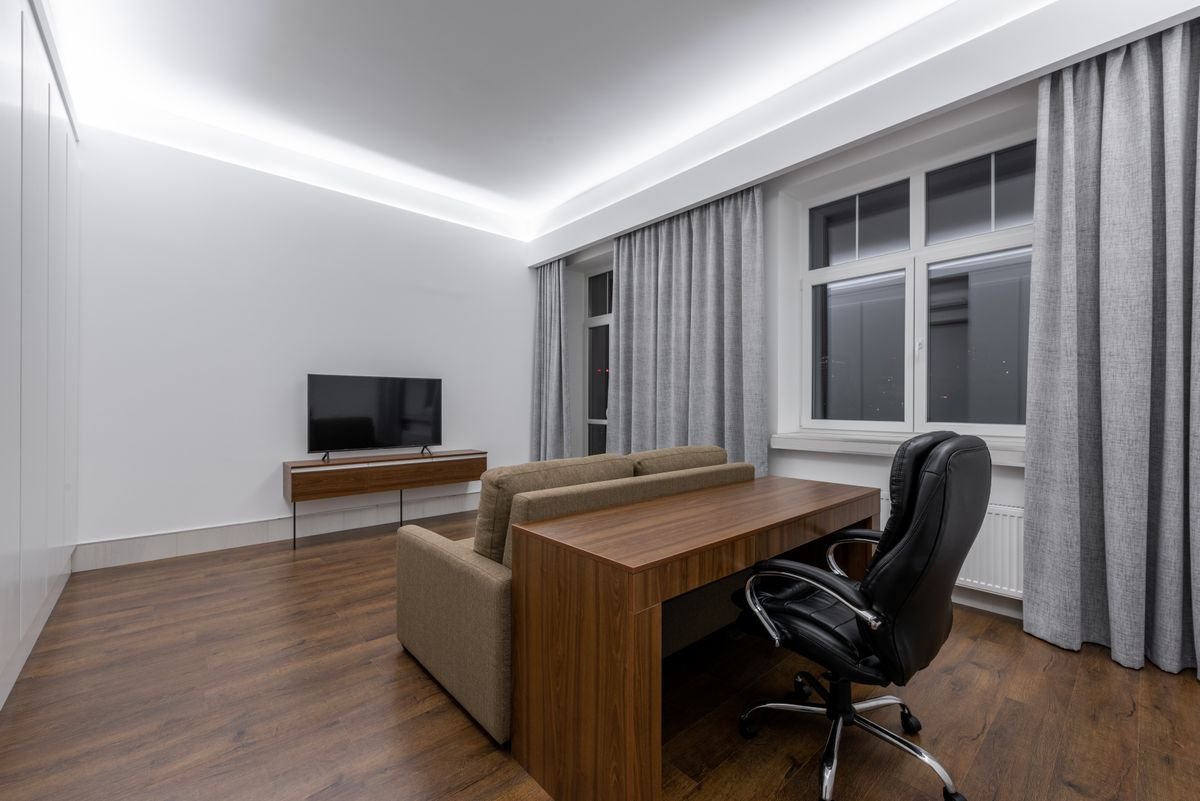
15. Low Credenza Wall
Style: Mid-century | Best for: Design-led rooms and renters with good furniture | Price feel: Mid-range
What it is: A long, low credenza — teak, walnut, or painted — sits under a wall-mounted screen — the whole composition: furniture as the feature. The photo’s minimalist cabinet under a TV, dressed with vases, is the look exactly. The wall above stays empty so the proportions breathe. It is one of the most portable living room tv wall ideas: move house, and the “wall” moves with you.
How to do it:
- Choose a credenza at least 12 inches wider than the TV on each side
- Keep its top 20–26 inches from the floor; hang the screen 4–6 inches above it
- Style the top in threes: one stack of books, one object, one plant — then stop
- Feed cables through the credenza’s back panel so the wall stays untouched
Pro tip: Swap doors for cane or slatted fronts so remotes work through them.
Avoid this: Avoid a credenza narrower than the screen — the TV will look like it is balancing, not floating.
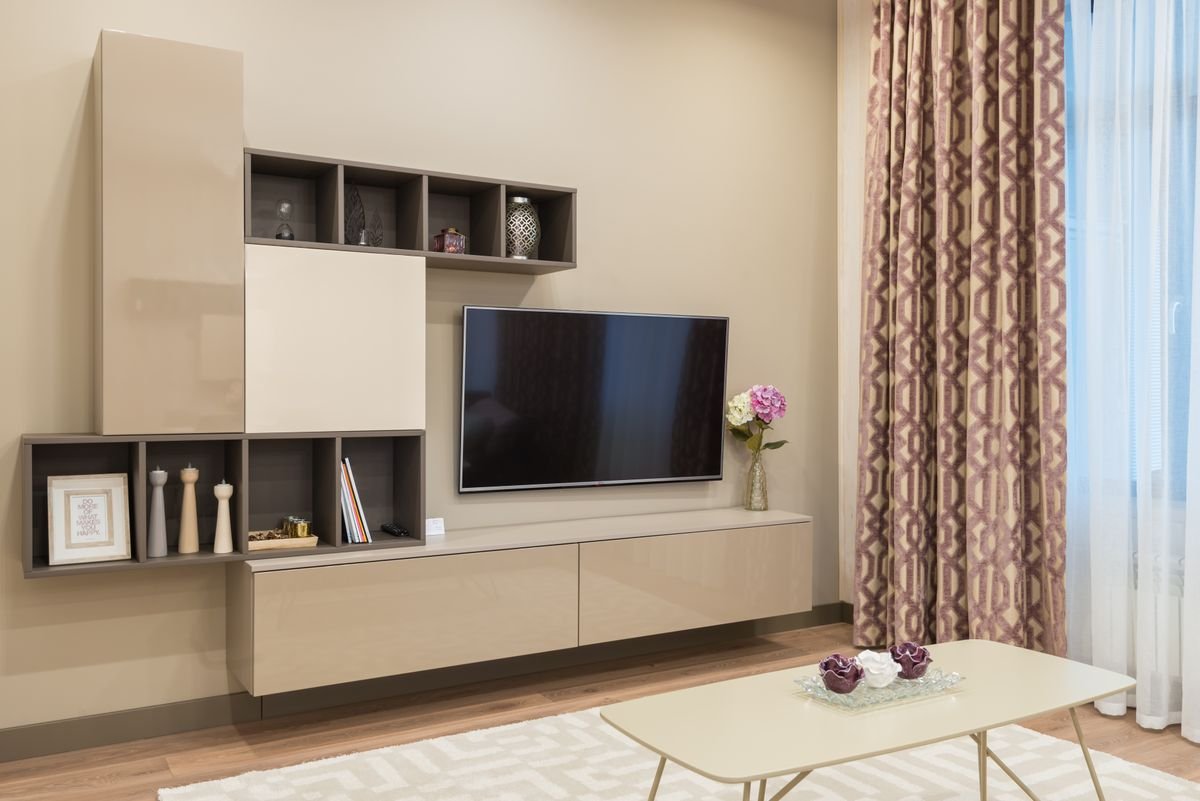
16. Corner Media Unit
Style: Space-saving | Best for: Odd-shaped rooms and small flats | Price feel: Budget
What it is: When no wall is long enough, the corner becomes the media wall: a corner unit or an angled TV mount, seating swung to face it diagonally. The photo’s cozy corner arrangement — plants, wood, a TV tucked into the angle — shows how welcoming it can look. Corners eat dead space, and a diagonal layout often seats more people than a flat wall.
How to do it:
- Use a corner unit 36–48 inches wide, or a full-motion mount
- Angle the sofa to face the corner and anchor the layout with a round rug
- Add one tall plant or floor lamp in the corner triangle to soften it
- Corners seat closer, so a 43–55 inch screen suits most
Pro tip: A corner shelf above the unit, with trailing plants, stops it looking like a compromise.
Avoid this: Avoid pushing a big rectangular unit flat into the corner — it wastes both walls.
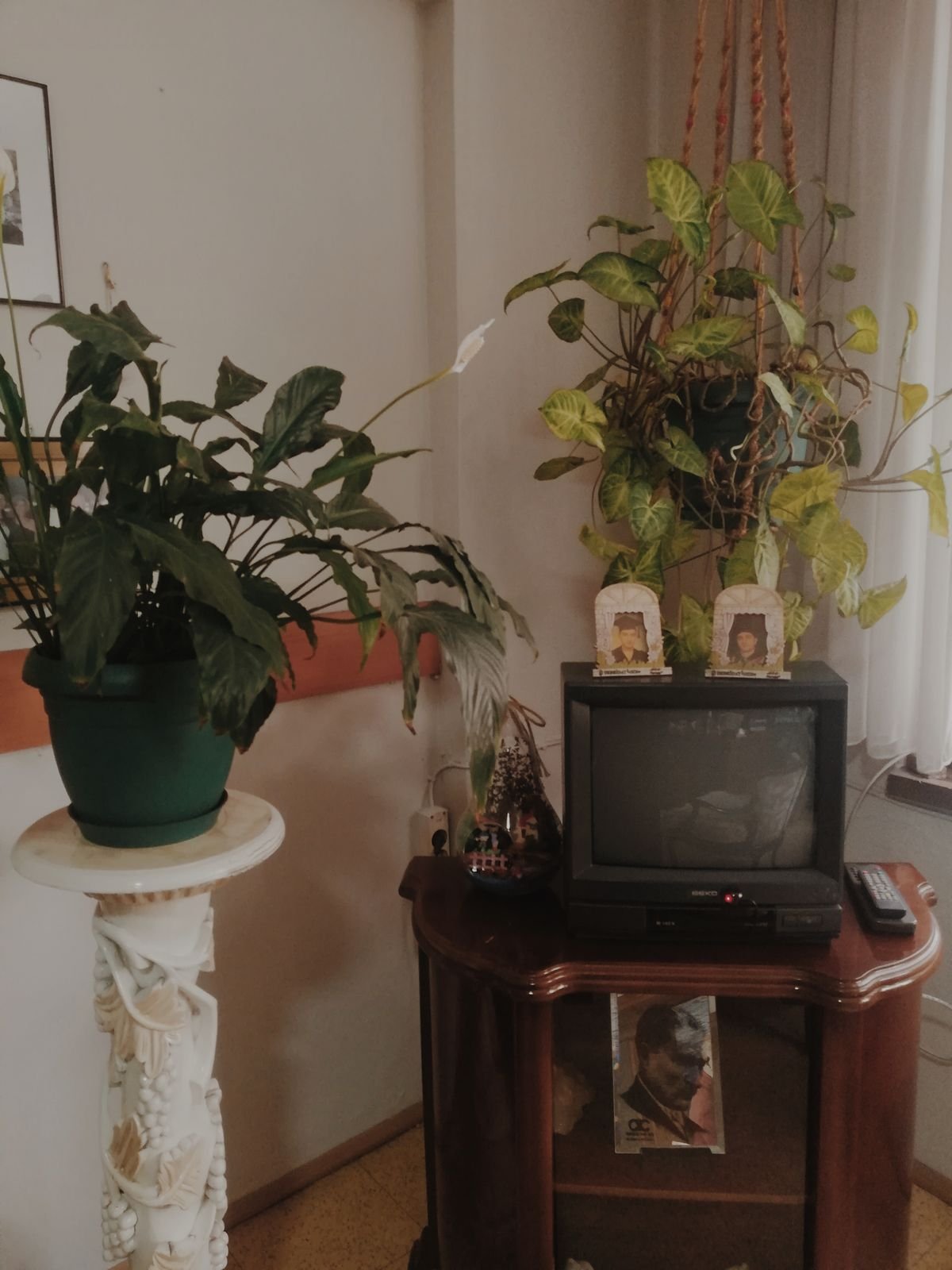
Floating & Minimalist TV Walls
Minimalism is a discipline, not an absence: fewer pieces, each placed exactly. These living room tv wall ideas float furniture off the floor, slim the screen’s presence to almost nothing, and make small rooms feel bigger — floor you can see is space you can feel.
17. Floating Console TV Wall
Style: Minimalist | Best for: Small rooms and modern flats | Price feel: Mid-range
What it is: A wall-hung console floats 8–12 inches off the floor beneath the screen, so flooring runs unbroken underneath. The photo — a wall-mounted TV over a wooden console in a pared-back room — is the reference look. Floating furniture is the small-room hero of living room tv wall ideas: cleaning is easier and sightlines run longer.
How to do it:
- Fix the console into studs with a rated hanging rail — it must hold gear plus its own weight
- Keep the console top about 18–22 inches from the floor, screen 4–6 inches above it
- Run cables from the TV straight down into the console’s back void
- Leave the floor beneath empty — no baskets, no shoes, or the float is wasted
Pro tip: An LED strip under the console makes it hover at night.
Avoid this: Avoid floating a unit not designed for wall-hanging; use one with a reinforced back rail.
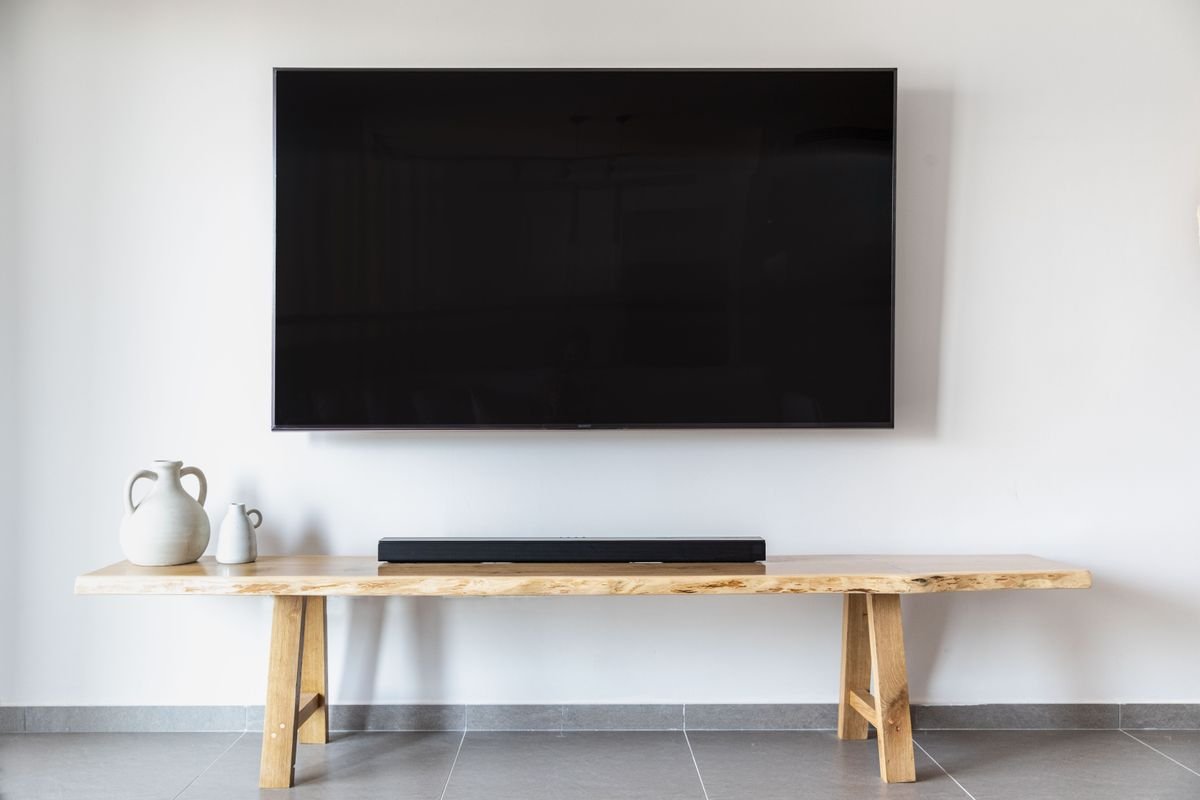
18. Floating Back Panel With LED
Style: Sleek modern | Best for: New-builds and media rooms | Price feel: Mid-range
What it is: A single panel — MDF, laminate, or stone-look board — sits off the wall on a frame; the TV mounts to it and LED strips hide behind its edges, washing the wall with a halo. The photo’s ambient-lit TV unit shows the glow. The panel crops the screen’s black rectangle and gives even a budget TV a designed frame.
How to do it:
- Make the panel 8–12 inches larger than the TV on all sides
- Stand it off the wall 2–4 inches on a timber frame for the LED cavity
- Fix the TV bracket through the panel into the frame and studs behind
- Choose warm-white (2700–3000K) dimmable LED so the halo flatters, not glares
Pro tip: Put the LED on the TV’s smart plug so one command lights the wall.
Avoid this: Avoid multicolour party lighting for daily viewing — it tires eyes fast.
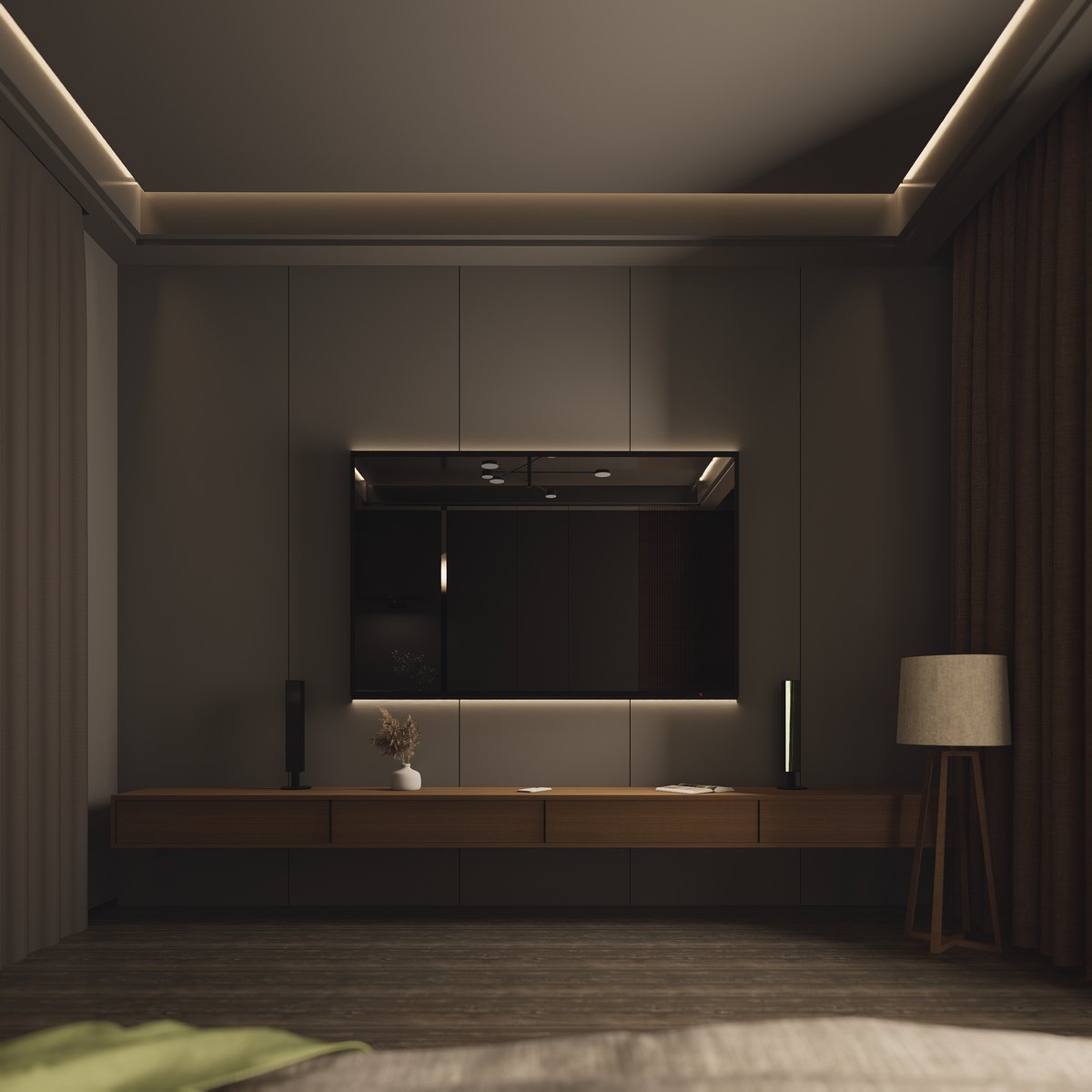
19. Frame TV Art Look
Style: Gallery disguise | Best for: Rooms where the TV is not the point | Price feel: Premium
What it is: A frame-style TV (or any slim TV in a picture-frame bezel) displays artwork when idle, hanging flush among real paintings. In the photo, a TV sits composed with wall art — the screen reads as decor, not tech. For design-first households, this is among the most loved living room tv wall ideas: the wall stays beautiful 20 hours a day, not just during films.
How to do it:
- Use a flush mount so the screen sits within half an inch of the wall
- Hang real framed art at the same depth and spacing around it
- Hide the connection box in a cabinet or recessed wall box behind the screen
- Pick matte-display artwork with soft tones — dark glossy images reveal the trick
Pro tip: Rotate the art seasonally, matched to your cushions’ palette.
Avoid this: Avoid a standard glossy TV; reflections give the trick away.
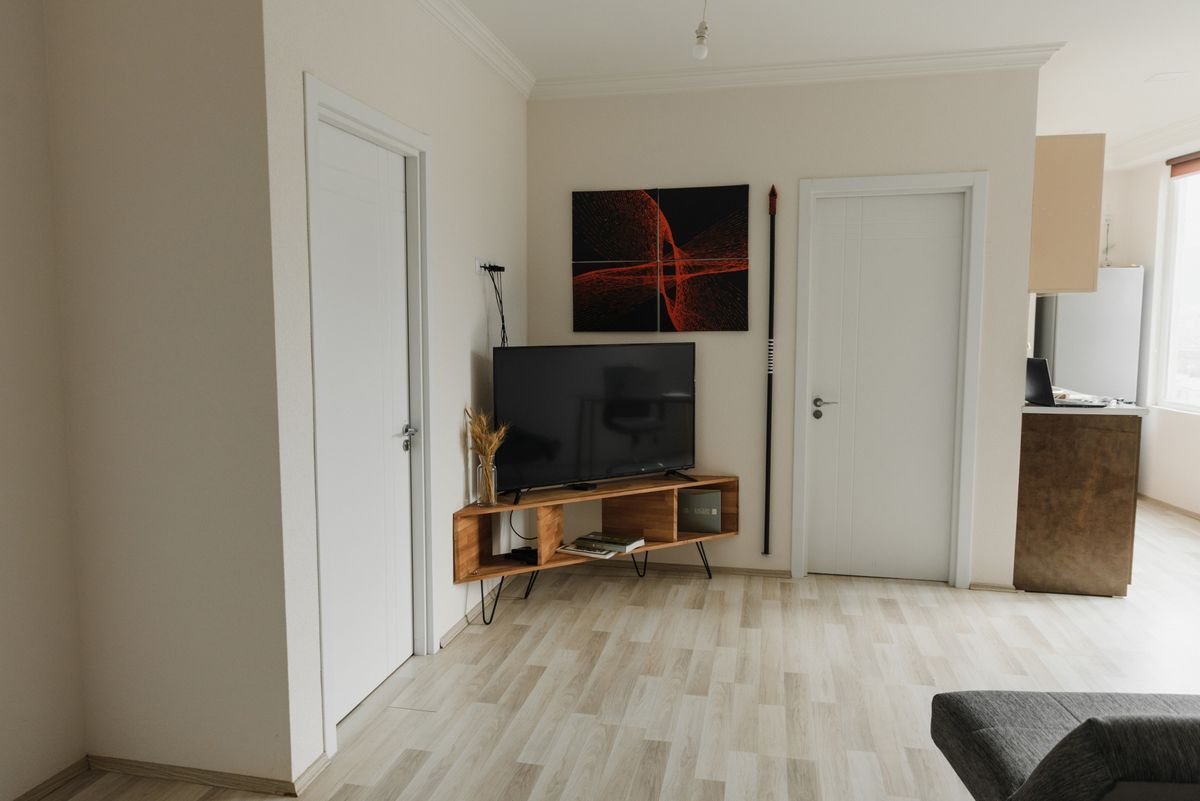
20. Sliding & Concealed Panel TV Wall
Style: Hidden screen | Best for: Formal rooms and art lovers | Price feel: Premium
What it is: Artwork panels or slatted doors slide sideways to reveal the TV only when wanted. Closed, the wall is art; open, it is a cinema. The photo’s dark, panelled wall shows the kind of backdrop these systems hide within. It is the most theatrical of the living room tv wall ideas here — and the one guests always ask about.
How to do it:
- Use a recessed TV niche or slim TV (under 2 inches deep) so panels close flat
- Fit sliding gear rated for the panel’s full weight, with soft-close stops
- Leave a finger gap and ventilation slots — concealed TVs still produce heat
- Commission the panels from the same material as nearby joinery for a seamless read
Pro tip: Two half-width panels sliding apart feel grander than one big panel.
Avoid this: Avoid hinged art on a standard mount — the swing arc catches screen corners.
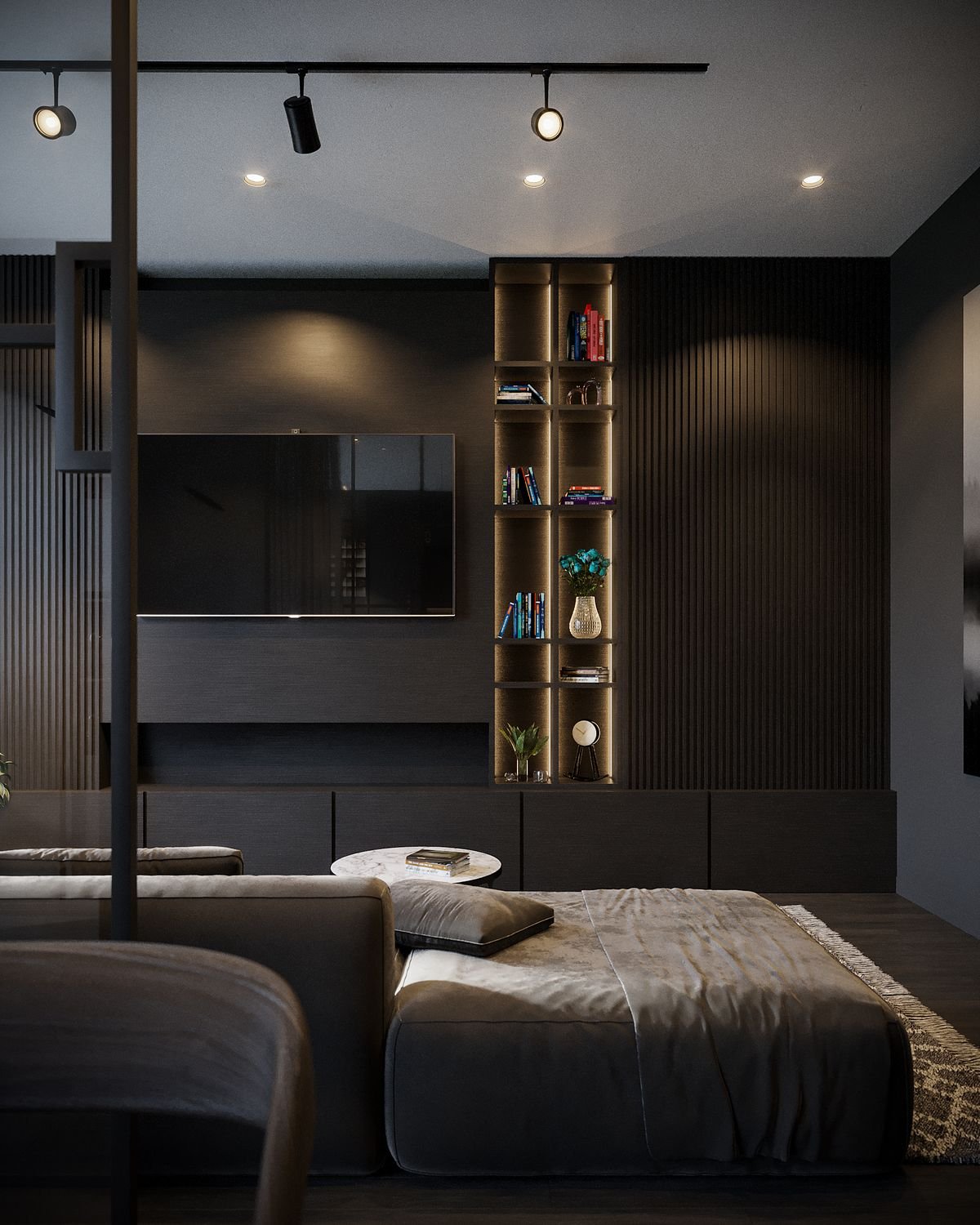
21. Dark Accent Backdrop Wall
Style: Moody cinema | Best for: Film lovers and north-facing rooms | Price feel: Budget
What it is: One wall painted deep — charcoal, ink blue, forest, or near-black — so the screen’s bezel melts into it and on-screen colours look richer. The photo’s blue accent wall with a TV shows the effect in daylight; at night it is pure cinema. One tin of paint, and the best value-per-drama entry among living room tv wall ideas.
How to do it:
- Paint the whole TV wall, including skirting, in a matte or eggshell finish
- Choose a colour with warm undertones so lamplight keeps it cosy, not cold
- Keep surrounding walls pale to hold the contrast and the room’s daylight
- Add one warm metallic (brass lamp, gold frame) — dark walls love a glint
Pro tip: The same trick deepens a media nook: paint a shelving bay’s inside dark, frame pale.
Avoid this: Avoid pure black in a small, dark room — a near-black with colour keeps depth.
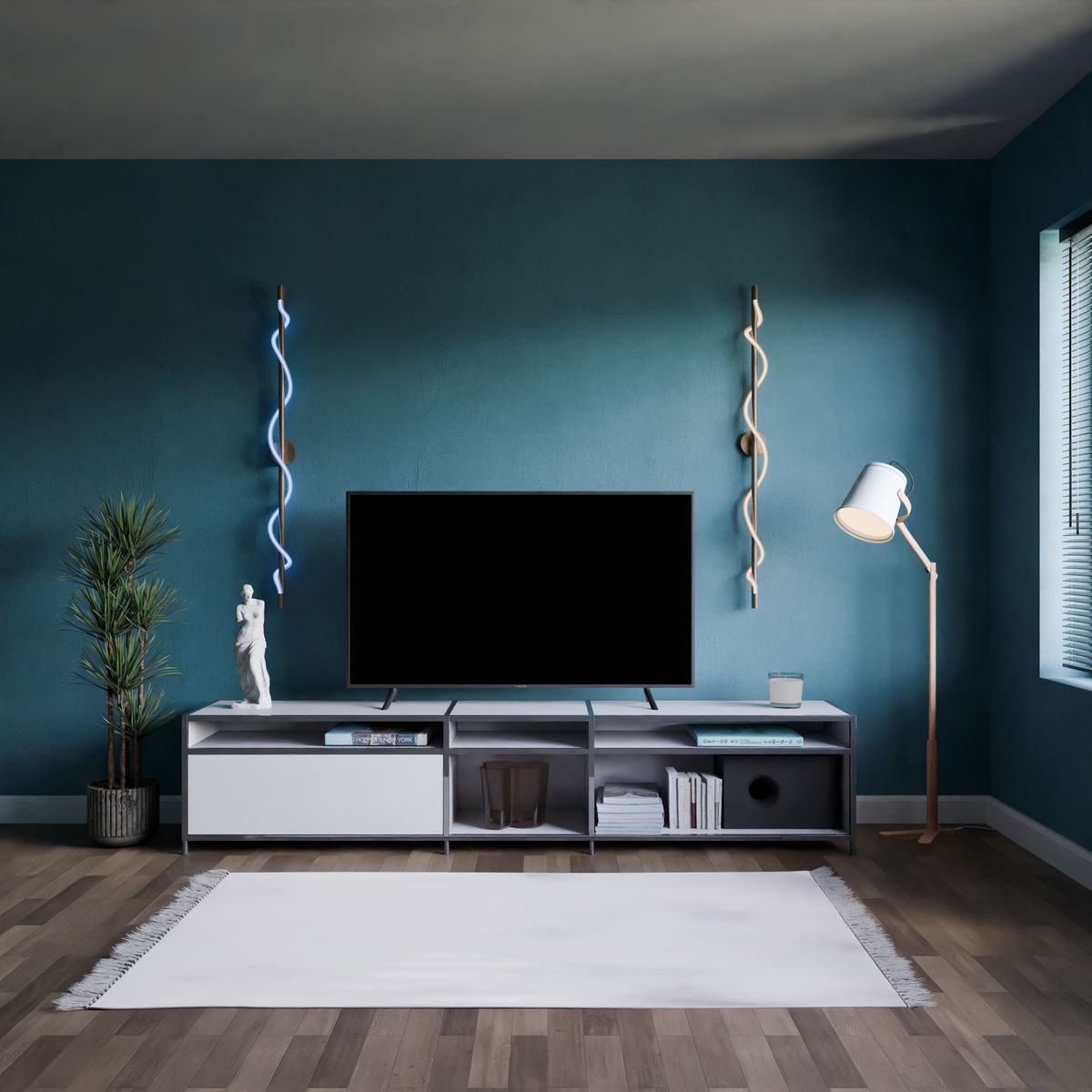
22. Cable-Free Minimalist TV Wall
Style: Ultra minimal | Best for: Purists and tiny rooms | Price feel: Budget
What it is: Screen, wall, nothing else. The TV hangs alone — no console, no shelves — with the media box hidden in a cupboard or behind the screen, controlled by an IR repeater. The photo’s single TV on a white wall with one sculptural vase is the essence. Restraint this strict takes planning, which is why it impresses.
How to do it:
- Recess a back box behind the TV for the streaming stick, cables, and power
- Use a TV with a separate connection box — one slim cable reaches the screen
- Hide speakers as in-ceiling or a slim soundbar tucked under the screen’s lower edge
- Keep the wall finish flawless — with nothing to distract, every bump shows
Pro tip: One object — a vase, a sculpture — placed off-center keeps minimal from feeling empty.
Avoid this: Avoid adding a “temporary” stand later; the look depends on the discipline holding.
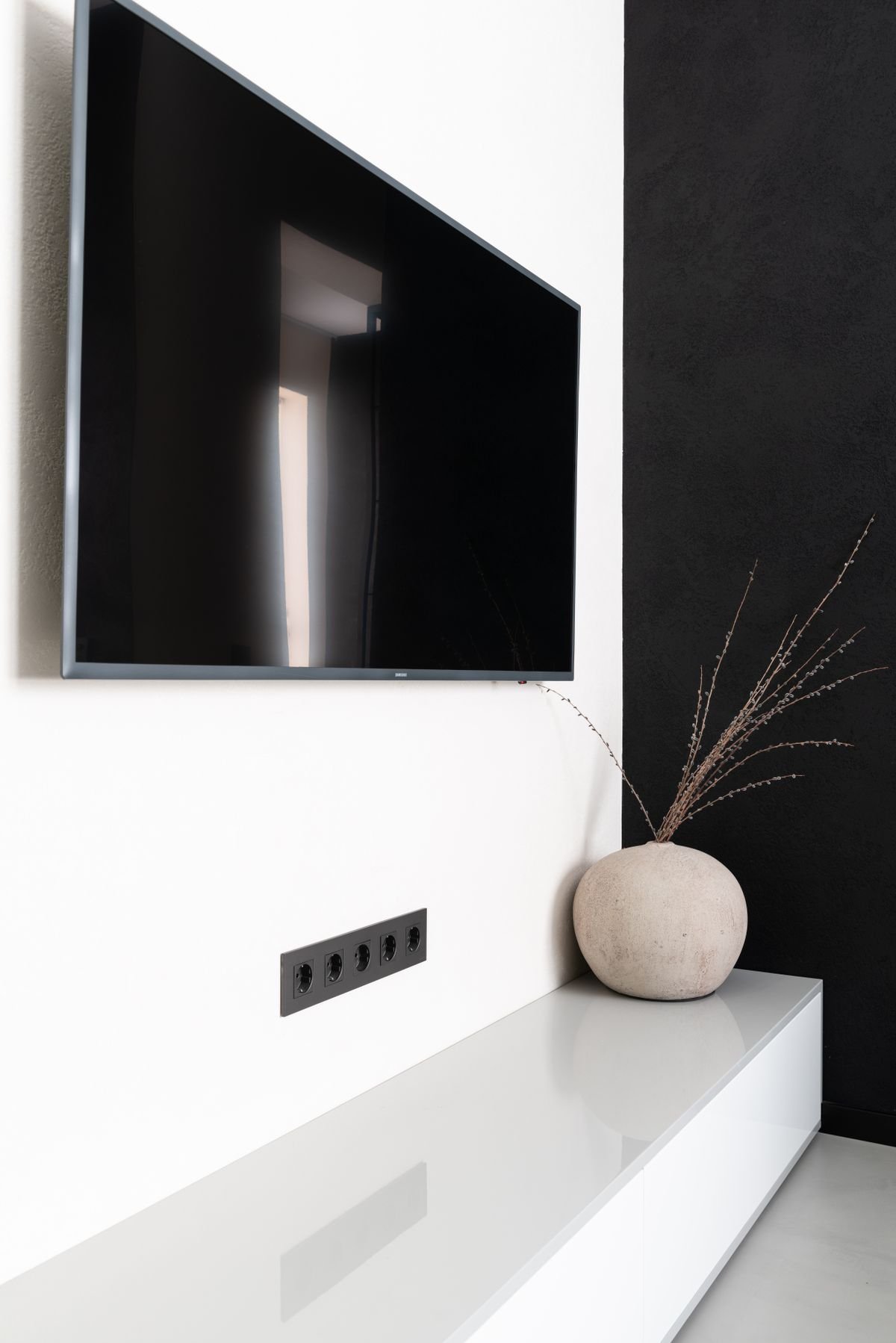
23. TV on an Easel Stand
Style: Studio style | Best for: Renters and art-studio aesthetics | Price feel: Mid-range
What it is: A tripod easel stand — oak legs, a slim crossbar — holds the TV like a canvas in a studio. Nothing touches the wall; the set moves rooms in minutes. In the photo, a TV on a clean white stand shows the freestanding principle. Easels suit renters and anyone who rearranges often, and the stand itself becomes sculpture.
How to do it:
- Match the stand’s rating to your screen size (most suit 45–65 inches) and weight
- Stand it 4–8 inches off the wall so cables drop behind the legs
- Use the stand’s cable channel or a fabric sleeve down the rear leg
- Anchor with the supplied safety strap if children or pets roam
Pro tip: Angle the easel a few degrees off-square for a deliberate studio look.
Avoid this: Avoid easels in walkways — tripod feet are ankle magnets.
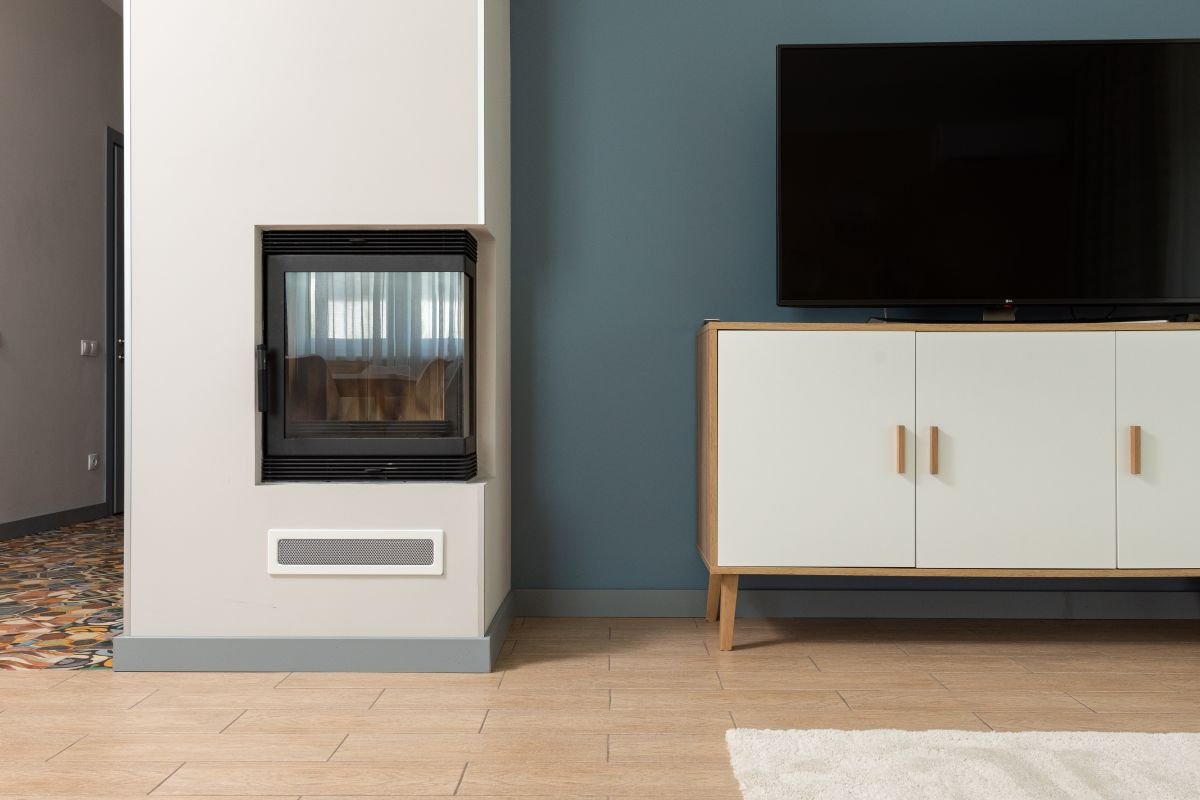
Gallery & Decor Around the TV
You do not have to hide the TV — you can outnumber it. These living room tv wall ideas surround the screen with art, shelves, mirrors, and plants until the black rectangle is one element in a composed wall. If you love the layered look, our living room gallery wall ideas pair perfectly with the arrangements below.
24. Art Cluster Around the Screen
Style: Eclectic gallery | Best for: Art collectors and maximalists | Price feel: Budget
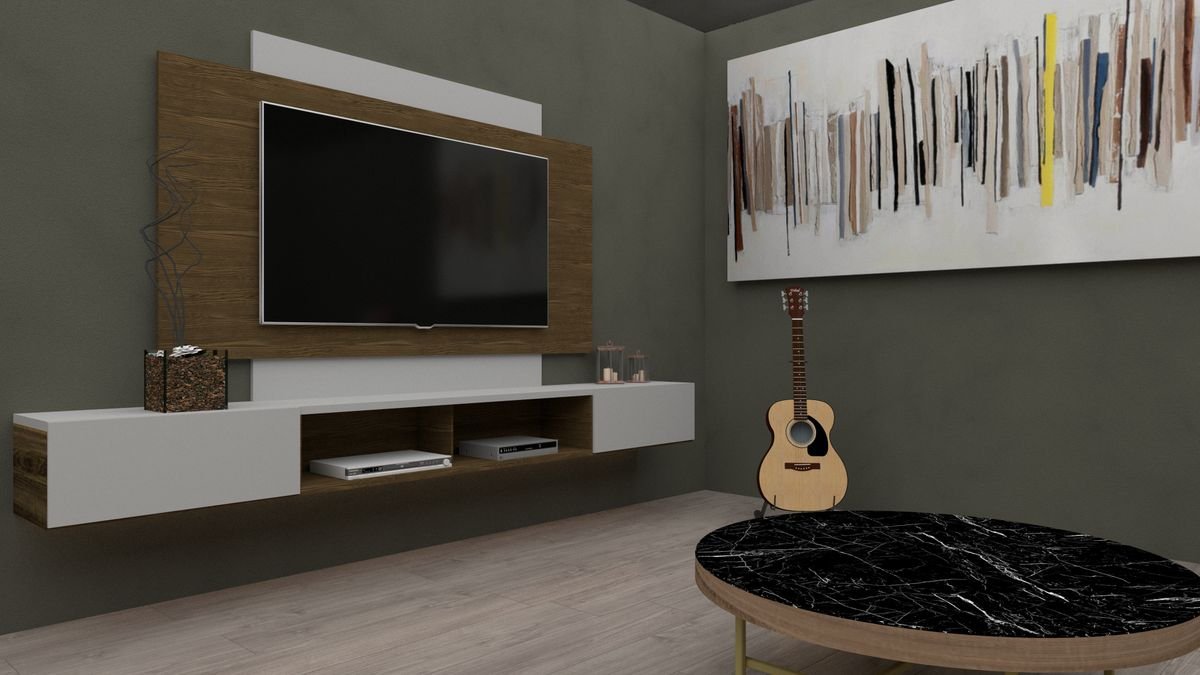
What it is: Treat the TV as the largest “frame” in a gallery wall and hang art around it until the screen is absorbed into the composition. In the photo, a mounted TV shares its wall with abstract art and even a guitar. It is the friendliest of living room tv wall ideas for people who own more art than wall, and it costs nothing but nails.
How to do it:
- Hang the TV first, then arrange frames around it with 2–3 inch gaps
- Keep frame finishes within one family (black, wood, or gilt) so the mix reads curated
- Let one artwork echo the screen’s proportions on the opposite side for balance
- Plan the cluster on the floor and photograph it before drilling anything
Pro tip: Matte, non-glare frames keep reflections from competing with the screen.
Avoid this: Avoid tiny frames against the screen edge — the TV dwarfs them.
25. Picture Ledges Flanking the TV
Style: Layered | Best for: Changeable, seasonal styling | Price feel: Budget
What it is: Two slim picture ledges beside the screen hold leaning frames and objects you can swap in minutes. The photo’s styled shelf beside a TV shows the layered effect. Ledges give the gallery look without the commitment — rearrange weekly if you like — and they fill the awkward strips of wall flanking most screens.
How to do it:
- Mount ledges 4–6 inches from the screen’s side edges, aligned with its top
- Layer frames two deep at most, tallest at the back
- Repeat one colour from the artwork in a cushion or throw across the room
- Use museum putty under front frames if the household includes cats or toddlers
Pro tip: A deep ledge under the screen also solves the soundbar problem, no drilling.
Avoid this: Avoid overloading ledges; three to five pieces per ledge is plenty.
26. Shelves-and-Art Mix
Style: Collected | Best for: Books, ceramics, and travel finds | Price feel: Budget
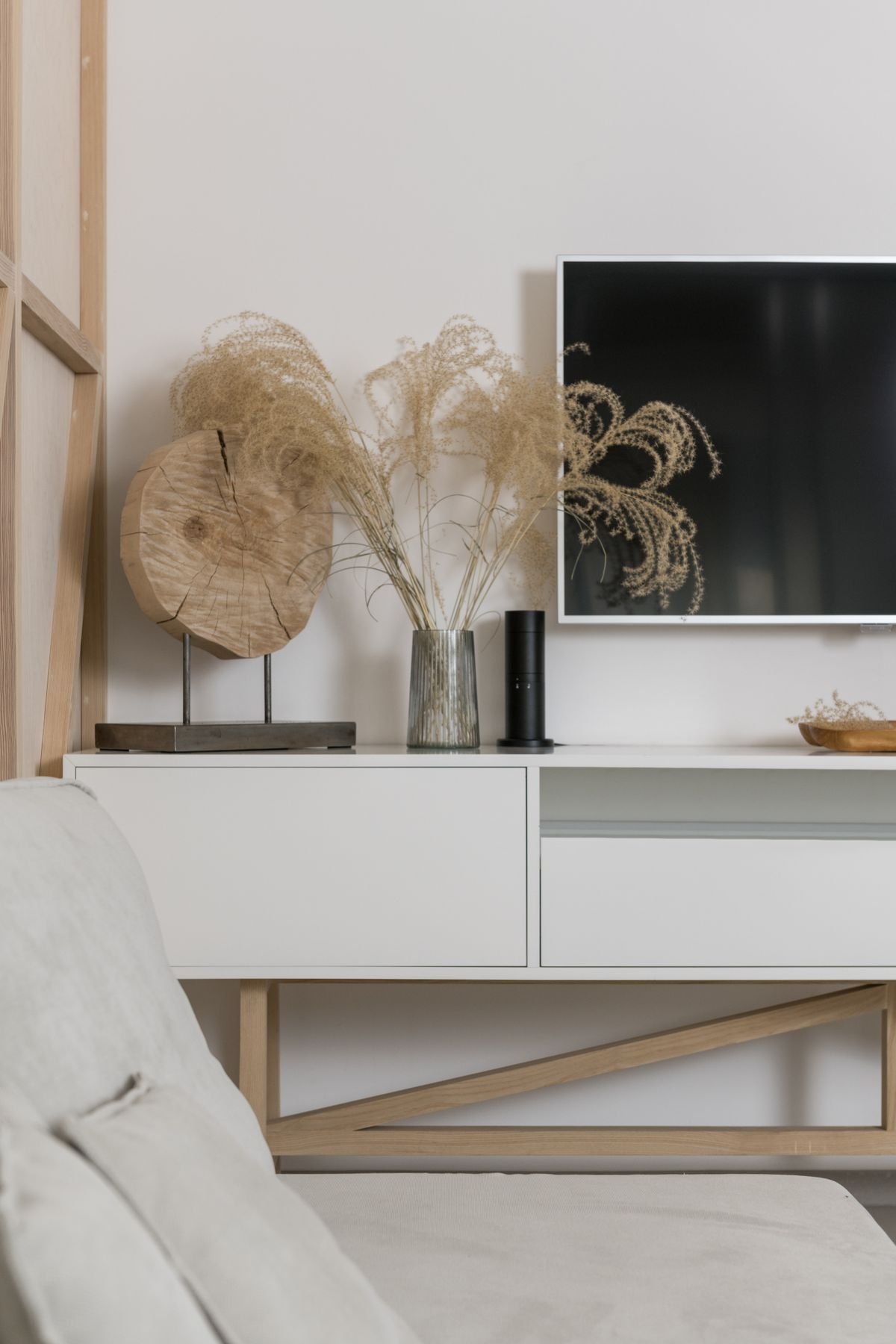
What it is: Open shelves and framed art share the wall in one loose composition — a shelf above the screen, art below, books where a frame might go. The photo’s TV with wall shelves and a grey sofa shows how naturally the mix settles. Unlike strict symmetry, this arrangement grows over time — the most organic of the gallery-style living room tv wall ideas.
How to do it:
- Fix shelves into studs and keep them 8–12 inches clear of the screen’s heat vents
- Mix horizontal book stacks with one vertical row per shelf for rhythm
- Leave one shelf noticeably emptier than the rest — breathing room reads as style
- Anchor the composition with the largest frame at the visual center, not the TV
Pro tip: Style shelves in threes — object, book stack, plant — and the wall looks “done.”
Avoid this: Avoid shelves above where heads rest on the sofa; keep them over the TV zone.

27. Mirror & Sconce Framing
Style: Elegant | Best for: Dark rooms needing light and lift | Price feel: Mid-range
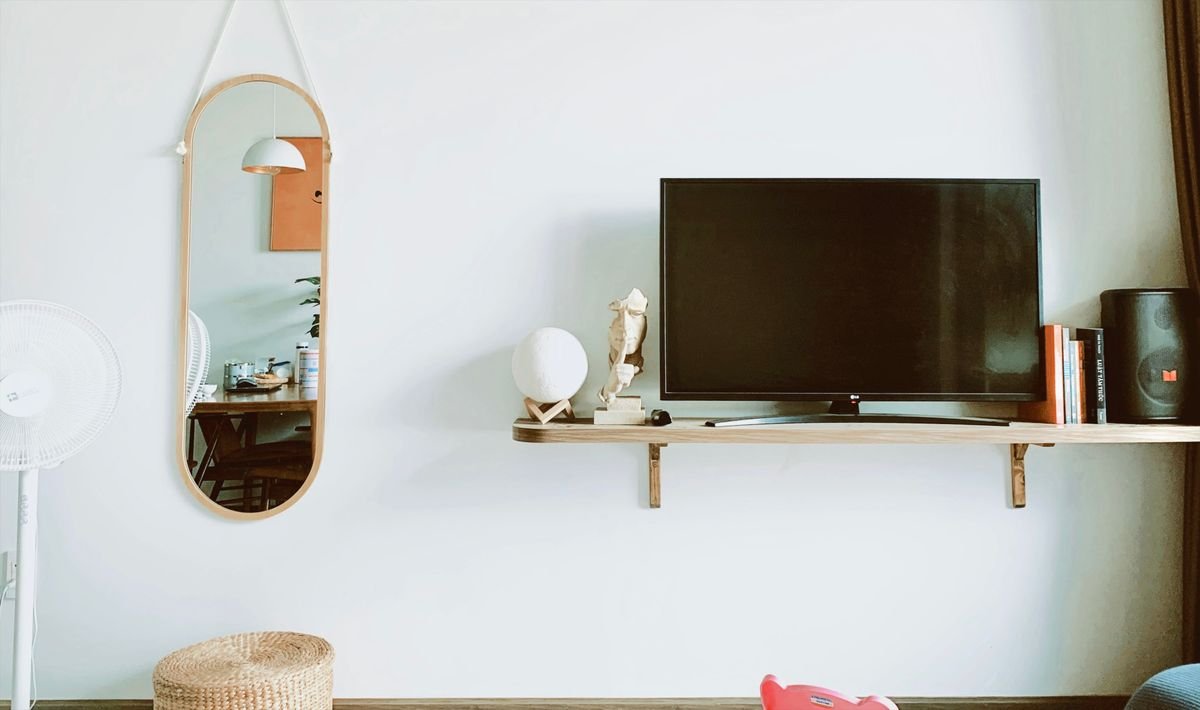
What it is: A round mirror and a pair of wall sconces turn the TV wall into a lit, reflective composition borrowed from fireplace styling. In the photo, a mirror shares the wall with a mounted TV. Sconces at screen height also serve viewing: soft side light reduces eye strain during evening films without reflecting in the picture.
How to do it:
- Place sconces level with the screen’s center, about 60 inches from the floor
- Choose frosted or shaded sconces — bare bulbs will mirror in the screen
- Size the mirror at roughly half the screen’s width for proportion
- Angle the mirror to reflect a window or art, not the sofa’s ceiling light
Pro tip: Put sconces on their own dimmer for cinema-evening control.
Avoid this: Avoid a mirror directly opposite the screen — it doubles every bright scene.
28. Plant-Framed TV Wall
Style: Biophilic | Best for: Plant people and bright rooms | Price feel: Budget
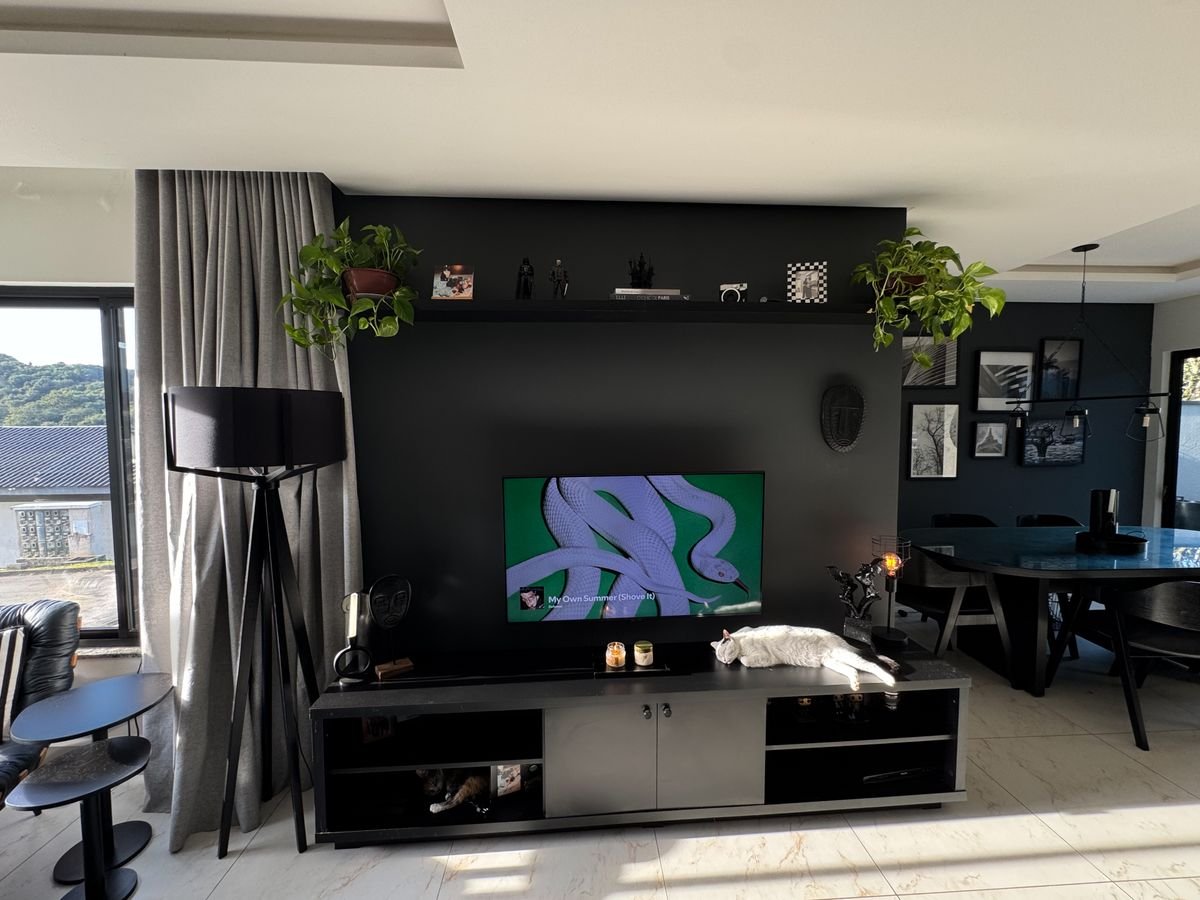
What it is: Tall plants flank the screen, trailing plants soften the console edges, a hanging planter fills the top corners — the TV sits in a loose green frame. In the photo, decor plants around a TV unit show how quickly foliage domesticates technology. Living frames also help air and acoustics, making this among the healthiest living room tv wall ideas here.
How to do it:
- Use one tall plant (48 inches plus) on each side, in matching pots
- Keep leaves at least 6 inches from the screen’s vents and edges
- Add one trailing plant on a high shelf so greenery reaches the top corners
- Choose low-light-tolerant species (pothos, snake plant) if the wall is north-facing
Pro tip: Rotate plants a quarter turn monthly so they grow evenly.
Avoid this: Avoid misting plants beside the screen — water and electronics mix badly.
29. Symmetrical Decor Pairs
Style: Formal balance | Best for: Traditional rooms and centered layouts | Price feel: Budget
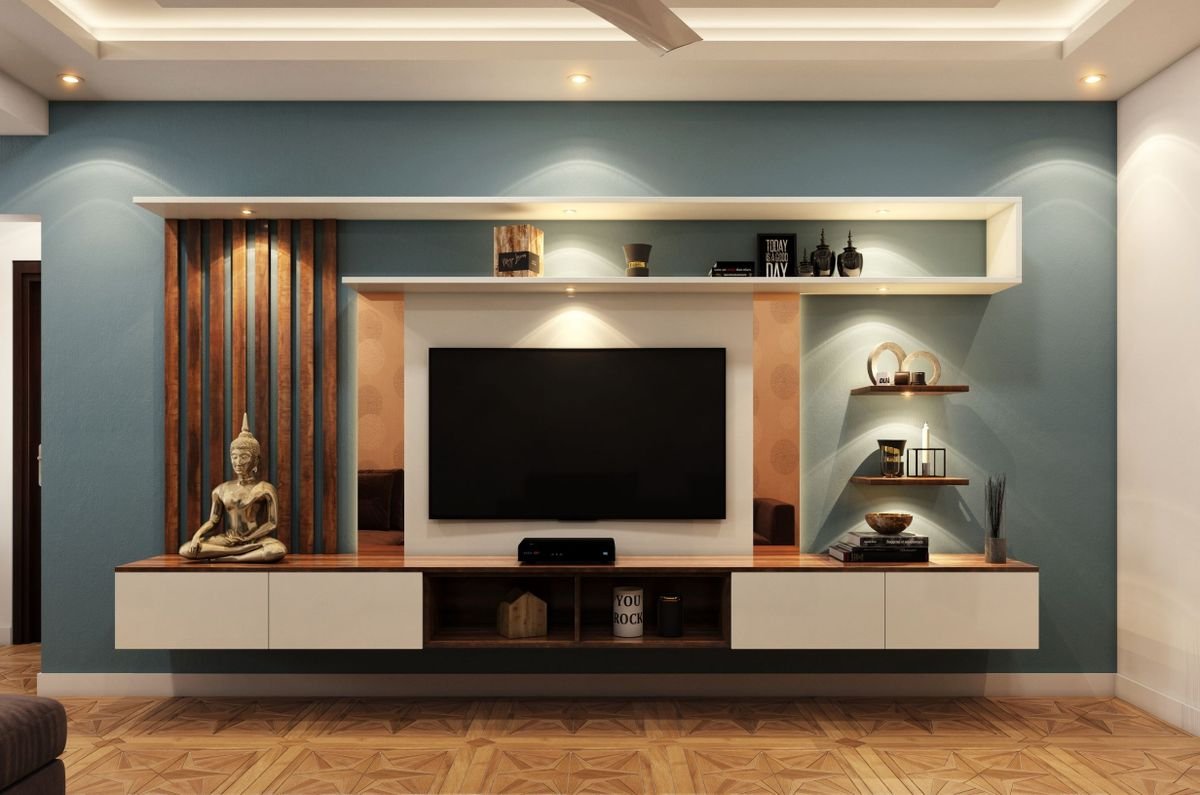
What it is: Everything beside the screen comes in twos: two prints, two sconces, two plants, two vases. The photo’s composed, elegant room shows the calm this creates. Symmetry is decorating’s oldest trick because the eye reads it as order instantly — and a wall dominated by one big rectangle benefits from echoed pairs more than any other.
How to do it:
- Measure from the screen’s center line and mirror every placement exactly
- Buy pairs at the same time — dye lots and finishes drift between batches
- Keep the console styling paired too, or the wall’s balance stops at the screen
- Break the pattern once, deliberately, with a single plant or object at the center
Pro tip: Symmetry photographs beautifully — this wall sells the room.
Avoid this: Avoid near-pairs — the eye reads the mismatch as a mistake.
Fireplace + TV Combos
Two focal points, one wall — the classic living room argument. These living room tv wall ideas settle it five ways, from screen-over-hearth to sleek linear insert. Respect the heat rules below, and browse our fireplace and wood stove accessories to finish the hearth.
30. TV Above the Fireplace
Style: Classic combo | Best for: Rooms with one obvious focal wall | Price feel: Mid-range
What it is: The screen mounts on the chimney breast above the mantel, stacking both focal points into one wall — as in the photo, where a wall-mounted TV crowns a brick fireplace. It saves a whole wall and suits hearth-centred rooms. The compromise is height: fireplace screens sit higher than ideal, so seating distance and a tilting mount matter more here than anywhere in this guide.
How to do it:
- Use a pull-down or tilting mount to drop the screen nearer eye level
- Keep the TV bottom at least 12 inches above the mantel shelf
- Check the wall temperature above a lit fire — warm is fine, hot is not
- Route cables down inside the breast or in a painted raceway at the corner
Pro tip: A deeper mantel shelf (10–12 inches) deflects rising heat from the screen.
Avoid this: Avoid mounting above a wood stove flue wall — sustained heat shortens TV life.
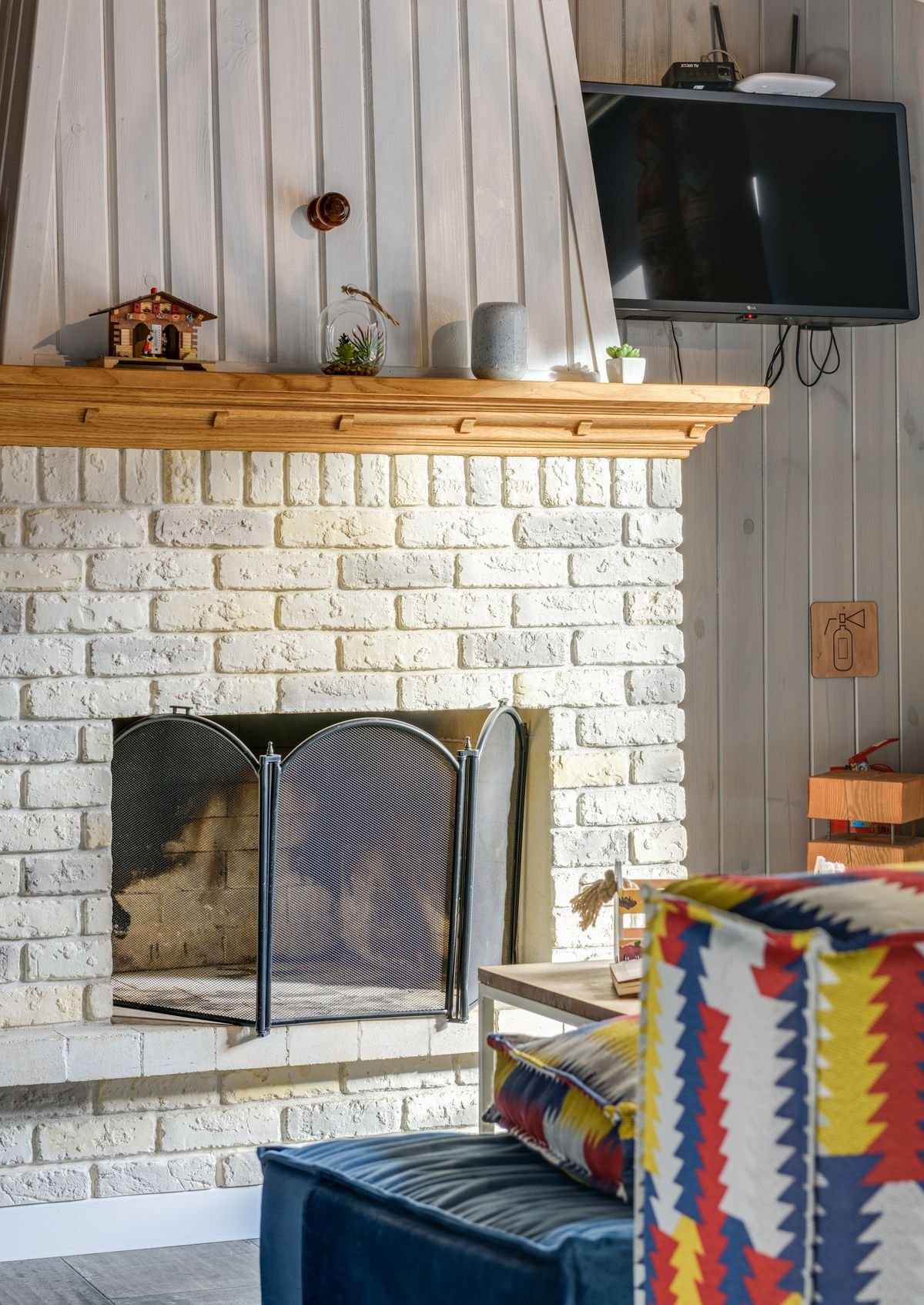
31. Side-by-Side Fireplace & TV
Style: Dual focal | Best for: Wide walls and open-plan rooms | Price feel: Mid-range
What it is: Instead of stacking, place fireplace and TV side by side on one long wall — fire on one half, screen on the other, seating angled to both. In the photo, a TV hangs on a wooden wall near the fireplace rather than above it. Both get comfortable heights, nobody cranes, and the room gains a long, luxurious focal run.
How to do it:
- Give each feature its own visual bay — panelling, paint, or shelving to divide them
- Keep the TV at the standard 42-inch center height; the fire needs no compromise
- Run a continuous low unit beneath both to unify the wall
- Angle the main sofa toward the midpoint so both views are comfortable
Pro tip: Repeat one material in both bays so the wall reads as one design.
Avoid this: Avoid centering the sofa on one feature only — the other feels forgotten.
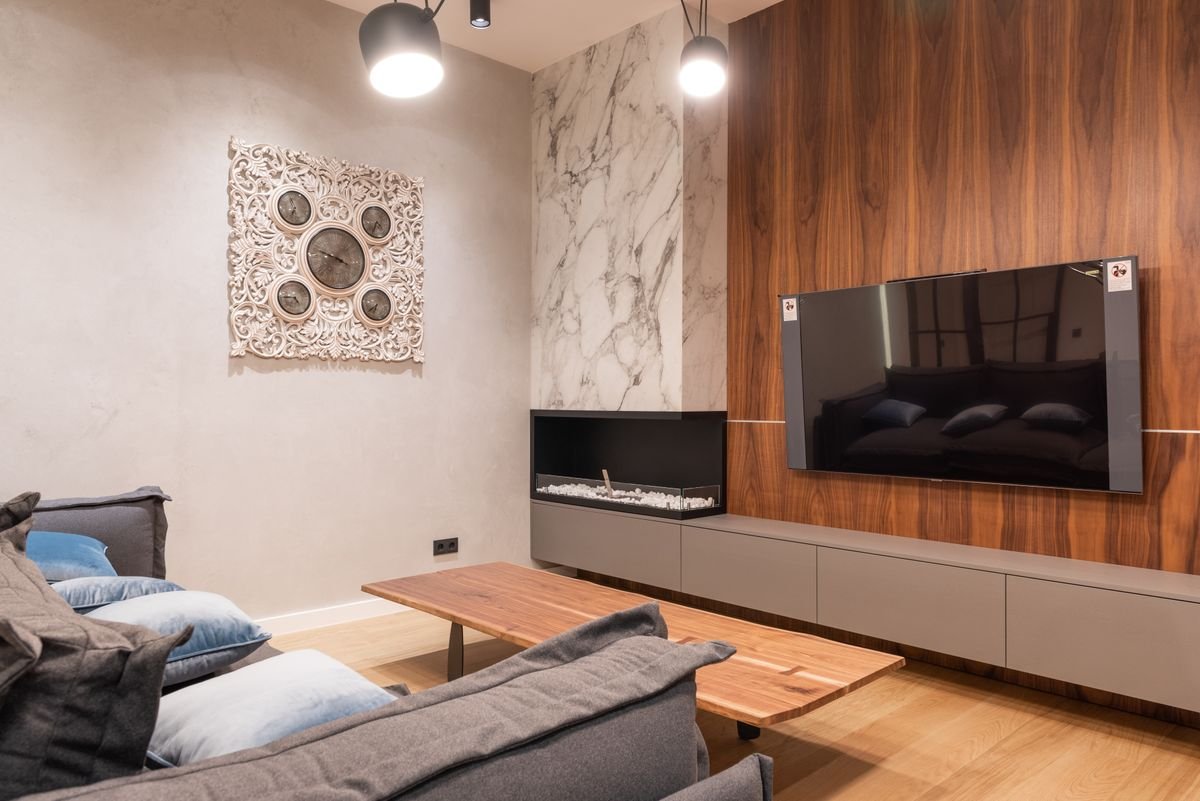
32. Electric Fireplace Media Wall
Style: Modern insert | Best for: Flats and homes without a chimney | Price feel: Mid-range
What it is: A stud-wall bump-out holds an electric fireplace insert below the TV, creating the media-wall look in homes that never had a hearth. In the photo, a bright modern room pairs a fireplace with a mounted TV in this spirit. Electric inserts produce modest, controlled heat and need only a socket — among the most achievable living room tv wall ideas for new-builds.
How to do it:
- Frame the bump-out 6–10 inches deep — enough for the insert and a cable void
- Follow the insert maker’s clearance: typically 8–12 inches between firebox top and TV
- Clad the bump-out in plaster, slats, or tile to make it read as architecture
- Put the insert and TV on separate sockets inside the void
Pro tip: Choose an insert with flame effect independent of the heater — ambience all year.
Avoid this: Avoid the cheapest inserts with noisy fans; you will hear them constantly.
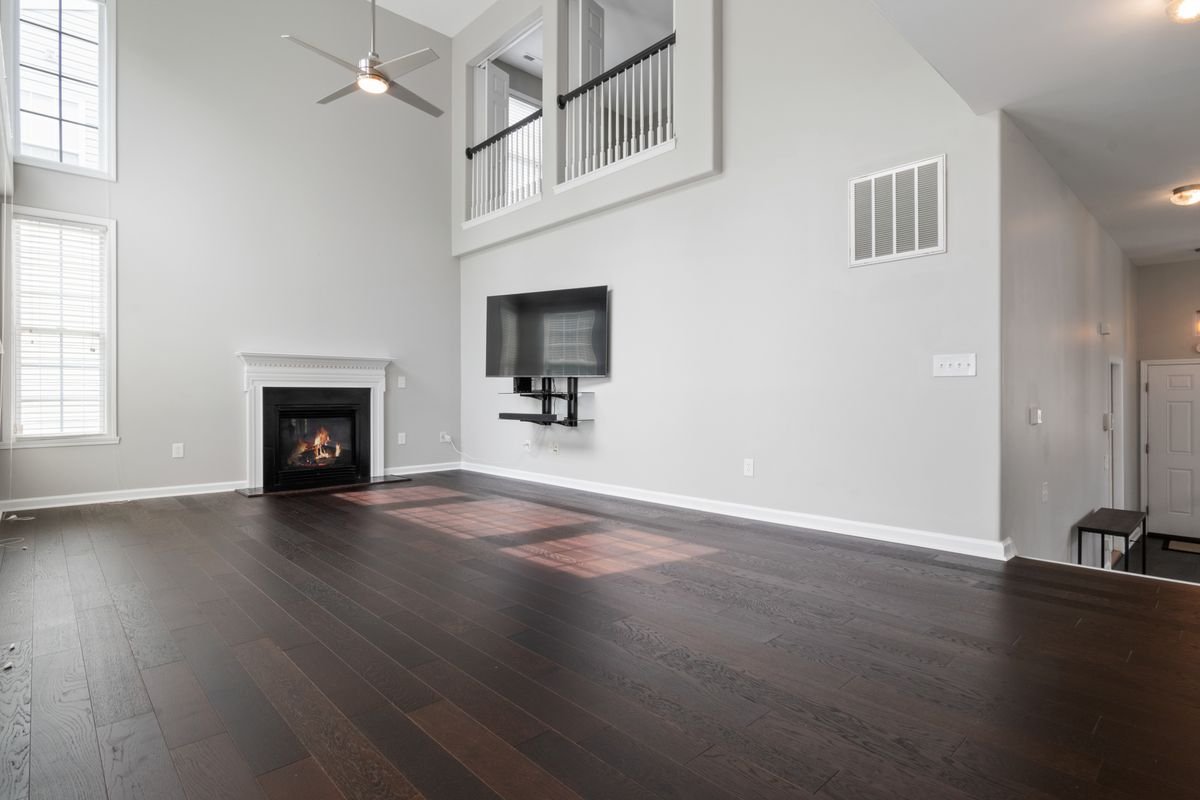
33. Linear Fireplace Under the TV
Style: Contemporary | Best for: Sleek, wide-format rooms | Price feel: Premium
What it is: A long, low ribbon of flame — gas or electric — stretches beneath the screen, echoing its proportions. The photo’s minimalist wall-hung fireplace and TV pairing shows the geometry: two horizontal lines, each glowing. It is the most architectural of the fireplace combos, and the proportions suit 65-inch-plus screens best.
How to do it:
- Match the fireplace width to the TV (a 48–60 inch insert under a 65-inch screen)
- Keep 12 inches between the firebox top and the screen’s lower edge
- Use a heat-deflecting mantel beam or shelf between the two if the maker requires it
- Have gas work done by a certified installer — this is not a DIY line item
Pro tip: A stone or plaster bench under the fireplace extends the line and adds seating.
Avoid this: Avoid placing a soundbar between fire and TV — heat rises through that gap.

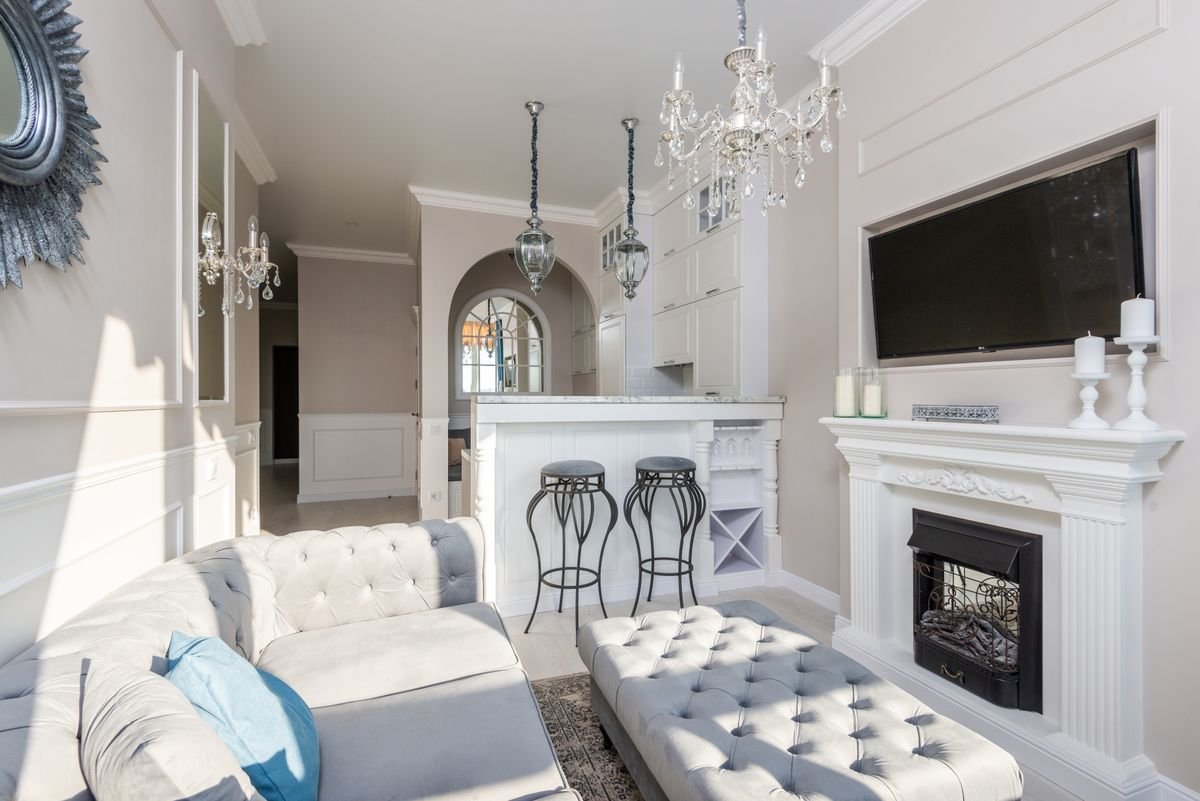
34. Mantel Styling With a TV
Style: Decorated hearth | Best for: Traditional mantels with a screen above | Price feel: Budget
What it is: If the TV already lives above the mantel, good mantel styling makes it look chosen rather than tolerated. Candles, garlands, and layered frames soften the screen’s hard rectangle — the photo’s candlelit fireplace under a television shows the mood. Small shifts (seasonal greenery, brass, books) keep the wall feeling decorated around the tech.
How to do it:
- Style in threes at each end of the mantel: height, texture, glow
- Keep the middle third under the screen clear so the composition can breathe
- Use flameless candles near the screen — real flames plus heat plus cables is one risk too many
- Swap one element seasonally; the wall refreshes for the price of a garland
Pro tip: A low garland along the mantel’s front edge balances the screen’s width.
Avoid this: Avoid tall objects overlapping the screen’s corners — they annoy in every scene.
Budget & Renter-Friendly TV Walls
No drilling, no joinery, no landlord drama. These living room tv wall ideas cost little, reverse in an afternoon, and still deliver a wall that looks planned. Several borrow tricks from our living room accent wall ideas — the TV simply joins the composition.
35. Paint-Only Feature Wall
Style: Colour block | Best for: First flats and fast makeovers | Price feel: Budget
What it is: One painted rectangle — or a full wall — in a colour pulled from your sofa or rug. The block acts as a frame, defining the TV zone with zero objects. The photo’s grey feature wall shows the quiet version; bolder rooms go terracotta, olive, or ink. It is the cheapest of all living room tv wall ideas, and the first to try: paint is reversible courage.
How to do it:
- Paint a rectangle 8–12 inches wider than the TV-and-console zone on each side
- Use crisp painter’s tape and remove it while the second coat is still tacky
- Choose matte or eggshell so the block reads as a backdrop, not a shine patch
- Echo the colour once more in the room — a cushion, a throw, a lampshade
Pro tip: An arched top edge on the block is the most pinned budget look right now.
Avoid this: Avoid painting the block exactly TV-sized — it reads as an outline.
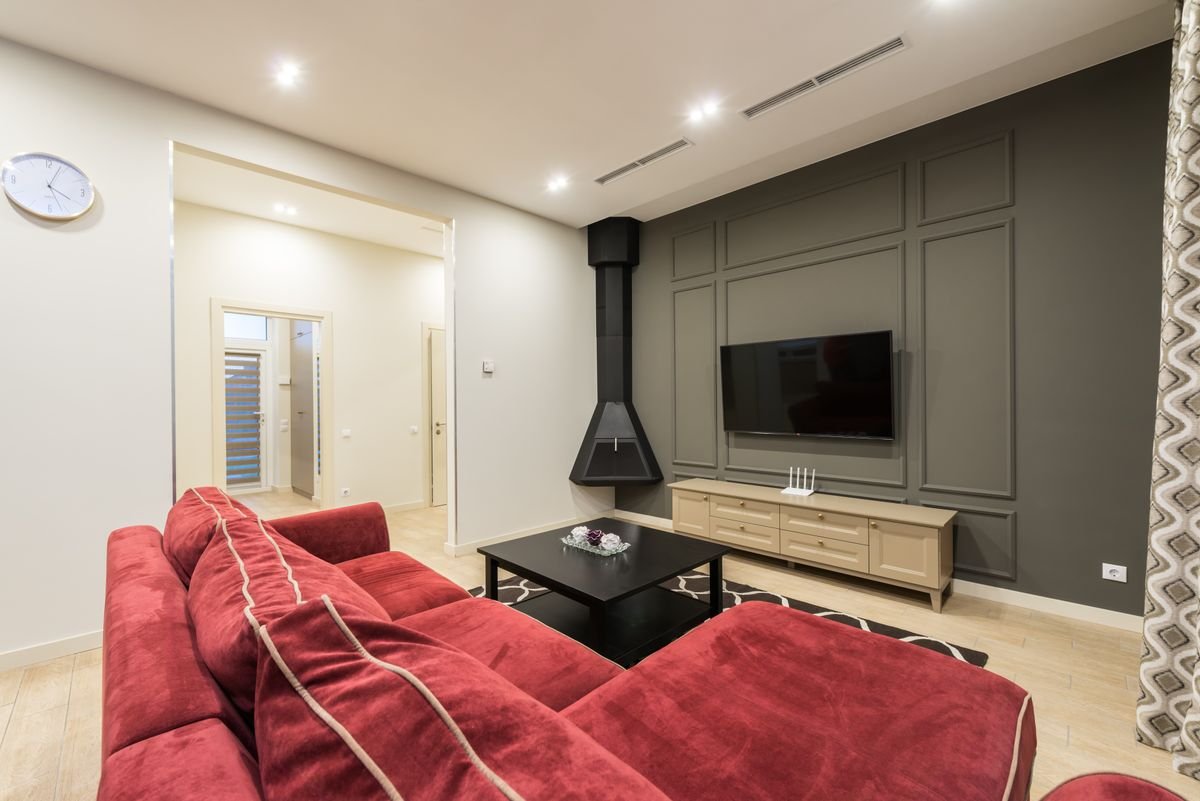
36. Peel-and-Stick Panel Wall
Style: Faux texture | Best for: Renters wanting the slat or brick look | Price feel: Budget
What it is: Adhesive panels imitating brick, stone, or slats stick straight onto a smooth wall and peel off at move-out. In the photo, a brick-look wall carries a mounted TV with the presence of real masonry. Quality varies, so buy the thickest foam or PVC versions and order a sample first — the good ones fool everyone except the person who hung them.
How to do it:
- Cover the TV zone plus a margin, keeping seams away from the screen’s edges
- Start from the center line and work outward so cuts land in the corners
- Mount the TV through the panels into studs — the panels themselves hold nothing
- Warm panels with a hairdryer at removal to release the adhesive cleanly
Pro tip: Faux-brick and slat patterns hide seams best; flat stone prints show every join.
Avoid this: Avoid sticking panels over flaking paint or damp plaster — they will fall.
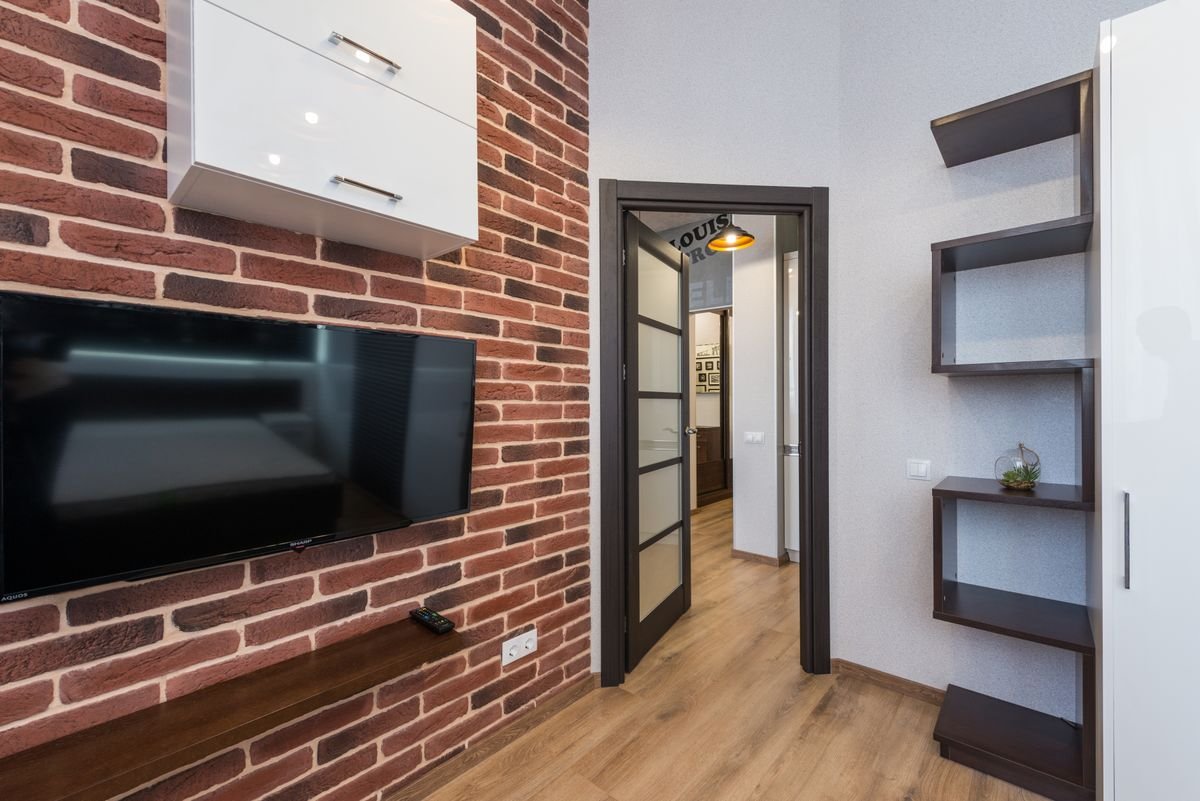
37. No-Drill TV Stand Wall
Style: Renter basic | Best for: Strict leases and first homes | Price feel: Budget
What it is: The TV stays on its stand or a low cabinet, but the wall behind gets the full treatment — paint block, art, a shelf resting on the cabinet — so the composition still reads as a TV wall. The photo’s TV on a white cabinet against a styled wall is the template. Among no-drill living room tv wall ideas, this is the safest: landlords cannot object to furniture.
How to do it:
- Choose a stand or cabinet at least as wide as the TV, ideally 12 inches wider
- Hang one large art piece or a pair above the screen using adhesive strips rated for the weight
- Bundle cables in a cable box on the cabinet so the “no-drill” wall stays clean
- Set the TV’s feet near the cabinet’s back edge to close the visual gap to the wall
Pro tip: An arcing floor lamp gives the stand setup mounted-wall height.
Avoid this: Avoid a stand narrower than the screen — wobble risk and visual imbalance in one.
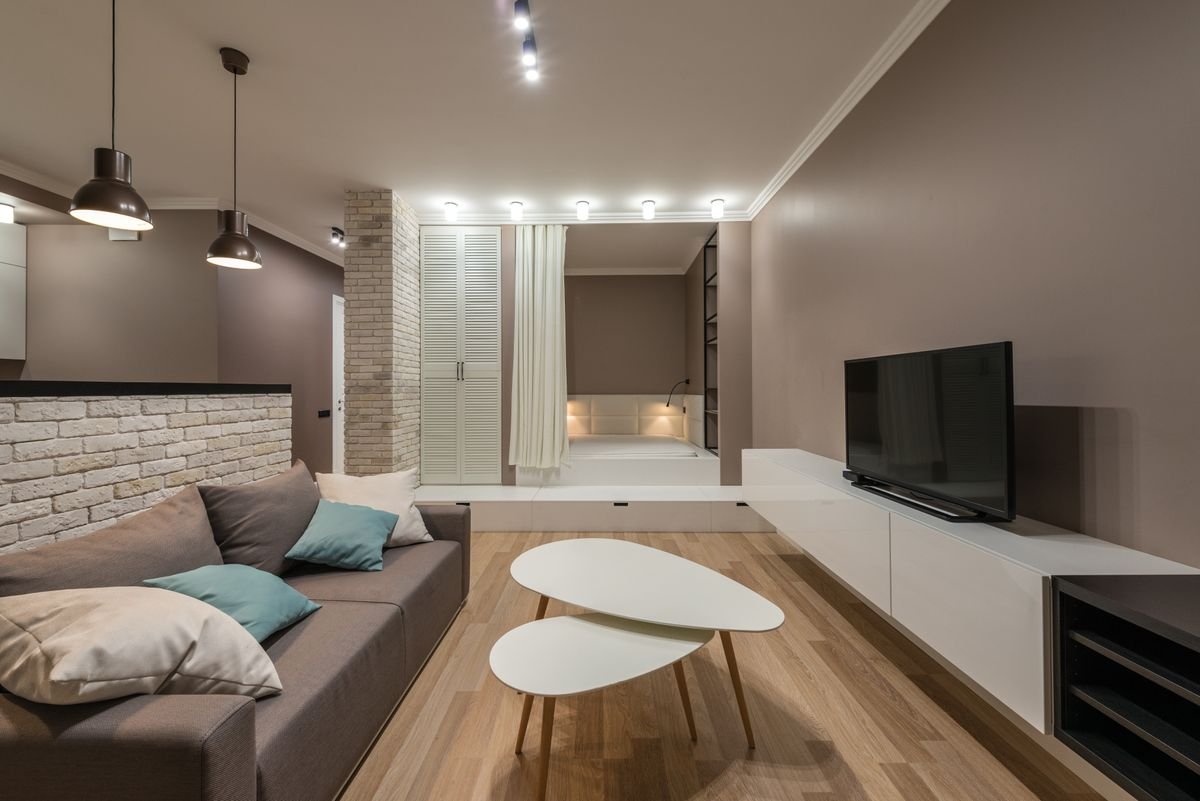
38. Flat-Pack Media Unit Hack
Style: Budget custom-look | Best for: IKEA-rich homes and DIYers | Price feel: Budget
What it is: Standard flat-pack cabinets and shelves, combined and trimmed, fake a built-in media wall for a fraction of the joinery price. Add skirting at the base, a cornice strip at the top, and one paint colour over everything, and the seams disappear. The photo’s tidy TV console setup shows the neatness aimed for — nobody guesses the price.
How to do it:
- Plan the run on paper: low cabinets center, shelf towers at the ends
- Screw units to each other and anchor the run to studs before adding trim
- Fill the gaps at the wall edges with scribe strips for the fitted look
- Prime laminate properly (shellac-based primer) before painting, or the finish will peel
Pro tip: Upgrading just the handles to solid brass lifts the whole wall.
Avoid this: Avoid mixing two white finishes side by side — lamplight exposes the mismatch.
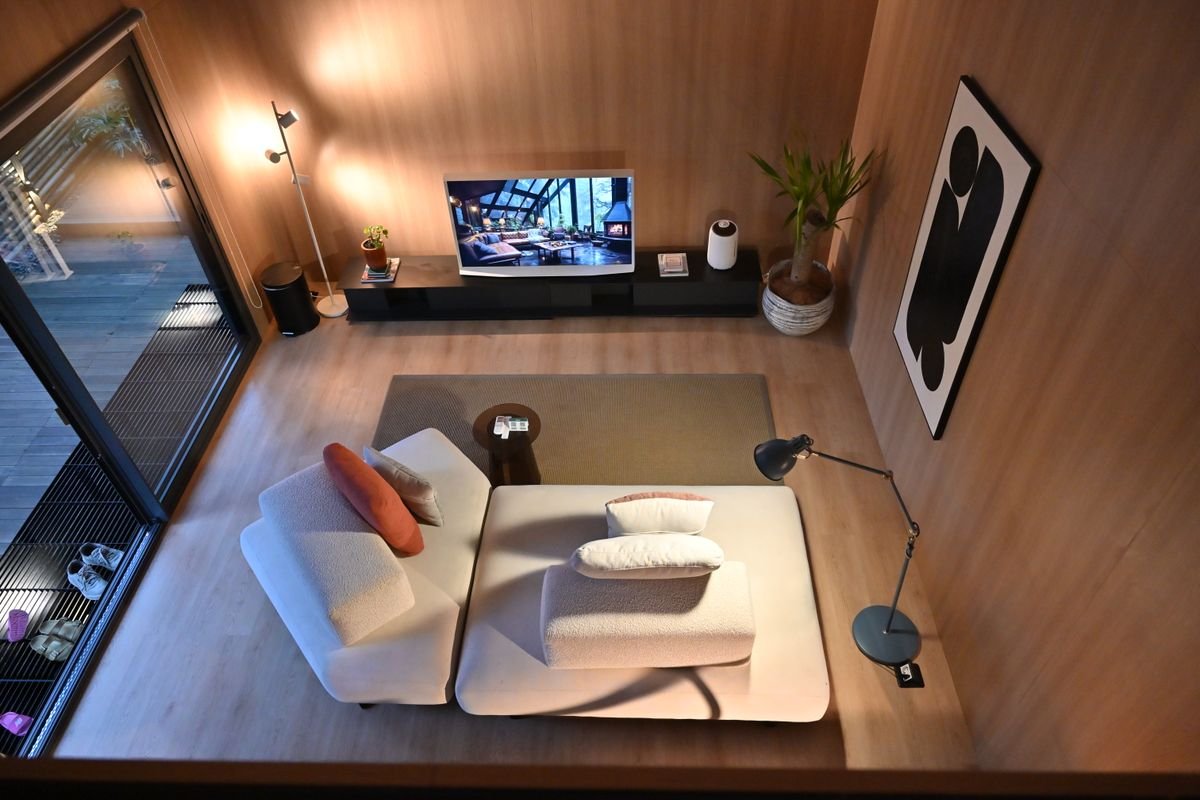
39. Fabric & Curtain Backdrop
Style: Soft layered | Best for: Renters and boho-leaning rooms | Price feel: Budget
What it is: Floor-length curtains behind the TV zone soften the wall, hide a multitude of rental sins, and improve the room’s sound. In the photo, light curtains frame a living room’s TV wall with exactly this softness. Hang the fabric from a ceiling track or slim rod, and the screen floats before a theatre-worthy backdrop.
How to do it:
- Run the curtain 12–20 inches wider than the TV zone on each side, floor to ceiling
- Choose a matte, textured weave (linen-look, bouclé) in a tone near the wall colour
- Keep fabric 6 inches clear of the TV’s vents and any heat source
- Let the TV stand or mount in front; the curtain needs no fixings beyond the track
Pro tip: A dark curtain behind the screen boosts perceived contrast on movie nights.
Avoid this: Avoid sheer fabrics — they show every cable silhouette in daylight.
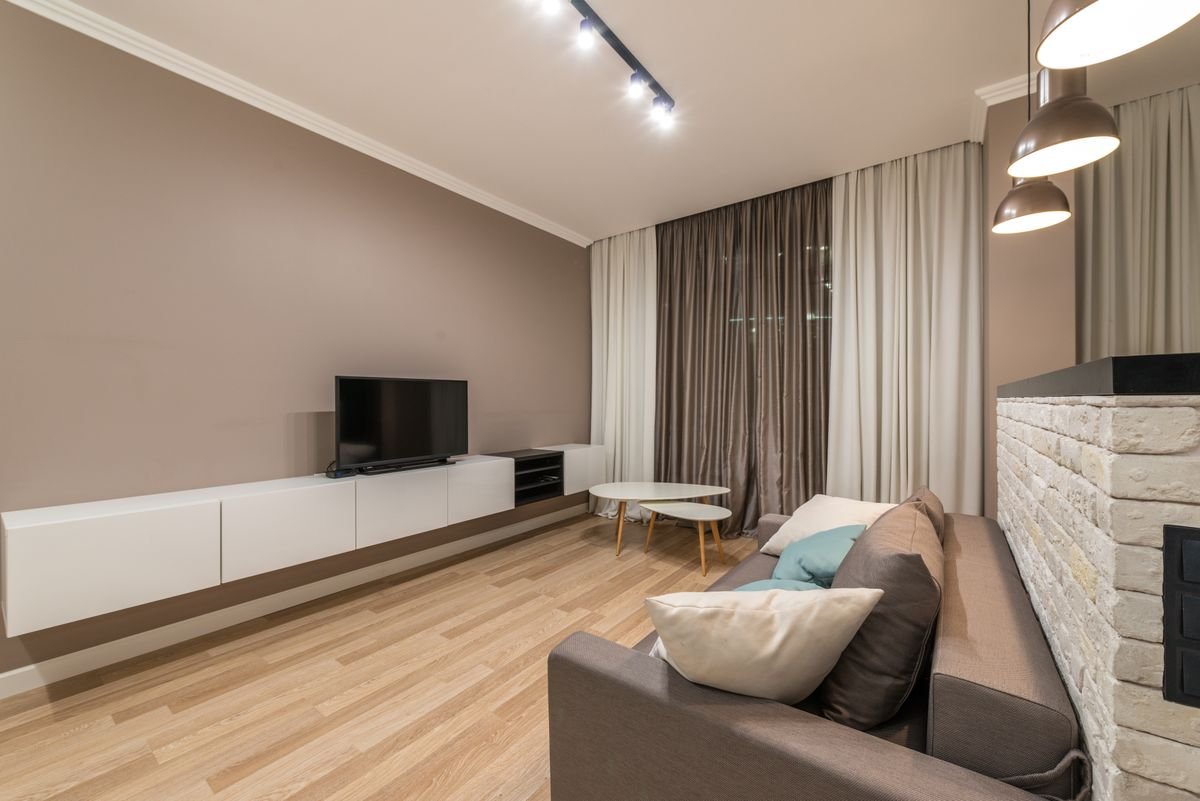
40. LED Backlight Glow Wall
Style: Ambient tech | Best for: Evening viewers and plain walls | Price feel: Budget
What it is: A bias-lighting LED strip on the back of the TV throws a soft halo onto the wall, floating the screen and easing eye strain in dark rooms. In the photo, ambient lighting around a living room TV shows the glow at work. It is the smallest intervention among living room tv wall ideas — twenty minutes, one strip — yet it transforms the wall every night.
How to do it:
- Stick the strip 2 inches in from the TV’s back edges, on all four sides
- Choose 6500K white bias light for accuracy, or warm white to match a cosy scheme
- Power it from the TV’s USB port so it switches on and off with the screen
- Set brightness so the halo is clearly dimmer than the picture itself
Pro tip: On a stand-mounted TV, add a second strip behind the console for two-level glow.
Avoid this: Avoid placing the strip visible from the sofa — you want glow, not source.
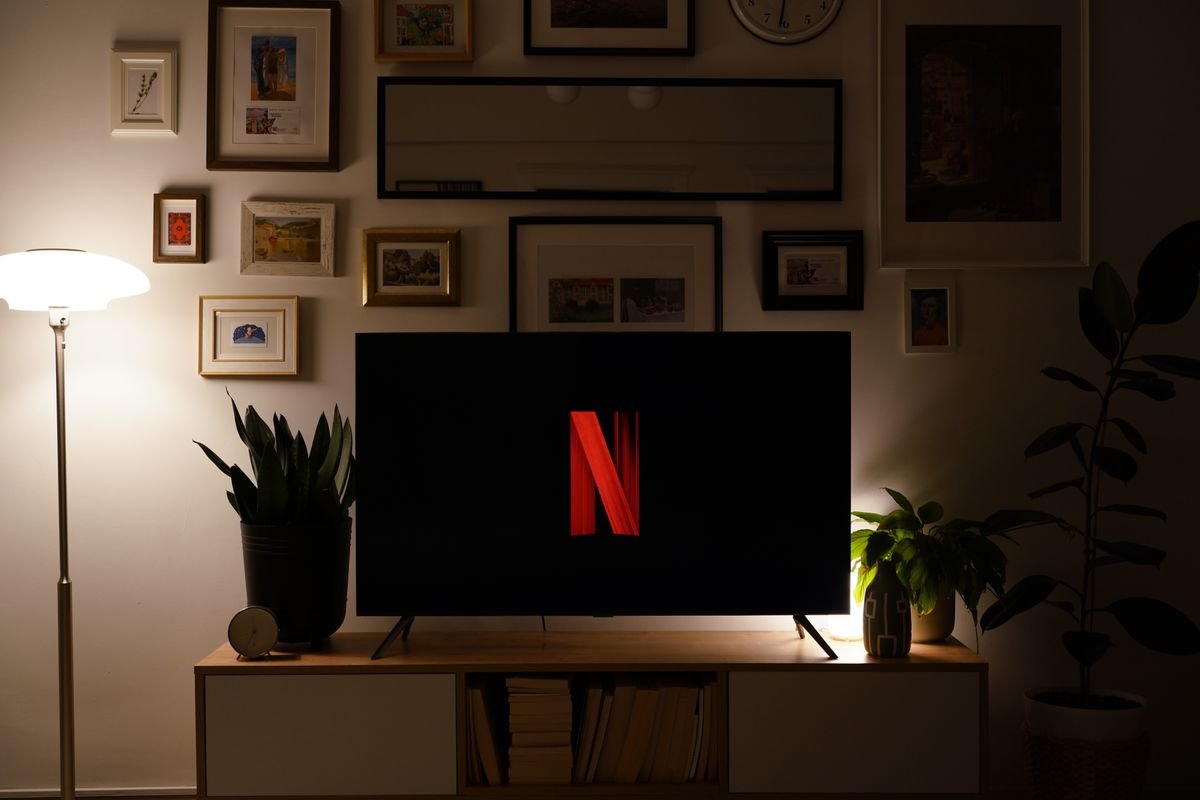
TV Mounting Height & Viewing Distance Guide
Get the height wrong and even the best wall fails. The comfortable rule: screen center at seated eye level — about 42 inches from the floor for a standard sofa. On a console, keep the TV’s bottom edge 4 to 6 inches above the surface, leaving room for a soundbar and settled proportions.
For viewing distance, use the screen’s diagonal as your ruler: about 1.5 to 2.5 times the diagonal suits most people — roughly 6.5 to 10.5 feet for a 55-inch TV, 8 to 13 feet for a 65-inch. Modern 4K screens forgive the closer end of that range. Most living room tv wall ideas assume these distances; Wikipedia’s home theater page goes deeper for dedicated rooms.
Height mistakes are the ones your neck reports first. If the screen center rises more than about 15 degrees above your seated eye line, expect strain on long films — why fireplace mounting (idea 30) benefits from a pull-down mount. Tilt brackets help: angle the screen down 5 to 10 degrees. Plan cables with height, too — a recessed power and HDMI box behind the screen is what makes a mounted TV look wireless. Today’s slim sets owe that float to the flat-panel display: a screen a couple of inches deep can sit almost flush.
Planning Checklist: Before You Build Your TV Wall
Run this checklist before you order a single panel — most living room tv wall ideas go wrong in the planning, not the building.
- Measure the wall width and height, the screen, and the viewing distance from the sofa
- Find and mark every stud (brackets and heavy shelves must land in studs or masonry)
- Plan power and HDMI positions, and the cable route between them
- Mark the screen center height (about 42 inches) with painter’s tape — live with it a day
- Check ventilation: consoles and receivers need airflow, and TVs need clearance from heat sources
- List your storage honestly — every device, game, and cable that the wall must hide or hold
- Set the budget order: mount and cable work first, structure second, decor last
- If renting, check your lease before any drilling — then pick from the renter section
Frequently Asked Questions
How high should a TV be mounted in the living room?
For most living room tv wall ideas, aim for screen center at about 42 inches — seated eye level on a standard sofa. Over a console, keep the bottom edge 4 to 6 inches above the surface. Fireplace mounting runs higher, so pair it with a tilting or pull-down mount.
How do I hide TV cables without opening the wall?
Use a paintable surface raceway from behind the TV down to the console — painted the wall colour, it nearly disappears. A cable box on the console hides the power strip and excess length. Renters get the full effect with zero holes; owners can upgrade to an in-wall kit (idea 13) later.
Can a TV wall work in a small living room?
Yes — small rooms often gain the most. Floating consoles (idea 17), corner units (idea 16), and paint-only features (idea 35) add design without eating floor space, and shorter distances suit 43 to 55 inch screens. The minimalist and renter sections were chosen with small rooms in mind: light palette, floating furniture, closed storage.
Is it OK to put a TV above a fireplace?
Usually, with two cautions. First, heat: check the wall above the mantel after an hour’s fire — if it feels hot to your palm, the TV needs a deeper mantel, a heat shield, or a different wall; makers advise against sustained exposure above about 100°F (38°C) at the screen. Second, height: fireplace living room tv wall ideas sit above ideal eye level, so use a tilting or pull-down mount.
How much does a built-in media wall cost?
A flat-pack hack (idea 38) can land between $400 and $1,200 in materials; semi-custom cabinet runs typically sit between $1,500 and $4,000; fully bespoke joinery with lighting and stone commonly runs $5,000 and upward. Among living room tv wall ideas, built-ins are the biggest spend — and the biggest storage payoff per square foot.
What is the most renter-friendly way to make a TV wall?
Keep the TV on a stand or easel (ideas 23 and 37) and style the wall with reversible layers: a painted block if your lease allows paint, peel-and-stick panels, leaning art, and LED backlighting. Every element removes in an afternoon, deposit worries included — the budget section’s living room tv wall ideas were designed for exactly this.
A TV wall is never really finished — it grows with your art, your plants, and your next screen. Start with the living room tv wall ideas that match your wall and your lease, get the height and cables right, and let the styling evolve. For the surrounding walls, our living room wall decor ideas and living room wallpaper ideas help the TV wall feel part of a whole room. Happy building — movie night is about to look a lot better.
