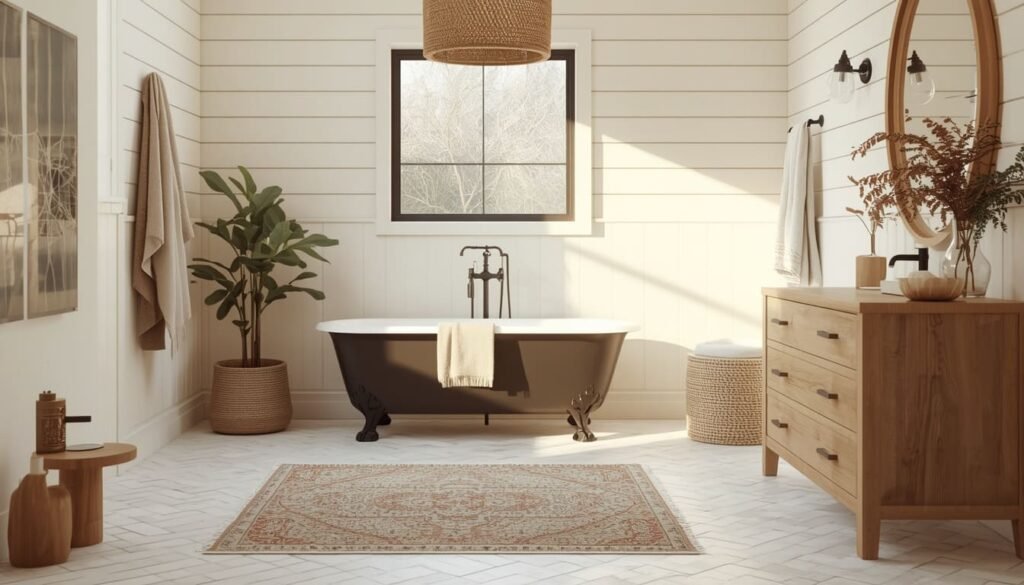
There’s something about a farmhouse bathroom that just feels like a exhale the kind of space where you actually want to linger instead of rushing out. American homeowners have fallen hard for this style, and honestly, I get it. It’s the only design aesthetic that makes a bathroom feel warm, lived-in, and intentional all at once. Whether you’re working with a cramped guest bath or a spacious master suite, these 20 farmhouse bathroom ideas will show you exactly how to pull off that fresh, cozy look without blowing your budget or making it look like a rustic cliché.
My Design Notes
A few years back, I worked with a young couple in Nashville who had just bought a 1987 ranch style home. Their master bathroom was rough pink tile, a blinding Hollywood vanity strip light, and a builder grade oak vanity that had seen better days. Their total budget? $1,800. Most designers would’ve walked away. I rolled up my sleeves.
We kept the existing tile completely untouched and worked around it. One shiplap accent wall, a pair of matte black sconces to replace that terrible light strip, a repurposed console table as a secondary vanity, and a vintage Turkish rug sourced from an Etsy shop. That was it. Total spend came to $1,640.
When the couple sent me the after photos, their neighbors genuinely thought they’d done a full gut renovation. That Nashville bathroom taught me something I tell every client now farmhouse style rewards resourcefulness far more than it rewards money. You don’t need a massive budget. You need the right moves.
Stunning Farmhouse Bathroom Design Secrets Every American Homeowner Needs to Know
1. Start With Shiplap But Know Your Wall Type First
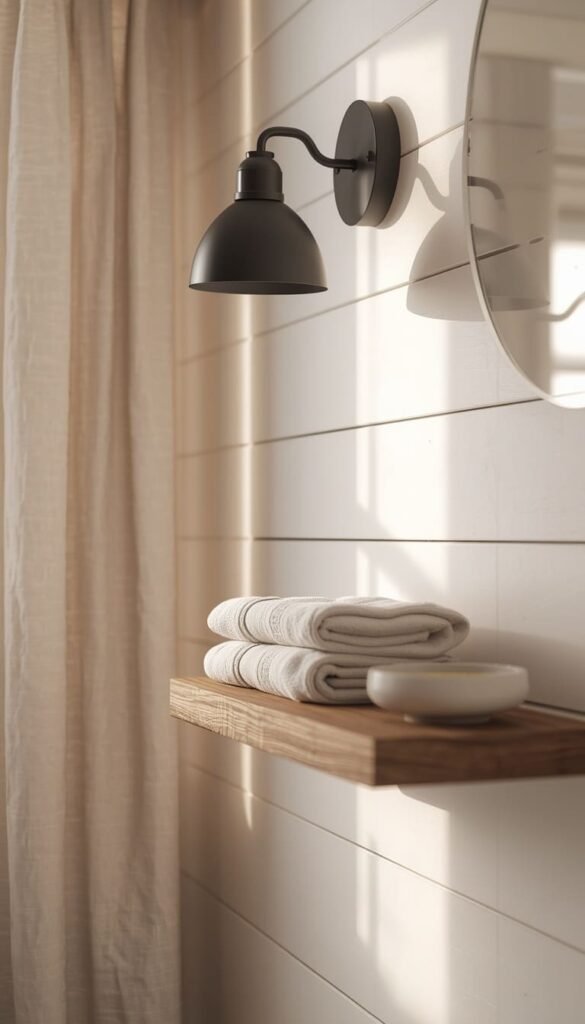
Shiplap is the backbone of farmhouse bathroom style and for good reason. It adds instant texture, warmth, and that unmistakable “this space has character” feeling that no paint color alone can achieve. But here’s what most inspiration boards won’t tell you: not every wall can handle it the same way. In a bathroom, moisture is your biggest enemy, and raw wood shiplap without proper sealing will warp, swell, and look terrible within a year.
My go-to recommendation for bathrooms is MDF shiplap boards primed and painted with a moisture resistant paint, or PVC shiplap if you’re doing a shower adjacent wall. Real wood works beautifully too just make sure it’s sealed on all six sides before installation, not just the face. One thing I always tell my clients: the wall behind your vanity or on a non shower facing side is the safest and most impactful place to start.
2. The Clawfoot Tub Worth It or Overrated
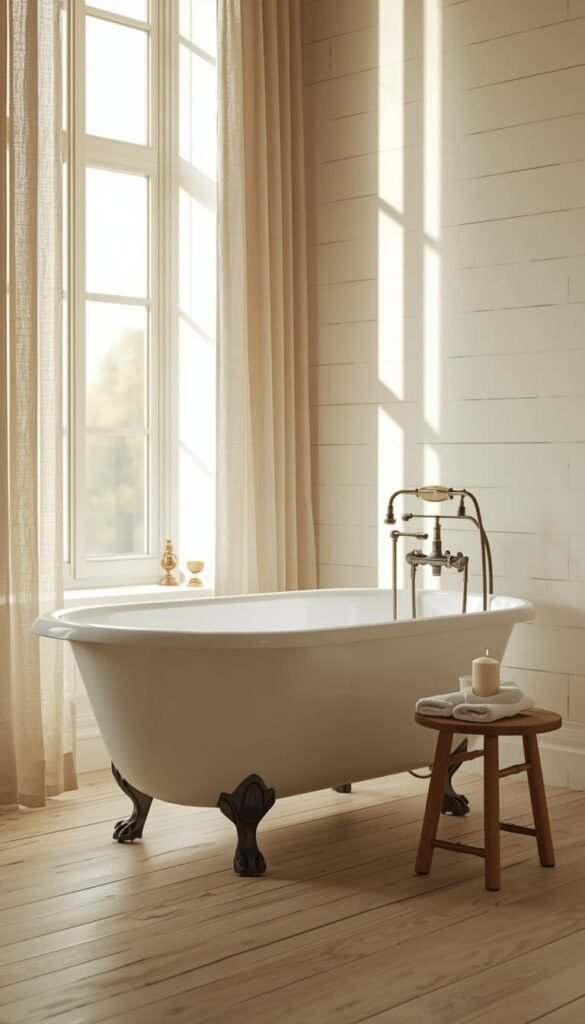
Let me be honest with you clawfoot tubs are stunning, and they photograph like a dream. They are also heavy, expensive to refinish, and a little uncomfortable for everyday bathing if you’re over 5’8″. That said, for the right bathroom and the right homeowner, nothing else comes close to that romantic, vintage farmhouse feeling.
A few things worth knowing before you commit:
- A genuine antique clawfoot can run anywhere from $400 to $2,500 depending on condition and sourcing. Reproduction models start around $800 and go well beyond $3,000.
- Freestanding tub fillers (the floor-mounted faucets) are a separate purchase and can add another $300 to $800 to your budget.
- Refinishing a worn clawfoot tub costs between $350 and $600, and needs to be redone every 5 to 10 years.
If you love the look but not the price, a freestanding acrylic tub with vintage style claw feet gives you 80% of the visual impact at about half the cost.
3. Go Matte Black on Every Fixture
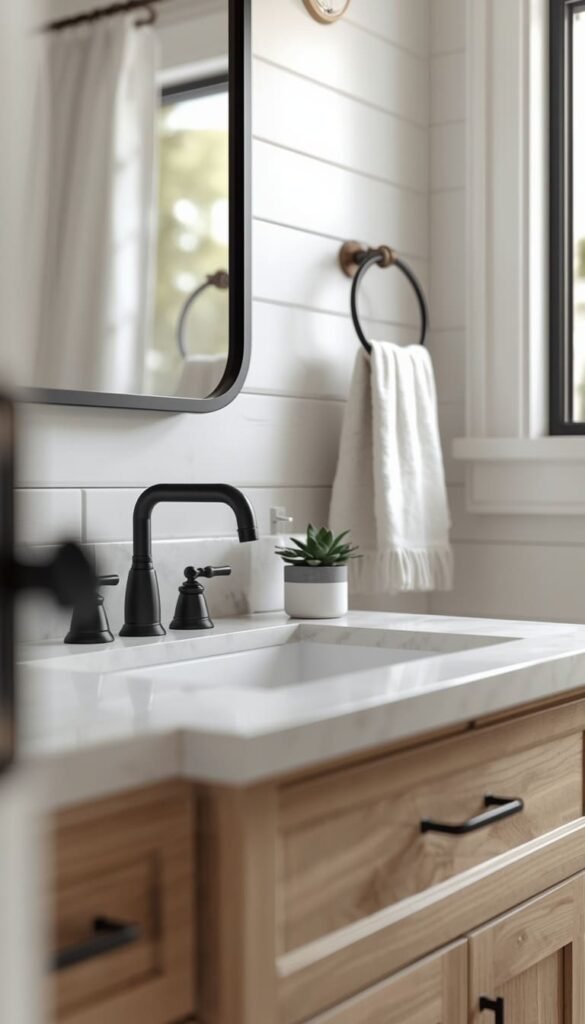
If there’s one finish decision that pulls a farmhouse bathroom together faster than anything else, it’s committing to matte black hardware. Towel bars, faucet, shower head, cabinet pulls, mirror frame when these all speak the same language, the room looks intentional and designed rather than assembled piece by piece. I’ve seen this single change take a bathroom from “fine” to “wow” without touching a single tile.
The key word here is matte, not glossy black. Matte black has that understated, slightly industrial edge that complements natural wood and white shiplap perfectly. Polished black can look a little cold and stark in a farmhouse setting. And a quick trick I’ve learned over the years even if your existing fixtures are brushed nickel, you can swap just the faucet and light fixture first. Those two alone will shift the entire energy of the room.
4. Swap the Builder Vanity for a Repurposed Dresser
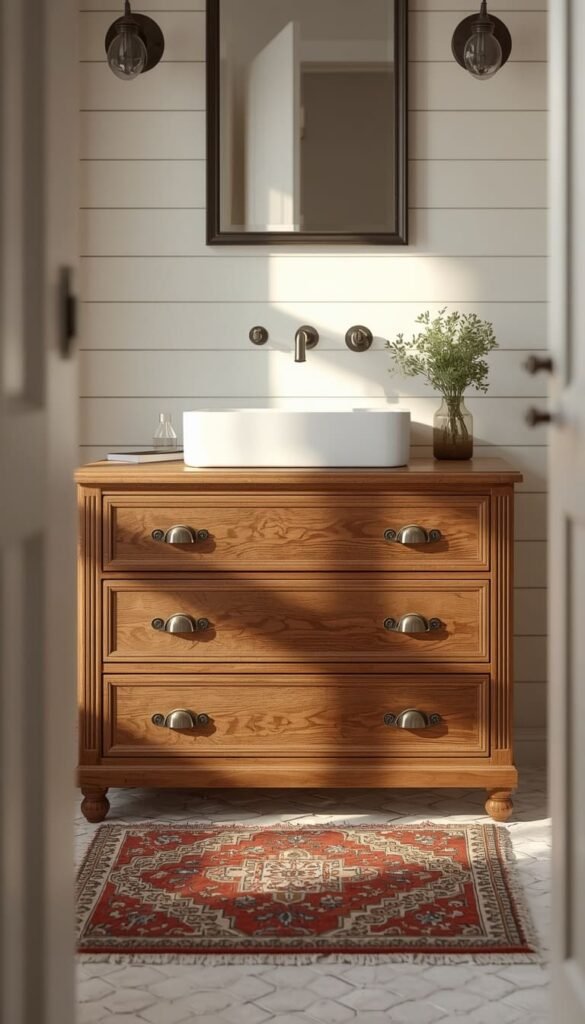
This is one of my favorite farmhouse bathroom upgrades because it is both budget friendly and genuinely one of a kind. That generic builder vanity sitting in millions of American bathrooms? It doesn’t have to stay. A vintage dresser or buffet, properly waterproofed and fitted with an undermount sink, instantly becomes the most interesting piece in the room.
Here’s how I approach it with clients:
- Shop Facebook Marketplace, Craigslist, or local estate sales for solid wood dressers in the $50 to $200 range. Avoid particleboard it won’t survive bathroom humidity.
- Have a plumber cut the drain and supply lines before you commit to a placement. It’s cheaper to plan ahead than to move it later.
- Seal the top with a waterproof epoxy or have a slab of marble, butcher block, or soapstone cut to fit.
One thing to watch out for is drawer depth. If the plumbing runs through the center, you may lose access to one or two drawers entirely. Plan your storage accordingly and honestly, even a dresser with two working drawers beats a standard vanity for character every single time.
5. Farmhouse Sink in the Bathroom Yes It Works
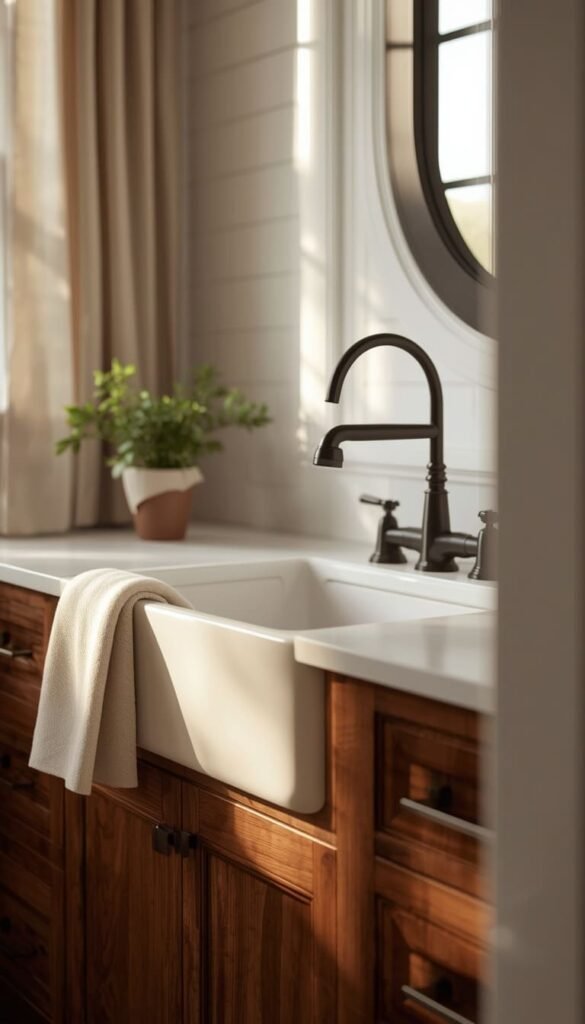
Most people associate the apron-front farmhouse sink with kitchens, and I completely understand why. But I’ve installed them in bathrooms several times now, and the reaction is always the same pure delight. There’s something about that deep, wide basin that feels both practical and undeniably charming in a farmhouse bathroom setting. It works especially well in a master bath or a larger powder room where the vanity is meant to be a statement piece.
When it comes to material, you’ve got two main contenders:
- Fireclay is the classic choice durable, easy to clean, and available in crisp white that pops against dark wood vanities. Budget around $400 to $900 for a quality fireclay sink.
- Soapstone has a richer, more moody feel with its dark gray tones. It’s naturally antimicrobial and incredibly durable, but it does require occasional oiling to maintain its finish. Expect to spend $600 to $1,500.
One thing worth knowing apron front sinks require a custom or semi custom vanity cabinet built specifically to accommodate them. You can’t just drop one into a standard vanity frame. Factor that into your budget planning from the start, and you’ll avoid a very frustrating mid project surprise.
If you could change just one thing in your bathroom this weekend, what would it be the lighting, the vanity, the walls, or something else entirely?
6. Shiplap the Ceiling Not Just the Walls
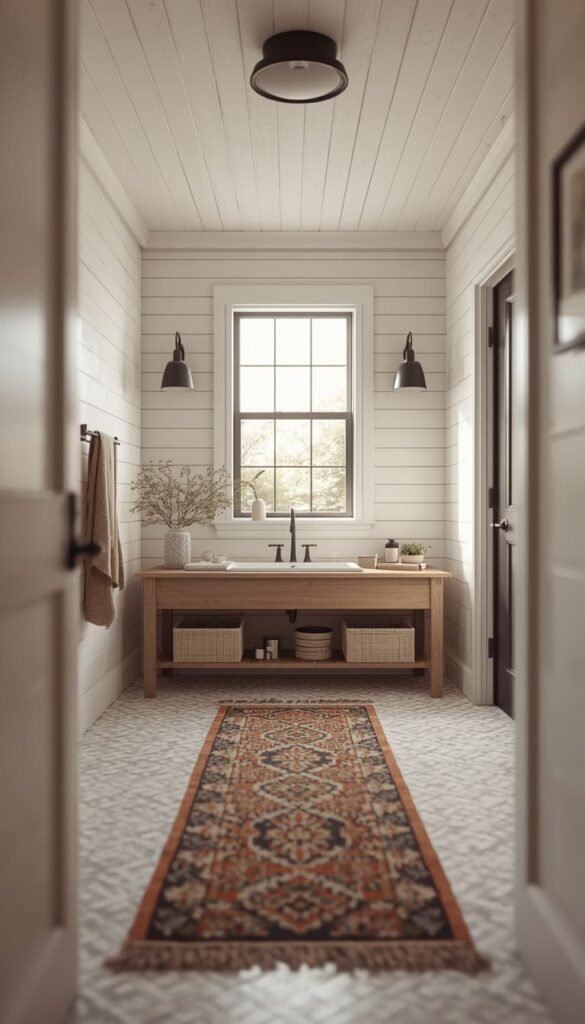
Here’s an idea that separates a truly thoughtful farmhouse bathroom from one that just followed a checklist take the shiplap up to the ceiling. I started recommending this a few years ago and the response from clients has been overwhelming. It creates this incredible sense of enclosure and coziness that wall shiplap alone simply cannot achieve. It feels like a cabin, in the best possible way.
It works particularly well in bathrooms with lower ceilings because it draws the eye upward and makes the space feel intentional rather than cramped. Pair a shiplap ceiling with white walls and warm wood accents below, and you’ve got a layered, magazine worthy look that took real thought to put together. A quick trick here paint the ceiling shiplap the same white as your walls for a seamless, airy feel, or go one shade warmer to add subtle depth.
Top 6 Farmhouse Bathroom Ideas:
| Idea | Estimated Price | Maintenance |
|---|---|---|
| Shiplap Accent Wall | $200 – $600 | Medium |
| Clawfoot Tub | $800 – $3,000+ | High |
| Repurposed Dresser Vanity | $150 – $500 | Medium |
| Matte Black Fixtures | $300 – $900 | Low |
| Vintage Wool Rug | $60 – $300 | Medium |
| Reclaimed Wood Accents | $100 – $400 | High |
7. Warm Wood Tones The Right Species for Humid Spaces
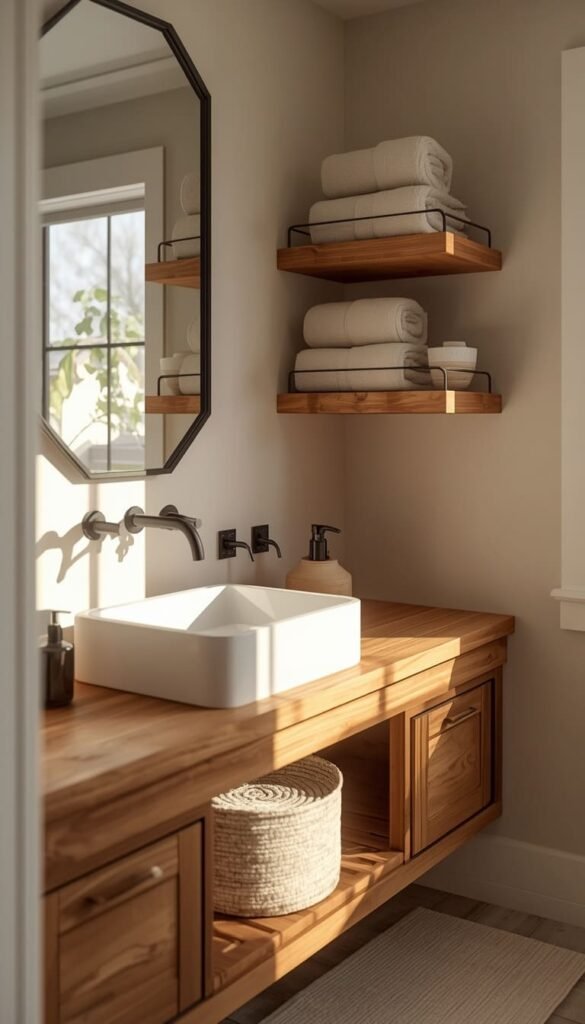
Wood in a bathroom is one of those design choices that looks absolutely beautiful and requires a serious conversation about maintenance. I’m not here to talk you out of it I love wood in bathrooms but I do want to make sure you choose the right species so you’re not dealing with warping or mold two years down the road.
My top recommendations for bathroom safe wood species:
- Teak is the gold standard. It’s naturally water-resistant, dense, and ages beautifully. It’s also the most expensive option, typically running 20 to 30% more than other hardwoods.
- White oak is my personal favorite for vanities and open shelving. It has a beautiful tight grain, takes stain well, and handles humidity better than red oak or pine.
- Bamboo is technically a grass, not a wood, but it performs incredibly well in moist environments and has a clean, slightly exotic look that works in modern farmhouse settings.
Whatever species you choose, sealing is non negotiable. Use a penetrating oil finish or a water-based polyurethane with at least three coats on any surface that will see regular moisture exposure. And never I mean never leave standing water on a wood vanity top. It will stain and swell no matter how well it’s sealed.
8. Black and White Farmhouse The Timeless Formula
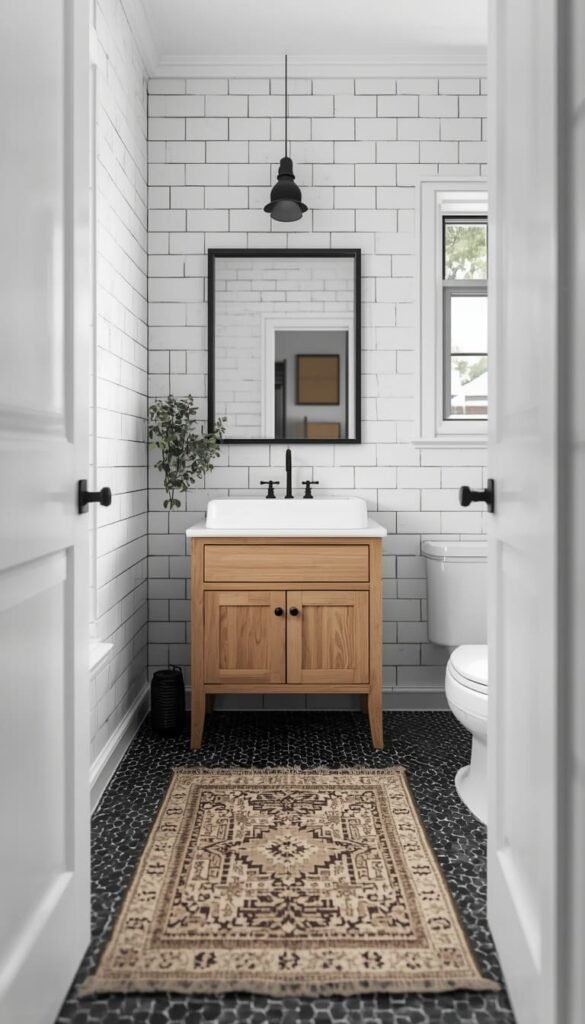
There is a reason this combination never goes out of style. Black and white in a farmhouse bathroom is crisp, clean, and endlessly versatile it works in a tiny powder room just as confidently as it does in a sprawling master bath. The trick is in how you distribute the two tones and which textures you bring in to keep it from feeling flat or clinical.
The formula I use with clients is simple: white as the dominant base walls, ceiling, large tile fields black as the accent layer through fixtures, mirror frames, window hardware, and cabinet pulls. Then warm it all up with a natural wood element, whether that’s a vanity, a floating shelf, or even just a wooden stool. That third element is what makes it feel farmhouse rather than just modern.
For tile specifically, classic white subway tile with dark grout is a combination that photographs beautifully and ages gracefully. One thing to watch out for though dark grout does show soap scum and hard water deposits more visibly than light grout. A quick weekly wipe down keeps it looking sharp, but if you’re a low maintenance household, go with a medium gray grout instead. Same visual effect, far more forgiving in real life.
9. Vintage Rugs in the Bathroom The Right Way
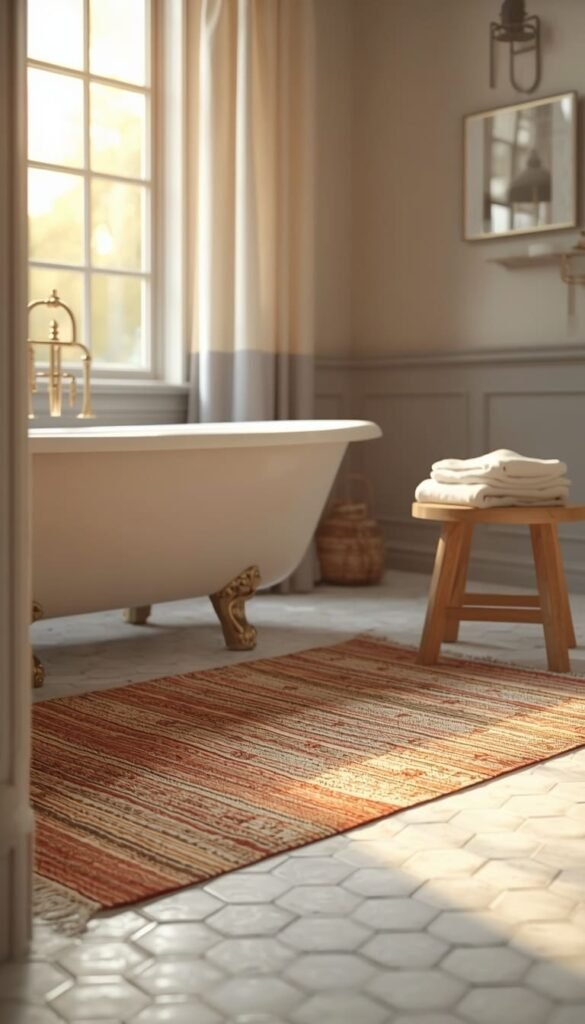
I know what you’re thinking a rug in the bathroom? It sounds like a mildew disaster waiting to happen. And honestly, if you grab a cheap cotton bath mat and call it a vintage rug, you’d be right. But a genuine wool rug, chosen thoughtfully and maintained properly, is one of the single most impactful things you can add to a farmhouse bathroom. It brings color, texture, and that layered “collected over time” feeling that no tile or paint can replicate.
The secret is in the fiber. Wool is naturally water repellent and resistant to bacteria in a way that cotton and synthetic fibers simply aren’t. Go for a low pile or flatweave style Turkish kilims and vintage Persian runners are my personal favorites for farmhouse bathrooms. They dry faster, lie flat without curling, and look incredible against wood floors or white hex tile.
A few practical rules I always share:
- Place the rug away from the direct splash zone of the shower or tub.
- Hang it over the tub edge or a drying rack after heavy use days to let it breathe.
- Spot clean immediately never let moisture sit in the fibers overnight.
Etsy, eBay, and local estate sales are your best sourcing options. Budget anywhere from $60 to $300 for a quality vintage piece in a bathroom-appropriate size.
10. Lighting That Actually Flatters Sconce Placement 101
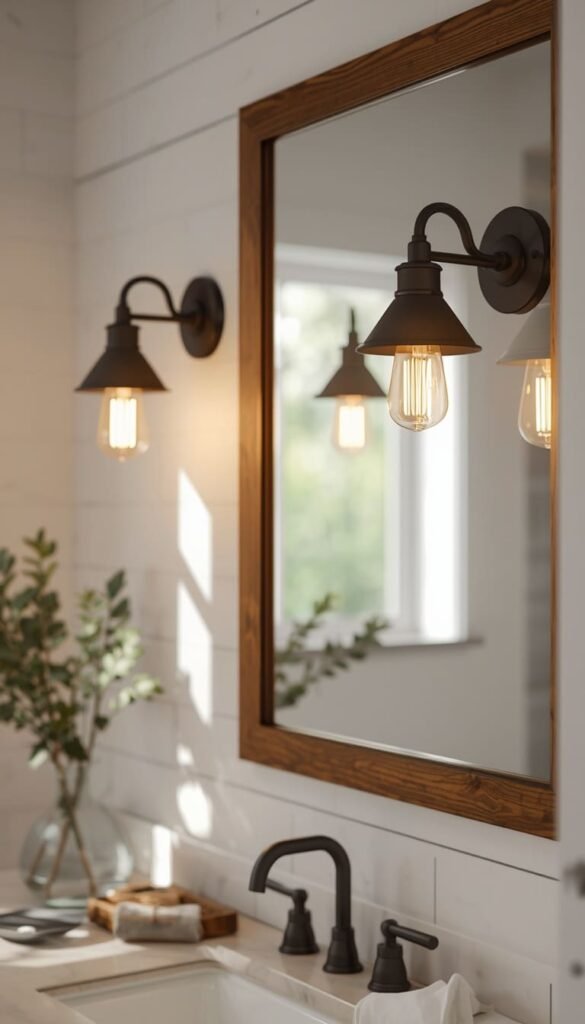
Bad lighting is the silent killer of otherwise beautiful bathrooms. I’ve walked into farmhouse bathrooms that had gorgeous shiplap, a perfect vanity, and stunning tile and they still felt off because the lighting was wrong. A single overhead fixture will never give you the warm, even light that a well designed farmhouse bathroom deserves. Sconces are the answer, but placement matters enormously.
The rule I follow is simple: mount vanity sconces at eye level, roughly 60 to 65 inches from the floor to the center of the fixture. Position them on either side of the mirror rather than above it whenever possible. Side mounted sconces eliminate the unflattering shadows that overhead lighting casts on your face and in a farmhouse bathroom, they also add that warm, candlelit glow that makes the whole space feel intentional.
For bulb choice, go warm white in the 2700K to 3000K range. Anything cooler than that will fight against your wood tones and cream walls, making the whole space feel colder than it should. And if you love the look of an Edison filament bulb which I absolutely do in farmhouse settings just know they’re decorative rather than functional. Layer them with recessed lighting above the shower for actual task illumination.
Are you team clawfoot tub or team walk in shower and what’s the one farmhouse element you absolutely cannot live without in your bathroom?
11. Reclaimed Wood Accents Without the Rot Risk
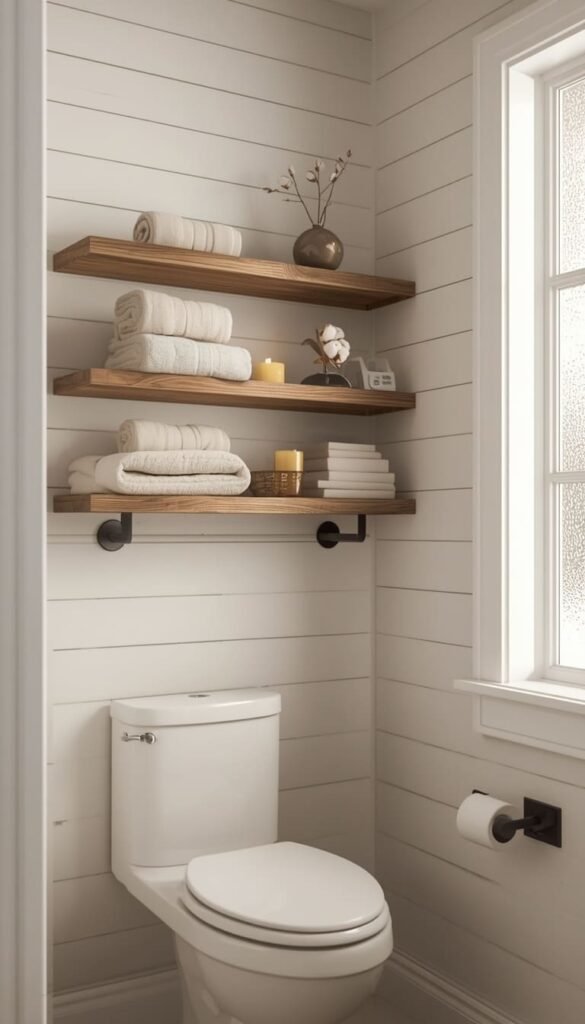
Reclaimed wood is one of those farmhouse elements that looks effortlessly authentic because it genuinely is. There’s a warmth and character in old barn wood or salvaged timber that no new material can fake. But I’ve also seen reclaimed wood installations go very wrong in bathrooms, and it almost always comes down to one thing: improper preparation.
Raw reclaimed wood is porous, often home to old moisture damage, and sometimes harboring mold spores you can’t see yet. Before any piece of reclaimed wood goes into a bathroom, it needs to be thoroughly dried, sanded, treated with a borate-based wood preservative, and sealed with at least two coats of a waterproof finish. This is not optional. It’s the difference between a beautiful accent wall that lasts a decade and one that starts smelling musty within eighteen months.
My favorite ways to use reclaimed wood in a bathroom without overdoing it:
- A single floating shelf above the toilet for display and storage
- A mirror frame built from reclaimed planks dramatic, personal, and surprisingly easy to DIY
- Open vanity legs or a console-style base under a vessel sink
Source from architectural salvage yards, Etsy shops specializing in reclaimed lumber, or even old fence boards from a local lumber yard. Just always ask about the wood’s history before you bring it home.
12. The Small Farmhouse Bathroom Playbook
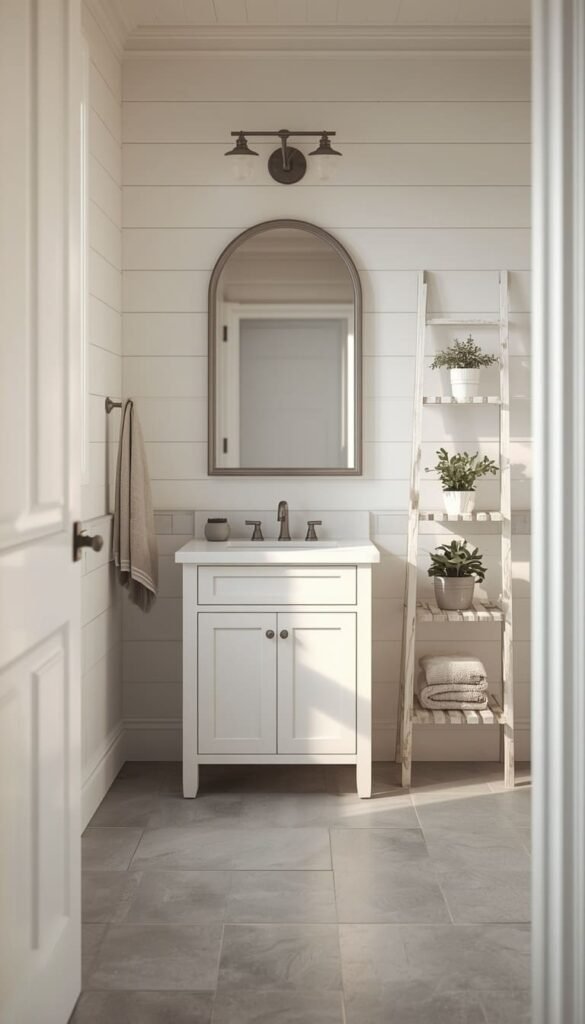
Small bathrooms are where farmhouse style either really sings or completely overwhelms a space. I’ve designed plenty of both, and the difference always comes down to restraint. The temptation in a small farmhouse bathroom is to pile in all the elements shiplap, clawfoot tub, vintage dresser vanity, rugs, gallery wall and the result ends up feeling cluttered rather than cozy. Cozy and cluttered are not the same thing.
Here’s the playbook I use for tight spaces specifically:
- Pick one statement piece and build around it. In a small bathroom, that might be a vintage inspired vanity, a bold wallpaper, or a beautifully framed mirror. One hero, supporting cast only.
- Go vertical with storage. A tall ladder shelf or a set of floating shelves draws the eye upward and keeps the floor clear, which makes any small room feel larger instantly.
- Use a large single mirror instead of two small ones. It reflects light, opens up the space visually, and feels more intentional than a pair of medicine cabinets.
- Keep the floor light. Dark floor tile in a small bathroom can feel heavy and cave like. White hex, light gray stone, or natural wood-look tile will keep things feeling open.
- Limit your wood tones to one. In a larger bathroom you can mix wood finishes beautifully. In a small space, two competing wood tones create visual noise. Pick one and commit.
13. Neutral Palette Zero Boring A Color Layering Method
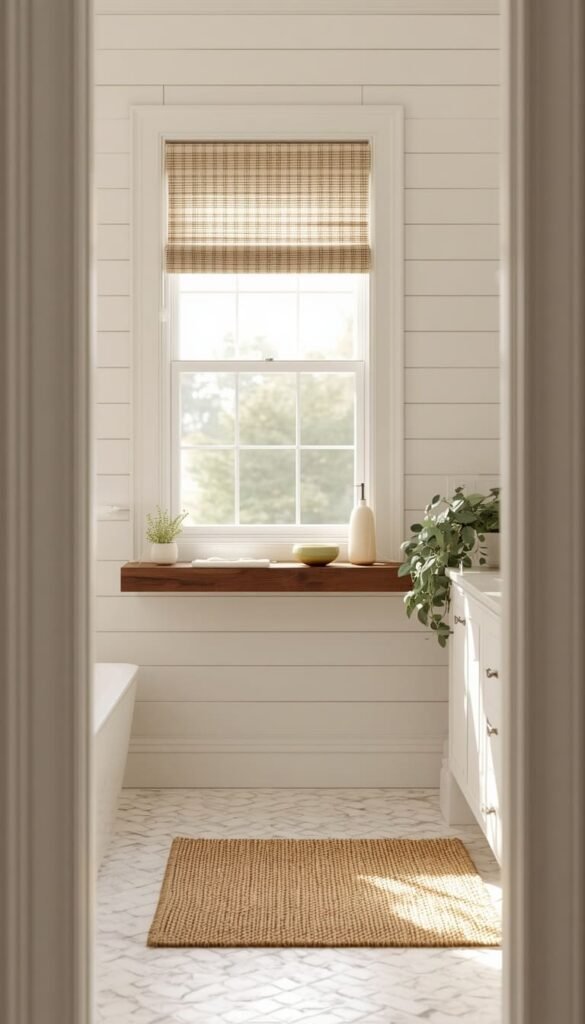
Neutral doesn’t have to mean flat. This is honestly one of the biggest misconceptions I run into when clients come to me with farmhouse bathroom inspiration boards they’ve chosen all the right individual elements but somehow the finished room feels lifeless. The problem is almost never the colors themselves. It’s the lack of tonal variation within those neutrals.
Here’s how I think about it: warm whites and cool whites are not the same color. Cream, ivory, linen, and bright white all read differently depending on your light source, your wood tones, and your tile choices. Mixing them intentionally a warm cream on the walls, a brighter white on the trim, an off white linen on the window treatment creates a layered, lived-in feeling that a single flat white simply cannot achieve.
The layering method I use with clients works in three steps:
- Start with your anchor tone. This is your wall color and largest surface. For farmhouse bathrooms I almost always lean warm Benjamin Moore White Dove, Sherwin Williams Alabaster, or Behr Antique White are my most reached for options.
- Add a contrasting texture in the same family. Natural linen towels, a woven basket, a jute bath mat these introduce visual interest without introducing color.
- Bring in one organic element with actual depth. A dark walnut shelf, a terracotta pot, a aged brass faucet. That single deeper tone is what gives the whole palette its dimension.
The result feels collected and warm rather than sterile which is exactly what a farmhouse bathroom should feel like.
14. Half Bathroom Powder Room Farmhouse Makeover
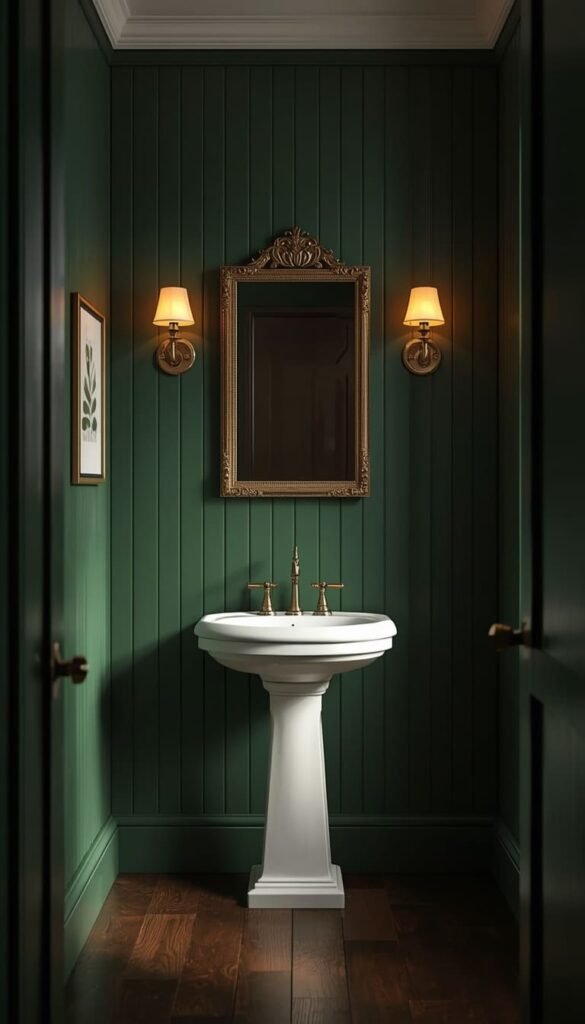
The powder room is honestly one of my favorite spaces to work with in a farmhouse remodel. It’s small, it sees limited moisture compared to a full bath, and because guests use it regularly, it’s the perfect place to take a design risk you might not feel comfortable with in your master suite. I’ve done some of my most creative farmhouse work in spaces no bigger than a closet.
The biggest opportunity in a powder room is the walls. Since you’re not dealing with a shower or heavy steam, you have far more material freedom here than in a full bathroom. This is where I’d go bold with a dramatic wallpaper, a deep moody paint color, or even a full shiplap treatment floor to ceiling. In a small space, committing fully to a look reads as intentional and sophisticated rather than overwhelming.
A realistic powder room farmhouse makeover on a tight budget might look like this:
- Swap the light fixture for a pair of matte black or aged brass sconces budget around $80 to $200 for a good quality set.
- Replace the builder mirror with a vintage framed or arch topped mirror from HomeGoods, TJ Maxx, or Facebook Marketplace typically $40 to $150.
- Add peel-and-stick shiplap wallpaper if you’re renting or want a commitment-free option a surprisingly convincing alternative that runs about $30 to $60 per roll.
- Swap out the faucet and cabinet hardware in a matching finish to tie everything together.
Total investment for a genuinely impressive powder room transformation? Realistically between $200 and $600. That’s one of the best design returns on investment in the entire house.
15. Wallpaper in a Farmhouse Bathroom Yes If You Do This
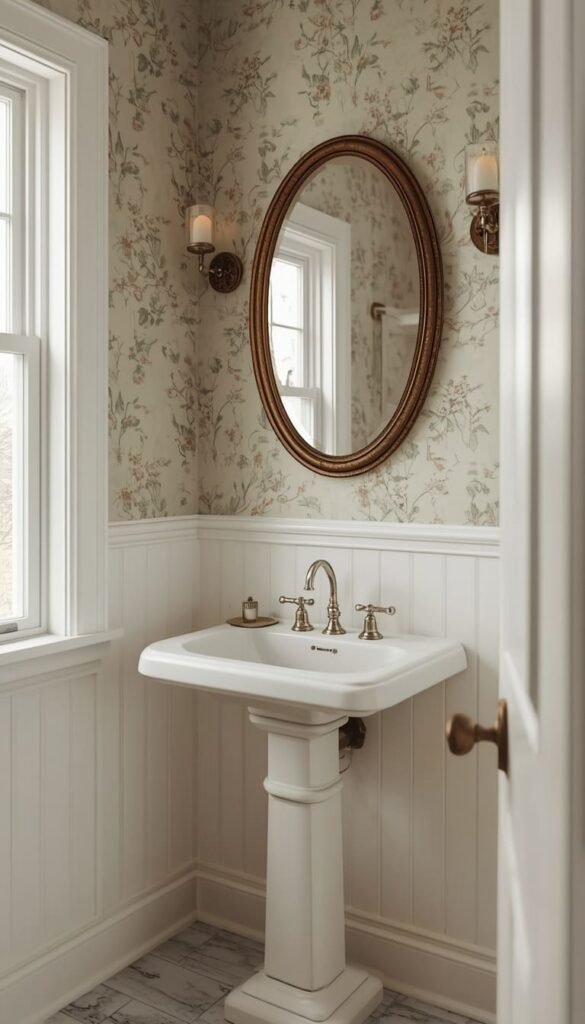
Wallpaper and bathrooms have a complicated history, and I’ll be the first to admit that a bad wallpaper installation in a humid space is a genuinely miserable thing to deal with. Peeling corners, bubbling seams, that faint musty smell behind the paper I’ve seen it all. But when it’s done right, wallpaper in a farmhouse bathroom is absolutely stunning. The key is choosing the right product and preparing the wall properly before a single strip goes up.
For full bathrooms with showers, I only recommend vinyl-coated or solid vinyl wallpapers they’re moisture resistant, scrubbable, and won’t absorb steam the way traditional paper does. For powder rooms with no direct moisture exposure, you have much more freedom and can consider fabric-backed options or even the beautiful grasscloth-look papers that photograph incredibly well.
Pattern-wise, farmhouse bathrooms look incredible with:
- Soft botanical or floral prints in muted greens, dusty blues, or warm terracottas
- Classic ticking stripe in navy or black on white for a crisp, country feel
- Subtle toile patterns that add a vintage European farmhouse quality to the space
One thing I always tell clients install wallpaper on a fully primed and painted wall, never directly on bare drywall. If you ever need to remove it, bare drywall will tear and you’ll be looking at a much bigger repair job than you bargained for.
What’s the biggest challenge stopping you from giving your bathroom that farmhouse makeover you’ve been pinning for months?
16. Storage That Looks Like Decor
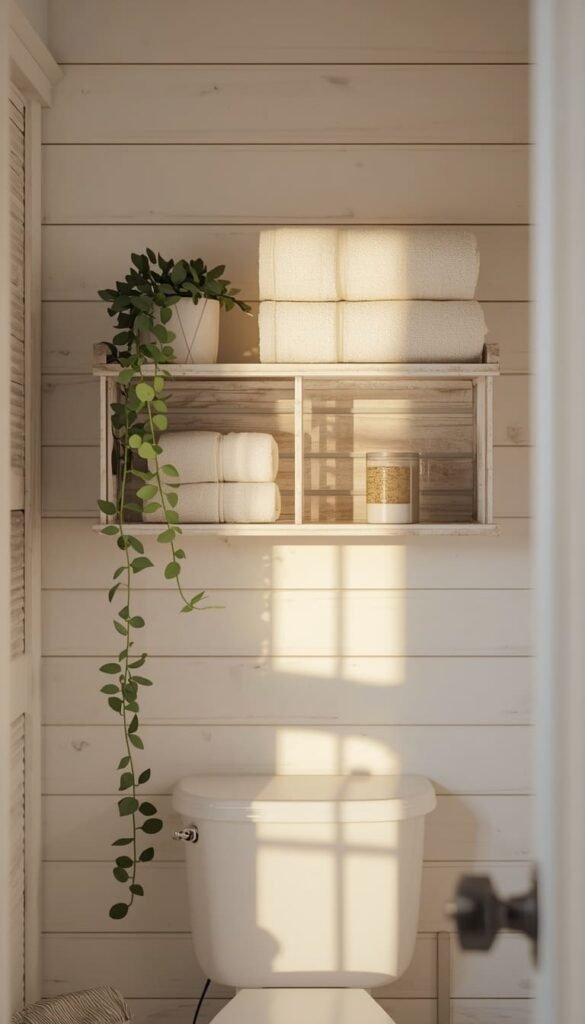
Farmhouse style has a genuine superpower that most other design aesthetics don’t its storage solutions are inherently decorative. Open shelving, wooden ladders, vintage cabinets, woven baskets all of these are functional storage options that also happen to look beautiful. You’re not hiding your bathroom organization behind closed doors. You’re putting it on display, which means it needs to be curated rather than just stashed.
The approach I love most is what I call “useful vignettes.” Instead of lining a shelf with random products, group items intentionally a small stack of folded linen towels next to a potted succulent next to a simple ceramic soap dish. It looks styled but takes thirty seconds to maintain. That’s the sweet spot between beautiful and livable.
Some of my favorite farmhouse storage pieces that double as decor:
- Vintage wooden step stools repurposed as side tables or towel holders beside a freestanding tub
- Antique dental or apothecary cabinets surprisingly common at estate sales and antique shops, and they add incredible character to a powder room or master bath
- Simple wooden wall mounted crates installed as open shelves above the toilet inexpensive, easy to install, and endlessly charming
- A tall leaning ladder in whitewashed or natural wood for hanging towels and displaying small plants
The goal is a bathroom that looks like it was thoughtfully lived in rather than frantically organized before company arrived.
17. Café Curtains The Easiest Farmhouse Upgrade Under $50
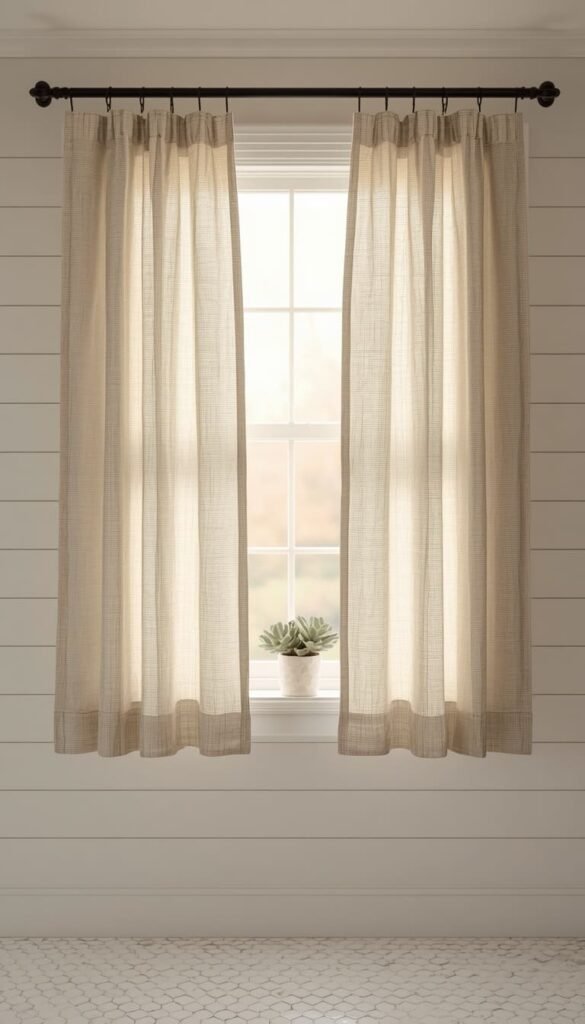
If I had to name the single most underrated farmhouse bathroom upgrade, café curtains would win every time. They’re inexpensive, easy to install, genuinely charming, and they solve the eternal bathroom window dilemma you need privacy, but you also desperately want natural light. A café curtain covers just the lower half of the window, giving you both simultaneously. It’s one of those solutions that’s so simple it almost feels like cheating.
For farmhouse bathrooms specifically, I gravitate toward natural linen, cotton muslin, or a classic ticking stripe fabric. These materials hang beautifully, filter light softly, and age gracefully they actually look better after a few washes, which is exactly the quality you want in a farmhouse aesthetic. Avoid anything too stiff or synthetic. It’ll look out of place against shiplap and wood tones.
The sizing rule that most people get wrong: your café curtain rod should sit at the midpoint of the window, not halfway up the glass. Measure from the windowsill upward to find the true center of the window frame, and mount the rod there. This proportion looks intentional and balanced rather than awkwardly low. A tension rod works perfectly here no drilling required, and the whole project from unpacking to hanging takes under fifteen minutes.
18. Mixing Metal Finishes Without It Looking Accidental
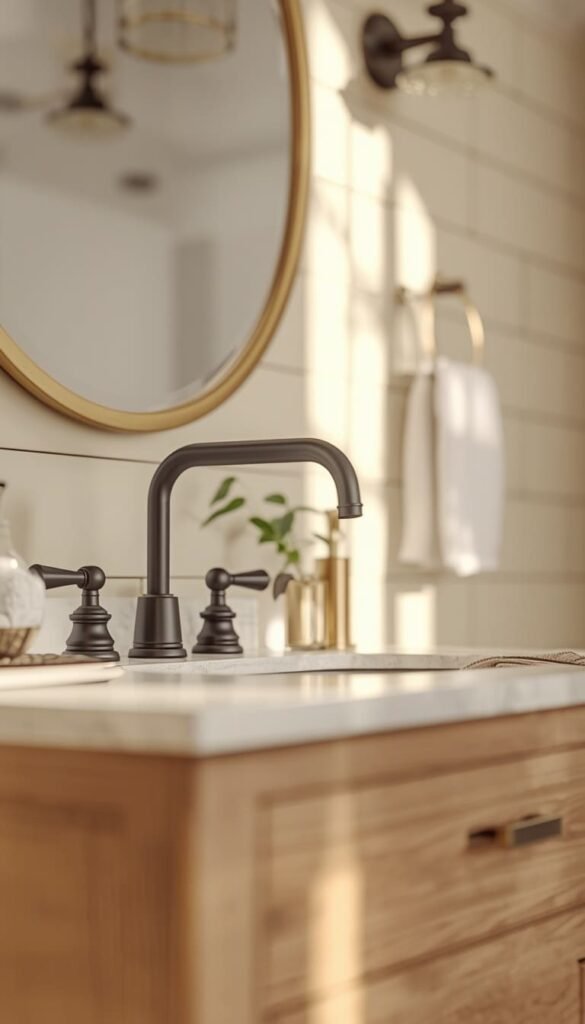
There was a time when mixing metals in a bathroom was considered a design mistake. Every fixture had to match, full stop. That rule is completely outdated now, and honestly, a thoughtfully mixed metal palette is one of the hallmarks of a well-designed modern farmhouse bathroom. The operative word though is thoughtfully. There’s a real difference between intentional mixing and just buying whatever was on sale.
The two-finish rule is what I live by in farmhouse bathrooms. Choose one dominant finish that appears on your largest fixtures typically your faucet, shower fixtures, and towel bars and one accent finish that shows up in smaller supporting roles like cabinet pulls, mirror frames, and light fixtures. That’s it. Two finishes, clearly distinguished by scale and frequency.
My favorite combinations for farmhouse bathrooms specifically:
- Matte black as dominant, aged brass as accent moody, warm, and incredibly popular right now in American farmhouse design
- Brushed nickel as dominant, matte black as accent cleaner and more transitional, works beautifully in lighter farmhouse spaces
- Unlacquered brass as dominant, oil rubbed bronze as accent deeply warm and vintage feeling, perfect for a more traditional farmhouse aesthetic
One thing to watch out for don’t mix finishes within the same fixture category. Your faucet and your shower head should always match each other. The mixing happens between categories, not within them. That’s the line between curated and chaotic.
19. Tile Choices That Honor the Farmhouse Aesthetic
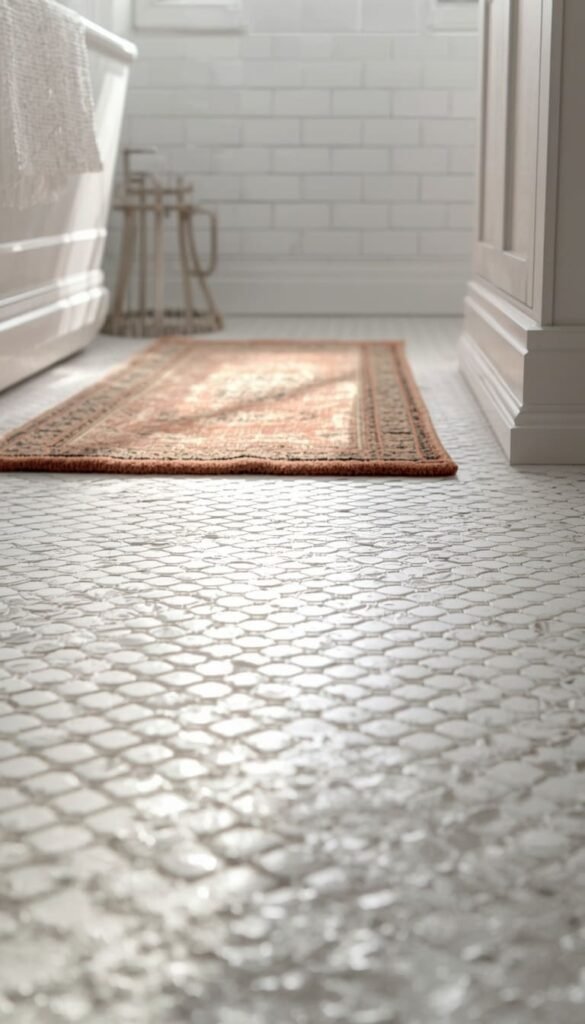
Tile might be the most permanent decision you make in a bathroom remodel, so it’s worth slowing down and thinking it through carefully. The good news is that farmhouse style has a surprisingly generous tile vocabulary there are several classic options that have looked right at home in American farmhouses for over a century, and they’re not going anywhere.
White subway tile is the obvious starting point, and for good reason. It’s affordable, widely available, and works with virtually every farmhouse color palette. But the grout color you choose changes everything. Bright white grout reads clean and modern. Warm gray grout feels more relaxed and vintage. Dark charcoal grout adds drama and an almost industrial farmhouse edge. Same tile, three completely different personalities.
Beyond subway tile, here are the options I reach for most often:
- Hex tile in white or soft black and white patterns for floors classic, durable, and deeply farmhouse in character. Small 1 inch hex reads more vintage, larger 4 inch hex feels more contemporary.
- Encaustic cement tile for a statement floor or a small accent area the handmade quality and graphic patterns are genuinely beautiful but they require sealing and more maintenance than ceramic. Worth it for the right client, not for everyone.
- Large format matte porcelain in a warm greige or stone look for a more restrained, modern farmhouse feel less pattern, more texture, very livable.
Grout width matters too. Wider grout lines read more rustic and handmade. Tighter grout lines feel more refined. For a farmhouse bathroom I typically recommend a 3/16 inch grout joint wide enough to feel artisanal, tight enough to stay clean.
If I handed you $500 right now and told you to spend it only on your bathroom, which three changes from this list would you make first?
20. The Modern Farmhouse Master Bathroom Spa Feel Rustic Soul
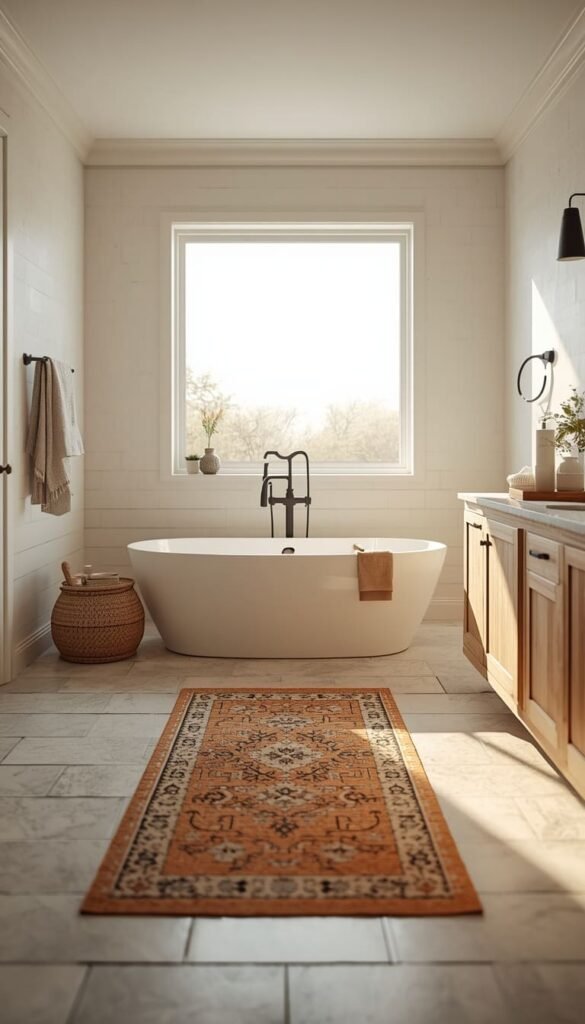
This is where everything comes together. The master bathroom is the one space in your home that’s entirely yours no guests, no performance, just your daily rhythm. And when you get a modern farmhouse master bath right, it genuinely feels like a private retreat. Not in the sterile, over designed spa hotel way. In the warm, personal, deeply comfortable way that only comes from a space that reflects real choices made by real people.
The layered approach is everything here. Start with your foundation shiplap or tongue and groove on at least one wall, a vanity in natural wood or painted in a soft organic tone, and flooring that grounds the space without overwhelming it. From there, build in the comfort elements: a freestanding tub if your space allows, a walk-in shower with a frameless or simple black-framed glass door, and lighting that transitions from bright and functional in the morning to warm and ambient in the evening with a simple dimmer switch.
Then comes the layer that most people skip entirely the personal touches that make it feel lived in rather than staged. A vintage rug beside the tub. A small tray on the vanity holding your favorite candle, a hand cream, and a simple bud vase. A wooden stool that holds a stack of actual books you actually read. Linen hand towels that soften with every wash. These are not expensive additions. They are thoughtful ones.
The best modern farmhouse master bathrooms I’ve designed share one quality above everything else they feel like the people who live there actually chose every single thing in the room. Not because it was trending, not because it was on sale, but because it was exactly right. That’s the standard worth chasing.
Your 2-Minute Farmhouse Bathroom Decision Map
By Budget
Weekend Warrior (Under $500)
- Swap fixtures to matte black throughout
- Hang café curtains for instant farmhouse charm
- Add a vintage wool rug and a leaning ladder
- Install peel and stick shiplap in the powder room
- Replace the builder mirror with a thrifted framed alternative
Commitment Level (Over $2,000)
- Install real wood or MDF shiplap on accent walls
- Source a clawfoot or freestanding soaking tub
- Commission a repurposed dresser or soapstone farmhouse sink vanity
- Retile with white hex or encaustic cement floor tile
- Invest in professional sconce placement and dimmer-switch lighting
By Lifestyle
Busy Families and Pet Households
- Skip white grout go medium gray instead
- Choose porcelain tile over encaustic cement for easier cleaning
- Avoid raw wood vanity tops near heavy splash zones
- Opt for low pile vintage rugs that dry quickly
- Stick to matte finishes they hide water spots and fingerprints far better than polished ones
Design Forward and Empty Nesters
- Go bold with moody wallpaper in the powder room
- Mix aged brass and matte black for a curated two finish palette
- Invest in a statement clawfoot tub as the room’s centerpiece
- Layer neutrals with depth cream walls, linen textiles, dark walnut accents
- Consider unlacquered brass fixtures that patina beautifully over time
Frequently Asked Questions
What makes a bathroom look like a farmhouse style?
Shiplap walls, matte black fixtures, a wood vanity, and vintage inspired lighting do most of the heavy lifting. You don’t need all of them even two or three elements together read unmistakably farmhouse.
How much does a farmhouse bathroom remodel cost in the USA?
The average cost ranges from $1,500 for a cosmetic refresh to $15,000+ for a full renovation. Your biggest budget decisions will be the vanity, tile, and tub prioritize those three first.
Is shiplap in a bathroom a bad idea?
Not if it’s properly sealed. MDF or PVC shiplap outperforms raw wood in humid spaces. Avoid installing it directly inside the shower zone and you’ll have zero problems.
What color should a farmhouse bathroom be?
Warm whites and soft neutrals are the classic choice. Benjamin Moore White Dove and Sherwin-Williams Alabaster are my two most recommended starting points for that cozy, lived-in farmhouse feel.
Can I do a farmhouse bathroom on a tight budget?
Yes and it photographs just as well. Swap your fixtures to matte black, add café curtains, and source a vintage mirror. That trio alone transforms a builder grade bathroom for under $300.
Conclusion
Your farmhouse bathroom doesn’t need a massive budget or a full gut renovation it just needs one good decision followed by another. Pick the idea from this list that made you stop scrolling, and start there. Buy the paint sample, order the sconce, measure that old dresser in your garage. Small moves made consistently are how real homes get transformed. I’ve watched a $1,640 budget turn a pink-tiled nightmare into a Nashville showstopper, and I genuinely believe your space has that same potential waiting in it.
