
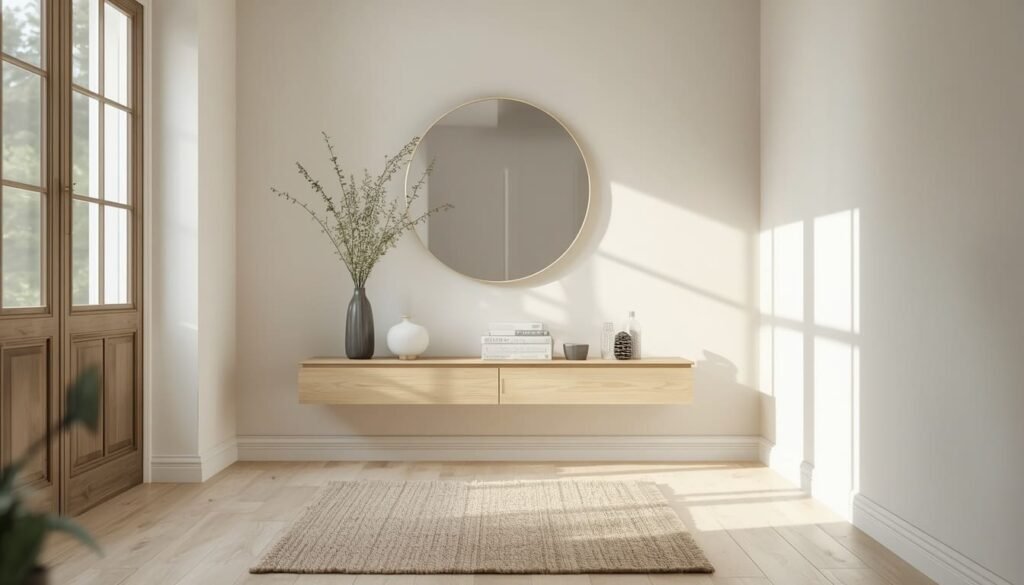
Your entryway is the first thing you see when you walk through the door and if it’s chaotic, trust me, it sets the tone for your entire evening. I’ve worked with dozens of American homeowners who spent thousands on living room makeovers but completely ignored the six foot hallway that greets them every single day. That’s a mistake. A Scandi entryway doesn’t demand a big budget or a big space. It just asks for intention the right materials, a restrained hand with decor, and storage that actually works for your real life.
My Design Notes
When I took on a project in Denver, Colorado, a working mom with two kids and a golden retriever wanted the Pinterest-perfect Scandi entryway she’d been saving for two years. White shiplap, an open linen bench, a single succulent. It looked stunning on screen. In real life? Salt crusted snow boots from November through March, a dog who treated coat hooks like personal enemies, and a husband with eleven baseball hats and zero apologies about it. We kept every principle of Nordic design intact but rebuilt the execution around their actual life. The open bench became a closed lid storage bench. The white jute rug became a washable flatweave runner. The open shoe rack got replaced with a slim flip door cabinet. When I walked out of that project, the entryway still felt calm, minimal, and unmistakably Scandi. That experience taught me something I now tell every client: the best Nordic entryways aren’t copied from Stockholm showrooms. They’re designed around the life being lived inside them.
Stunning Scandi Entryway Ideas That Transform Your Nordic Home From the First Step In
1.The Light Wood Bench With Hidden Storage
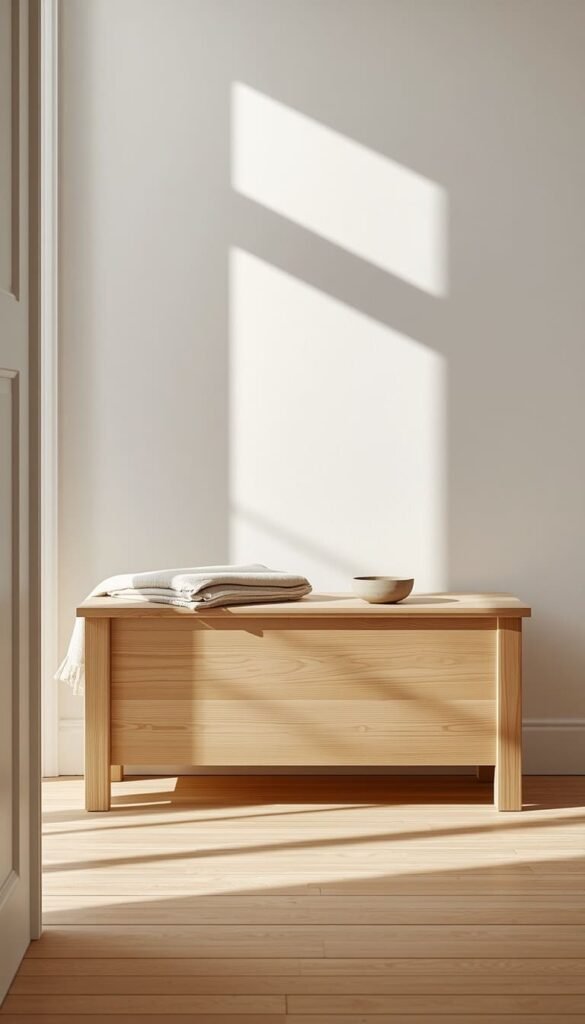
A light wood bench with a lift top lid is honestly one of the hardest-working pieces you can put in a Scandi entryway. It gives you a place to sit while pulling on boots, a surface to set your bag down for two seconds, and a hidden compartment that swallows scarves, dog leashes, and all the seasonal clutter that has no other home. I always recommend oak or ash finishes over pine here they hold up better in high-traffic zones and age beautifully instead of looking worn.
One thing to watch out for is sizing. A lot of American hallways run narrow, and a bench that’s too deep will block the natural flow of movement. I try to keep bench depth at 14 inches or under for anything under 4 feet wide.
Budget reality: you can find solid options at IKEA or Target in the $150 to $250 range. If you want something that genuinely lasts a decade, expect to spend $400 to $800 for solid wood construction.
2.Floating Shelf Styled the Nordic Way
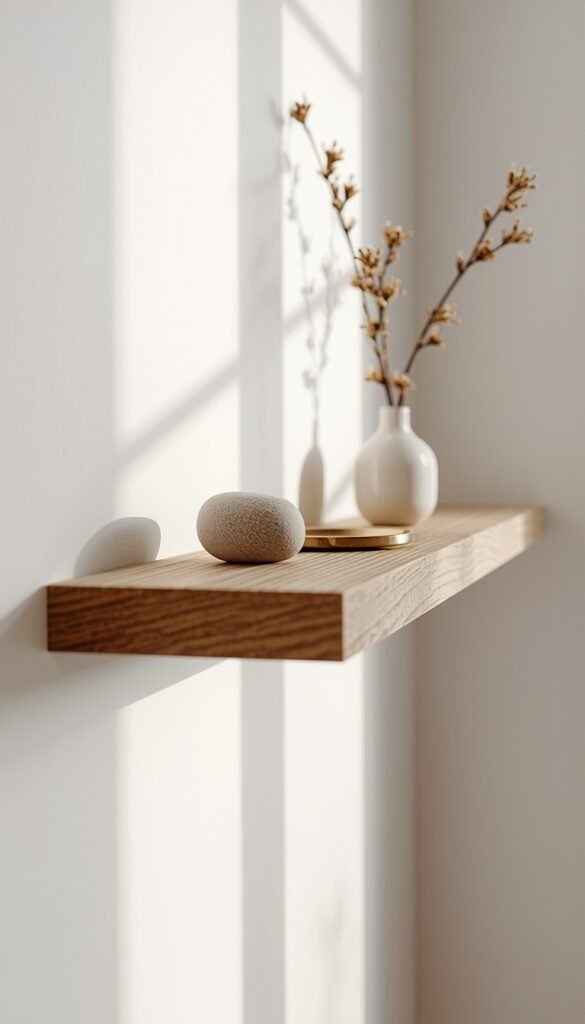
The floating shelf is where a lot of people either nail the Scandi look or completely lose it. I’ve seen shelves that look like a gift shop exploded on them, and shelves so empty they feel forgotten. The sweet spot is what I call the three object rule: one organic element like a small ceramic bowl or a smooth stone, one functional item like a small tray for keys, and one living element like a tiny potted plant or a single stem in a bud vase. That’s it. Nothing more.
A quick trick I’ve learned is to choose a shelf in the same tone as your wall white shelf on a warm white wall, oak shelf on a greige wall. When the shelf visually blends in, the objects on it feel intentional rather than cluttered.
3.The Round Mirror Trick That Makes Any Hallway Feel Bigger
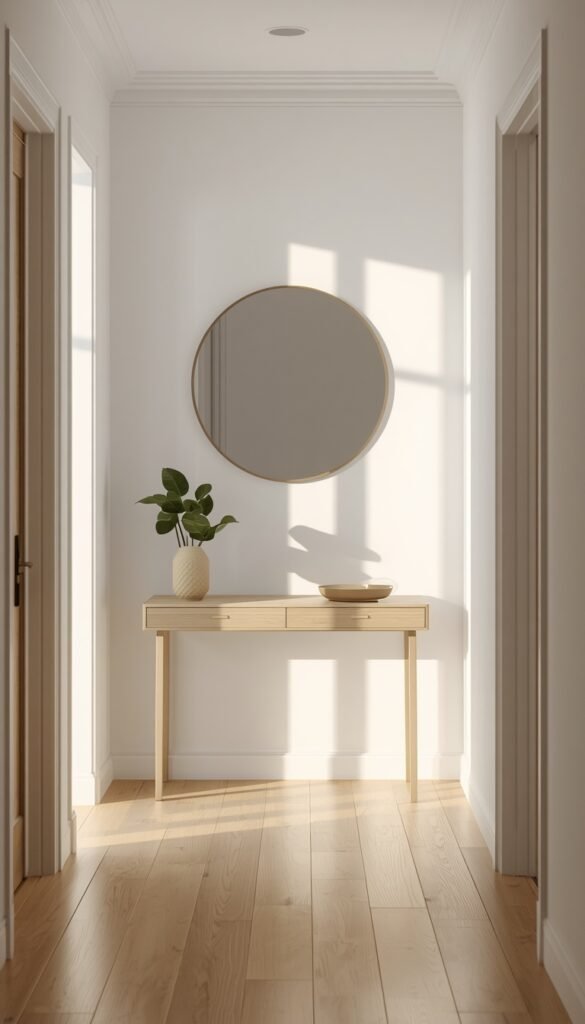
Round mirrors are having a long, well deserved moment in Scandi interiors, and for good reason. They soften the hard angles of a narrow hallway, bounce natural light deeper into the space, and add that quiet sculptural quality that Nordic design does so well. I’ve put round mirrors in entryways as small as 18 square feet and the difference is immediate the space just breathes differently.
Here’s what actually matters when choosing one:
- Size: For most American entryways, a mirror between 24 and 36 inches in diameter hits the right visual balance.
- Frame: Natural oak, matte black, or frameless all work beautifully. Avoid ornate gold or chunky painted frames they fight the calm.
- Placement: Center it at eye level, roughly 57 to 60 inches from the floor to the mirror’s middle point.
White walls with a bare round mirror and nothing else can feel a little cold. Ground it by placing a small shelf or console beneath it, even a very slim one.
4.Wall Hooks Done Right
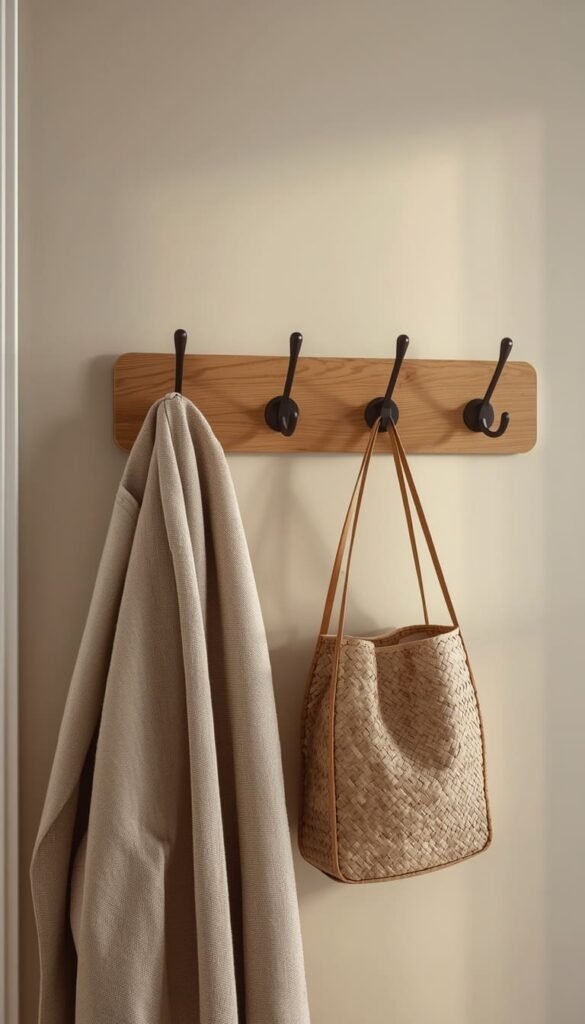
Wall hooks might seem like a minor decision, but in a Scandi entryway they’re doing a lot of visual heavy lifting. They’re one of the first things your eye lands on when you walk in, and the wrong style can make an otherwise beautiful space feel like a hardware store. I always steer clients toward solid wood hooks in natural oak or walnut, or simple matte black metal hooks with clean geometric shapes. Brass works beautifully too, but only if you carry it through at least one other element in the space otherwise it reads as an afterthought.
Spacing matters more than people realize. A quick trick I’ve learned is to leave at least 8 to 10 inches between hooks so coats and bags don’t pile into each other. Install them between 60 and 72 inches from the floor depending on who’s using them lower for households with kids.
One thing to watch out for is overloading. Scandi hooks are meant to hold today’s coat and today’s bag. They’re not a secondary closet. If every hook is buried under three layers of outerwear, the whole wall feels heavy and the Nordic calm disappears instantly.
5.The Slim Console Table for Narrow American Hallways
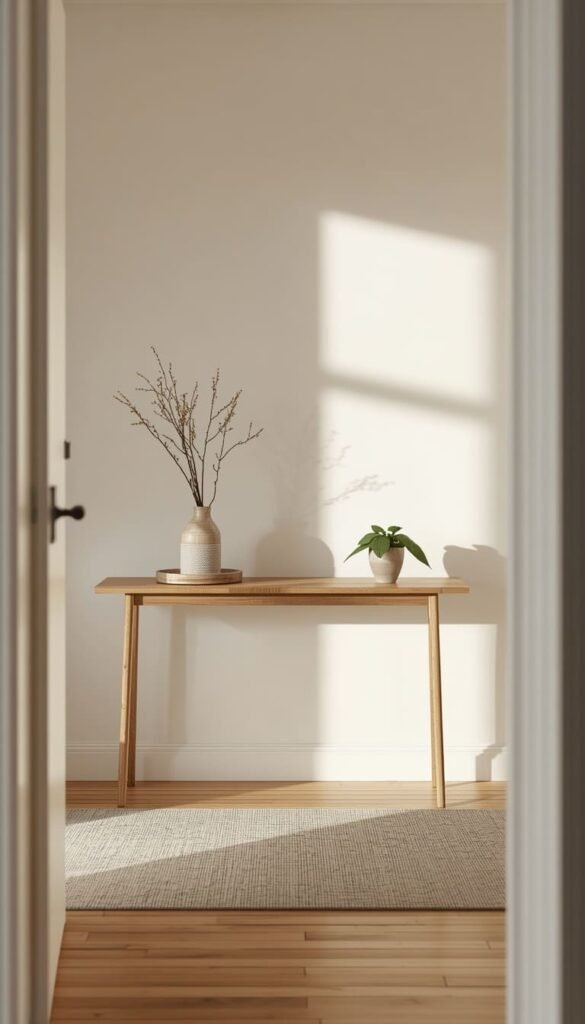
A console table in the entryway is one of those pieces that looks effortless in design photos and slightly chaotic in real life unless you choose the right one. The biggest mistake I see in American homes is a console that’s too deep. Anything over 14 inches starts eating into walkway space, and in a hallway under 5 feet wide, that’s a problem you’ll feel every single day. I keep my recommendations at 10 to 13 inches deep for most standard American entryways. That’s enough surface for a tray, a small lamp, and one decorative object without creating a bottleneck at the door.
For finish, light oak and white are the two that consistently photograph well and age gracefully in the Scandi palette. Avoid dark espresso finishes here they absorb light and make narrow spaces feel even more compressed.
Which part of your entryway bothers you the most right now the shoe chaos, the coat situation, or just the overall feeling that it needs a refresh?
6.Scandi Shoe Storage That Actually Hides the Chaos
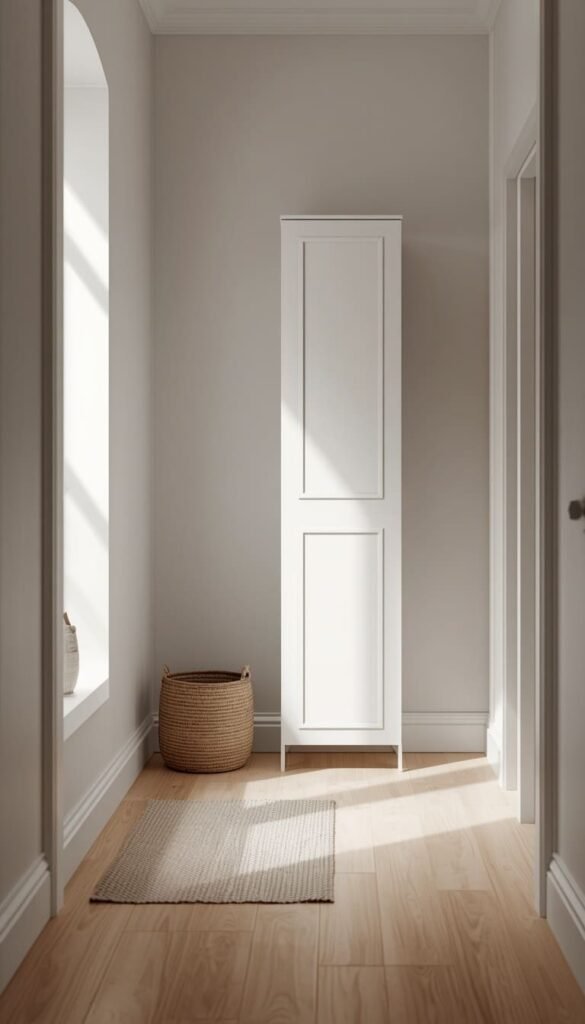
Open shoe racks look stunning in Scandinavian design blogs. In a real American household with three people, two dogs, and a muddy November, they look like a lost and found bin. I say this with complete love and zero judgment because I’ve seen it happen in the most beautifully designed homes. The Scandi answer to this is always a flip door or push to open shoe cabinet slim profile, clean front, and absolutely nothing visible from the outside.
Here’s how I typically break it down for clients based on household size:
- 1 to 2 people: A cabinet holding 8 to 12 pairs is usually plenty. Keep seasonal shoes in the bedroom closet.
- Family of 4: Look for modular options you can stack. IKEA’s STÄLL is a solid starting point.
- Pets in the house: Add a small basket next to the cabinet specifically for dog towels and leashes. It keeps the wet-muddy chaos contained in one spot.
One thing to watch out for is cabinet depth. Some shoe cabinets advertised as “slim” still run 15 to 16 inches deep. Measure your hallway clearance before ordering especially if your door swings inward.
Top 6 Scandi Entryway Ideas:
| Idea | Estimated Price | Maintenance |
|---|---|---|
| Light Wood Bench With Hidden Storage | $150 to $800 | Low |
| Slim Console Table | $120 to $600 | Low |
| Round Mirror | $40 to $250 | Low |
| Scandi Shoe Cabinet | $80 to $400 | Medium |
| Entryway Rug Runner | $30 to $200 | Medium |
| Wall Hooks and Hook Rail | $15 to $150 | Low |
7.The Entryway Rug Reality Check
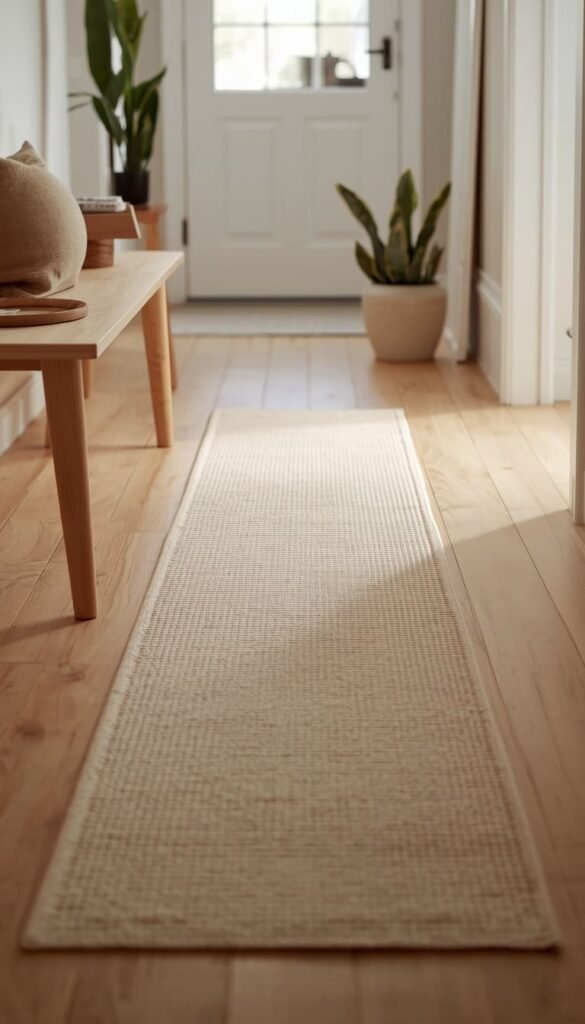
A soft runner on the entryway floor is one of the quickest ways to bring warmth into a Nordic space. The texture underfoot, the gentle visual break from bare floor it does a lot of quiet work. But this is also where I’ve watched well meaning homeowners make the most expensive mistake: buying a beautiful jute or natural fiber rug for a space that sees daily foot traffic, rain boots, and pet paws.
Jute looks gorgeous. It also stains permanently, gets matted quickly, and is nearly impossible to deep clean. My honest recommendation for American entryways is a washable flatweave cotton runner or a low-pile wool blend. Neutral tones warm oatmeal, soft grey, faded natural stripe keep it Scandi without showing every grain of dirt.
A quick trick I’ve learned is to size up slightly. Most people buy a runner that’s too short and it ends up looking like a doormat rather than an intentional design choice. For a standard hallway, a runner that’s at least 2 feet wide and 6 feet long reads as deliberate and anchors the space properly.
8.Lighting That Creates a Hygge Welcome
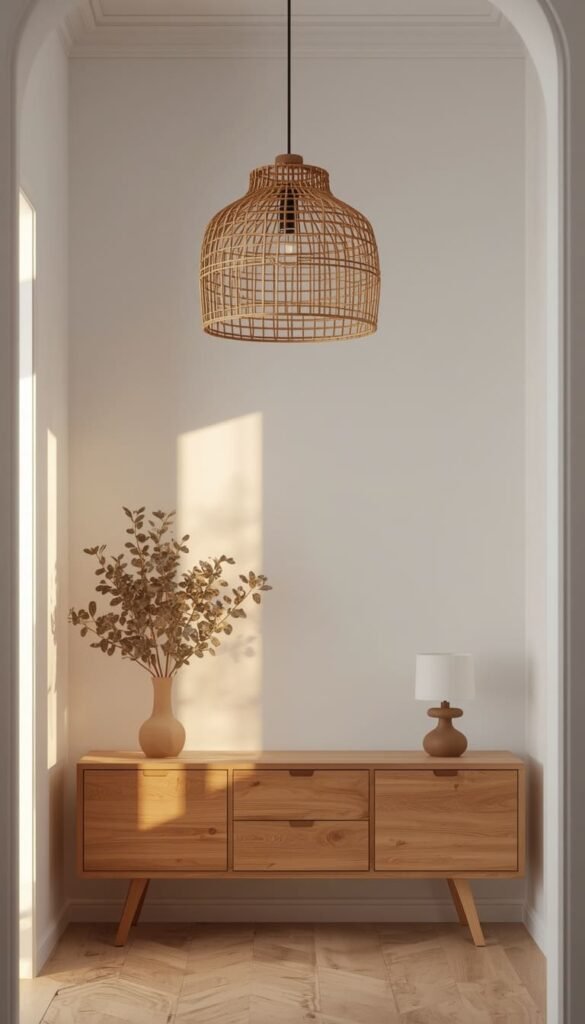
Lighting is the single most underestimated element in an entryway, and most American homes get it completely wrong. The standard overhead flush mount casting a cold white glow is the fastest way to kill any sense of Nordic warmth the moment someone walks through the door. I’ve walked into entryways with beautiful wood tones, soft neutrals, and a perfect round mirror and all of it felt sterile because the lighting was working against everything else.
The specific detail nobody talks about is bulb temperature. For a Scandi entryway, you want bulbs in the 2700K to 3000K range. That’s the warm amber zone that makes wood tones glow and neutrals feel cozy rather than flat. Anything above 3500K starts reading as office lighting.
For fixture style, here’s what works beautifully depending on your situation:
- Own your home: A simple pendant in matte white or natural rattan hung at around 7 feet from the floor is both functional and sculptural.
- Renting or low ceilings: A plug in wall sconce or a small table lamp on a console gives you that warm glow without touching the ceiling fixture at all.
- Tiny entryway with no surfaces: A battery-operated sconce with a warm bulb is a genuinely good solution and costs under $40 at most US home stores.
9.Japandi Entryway Where Scandi Meets Wabi Sabi
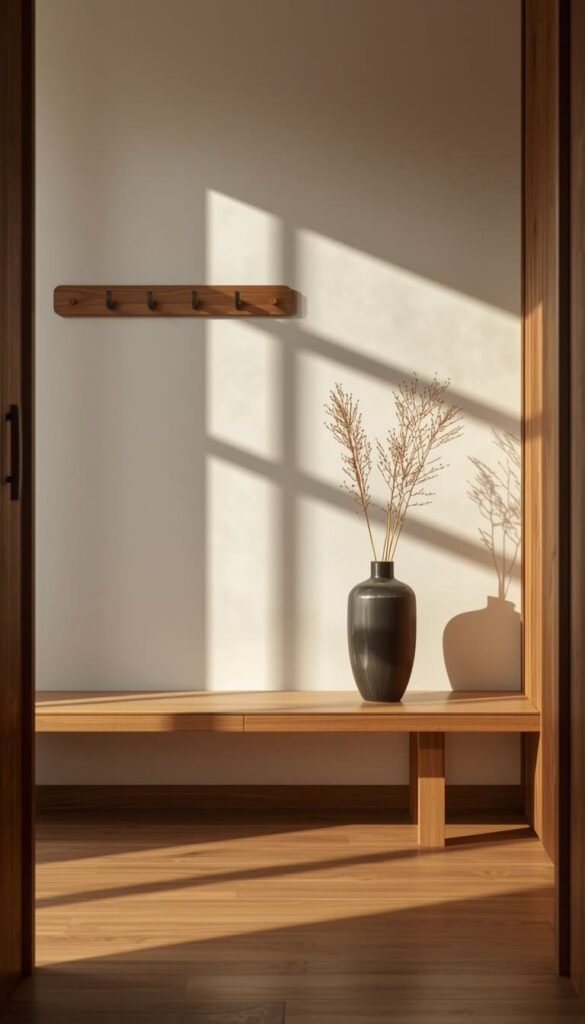
If you’ve been seeing the word “Japandi” everywhere lately and wondering whether it’s just a trend or something worth actually investing in, my honest answer is that it’s one of the most livable design directions I’ve worked with. It sits right at the intersection of Scandinavian minimalism and Japanese wabi-sabi philosophy the idea that beauty lives in simplicity, natural imperfection, and quiet restraint. In an entryway, this crossover feels completely natural because both design cultures prioritize function, calm, and natural materials above everything else.
The way I approach a Japandi entryway is to start with the Scandi bones light walls, clean lines, hidden storage and then layer in Japanese-influenced details:
- A low wooden bench closer to the floor in the Japanese tradition of removing shoes at the entry
- Darker organic accents like a charcoal linen cushion or a blackened oak hook rail against pale walls
- One single ceramic piece, intentionally imperfect, as the only decorative object on the console
One thing to watch out for is going too dark too fast. The Japandi palette can slide toward moody if you’re not careful, and in a small entryway that reads as oppressive rather than calm. Keep your wall color light and let the darker accents do the contrast work.
10.Scandi Mudroom Ideas for American Homes
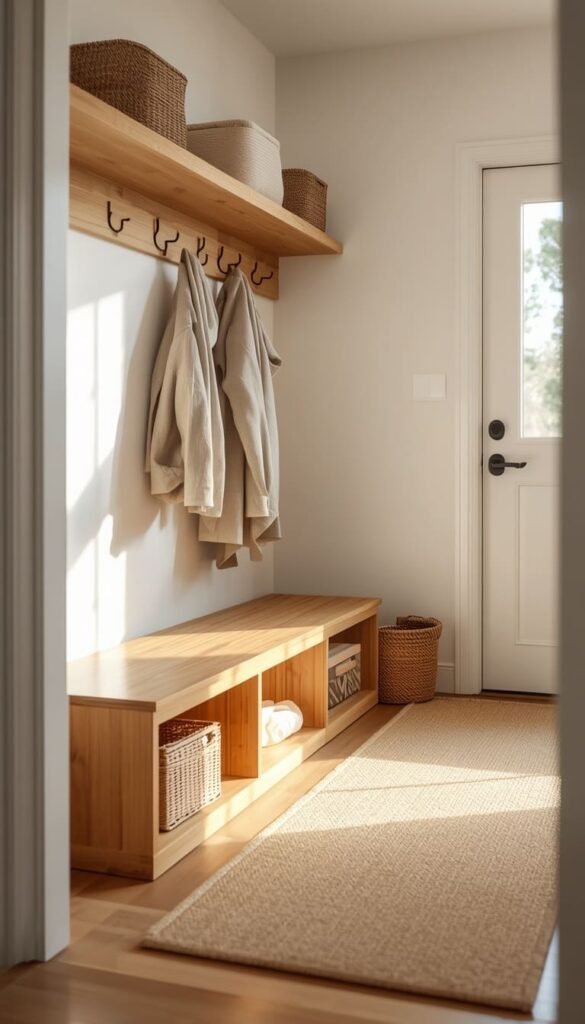
This is the one area where American home design genuinely has an advantage over the traditional Nordic apartment entryway. So many US homes especially in the Midwest, Northeast, and Pacific Northwest have a dedicated mudroom or a garage entry zone that functions as a transition space. And when you apply Scandi principles to that space, something really special happens.
The key difference between a cluttered American mudroom and a Nordic inspired one is editing. Most mudrooms I walk into are trying to do too much a bench, a cubby system, a message board, hooks for every family member, a charging station, a recycling bin, and somehow also a dog feeding station. The Scandi version strips that back to the essential three: a place to sit, a place to hang outerwear, and a place to store shoes. Everything else finds a home elsewhere.
A quick trick I’ve learned specifically for garage entry mudrooms is to use the same flooring material from the garage threshold into the mudroom space. It creates a visual flow that makes the transition feel intentional rather than like an afterthought, which is very much in line with how Nordic homes handle the indoor-outdoor boundary.
If you could change just one thing about your entryway this weekend, what would it be the storage, the lighting, or the way it looks when you first walk in?
11.The Entryway Console Table Styling Formula
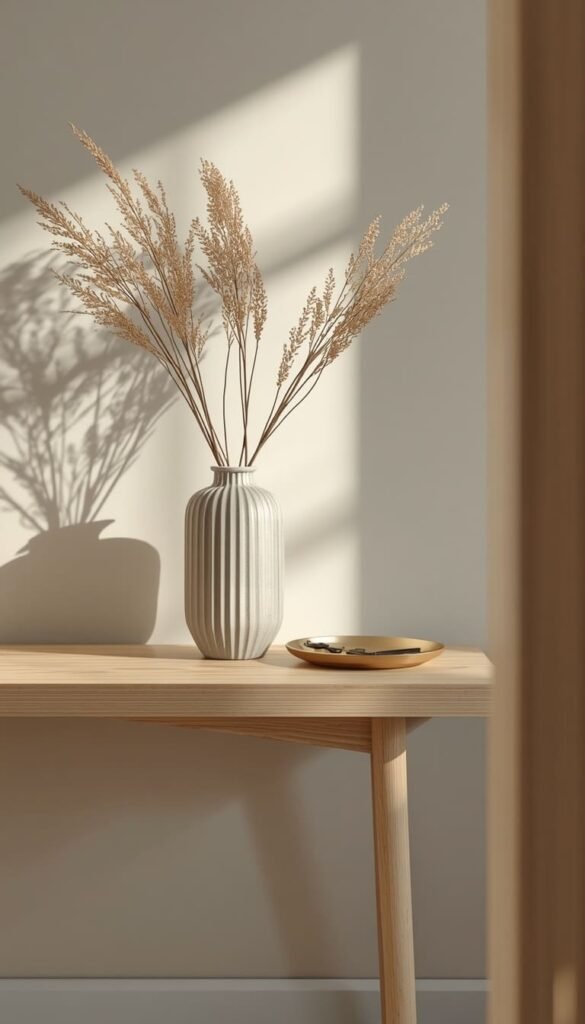
Styling a console table in the Scandi way is less about what you add and more about what you resist adding. I’ve styled dozens of entryway consoles over the years and the ones that photograph beautifully and feel genuinely calm in person always follow the same quiet formula. One anchor piece usually something with height like a slim vase or a small lamp. One functional element like a tray or a small bowl for keys. One natural or organic touch like a single branch, a small plant, or a smooth stone. And then empty space. Actual, intentional, unoccupied surface.
That last part is the hardest for most American homeowners. We’re culturally wired to fill surfaces. Leaving space feels unfinished. But in Nordic design, that breathing room is the point it’s what makes the pieces you did choose feel considered rather than collected.
What to never put on a Scandi entryway console:
- Stacked mail or paperwork of any kind
- More than one candle grouping unless they’re identical and in a deliberate arrangement
- Family photos those belong deeper in the home where the intimacy feels appropriate
- Anything with a logo or heavy branding visible from the front door
12.Greenery in the Entryway That Actually Survives
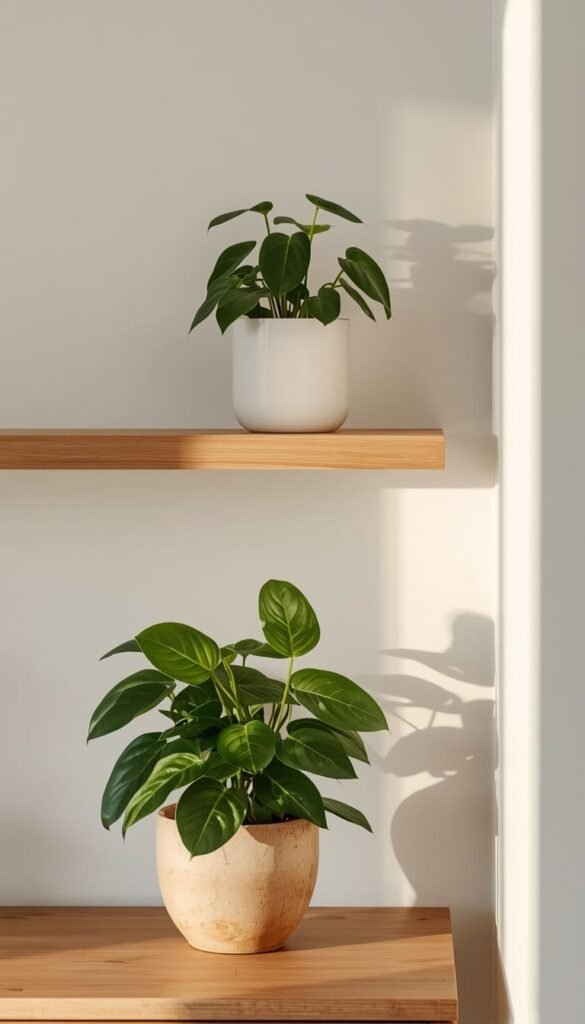
Every Scandi entryway mood board features a perfect, lush plant sitting in a beautiful ceramic pot near the door. What those mood boards don’t tell you is that entryways are usually the worst spot in your home for plant survival. Low natural light, temperature fluctuations every time the front door opens, and let’s be real the fact that it’s the room you walk through fastest and therefore water least.
I’ve killed enough aspirational entryway plants on behalf of clients to have a very firm shortlist of what actually works in real American homes. Pothos is my first recommendation every single time it tolerates low light, irregular watering, and temperature swings with remarkable patience. Snake plants are equally forgiving and add a beautiful vertical element that works perfectly against a white wall. ZZ plants are nearly indestructible and have a waxy, sculptural quality that feels very intentional in a Nordic space.
A quick trick I’ve learned is to keep the pot simple and the plant small. A large dramatic plant near a front door often ends up getting bumped, knocked, and eventually relocated. A small plant in a matte ceramic pot on a floating shelf or console corner brings the organic warmth of greenery without becoming an obstacle.
13.Small Scandi Entryway Making Under 20 Square Feet Work
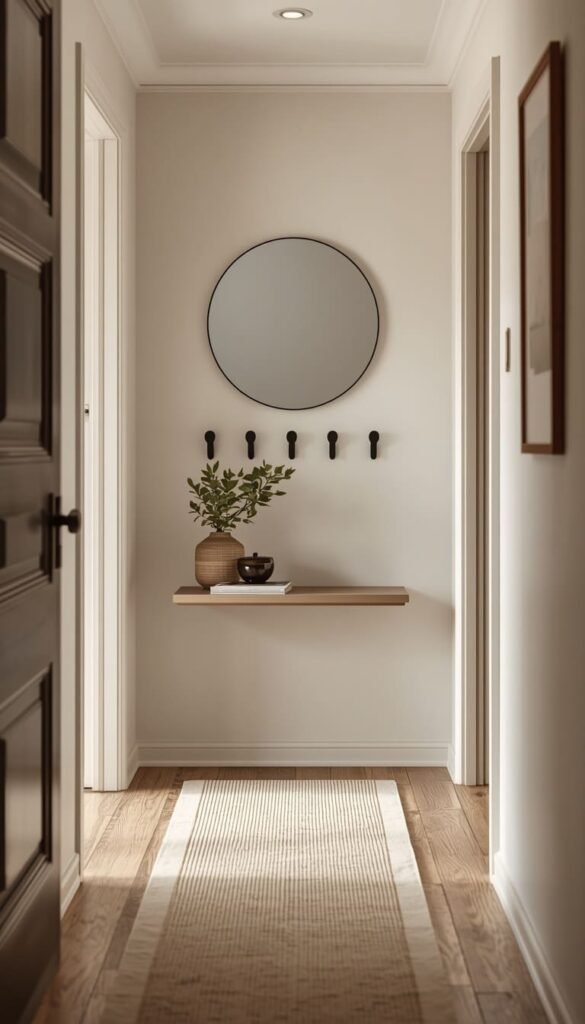
Small does not mean compromised. Some of the most beautiful Scandi entryways I’ve ever worked on were under 20 square feet, and they felt more intentional and calm than spaces three times their size. The secret is vertical thinking combined with ruthless editing two things that Nordic design does better than any other style I know.
The floor is sacred in a tiny entryway. Nothing lives on it permanently except a rug and one slim piece of furniture. Everything else goes up. Hooks at eye level, a floating shelf above that, and if ceiling height allows, a tall slim cabinet that draws the eye upward and makes the walls feel higher than they are.
Here’s what I typically recommend for entryways under 20 square feet:
- One slim console or floating shelf, maximum 10 inches deep
- One round mirror, 24 inches in diameter, centered above the console
- Two to four wall hooks mounted at 64 inches from the floor
- A washable runner that’s at least two thirds the length of the hallway
One thing to watch out for is choosing furniture with legs over solid base pieces. Furniture that shows floor underneath it creates a visual gap that tricks the eye into perceiving more space. A bench with tapered legs will always make a small entryway feel more open than a solid-base cabinet of the exact same size.
14.Scandi Entryway for Renters No Drill No Paint Solutions
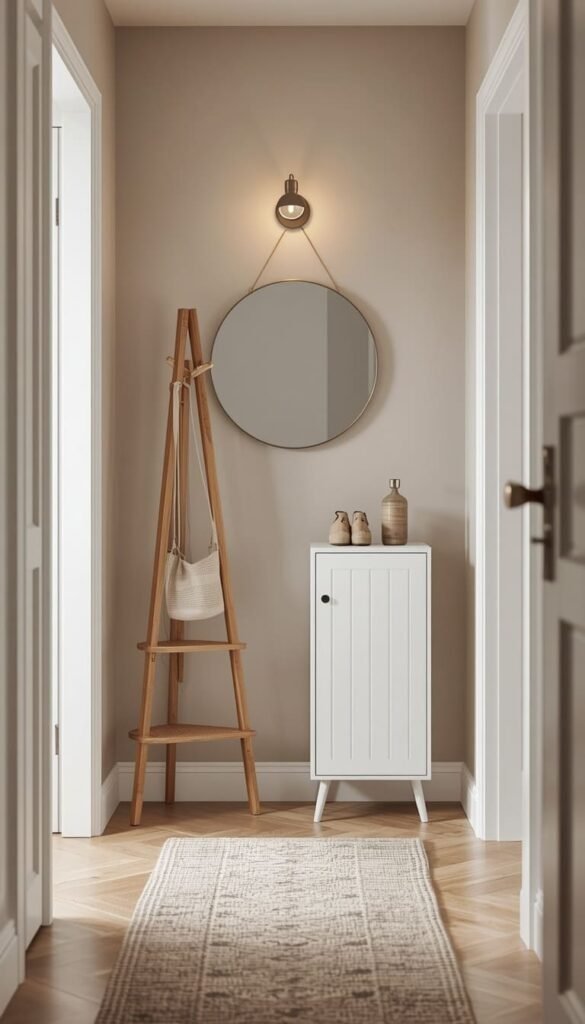
Renting in America means navigating a very specific set of design frustrations walls you can’t paint, surfaces you can’t drill into, and a landlord who will absolutely notice if you try. I’ve worked with renters in New York, Chicago, and Seattle who wanted a genuinely beautiful Scandi entryway without risking their security deposit, and the solutions are better than most people realize.
Command strips and adhesive hooks have genuinely improved to the point where they hold real weight. The large Command hook strips rated for 7.5 pounds hold a coat, a bag, and a light jacket without flinching I’ve tested this personally. For a full hook rail look, mounting three or four of these in a row at consistent spacing gives you the same clean visual result as a drilled installation.
Freestanding furniture is your biggest asset as a renter:
- A freestanding coat rack in natural wood takes up minimal floor space and moves with you
- A slim freestanding shoe cabinet requires zero wall contact and looks completely intentional
- A leaning mirror against the wall is not only renter-friendly but genuinely on trend in Scandi interiors right now
A quick trick I’ve learned for renters who want to add wall texture without paint is removable peel and stick wallpaper in a soft linen or subtle geometric pattern on one narrow wall. Applied carefully and removed correctly, it leaves no damage and can completely transform how a plain rental entryway feels.
15.Neutral Entryway Decor Building a Tonal Story
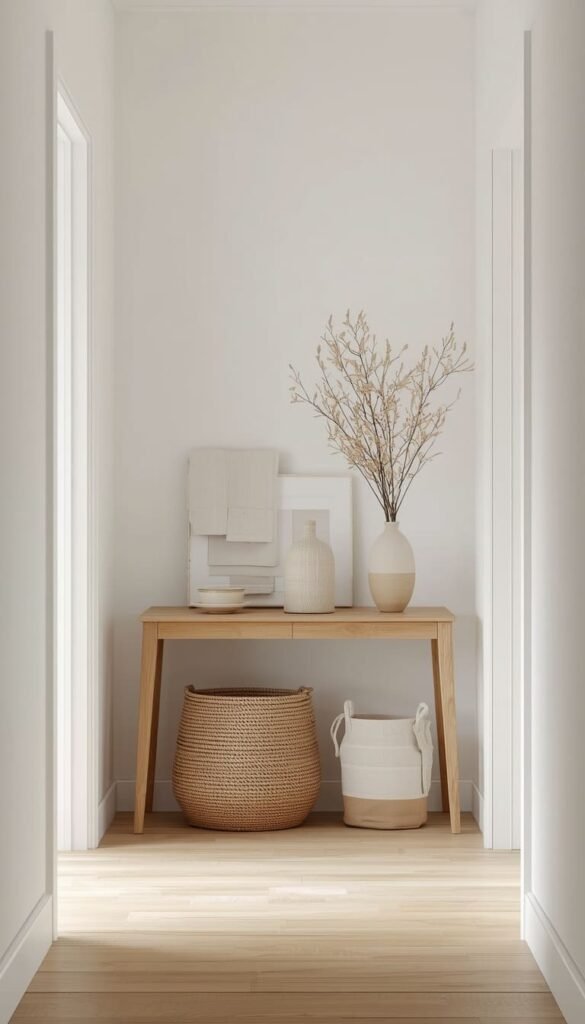
Neutral doesn’t mean boring. This is probably the most important thing I want you to take away from this entire article. The Scandi neutral palette is one of the most sophisticated color stories in residential interior design, and when it’s done well, it has more visual depth and warmth than a room full of bold color. The key is understanding that neutrals need variation in tone, texture, and material to feel alive rather than flat.
I build Scandi entryway palettes in three layers. The base layer is the wall and floor warm white or soft greige on walls, light oak or pale stone on the floor. The middle layer is the furniture a bench or console in a tone that’s either slightly warmer or slightly cooler than the wall, never matching exactly. The top layer is the accessories textures in linen, ceramic, wood grain, and woven fiber that catch light differently throughout the day and keep the space feeling dynamic.
Specific paint colors I recommend for American entryways in the Scandi palette:
- Benjamin Moore White Dove OC-17 for a warm, never-sterile white
- Sherwin-Williams Accessible Beige SW 7036 for a soft greige that works with oak floors beautifully
- Benjamin Moore Pale Oak OC-20 for a tone that sits perfectly between white and warm sand
Does your entryway currently have a dedicated spot for everything, or does it still feel like a daily battle between you and your own front door?
16.Budget Scandi Entryway IKEA Hacks and Affordable Alternatives
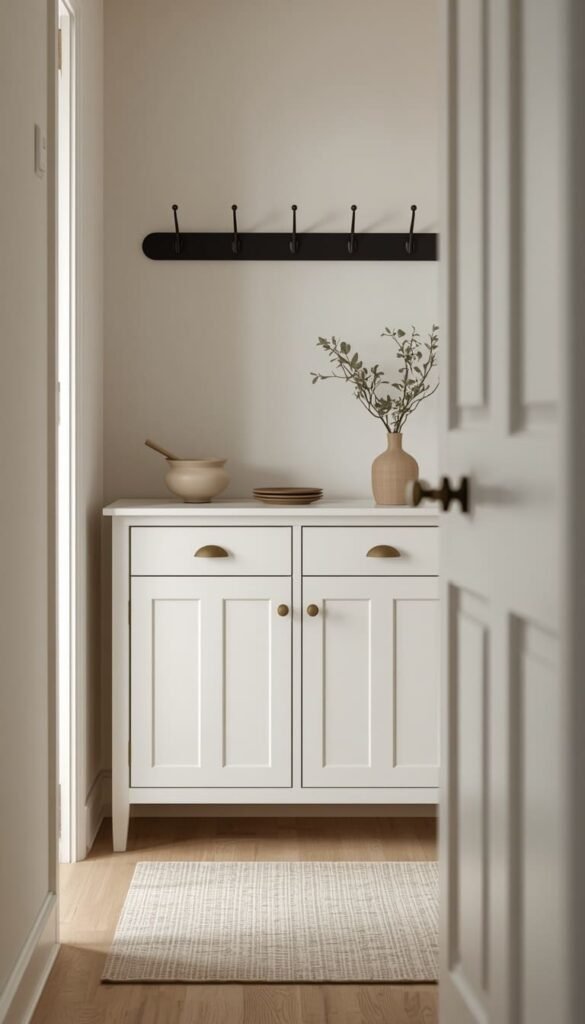
IKEA is genuinely Scandinavian design at accessible prices and I say that without any hesitation. The brand was founded in Sweden and many of its core pieces reflect authentic Nordic principles clean lines, functional forms, and natural materials at a price point that makes good design democratic. For an entryway on a budget, it’s my first stop every single time.
The HEMNES shoe cabinet in white stain is one of the best entryway pieces available in the US market under $200. It holds up to 12 pairs, has a classic Scandi profile, and looks significantly more expensive than it is. The TJUSIG hook rail in black gives you a clean wall hook solution for under $20. And the LACK floating shelf in white at $15 is the backbone of more styled Scandi entryways than I can count.
A quick trick I’ve learned for making IKEA pieces look higher-end is hardware swapping. Replacing the standard IKEA drawer pulls and knobs with solid brass or matte black alternatives from a hardware store costs between $20 and $40 and visually elevates the entire piece. It’s the single highest-return upgrade you can make on a budget build.
One thing to watch out for is overloading your entryway with too many IKEA pieces at once. When every single element is from the same catalog, the space can start to feel like a showroom rather than a home. Mix one or two IKEA anchor pieces with a vintage find, a handmade ceramic, or a quality rug and the whole space feels curated rather than assembled.
17.Scandi Apartment Entryway Urban Solutions for Tight Spaces
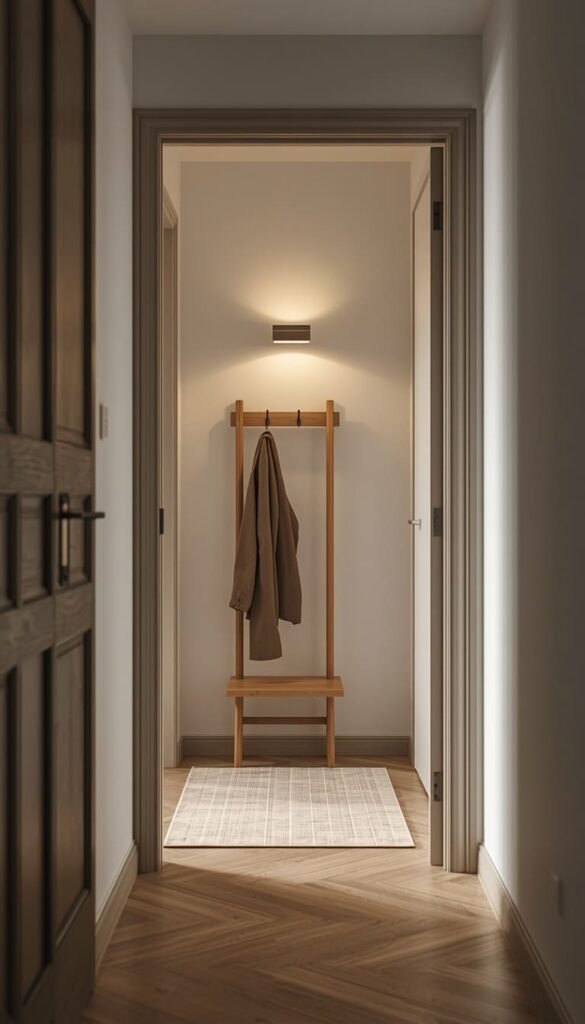
City apartments present a very specific design challenge that suburban homes simply don’t. In New York, Chicago, Boston, and San Francisco, I’ve walked into entryways that are essentially a 3-foot landing between the front door and the living room no dedicated hallway, no separate zone, just a doormat and a prayer. And yet some of the most beautifully calm Nordic entryways I’ve ever created have been in exactly these spaces.
The urban Scandi entryway works by borrowing from its surroundings. When there’s no physical separation between the entry and the living space, you create a visual boundary instead. A rug that’s distinct from the living room rug defines the zone. A single coat rack or hook panel positioned immediately inside the door signals where the entry begins and ends. A small floating shelf mounted at shoulder height does triple duty as a landing surface, a decor moment, and a visual anchor for the zone.
One thing to watch out for in open-plan apartments is scale. Everything needs to be slightly smaller and slightly lighter than you’d choose for a dedicated entryway. A full console table in a 3-foot landing becomes an obstacle course. A narrow 8-inch deep floating shelf becomes a design feature.
18.Three Quick Styling Upgrades Under $50
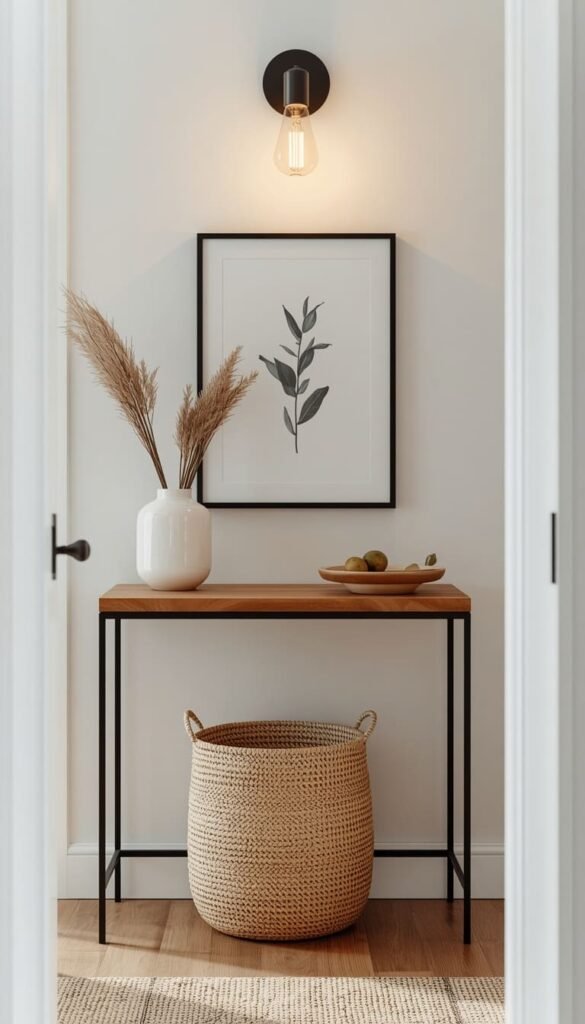
Not every Scandi entryway transformation requires a furniture investment or a weekend project. Some of the most impactful changes I’ve made in client entryways cost less than a dinner out and took under an hour to execute. These three upgrades work in virtually any entryway regardless of size, rental status, or existing furniture.
The first is a single linen or cotton basket placed under a console or bench. It costs between $15 and $30 at most US home stores, instantly adds warmth and texture, and gives you a catch-all for shoes, scarves, or anything that would otherwise live on the floor. The natural fiber quality reads as intentional rather than practical, which is exactly the Scandi balance you’re going for.
The second upgrade is swapping your existing lightbulb for a 2700K warm white LED. This costs under $10 and takes thirty seconds. The difference in how your entryway feels when you walk through the door in the evening is genuinely remarkable warmer, softer, and immediately more welcoming without changing a single piece of furniture.
The third is one piece of simple wall art. Not a gallery wall, not a collection of frames one print in a simple natural wood or black frame. A botanical illustration, a minimalist line drawing, or a soft abstract in neutral tones. Hung at eye level above the console or bench, it gives the entryway a finished quality that no amount of decorative objects can replicate.
19.The Mistakes I See Every Time and How to Fix Them
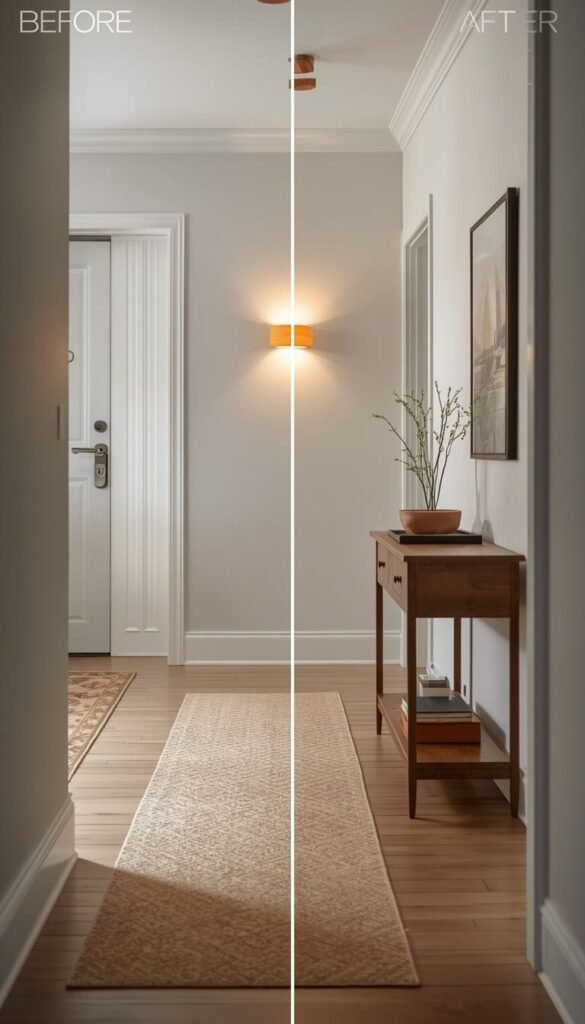
After years of working on entryways across the US, I’ve noticed the same five mistakes appearing in almost every home I walk into. None of them are catastrophic. All of them are completely fixable, usually without spending much money at all.
The first is a rug that’s too small. A rug that only fits under the front door feels like a leftover rather than a design choice. Size up always.
The second is cold overhead lighting with no warmth layer. I’ve covered this already but it bears repeating because it’s genuinely the most common issue I encounter. One warm lamp changes everything.
The third is open storage that’s holding too much. Hooks buried under coats, shelves crowded with objects, shoe racks overflowing onto the floor. The fix is always editing first, organizing second. You cannot organize your way out of too much stuff.
The fourth is furniture that’s the wrong scale for the space. A console that’s too tall makes a low-ceiling entryway feel cramped. A bench that’s too wide blocks natural movement. Always measure twice and visualize the negative space around the piece before buying.
The fifth and this one surprises people is no scent. Scandi homes have a distinct sensory quality that goes beyond the visual. A small candle, a subtle reed diffuser, or even a bundle of dried eucalyptus near the entry creates an olfactory welcome that guests notice immediately even if they can’t identify why the space feels so good.
What is the one item that always ends up on your entryway floor no matter how many times you put it away shoes, bags, or something else entirely?
20.Simple Entryway Styling the Nordic Final Touch
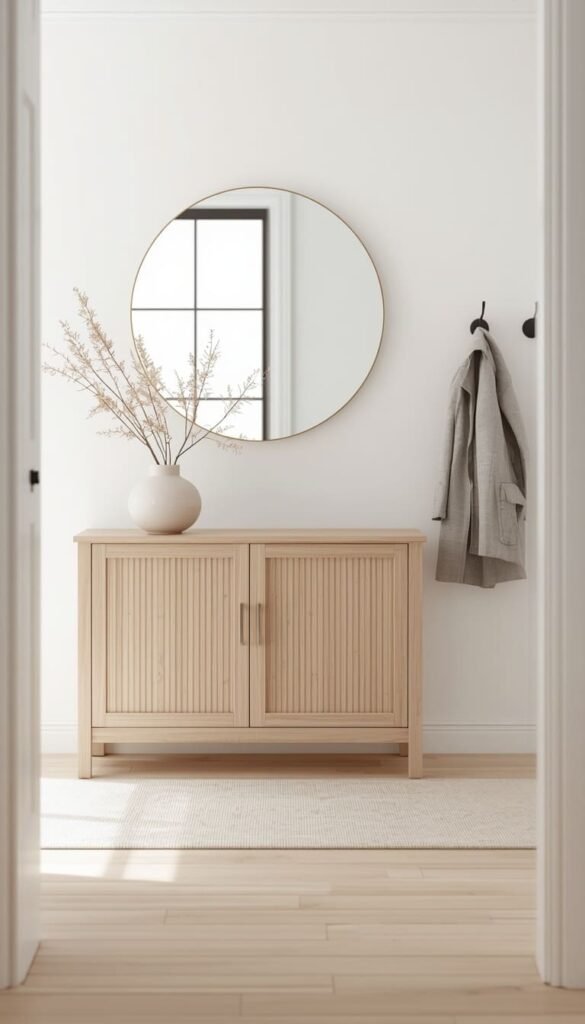
Everything we’ve covered in this article builds toward one final idea, and it’s the simplest one of all. A Scandi entryway is never finished in the sense of being complete and static. It’s a living space that gets edited seasonally, reset daily, and refined gradually as you understand more about how your household actually uses it. The Nordic approach to home design has always been evolutionary rather than decorative you add what serves you and remove what doesn’t, consistently and without sentimentality.
My final advice is this: choose one element from this list and implement it this week. Not all twenty. One. Maybe it’s swapping the lightbulb to a warmer temperature. Maybe it’s clearing the console surface down to three objects. Maybe it’s ordering that slim shoe cabinet you’ve been considering for six months. The Scandi entryway isn’t built in a single weekend makeover. It’s built in small, confident decisions made over time each one bringing the space a little closer to that feeling of quiet, grounded calm that makes coming home the best part of the day.
Your 2-Minute Scandi Entryway Decision Map
By Budget
Starter and Budget (Under $300 total)
- Start with IKEA HEMNES shoe cabinet as your anchor piece
- Add Command hook strips in a clean row for coats and bags
- Layer in a washable flatweave cotton runner under $50
- Swap your existing bulb to a 2700K warm white LED immediately
- One linen basket under a bench or console completes the look
Luxury and Investment ($800 and above)
- Choose solid oak or ash bench with dovetail joinery and lift-top storage
- Install a custom hook rail in blackened oak or solid brass hardware
- Invest in a hand knotted wool runner in a natural undyed tone
- Add a designer pendant or rattan flush mount for warm ambient light
- One quality ceramic piece as the single decorative object on the console
By Lifestyle
Busy Families and Pet Owners
- Prioritize closed storage over open shelving always
- Choose washable rugs exclusively no jute, no natural fiber flatweaves
- Mount hooks higher than standard so kids cannot reach outerwear unsupervised
- Keep a dedicated basket specifically for pet leashes, towels, and dog gear
- Edit the console surface to zero decorative objects function only
Minimalists and Empty Nesters
- One floating shelf replaces the need for a full console table
- Two hooks maximum one for today’s coat, one for a guest
- A single round mirror and one ceramic piece is genuinely enough
- Let the floor stay completely bare except for one well-sized runner
- Resist every seasonal decor impulse the calm is the decoration
Frequently Asked Questions
What is the best flooring for a Scandi entryway?
Light oak hardwood or large format pale stone tile works best. Both reflect light, hide minor dirt well, and age gracefully with Nordic style furniture sitting on top.
How do I make a narrow hallway look wider without renovating?
A round mirror, light wall color, and furniture with exposed legs create the illusion of width immediately. Keep the floor completely clear even one pair of shoes left out visually shrinks the space.
Can I do a Scandi entryway on a tight budget?
Yes, absolutely. IKEA’s HEMNES cabinet, a $10 warm LED bulb swap, and one linen basket get you 80 percent of the Nordic look for under $150 total.
How many hooks should a Scandi entryway have?
Ideally three to five hooks maximum for a standard household. More than that encourages overloading, which kills the clean Nordic aesthetic faster than anything else.
What colors work best for a Scandi entryway in an American home?
Benjamin Moore White Dove, Sherwin Williams Accessible Beige, and pale greige tones work beautifully. Avoid stark cool whites they read as clinical rather than calm in most US home lighting conditions.
Conclusion
Your entryway doesn’t need a complete overhaul to feel like a different space it needs one good decision made today. Clear that console surface down to three objects, swap that harsh bulb for a warm one, or finally order the slim shoe cabinet you’ve had saved in your browser for two months. Small moves compound quickly in a space this size, and the payoff shows up every single morning when you walk out the door feeling calm instead of chaotic. So tell me which one of these 20 ideas are you tackling first, and what does your entryway look like right now.
