22 Modern Luxury TV Wall Ideas for a High End Look
Your TV wall is either the most stylish thing in your living room or the most awkward. There’s rarely an in between. I’ve walked into hundreds of American homes where a beautiful space was completely undermined by a flat screen just… hanging there, with no context, no intention, and a tangle of cords snaking down the wall. The good news? A luxury TV wall doesn’t have to cost a fortune or require a full renovation. With the right design approach, even a modest wall can look like it belongs in an Architectural Digest feature.
My Design Notes
A few years ago, I was working with a client in Nashville, Tennessee a stunning open plan home with wide plank oak floors, exposed brick, and some of the most beautiful natural light I’ve ever designed around. The problem? A 75-inch TV mounted dead-center on the main wall, looking like a black hole swallowing the entire room. Her husband loved it exactly where it was. She wanted it gone. My job was to make them both happy.
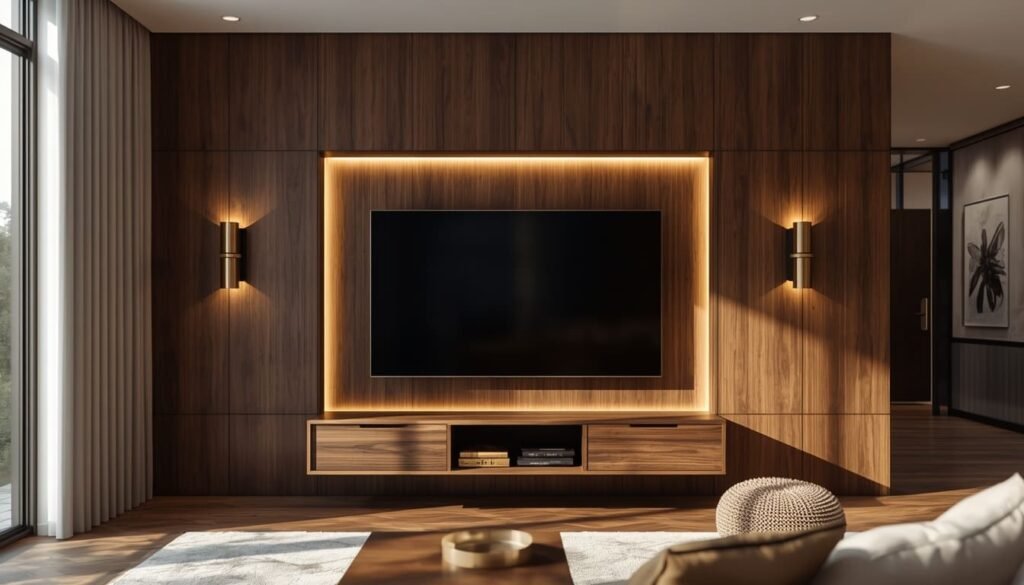
We designed a floor to ceiling dark walnut wood slat panel with a recessed niche so the TV sat completely flush with the wall. Then we flanked it with two linen shade sconces at just the right height. No more floating black rectangle. Suddenly, the TV belonged there like it had always been part of the architecture.
That project taught me the single most important rule I now share with every client: you don’t fight the screen. You design around it. Everything I’m sharing in this article comes from that philosophy real projects, real budgets, and real results.
Stunning Luxury TV Wall Designs That Elevate Every Living Room
1. Marble Slab Feature Wall
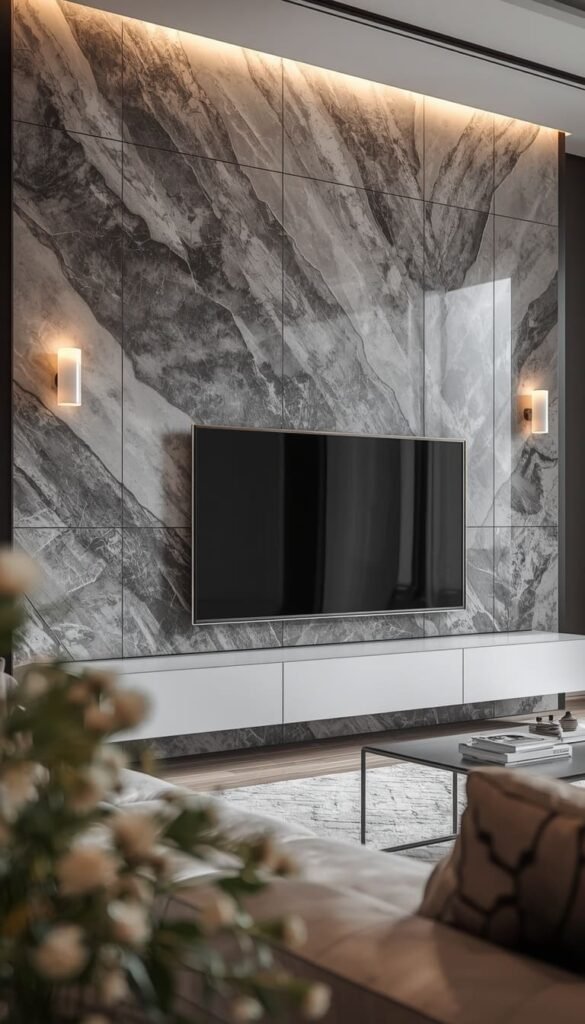
There is something about a marble TV wall that just stops people in their tracks. I’ve specified this finish in several high end projects across the South and every single time, the client stands in the finished room and goes completely quiet for a moment. That’s the marble effect. The deep veining, the cool surface, the way it catches light differently at 8am versus 8pm it feels alive in a way that painted drywall simply never will.
Now, the reality check you won’t find in most design blogs: natural marble is gorgeous but genuinely high maintenance. It etches from acidic spills, stains from wine, and needs professional sealing every 12 to 18 months. For a TV wall specifically where you’re not cooking or eating directly on it marble holds up reasonably well. But if you have young kids or a chaotic household, consider a porcelain marble look slab instead. The visual difference in photos is nearly zero. The lifestyle difference is enormous.
Budget wise, expect to spend anywhere from $4,000 to $18,000 for a full natural marble feature wall depending on your slab selection and your city. Porcelain alternatives bring that number down to $1,500 to $4,000 installed.
2. Dark Wood Veneer Panel
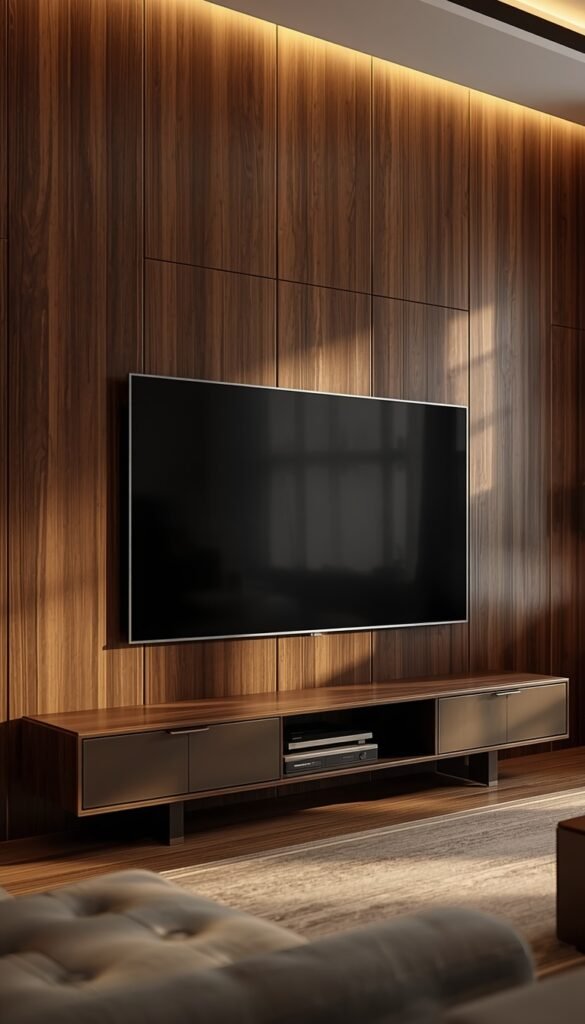
Dark wood veneer is one of those finishes that photographs beautifully and lives even better in person. When I specify this for clients who want warmth without the rustic farmhouse feel, it always delivers. The grain catches ambient light in the evening and gives the entire wall a quiet, sophisticated depth that paint simply cannot replicate.
The species matters more than most people realize. Here’s what I typically recommend based on budget and aesthetic:
- Walnut is the gold standard rich, chocolatey, and genuinely luxurious. It runs higher in cost but ages beautifully.
- White oak gives you a lighter, more contemporary feel and is more widely available at mid-range price points.
- Bamboo veneer is the budget friendly option that still reads as high-end in most living rooms.
One thing to watch out for is the sheen level. A high-gloss finish on wood veneer can look plastic and dated within a few years. I always push clients toward a satin or matte finish it photographs better, shows fewer fingerprints, and honestly just feels more expensive.
3. Japandi Inspired Floating Console
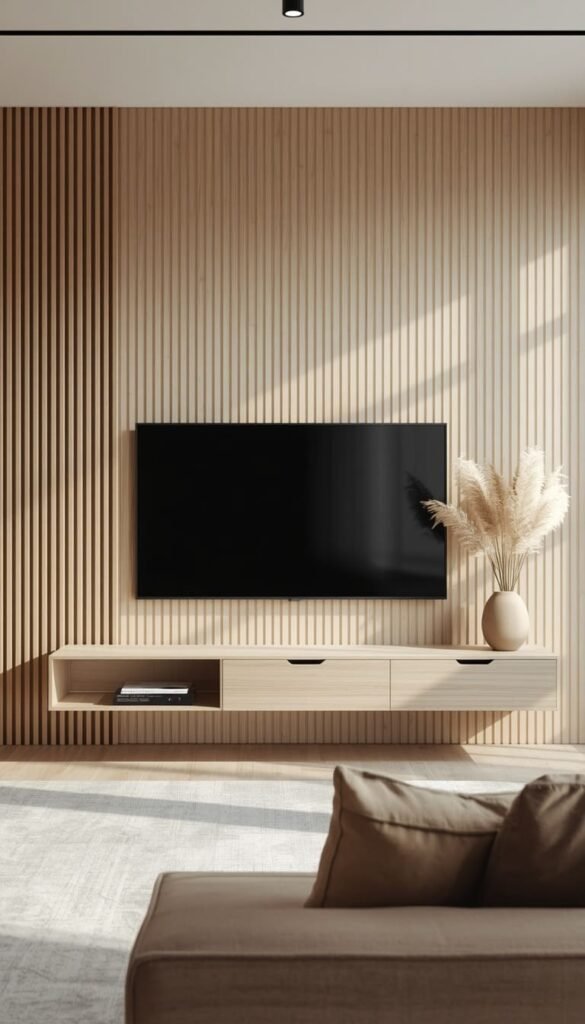
If you’ve been anywhere near interior design content in the last two years, you already know Japandi is not going away. And honestly, as a designer, I’m glad. It’s one of the few trends that actually makes people’s homes calmer and more functional at the same time. For a TV wall, the Japandi approach means a low profile floating console in pale oak or matte white, clean vertical wall paneling behind the screen, and absolutely nothing on that wall that doesn’t earn its place.
The floating console is doing a lot of heavy lifting here visually and practically. Mounted 18 to 24 inches off the floor, it creates that airy, uncluttered look while giving you real storage for streaming devices, remotes, and cables. A quick trick I’ve learned from doing this style repeatedly: keep the console at least 6 inches narrower than your TV on each side. It sounds counterintuitive but it actually makes the whole setup look more intentional and less like a big box store display.
For sourcing, CB2, Article, and West Elm all carry Japandi friendly consoles in the $400 to $1,200 range. If you want true custom, a local woodworker can build exactly what you need for comparable money and you’ll get something nobody else has.
4. Backlit LED Niche Done Right
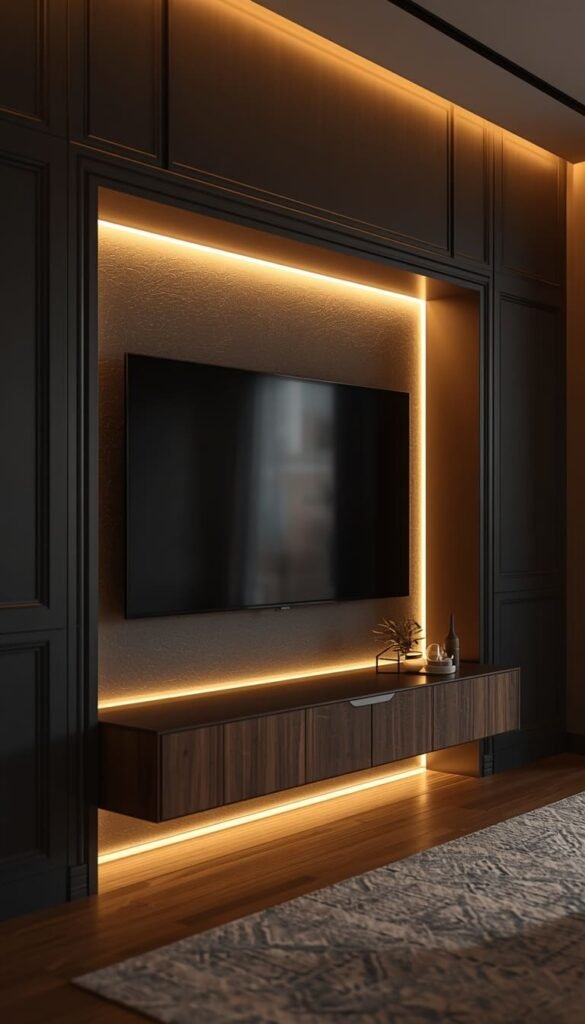
Bias lighting behind a TV is one of those design moves that looks like a million dollars and costs about $40 if you do it correctly. The science behind it is simple having a soft light source behind your screen reduces the contrast between the bright display and the dark wall around it, which genuinely reduces eye strain during long viewing sessions. It also makes the entire wall feel more architectural and intentional.
The problem is most people buy the wrong product and end up with something that looks like a college dorm setup. A quick trick I share with every client: skip the basic adhesive LED strip kits from big box stores and invest in a high CRI (90+) tunable white LED strip with a diffuser channel. The diffuser is the secret it softens the light into a clean, even glow instead of individual hot spots that cheapen the whole look.
Here’s what actually matters when shopping for bias lighting:
- Choose warm white (2700K to 3000K) for a cozy, luxurious feel cool white reads clinical and harsh.
- Always install behind a recessed panel or inside a channel, never directly on a flat wall.
- Dim it down to about 10 to 15 percent of full brightness during movie watching for the best effect.
The full setup quality LED strips, aluminum diffuser channel, and a smart dimmer should run you $80 to $150 total. The result looks like work done by a $500-per-hour lighting consultant.
5. Custom Built In Bookshelf Wall
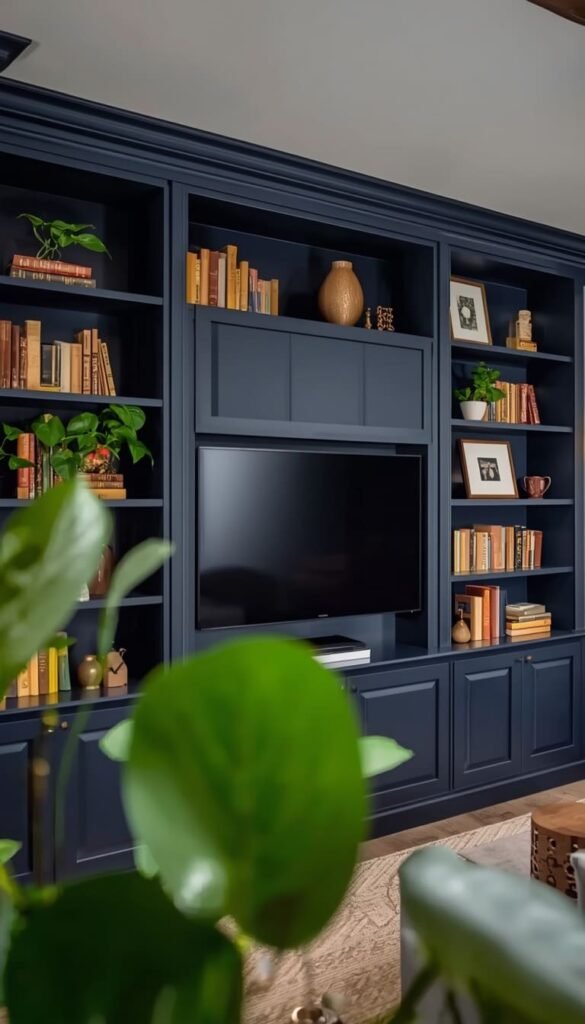
A floor to ceiling bookshelf wall with the TV integrated into it is, in my opinion, one of the most timeless and livable luxury TV wall solutions available to American homeowners. It works in a traditional Colonial, a modern farmhouse, a sleek contemporary apartment the style adapts because the bones of the idea are so fundamentally right. You’re giving the TV a context, surrounding it with things that have personality, and creating a wall that’s genuinely interesting whether the screen is on or off.
The cost conversation is where this gets real. Fully custom built-ins from a cabinetmaker will run you $1,500 to $3,500 per linear foot in most US markets. For a 12-foot wall, that’s a serious investment. But here’s what most design blogs won’t tell you the IKEA Billy bookcase hack, done thoughtfully with added crown molding, inset doors, and a fresh coat of paint, can achieve 80 percent of that look for roughly $800 to $2,000 total. I’ve specified both versions for clients at very different budget levels and the right styling makes both look intentional and high-end.
What separates a gorgeous built-in wall from a cluttered one is edit discipline. Style your shelves with a mix of:
- Books grouped by color or spine size for visual rhythm
- A few meaningful objects ceramics, small sculptures, framed photos
- At least one trailing plant to bring life and softness to the structure
Leave breathing room. Empty shelf space is not wasted space it’s intentional luxury.
My TV is just floating on a blank wall with zero personality and it bothers me every single day?
6. Fluted Wood Panel Accent Wall
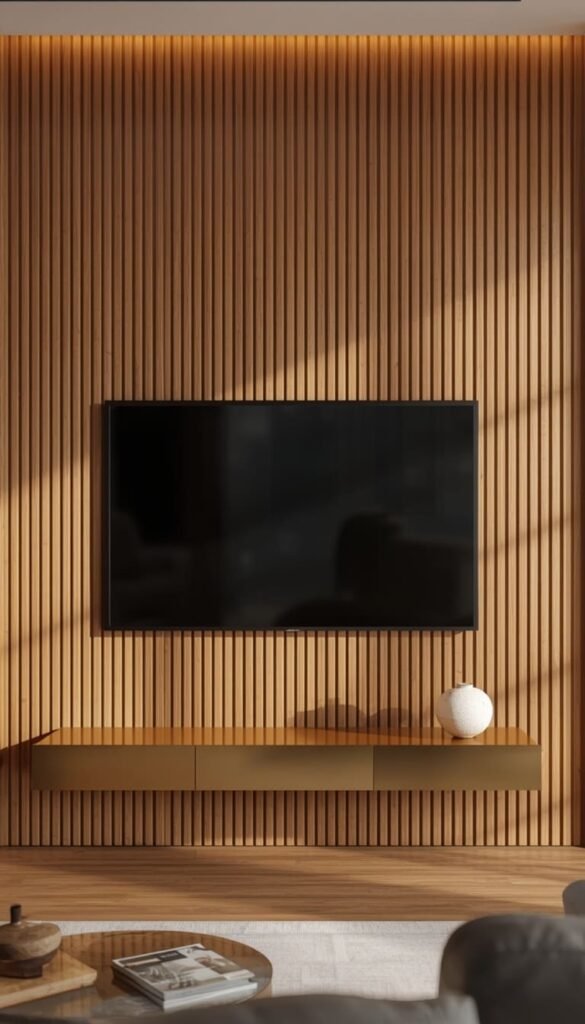
Fluted wood panels are having a serious moment in American interiors right now and honestly, the obsession is completely justified. That rhythmic vertical texture does something remarkable to a TV wall it adds depth and shadow play that shifts throughout the day as natural light moves across it. In the morning it looks soft and warm. By evening with your lamps on, it looks genuinely dramatic.
What I love most about specifying fluted panels for clients is the versatility. Paint them deep charcoal and the wall feels like a luxury hotel suite. Keep them in natural oak and it reads Scandinavian and serene. Add a matte black TV against natural fluted wood and the contrast is quietly spectacular.
One thing to watch out for: dust. Those grooves collect it. If you have allergies or simply hate cleaning, factor in a quick weekly wipe-down with a dry microfiber cloth as part of your routine. It takes about three minutes but skipping it for a month makes the wall look neglected fast. Pre-finished fluted MDF panels are available at most lumber yards and online retailers like Wayfair and Amazon in the $3 to $8 per square foot range making this one of the more accessible luxury looks on this entire list.
Top 6 Luxury TV Wall Ideas:
| Idea | Estimated Price | Maintenance |
|---|---|---|
| Marble Slab Feature Wall | $1,500 – $18,000 installed | High |
| Custom Built In Bookshelf Wall | $800 – $42,000 installed | Low |
| Backlit LED Niche | $80 – $150 DIY | Low |
| Linear Fireplace and TV Combo | $800 – $3,500 insert only | Medium |
| Geometric Wood Slat DIY Wall | $245 – $385 DIY | Low |
| Travertine and Stone Tile Wall | $900 – $8,000 installed | Medium |
7. Minimalist White Shiplap Wall
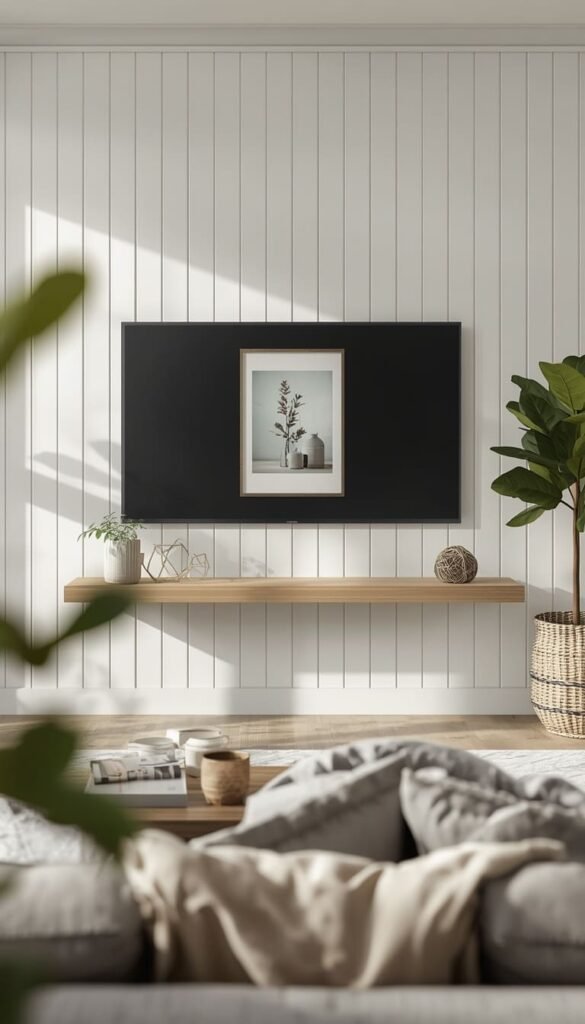
Let me be honest with you about white shiplap because most design content is not. When it’s done well, a white shiplap TV wall looks clean, airy, and genuinely beautiful. It works especially well in coastal homes, modern farmhouse spaces, and any room that gets strong natural light. Paired with a Samsung Frame TV and a simple floating shelf below, it can look effortlessly curated without spending a lot of money.
When it’s done poorly, it looks like every other shiplap wall built between 2015 and 2020 and it dates a room immediately. The difference comes down to three things: the profile of the shiplap, the finish, and what you put around it. Narrow profile shiplap (2.5 to 3 inches) reads more contemporary and refined. Wide boards (5 to 7 inches) skew more rustic and casual. A flat matte finish always looks more intentional than a shiny one.
If your home already has a lot of shiplap elsewhere, I’d actually steer you toward one of the other options on this list. Repetition of the same texture throughout a home is one of the fastest ways to make a space feel like a showroom instead of a home.
8. Sage Green Painted Built Ins
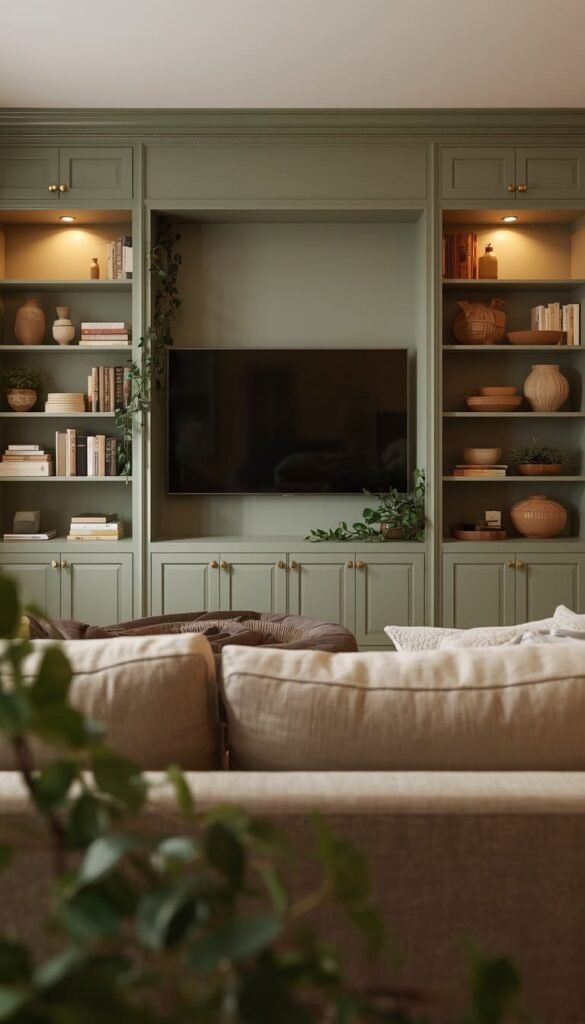
Sage green built-ins around a TV wall might be the single most requested color treatment I’ve seen from American clients over the last three years. And I get it completely. That soft, muted green sits right at the intersection of nature inspired calm and grown-up sophistication it works with warm wood floors, white walls, brass hardware, and natural linen upholstery all at once. It’s almost unreasonably versatile.
From a color psychology standpoint, green genuinely promotes a sense of calm and restoration which makes it a particularly smart choice for a room where you’re already trying to relax and unwind. A quick trick I’ve learned: the undertone of your sage matters enormously in artificial light. Some sage greens pull gray under LED lighting and some pull yellow. Always test your sample under the lighting conditions you actually live in not just in daylight.
My current go to paint recommendations for this look:
- Farrow and Ball Mizzle — sophisticated, slightly complex, looks incredible with brass
- Benjamin Moore Rosemary — warmer and more approachable, great for family rooms
- Sherwin Williams Pewter Green — the most popular for good reason, works in almost any light
Pair whichever you choose with unlacquered brass or aged bronze hardware and you have a built-in wall that will look current for the next decade minimum.
9. Moody Navy or Black TV Wall
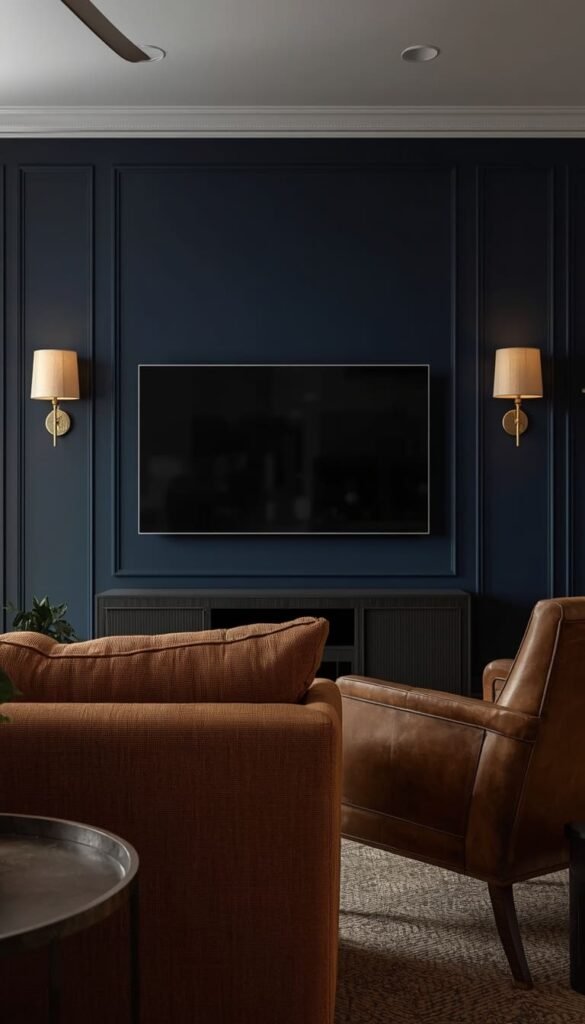
Here’s a design trick I wish more American homeowners knew about: painting your TV wall a very dark color navy, charcoal, or true black is one of the smartest things you can do for a room with a large flat screen. When the TV is off, a black screen against a dark wall practically disappears. When it’s on, the contrast between the bright display and the dark surround actually enhances the viewing experience. You’re essentially creating a mini cinema effect without spending a single dollar on equipment.
The psychological shift a dark TV wall creates in a room is remarkable. It adds instant depth, makes the ceiling feel taller by contrast, and gives the entire space a sense of intentional drama that lighter walls simply cannot achieve. I’ve transformed genuinely awkward living rooms with nothing more than a gallon of dark paint and the right lighting around it.
One thing to watch out for here is undertones. Black and navy paints behave very differently under warm versus cool light sources. Test these before committing:
- Farrow and Ball Hague Blue — the most luxurious navy I’ve ever specified, has a slight teal depth
- Benjamin Moore Wrought Iron — the perfect near-black with warm undertones that stops it feeling cold
- Sherwin Williams Tricorn Black — a true, clean black with no distracting undertones
Keep your surrounding furniture and textiles in warm, tactile materials bouclé, linen, aged leather and the dark wall will feel cozy and enveloping rather than heavy.
10. Grasscloth Wallpaper Backdrop
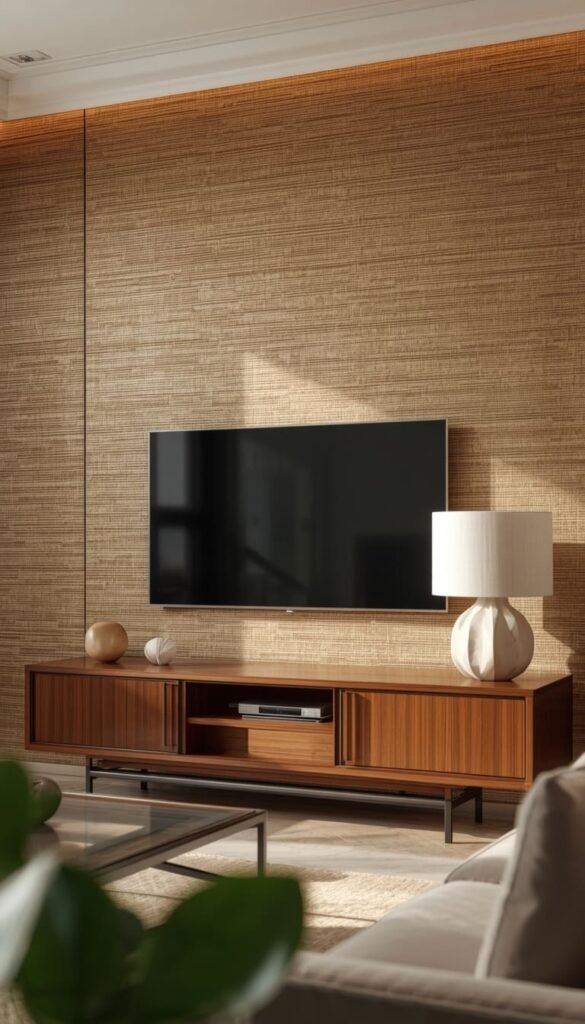
I have a genuine soft spot for grasscloth on a TV wall and I’ll tell you exactly why. Every other material on this list is smooth, geometric, or architectural. Grasscloth is organic. It has an irregularity to it a handmade quality that immediately makes a room feel curated rather than assembled. Behind a TV, that natural texture creates a backdrop that’s visually interesting without competing with what’s on screen.
The tactile quality of grasscloth is something you genuinely cannot appreciate in photos. In person, it has a warmth and depth that makes the whole wall feel like a design decision rather than a background. Paired with warm sconces on either side of the TV and a floating console below, it’s one of the most complete and satisfying TV wall looks I know how to create.
The practical side deserves honesty though. Grasscloth is:
- Not washable — marks and moisture can permanently stain it
- Difficult to repair if damaged — seams show and patches rarely match perfectly
- Not ideal for walls that get direct sunlight — it fades unevenly over time
For a TV wall specifically, where you’re unlikely to be splashing liquids or scrubbing the surface, these limitations are very manageable. Budget around $8 to $22 per square foot installed depending on the quality of the grasscloth you select.
I have a setup but the cables and clutter are quietly driving me crazy?
11. Linear Fireplace and TV Combo
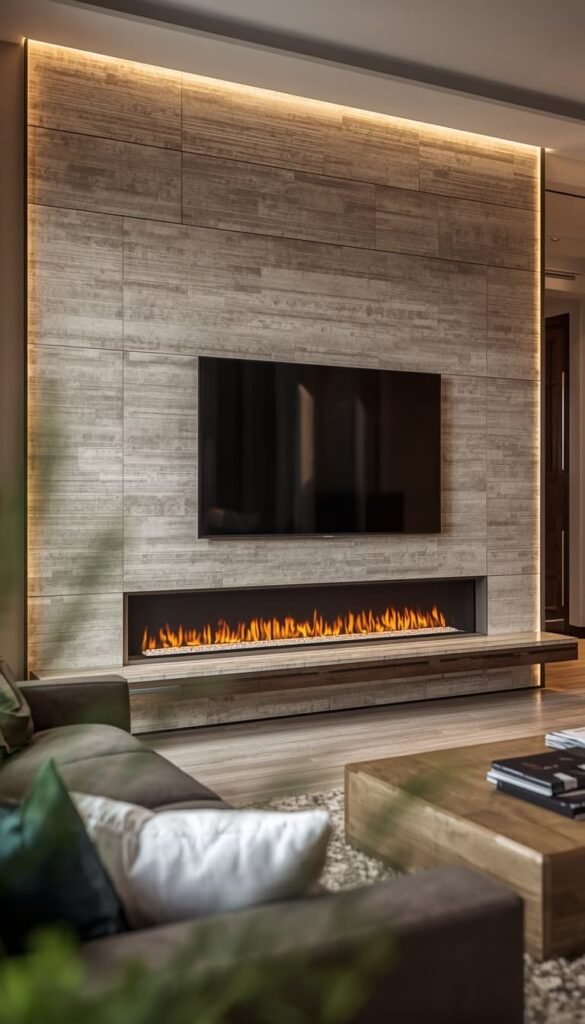
Combining a linear fireplace with a TV on the same wall is one of the most requested luxury upgrades I see from American homeowners right now and when it’s executed well, the result is genuinely breathtaking. That long, low flame below the screen creates a layered focal point that makes the entire room feel like a five-star resort living space. It’s functional, dramatic, and deeply satisfying to come home to.
But this is also the idea on this list that comes with the most important practical warnings, and I’d be doing you a disservice if I glossed over them. Heat management is the critical issue. Most TV manufacturers void your warranty if the TV is mounted too close to a heat source. The general rule is a minimum of 12 inches of clearance between the top of the fireplace opening and the bottom of your TV but always check your specific TV manufacturer’s guidelines before installation.
A quick trick I’ve learned from working with AV integrators on these projects: always specify an electric or ethanol linear fireplace for a TV combo wall rather than gas if you’re in a tighter space. Electric units produce dramatically less heat, give you full control over the flame effect independently of heat output, and don’t require venting that complicates your wall build-out. The visual result is identical. The installation headache is not even close.
Budget for a quality linear electric fireplace insert in the $800 to $3,500 range depending on width, plus your wall construction and finishing costs on top.
12. Samsung Frame TV Integrated Look
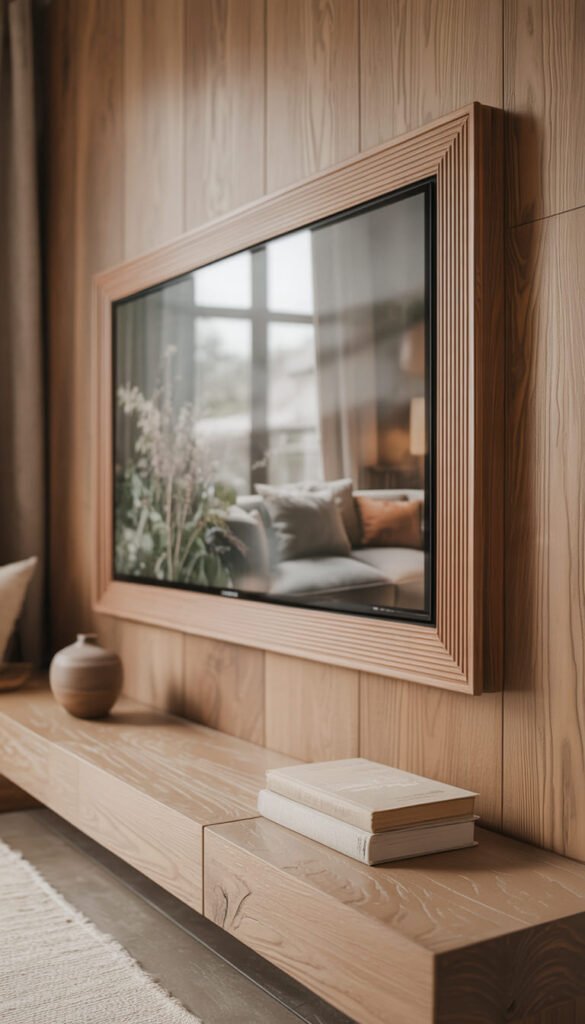
Let me give you the honest designer’s take on the Samsung Frame TV because it deserves both its praise and its criticism in equal measure. On the positive side, it is genuinely the most successful attempt any technology company has made at turning a flat screen into something that belongs in a designed room. The ability to display artwork when the TV is off, the ultra slim wall mount that sits flush against the surface, and the customizable bezels that let you match your décor these are real, meaningful design features that I’ve seen transform client spaces.
The criticism is equally real though. At $1,000 to $2,800 depending on screen size, you are paying a significant premium over comparable non-Frame Samsung models with similar picture quality. The Art Store subscription adds another $4.99 per month for access to the full artwork library. And the matte display coating while beautiful for reducing glare does affect picture brightness and color vibrancy compared to a standard glossy screen, which matters if you’re a serious film or sports viewer.
My honest recommendation: the Frame TV is worth every penny if your TV wall is a primary design feature in a formal living room or open-plan space where the screen is visible even when not in use. It’s probably not worth the premium if your TV is tucked into a built-in where it’s already visually contained, or if picture quality performance is your top priority over aesthetics.
13. Sconce Flanked TV Wall
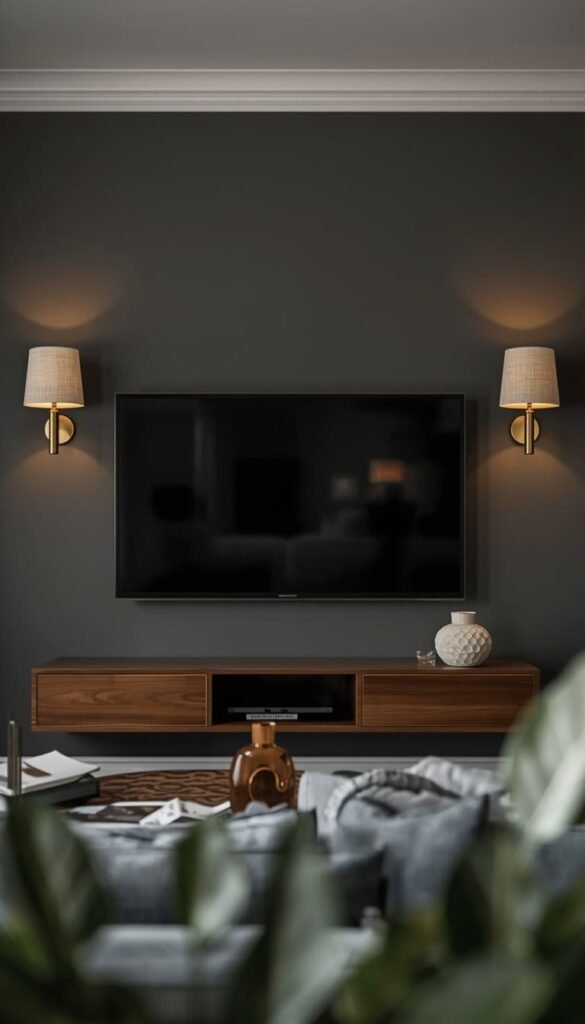
Sconces flanking a TV wall are one of those design moves that look like they require a decorator’s eye but are actually very straightforward to execute once you know the rules. I specify this treatment constantly for clients who want their TV wall to feel finished and intentional without committing to a full built-in or wallpaper project. Two well-chosen sconces do an enormous amount of work they add symmetry, provide the ambient lighting that makes evening viewing comfortable, and give the wall a furnished quality that bare paint simply lacks.
The placement detail that most people get wrong is height. A quick trick I’ve learned from doing this in dozens of rooms: mount your sconces so the center of the shade sits approximately at eye level when you’re seated typically 48 to 54 inches from the floor. Most people mount them too high, which pushes the light up toward the ceiling where it doesn’t help anyone. Getting this height right makes the difference between sconces that feel purposeful and sconces that feel like an afterthought.
For style direction, here’s how I match sconces to TV wall aesthetics:
- Warm brass with a linen shade works beautifully against dark painted walls or wood veneer panels
- Matte black with an exposed Edison bulb suits industrial, Mid-Century Modern, and contemporary spaces
- Aged bronze with an opaque white shade is the most versatile finish it reads traditional or transitional depending on everything around it
Budget between $150 and $600 per sconce for fixtures that look genuinely high end. Anything below that range tends to show its price point up close.
14. Travertine and Stone Tile Wall
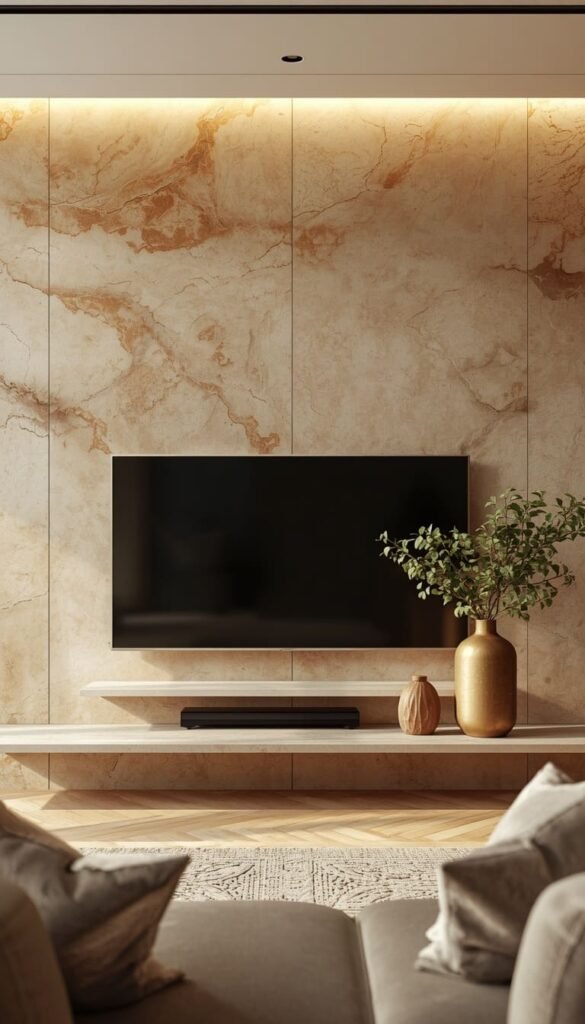
Travertine is having its biggest moment in American interiors since the early 2000s but this time around it looks completely different and infinitely more sophisticated. Where the original travertine trend leaned beige and builder-grade, today’s application is intentional, architectural, and genuinely luxurious. On a TV wall, large format travertine tiles or slabs create a texture that is simultaneously ancient and completely contemporary. There is simply nothing else that looks quite like natural stone in a living room.
What makes travertine particularly successful as a TV wall material is its tonal variation. Unlike marble, which can feel stark and formal, travertine has a warmth and earthiness to it that makes a room feel immediately livable. The natural pitting and veining in the stone catches light beautifully especially in the evening with warm sconces or LED accents doing their work around the perimeter.
The honest maintenance reality: travertine is porous and requires sealing upon installation and annually thereafter. The natural pits in unfilled travertine can trap dust and require a soft brush rather than a damp cloth to clean properly. If those realities concern you, a large format porcelain tile that mimics travertine honestly looks stunning and requires almost zero maintenance beyond a weekly wipe. For a wall application where spills and heavy wear are not a factor I typically recommend the natural stone to clients who can manage the upkeep, because nothing manufactured truly replicates the depth of the real thing.
Installed cost for natural travertine on a feature wall runs $2,500 to $8,000 depending on slab size, tile format, and your market. Porcelain alternatives come in at $900 to $3,000 installed.
15. Floating Console with Hidden Storage
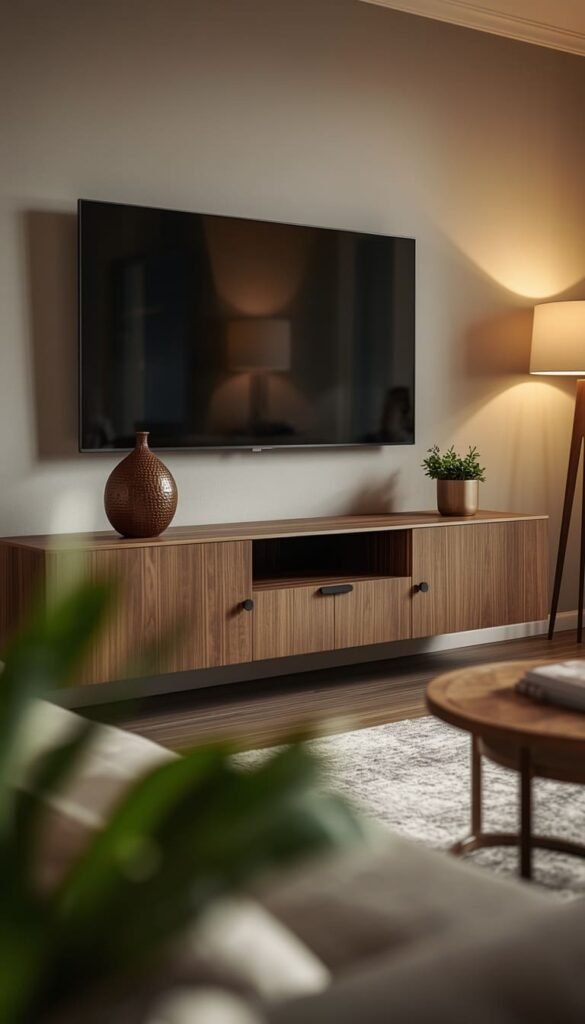
A well-designed floating console is doing more work than it gets credit for in most TV wall setups. It anchors the screen visually giving that large black rectangle something to sit above so it doesn’t look like it’s floating helplessly in the middle of the wall. It provides storage for all the technology that makes a modern living room function. And when it’s specified correctly, it contributes its own design moment to the wall rather than just existing as a utility piece.
The hidden storage element is where the real luxury lives. I always push clients toward consoles that combine closed cabinet doors with at least one open section closed for cable boxes, gaming consoles, and the general chaos of modern technology, open for a few curated decorative objects that give the console visual personality. The closed section handles the reality of how you actually live. The open section handles how you want the room to look.
Wire management deserves its own conversation here because it’s the detail that separates a finished TV wall from an unfinished one regardless of how much you spend on everything else. The solutions I recommend most consistently:
- In-wall cable management kits run about $25 to $60 and route your HDMI and power cables cleanly through the wall this is the most seamless solution and worth doing during any wall project
- Cable raceways in a finish that matches your wall color are the rental friendly alternative they’re visible but look intentional when painted to match
- Furniture-grade cable boxes on the console surface corral loose cables elegantly for everything that can’t be routed through the wall
A floating console mounted at 24 to 30 inches from the floor hits the right visual proportion for most standard ceiling heights and feels genuinely custom even when it isn’t.
My TV wall looks fine but it feels generic and I want it to feel intentional?
16. Full Height Paneled Feature Wall
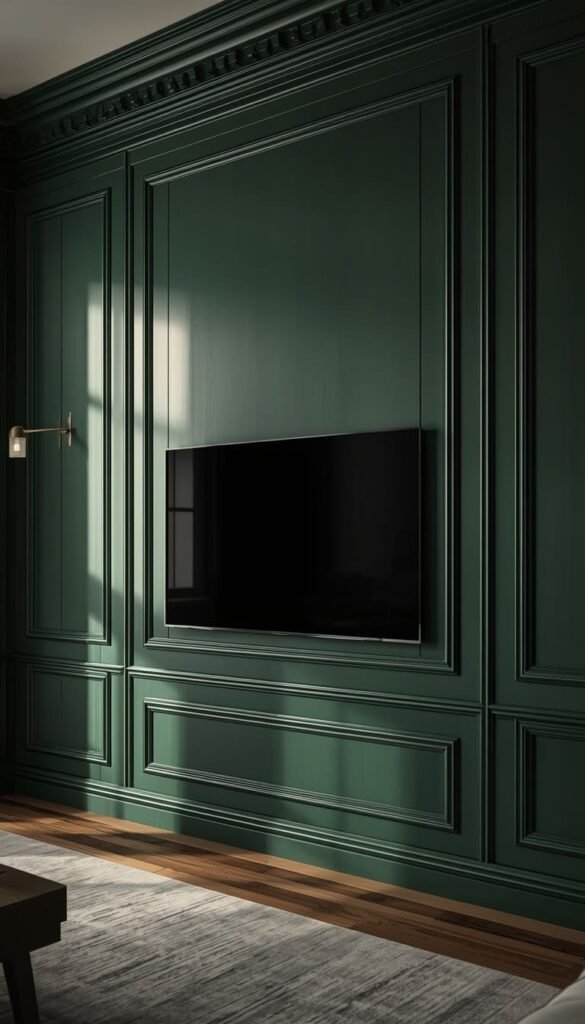
A full floor to ceiling paneled TV wall is one of the most architecturally impactful things you can do to a living room without touching the layout or the furniture. When the paneling runs the full height of the wall from baseboard to ceiling it draws the eye upward, makes the ceiling feel taller, and gives the room a sense of permanence and craftsmanship that is genuinely difficult to achieve any other way. This is the treatment I reach for when a client says their room feels unfinished or lacks a strong focal point.
The proportion rules matter enormously here and they shift based on your ceiling height. In a standard 8-foot ceiling room, keep your panel profile narrow and simple wide, heavy moldings will make the wall feel compressed and fussy. In a room with 9 or 10-foot ceilings, you have room to go bolder with panel width and depth. Rooms with 12-foot or vaulted ceilings can handle truly dramatic large-scale paneling that would overwhelm a more modest space.
Material choice shapes the entire personality of this wall treatment. Painted MDF paneling in a deep color reads formal and architectural think classic Manhattan townhouse. Natural wood paneling in oak or walnut reads warm and organic. Fluted or reeded panels add texture and contemporary energy to either material. The TV integrates most seamlessly when mounted flush within a recessed center panel so the screen sits at the same plane as the wall surface rather than projecting outward into the room. That single detail elevates the entire installation from a mounted TV to a genuinely designed wall.
17. Mirrored TV Wall Panel
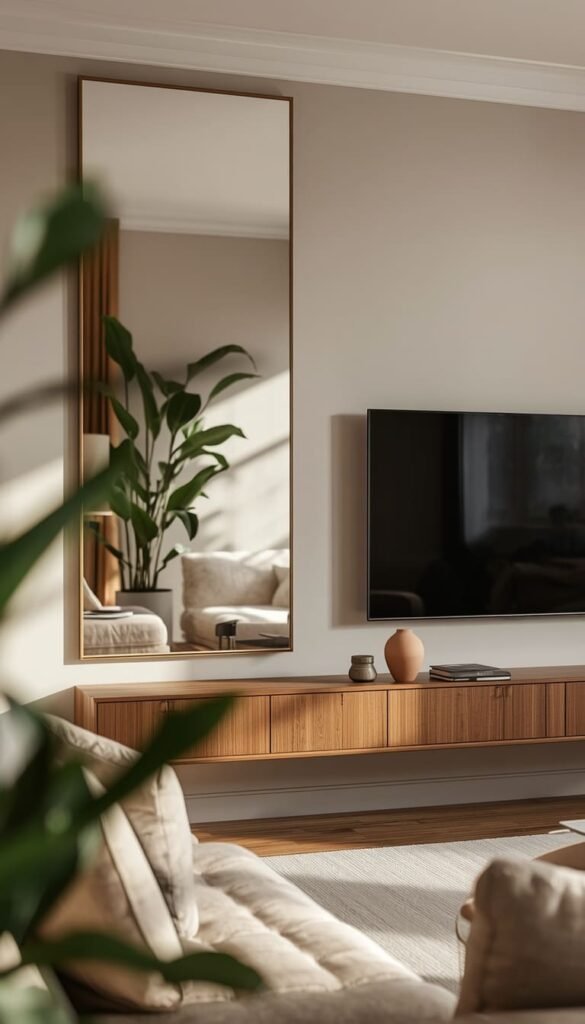
A mirrored panel behind or flanking a TV wall is one of the most underutilized tricks in residential interior design and I think it’s because people associate mirrors with dated 1980s aesthetics and never revisit the idea. Done correctly with modern proportions and framing, a strategic mirror panel on a TV wall does something genuinely remarkable: it doubles the perceived depth of the room, bounces natural light into corners that never otherwise see it, and creates the illusion of a window where there isn’t one.
I’ve used this treatment most successfully in narrow living rooms and apartment spaces where the TV wall sits directly opposite the main seating and the room feels compressed. A large mirror panel mounted to one side of the TV not behind it, which creates a distracting reflection during viewing visually expands the wall and makes the entire space feel significantly larger and more generous than it actually is.
The framing detail makes or breaks this look. A frameless mirror panel reads sleek and contemporary. A thin brass or bronze frame elevates it into something that feels designed and intentional. What to avoid is any ornate or heavily decorative mirror frame near a TV the combination of busy frame plus large black screen creates visual chaos that no amount of styling can rescue.
Budget around $400 to $1,500 for a custom cut mirror panel depending on size and edge treatment. The return on that investment in terms of how much larger and more luxurious the room feels is genuinely disproportionate to the cost.
18. Geometric Wood Slat DIY Wall
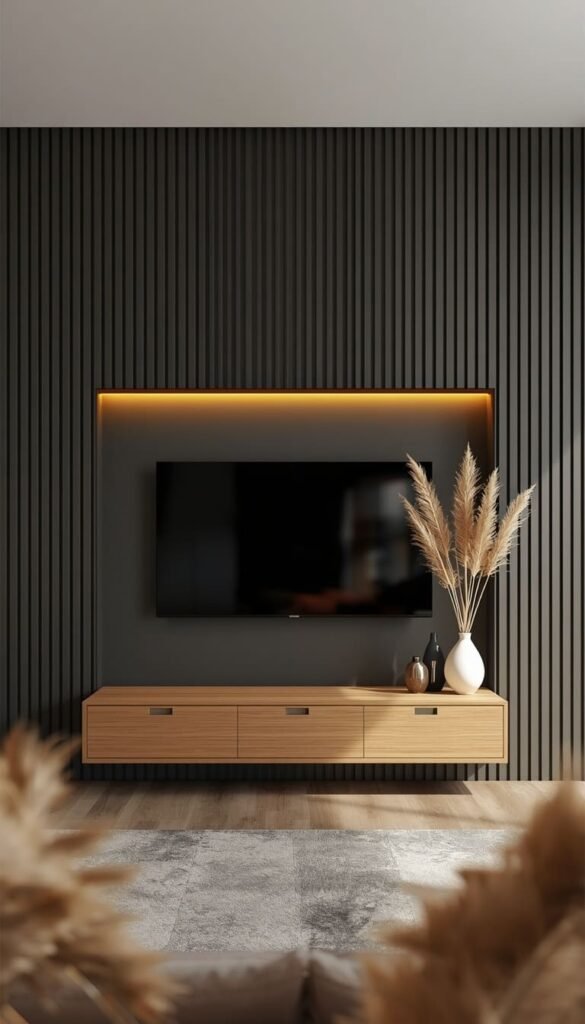
This is the idea on this list that I get the most questions about from homeowners who want a high end result on a realistic budget and the reason it keeps coming up is simple. A geometric wood slat wall looks like it cost thousands of dollars and can genuinely be completed over a weekend for $300 to $500 in materials if you’re willing to put in the work. I’ve seen clients execute this so well that guests assumed it was custom millwork installed by a professional.
The basic approach is straightforward: thin wood strips typically 1×2 or 1×3 pine or poplar are mounted vertically or in a geometric pattern directly onto the wall surface using construction adhesive and finish nails. The entire wall is then painted in a single unified color so the strips and the wall behind them read as one cohesive textured surface rather than applied decoration. That paint step is the secret. Without it, the slats look stuck on. With it, they look architectural.
Here is a realistic material breakdown for a standard 12 foot TV wall:
- Wood strips (1×2 poplar, 12-foot lengths) — approximately $120 to $180 depending on quantity and lumber prices in your area
- Construction adhesive and finish nails — approximately $25 to $35
- Primer and two coats of quality paint — approximately $60 to $90
- LED strip lighting installed behind the TV niche — approximately $40 to $80
Total investment sits comfortably between $245 and $385 for most standard walls. Add a floating console in a complementary finish and you have a TV wall that photographs like a design magazine feature.
19. Vintage Console and Art Gallery Mix
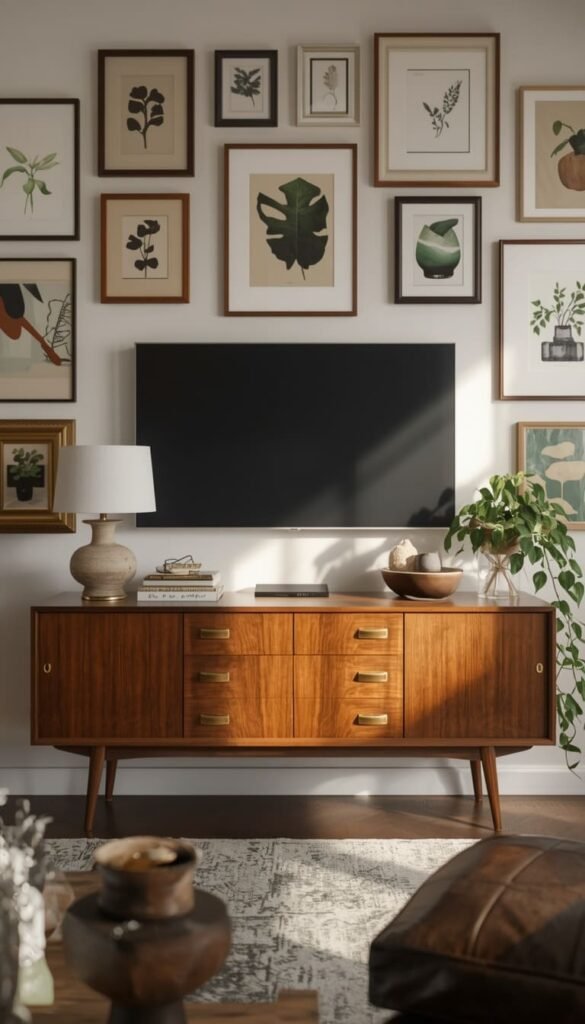
Not every luxury TV wall needs to be built, paneled, or tiled. Some of the most sophisticated TV walls I’ve ever designed for clients were achieved primarily through curation the right vintage console below the screen and a thoughtfully arranged collection of framed art around it. This approach works particularly well in Mid-Century Modern interiors, eclectic spaces, and any room where the homeowner has a genuine collection of art or objects worth displaying.
The vintage console does the heavy lifting here. A credenza or sideboard from the 1950s or 1960s in walnut or teak the kind you find at estate sales, on Chairish, or at local antique markets for $400 to $1,200 brings an authenticity and warmth to a TV wall that no new piece of flat-pack furniture ever will. The patina, the tapered legs, the original hardware these details read as genuinely luxurious because they are genuinely irreplaceable.
The art arrangement around the TV is where most people hesitate and they shouldn’t. A quick trick I’ve learned from styling dozens of these walls: treat the TV as one element within the gallery arrangement rather than the centerpiece everything orbits around. Mix frame sizes, vary the distance between pieces, and include at least one piece that’s large enough to hold its own visually against the screen. When the TV is off, the wall reads as a curated gallery. When it’s on, the art provides a rich, layered context that makes the whole setup feel considered and personal.
20. Rental Friendly TV Wall
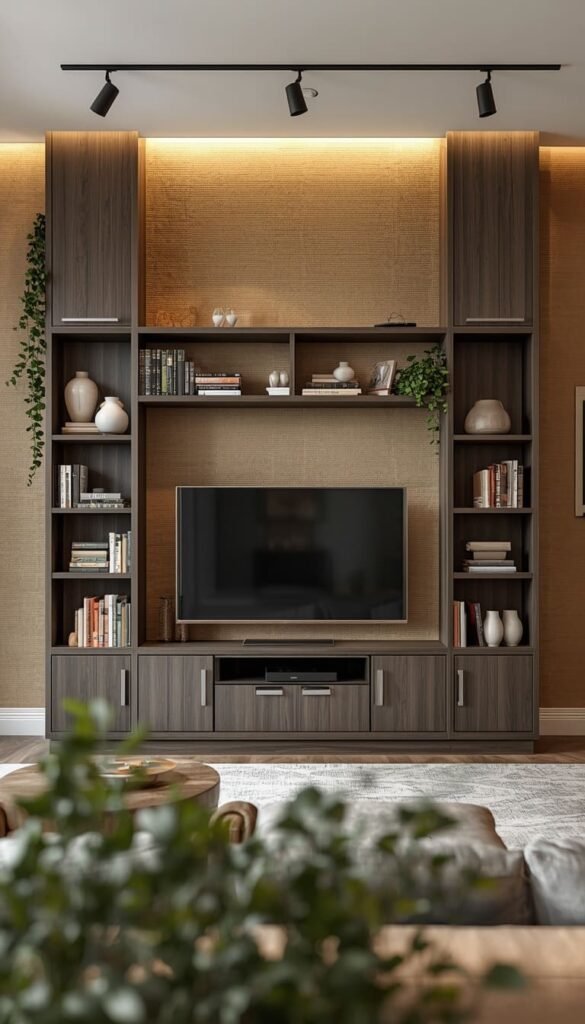
This section exists because a genuinely large portion of American households rent their homes and virtually every design resource online acts as though everyone has the freedom to drill into walls, install built-ins, and make permanent structural changes. I want to address this directly because there are real, beautiful TV wall solutions that leave zero damage and satisfy even the most restrictive lease agreements.
The foundation of a rental friendly luxury TV wall is a freestanding approach. A tall, substantial media console or bookshelf unit that reaches close to ceiling height creates the visual impression of a built-in without touching a single wall permanently. Style it with intention consistent color palette, curated objects, proper lighting and it reads as a designed feature rather than a temporary solution.
For the wall surface itself, the options are better than most renters realize:
- Peel-and-stick wallpaper has improved dramatically in quality over the last five years — many brands now offer grasscloth textures, geometric patterns, and even stone looks that are genuinely convincing and completely removable
- Large-scale art leaned against the wall rather than hung creates a deliberately casual, editorial aesthetic that is very much in style right now
- Floor lamps positioned flanking the TV replace the sconce lighting that requires wall installation and create a similarly warm, layered light environment
The one non negotiable even in rental spaces: cable management. A cable raceway painted to match your wall color costs under $20 and makes the difference between a setup that looks intentional and one that looks temporary. That detail matters more than almost anything else.
I’m starting completely from scratch and honestly don’t know where to begin?
21. Luxury Home Theater Wall
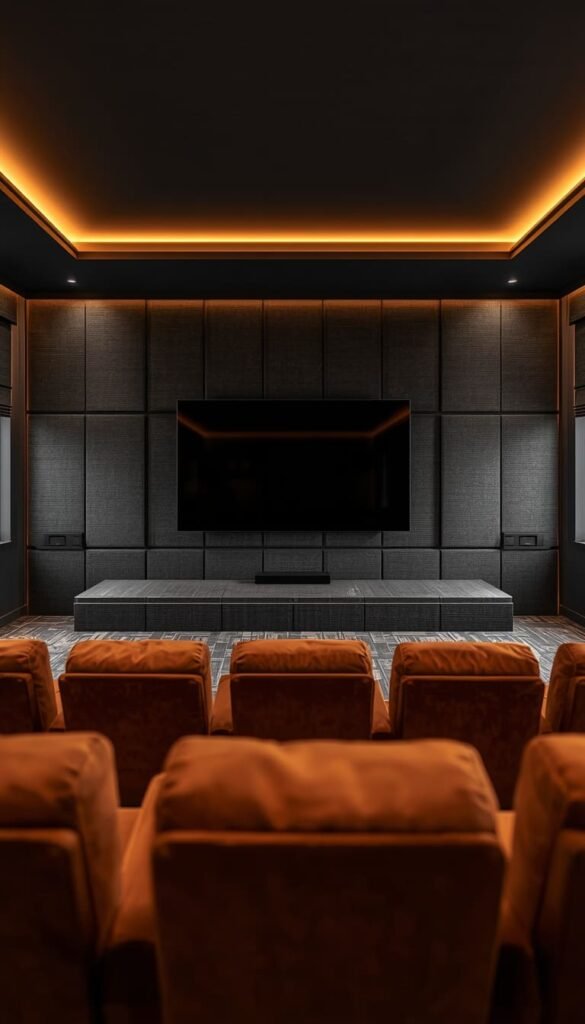
When a client tells me they want a true luxury home theater wall in their living room, my first question is always the same: are you prepared to bring in a professional AV integrator? Because this is the one idea on this entire list where DIY enthusiasm genuinely has its limits and where the gap between a good result and a truly exceptional one comes down almost entirely to professional expertise in acoustics, display calibration, and system integration.
A proper luxury home theater wall goes significantly beyond mounting a large screen and adding some ambient lighting. The screen itself is typically a 85-inch or larger 4K display, a short throw laser projector, or in truly high end installations, a Micro LED panel that can reach 110 inches or beyond. Behind that screen, acoustic wall panels manage sound reflection and absorption in ways that transform how dialogue, music, and effects actually feel in the room. These panels can be fabricwrapped and custom colored to match your interior they look like a design decision rather than a technical one when specified correctly.
The elements that separate a genuinely luxurious home theater wall from an expensive but ordinary one:
- Motorized blackout shades that integrate with your AV system and lower automatically when you start a film
- Tiered or stadium seating risers if the room depth allows even a single 8-inch riser for the back row makes a transformative difference in sightlines
- Dedicated acoustic treatment on the side walls and ceiling, not just the TV wall
- A professional calibration session for your display after installation most people never do this and never realize how much picture quality they’re leaving on the table
Budget expectations for this level of installation start at approximately $15,000 for a well executed mid-range setup and climb steeply from there depending on display technology, seating, and automation complexity. It is a significant investment. For the right client and the right space, it is also one of the most used and most loved rooms in the entire home.
22. Outdoor Inspired Coastal TV Wall
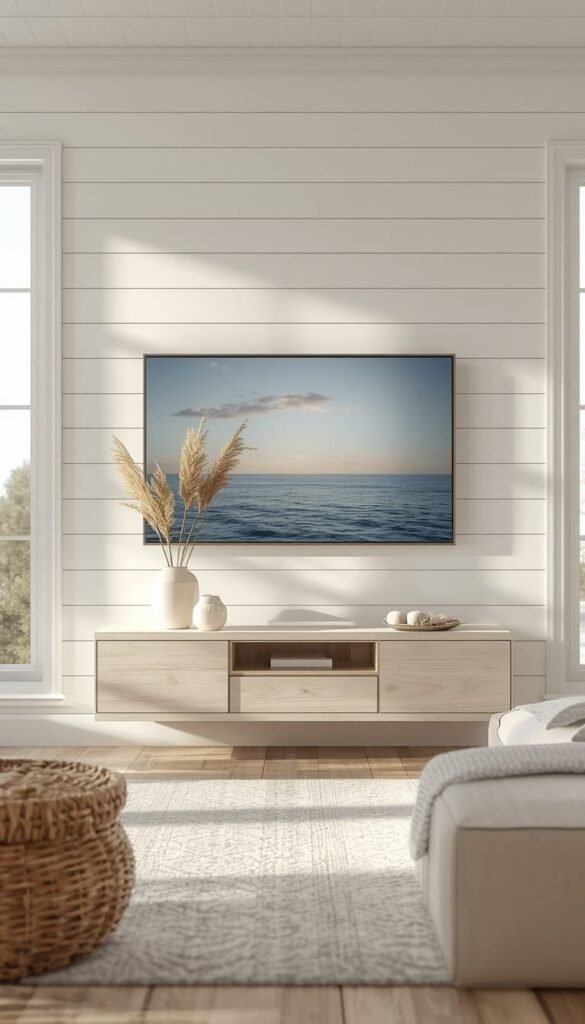
Coastal TV walls occupy a very specific and very beloved place in American interior design particularly across Florida, the Carolinas, California, and the Gulf Coast where indoor outdoor living is a genuine lifestyle rather than an aesthetic choice. Done well, a coastal TV wall feels like the room is exhaling. Light woods, natural textures, whitewashed surfaces, and a palette pulled directly from sand and sea create a backdrop for your screen that feels relaxed and genuinely luxurious at the same time.
The material selection for a coastal TV wall requires more thought than most design guides acknowledge because humidity is a real and destructive force in coastal environments. I’ve seen beautiful wood veneer panels warp and separate within two years in a Florida home that wasn’t properly climate controlled. Natural grasscloth can develop mold behind the paper in high-humidity conditions if the wall isn’t properly sealed first. These are not reasons to avoid these materials — they’re reasons to specify them correctly.
For genuine coastal climates, here’s what I recommend based on real project experience:
- PVC or composite shiplap over natural wood it looks identical in most installations and is completely impervious to moisture and humidity fluctuation
- Porcelain tile in a wood or stone look for any wall area near windows or exterior doors where humidity exposure is highest
- Marine-grade finishing products on any natural wood elements the same coatings used on boat interiors hold up remarkably well in residential coastal applications
- A Samsung Frame TV with a matte finish screen works particularly well in coastal rooms with significant natural light the anti-glare coating handles bright, sun-filled rooms far better than standard glossy displays
Your 2 Minute TV Wall Decision Map
By Budget
Weekend Warrior ($245 – $500)
- Geometric wood slat DIY wall is your best starting point
- Peel and stick wallpaper backdrop for renters who want texture
- Backlit LED niche upgrade costs under $150 and looks like a professional installation
- A vintage console from Chairish or a local estate sale pulls the whole look together for under $400
Luxury Investment ($2,500 and above)
- Marble slab or travertine feature wall for a genuinely architectural statement
- Custom built-in bookshelf wall with integrated TV niche for timeless livability
- Linear fireplace and TV combo for that five-star resort focal point
- Full height paneled feature wall with recessed TV mount for maximum design impact
By Lifestyle
Busy Families and Pet Owners
- Skip natural marble — porcelain lookalike is your smarter move
- Painted wood slat walls hide scuffs and are easy to touch up
- Closed console storage keeps gaming gear and remotes out of sight
- Dark painted built-ins camouflage everyday wear and fingerprints beautifully
Minimalists and Design Purists
- Japandi floating console with clean vertical paneling — nothing more needed
- Samsung Frame TV eliminates the black rectangle problem when the screen is off
- Grasscloth wallpaper backdrop adds texture without visual noise
- One pair of well placed sconces does more work than an entire shelf of decorative objects
Renters and Small Spaces
- Freestanding tall media console creates a built-in illusion without drilling
- Mirrored panel flanking the TV expands a narrow room dramatically
- Peel and stick grasscloth or geometric wallpaper behind the TV costs under $200
- Cable raceways painted to match the wall make any setup look finished and intentional
Coastal and Humidity Prone Homes
- PVC composite shiplap over natural wood every single time
- Porcelain stone look tile near windows and exterior walls
- Marine grade finishing products on any natural wood elements you insist on keeping
- Frame TV matte display handles bright sun filled rooms better than standard screens
Frequently Asked Questions
What is the best color to paint a TV wall in a living room?
Dark shades win every time. Navy, charcoal, and deep forest green make the screen disappear when it’s off and enhance contrast when it’s on. Farrow and Ball Hague Blue and Benjamin Moore Wrought Iron are my two most specified choices for this exact purpose.
How much does a luxury TV wall cost in the USA?
The average cost ranges from $800 for a quality DIY wood slat wall to $25,000 or more for a full custom marble or built-in installation. Your biggest cost variables are materials and whether you’re hiring a contractor or doing the work yourself.
Can I build a luxury TV wall in a rental apartment?
Yes, and more easily than most people think. Peel and stick wallpaper, freestanding media consoles, and leaned art panels create a high-end look without touching the walls permanently.
Is it safe to mount a TV above a fireplace?
Yes, but only with proper clearance. Most manufacturers require a minimum of 12 inches between the fireplace opening and the bottom of your TV. Electric fireplaces are the safest option since heat output is fully controllable.
What type of TV looks best on a feature wall?
The Samsung Frame TV is the strongest choice for a designed feature wall. Its flush mount, matte display, and artwork mode make it feel like part of the wall rather than something stuck onto it.
Conclusion
Your TV wall doesn’t have to be a renovation project to become something you’re genuinely proud of. Sometimes it starts with a single paint sample, a thrifted console, or finally dealing with those exposed cables that have been bothering you for two years. Small, intentional moves compound into a room that feels completely different and that feeling of coming home to a space that actually reflects your taste is worth every bit of effort it takes to get there.Pick one idea from this list that excites you and take one concrete step toward it today. Not next weekend. Today.