
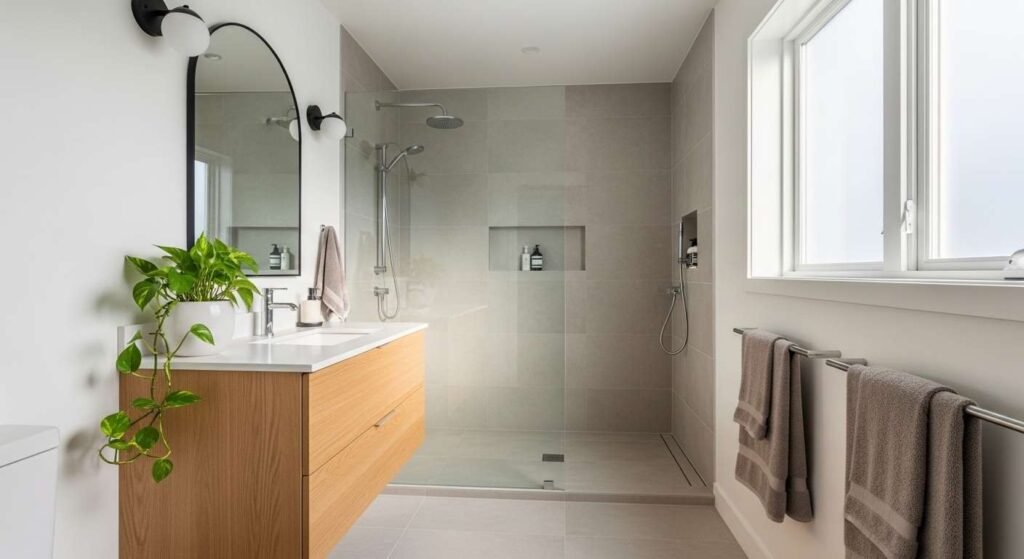
Your ensuite should feel like the first deep breath of the morning and if it doesn’t, Scandi design might be exactly what it needs. Over the past few years, I’ve watched American homeowners shift away from heavy, ornate bathrooms toward something quieter and more intentional. The Scandinavian ensuite aesthetic sits right at the center of that shift. It’s not about spending more. It’s about choosing better. In this guide, I’m walking you through 20 Scandi ensuite ideas that actually work in real homes, real budgets, and real square footage — no magazine-perfect conditions required.
My Design Notes
Last year, I worked with a couple in Naperville, Illinois who had a 55-square-foot ensuite attached to their primary bedroom. It felt like a closet with a toilet. They came to me wanting something spa-like but had a $12,000 budget and were genuinely convinced it wasn’t possible.
My first move was convincing them to ditch the bulky double vanity they’d been pinning on Pinterest for months. We went floating, single-sink, light oak finish instead. Then we pulled out the old shower-tub combo and installed a walk-in frameless glass shower. Suddenly, the room could breathe.
Warm white walls. One large-format limestone-look porcelain tile on the floor. Matte black fixtures. A single arched mirror above the vanity. That was it. No clutter, no layered décor, nothing extra. Total project came in at $11,400. When they walked in for the reveal, the wife turned to me and said, “It feels like a European hotel.” That’s exactly what thoughtful Scandi design does. It makes constraint feel completely intentional.
20 Stunning Scandinavian Ensuite Design Secrets That Create Effortless Calm in Any Bathroom
1. Start With a Warm White Base, Not Bright White
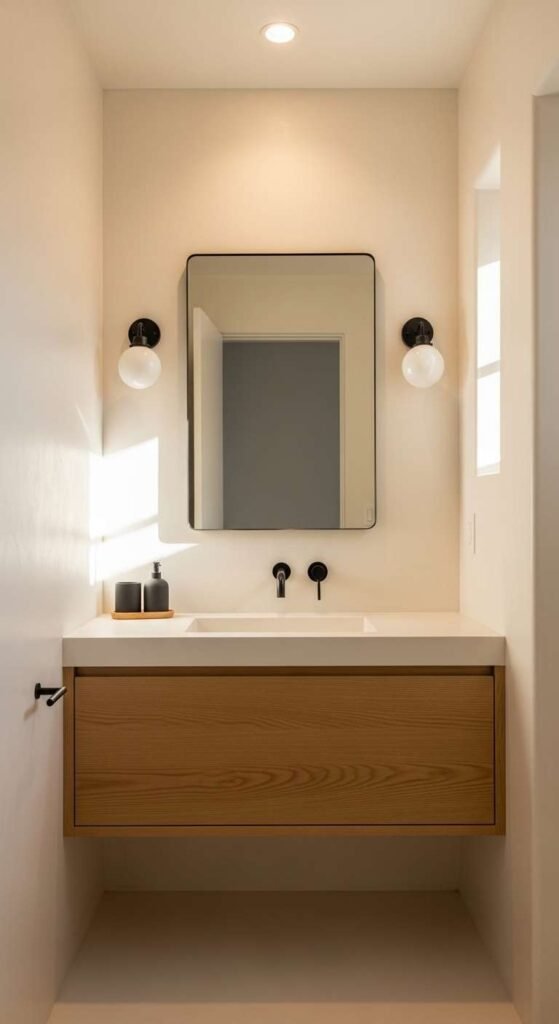
Most people default to bright white when they think Scandi. I get it — it looks clean, it looks crisp, and every Pinterest board seems to confirm it. But here’s what those boards don’t show you: bright white walls under warm bathroom lighting can feel cold and clinical by 7am. Not exactly the calm retreat you were going for.
Warm whites — think shades like Swiss Coffee, Alabaster, or Shoji White — sit in that perfect middle ground. They read as clean without feeling sterile. They bounce light softly instead of harshly. And paired with light wood accents, they create that signature Scandi glow that feels genuinely inviting.
A quick trick I’ve learned from working on multiple ensuite renovations is to always test your white in the actual bathroom light before committing. Natural north-facing light and warm vanity bulbs will read the same white very differently. Grab a sample pot, paint a 12-inch square, and live with it for two days.
2. Float Your Vanity to Steal 6 Inches of Visual Space
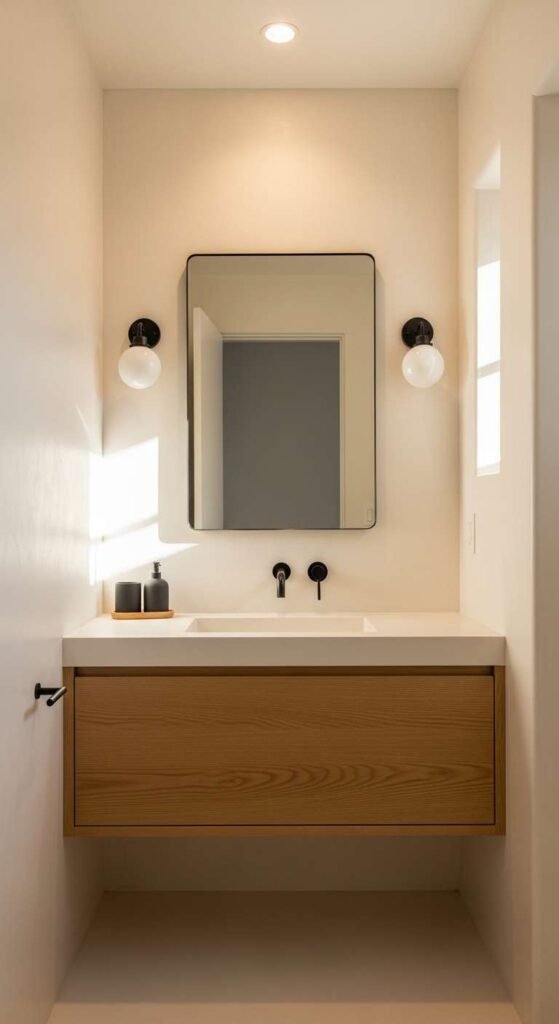
If there’s one single upgrade I recommend to almost every ensuite client before anything else, it’s switching to a floating vanity. It sounds subtle. The impact is anything but.
When your vanity is wall-mounted, the eye travels across uninterrupted floor space. That continuous line makes the room feel wider and longer than it actually is. In a compact ensuite — say, anything under 60 square feet — that visual breathing room is worth its weight in gold.
Here’s what to keep in mind:
- Aim for a mount height of 32 to 34 inches for the most comfortable and visually balanced look
- Light oak and matte white are the two finishes that photograph best and age the most gracefully
- Budget-wise, a solid floating vanity from brands like IKEA’s GODMORGON line or Foremost can run as low as $400, while custom options from local millworkers sit closer to $1,800 to $3,500
The floating vanity isn’t just a style choice. In a Scandi ensuite, it’s a spatial strategy.
3. Choose Light Oak Over Pine for Your Wood Accents
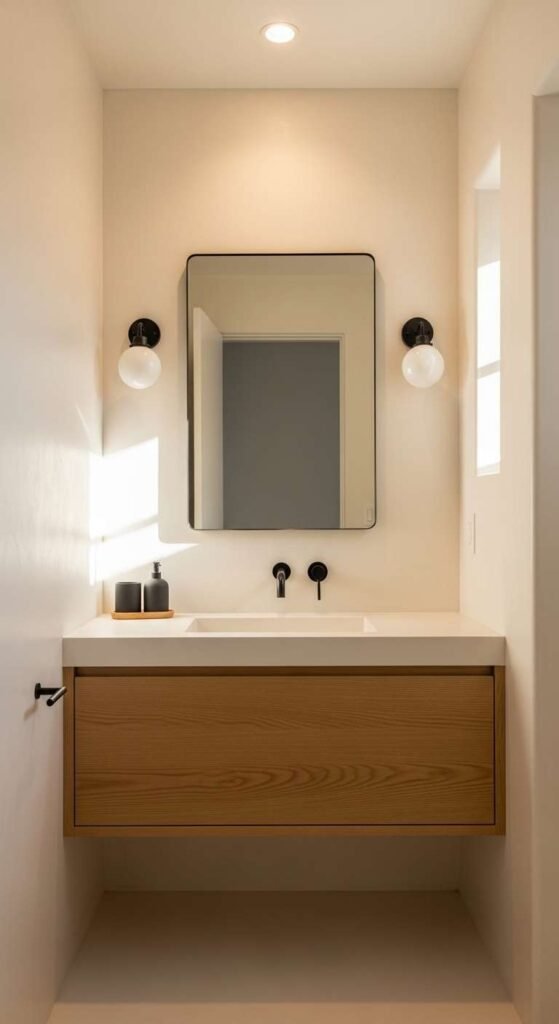
Wood is non-negotiable in Scandinavian bathroom design. It’s what keeps the space from feeling like a sterile hotel corridor. But not all wood behaves the same way in a humid ensuite environment, and this is where a lot of homeowners make an expensive mistake.
Pine is cheap and widely available, but it’s also soft, porous, and prone to warping when it gets hit with daily steam and moisture. I’ve seen pine vanities start to swell and discolor within 18 months in a high-use ensuite. Light oak, on the other hand, is denser and far more forgiving. It also has that warm, golden-neutral tone that sits beautifully against white walls and matte black or brushed brass fixtures.
One thing to watch out for is raw or untreated wood finishes — they look stunning in showrooms and absolutely struggle in real bathrooms. Always confirm your vanity has a moisture-resistant lacquer or UV-cured finish before purchasing. If you’re sourcing reclaimed oak, seal it yourself with at least two coats of a water-based polyurethane before installation.
4. Install a Frameless Glass Shower in Even the Smallest Ensuite
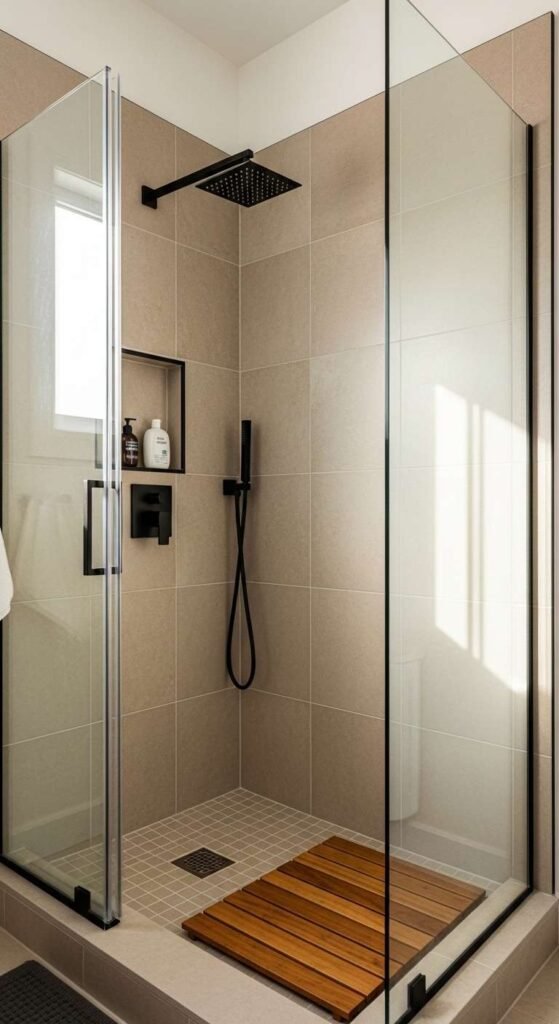
The shower is where most small ensuite designs go wrong. A bulky shower curtain or a framed enclosure with thick aluminum borders visually chops the room in half. It creates a “before” and “after” zone in a space that’s already tight.
A frameless glass shower enclosure removes that boundary entirely. The eye travels straight through, reading the full depth of the room. It’s one of the most effective spatial tricks in residential design, and it works in ensuites as narrow as 36 inches.
From a practical standpoint, frameless glass does require more frequent squeegee maintenance to keep water spots from building up — especially if you’re in a hard water area like Phoenix, Denver, or the Dallas suburbs. That’s a real consideration. But the payoff in terms of openness and that clean Scandi aesthetic is hard to match with any other shower solution.
For a truly Nordic feel, pair it with a simple rainfall showerhead in matte black or brushed nickel, large-format wall tiles in a warm greige, and a teak or stone shower floor. Simple, considered, and genuinely spa-like.
Are you working with a small ensuite right now, or do you have more space to play with?
5. Go Matte Black for Fixtures, But Know the Tradeoffs
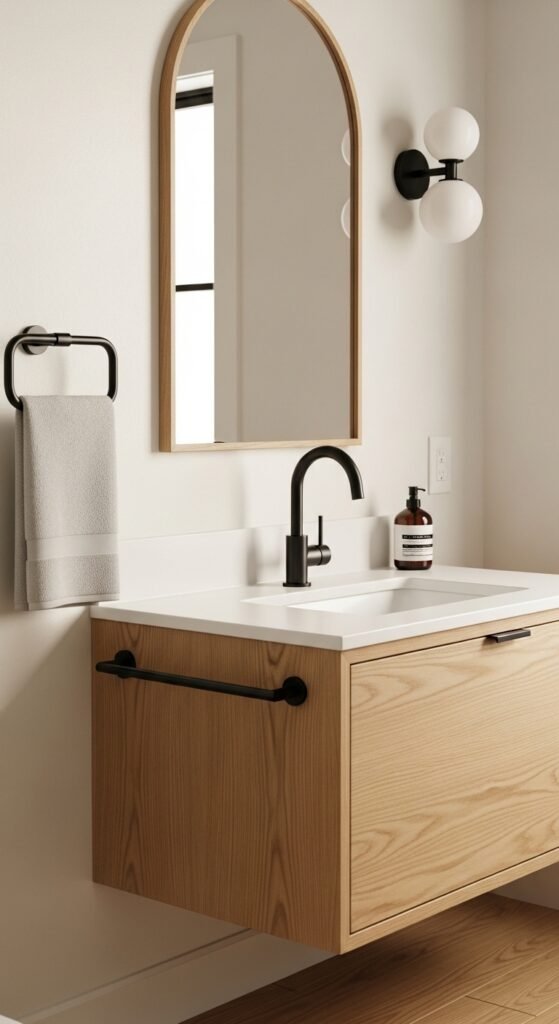
Matte black fixtures have had a serious moment in American interior design over the last few years, and honestly, they deserve it. Against warm white walls and light oak wood, a matte black faucet or towel bar adds exactly the right kind of quiet contrast. It grounds the space without being aggressive. It’s the punctuation mark that keeps a very neutral room from feeling unfinished.
But let me be straight with you about the maintenance reality, because most design blogs skip this part entirely.
Matte black finishes show water spots and toothpaste splatter more visibly than polished chrome. They need a soft cloth wipe-down every few days to stay looking sharp. Avoid abrasive cleaners completely — they’ll strip the finish faster than you’d expect. If your household is high-traffic with kids or multiple users, brushed nickel or brushed brass might actually serve you better day-to-day while still keeping that Scandi-adjacent warmth.
That said, if you’re committed to matte black — and many of my clients are — brands like Kohler’s Purist line, Delta’s Trinsic series, and Moen’s Align collection all offer solid matte black options in the $150 to $400 range per fixture that hold up well over time.
6. Use a Single Large Format Tile to Make a Small Room Feel Huge
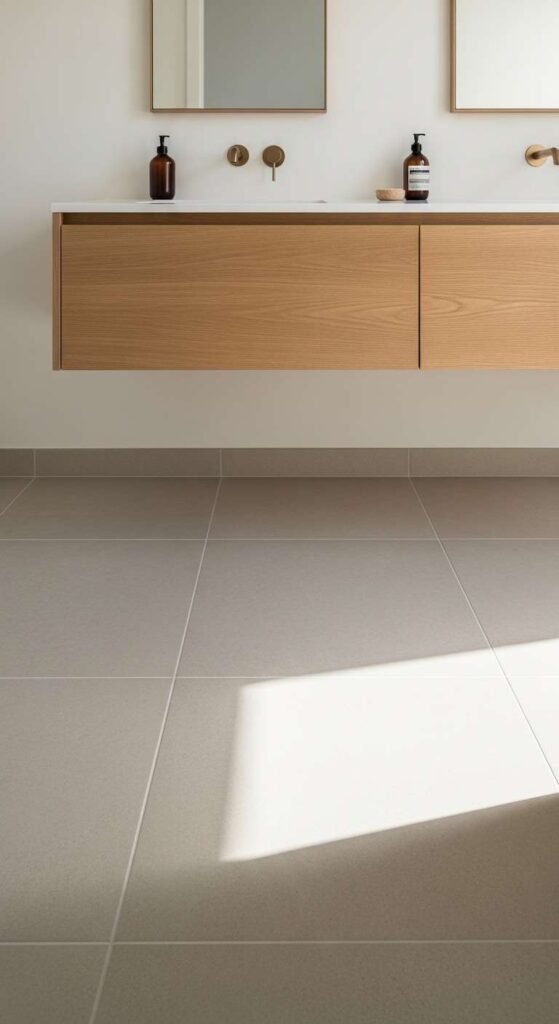
Here’s something I explain to almost every client who walks into a small ensuite renovation consultation: the grout lines are doing more work than the tile itself. And in a small space, more grout lines mean more visual interruption, which makes the room feel busier and smaller than it actually is.
Switching to a large-format tile — anything from 24×24 inches up to 24×48 inches — dramatically reduces the number of grout lines your eye has to process. The floor reads as one continuous surface. The room expands, at least perceptually.
A few things worth knowing before you commit:
- Large format tiles require a very flat, properly leveled subfloor — any dips or humps will cause cracking over time, so factor in floor prep costs
- Rectified tiles (precision-cut edges) allow for thinner grout joints, which looks cleaner and more intentional
- For color, stay in the warm greige or soft stone family — creamy beiges and light grays both work beautifully in a Scandi ensuite palette
The investment is worth it. It’s one of those changes that people notice immediately without being able to explain exactly why the room feels so much better.
Top 6 Scandi Ensuite Ideas at a Glance
| Idea | Estimated Price | Maintenance |
|---|---|---|
| Frameless Glass Shower | $1,200 to $3,500 installed | Medium |
| Floating Vanity | $400 to $3,500 | Low |
| Large Format Floor Tile | $3 to $8 per sq. ft. | Low |
| Heated Towel Rail | $150 to $800 installed | Low |
| Arched Mirror | $150 to $450 | Low |
| Fluted Glass Shower Screen | $1,200 to $2,800 | Medium |
7. Build In a Niche Shelf Instead of Adding Clutter
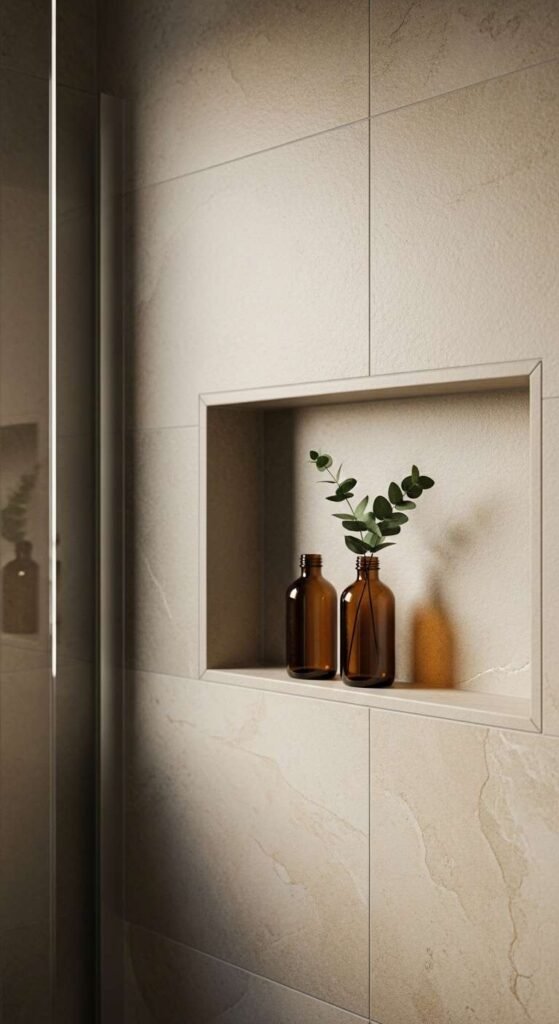
Nothing breaks the calm of a Scandi ensuite faster than a collection of shampoo bottles lined up along the edge of a tub or shower floor. It’s the visual equivalent of noise. And yet, storage is a real need — you can’t design it away entirely.
The niche shelf solves this beautifully. Recessed directly into the shower wall between studs, it sits flush with the surface, takes up zero floor or ledge space, and keeps your products contained and intentional-looking. Done right, it almost disappears into the wall design.
If you’re mid-renovation, adding a niche is a relatively straightforward task for a tile contractor — typically adding $200 to $500 to the job depending on your market. If your walls are already finished, it becomes a more involved project that may require opening up drywall, which is when I’d strongly recommend bringing in a pro rather than going DIY. The waterproofing around a niche has to be done correctly, or you’re looking at moisture damage inside the wall cavity down the line.
Keep the niche simple — one or two shelves, same tile as the surrounding wall, no decorative border. Let it blend. That restraint is very much the Scandi way.
8. Layer Your Lighting Like a Scandinavian Designer Would
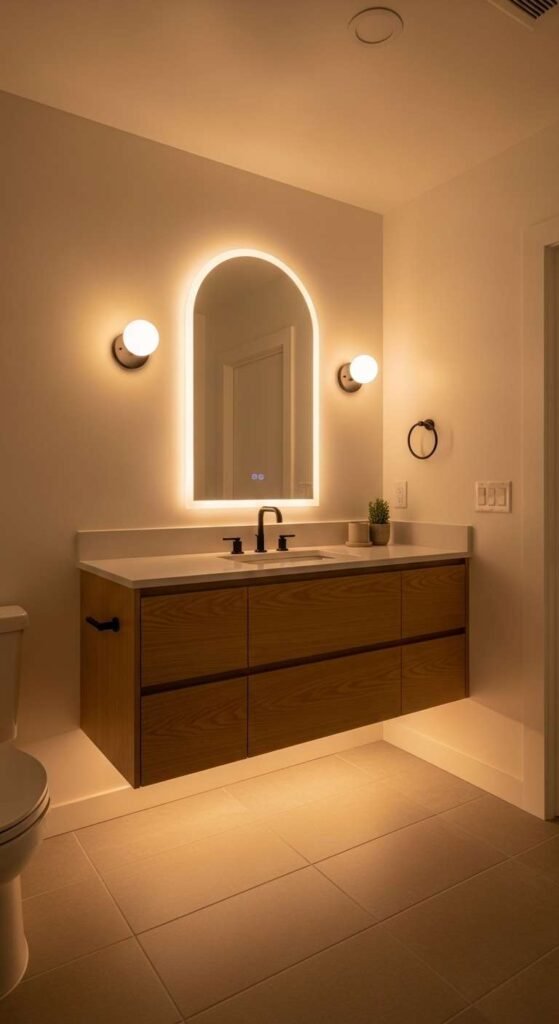
Lighting is where American bathroom design most consistently falls short, and I say that with genuine affection for my clients because it’s an easy gap to miss. Most US ensuites are built with a single overhead light and maybe a basic vanity bar above the mirror. It gets the job done functionally. It does almost nothing for atmosphere.
Scandinavian designers think about bathroom lighting in three distinct layers, and once you understand this framework, you’ll never look at a flat-lit bathroom the same way again.
The first layer is ambient light — your overhead source, ideally on a dimmer. The second is task lighting, placed at eye level on either side of the mirror rather than above it, which eliminates the unflattering shadows that overhead-only lighting creates. The third layer is accent lighting — a small LED strip under a floating vanity, a warm wall sconce near the tub, or a backlit mirror that creates a soft glow around the reflection.
That third layer is what creates hygge. It’s what makes a bathroom feel like a place you want to linger in rather than rush through. Installing a dimmer switch on your existing overhead light is genuinely one of the lowest-cost, highest-impact upgrades you can make — typically $25 to $75 for the hardware and an easy DIY if you’re comfortable with basic electrical work.
9. Add a Heated Towel Rail for Year Round Hygge
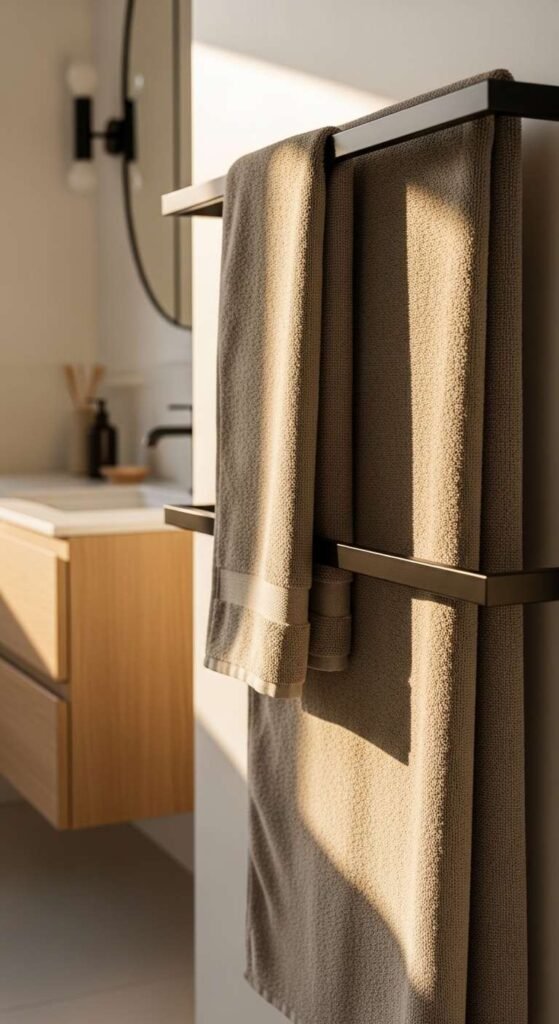
If there’s one upgrade that consistently gets the biggest reaction during a reveal, it’s the heated towel rail. Clients always think it’s a luxury they can skip. Then they use it through their first Chicago winter or Pacific Northwest November and wonder how they ever lived without it.
A heated towel rail does two things in a Scandi ensuite. Obviously, it keeps your towels warm and dry. But it also acts as a gentle, radiant heat source that takes the chill off the room on cold mornings without requiring a bulky radiator or baseboard heater cluttering the wall.
From an installation standpoint, you have two routes:
- Hardwired electric towel rails are the cleaner, more permanent option — they require an electrician but look completely seamless and typically run $300 to $800 installed
- Plug-in versions are a solid compromise if you’re renting or not ready to commit to hardwiring — brands like Amba and Warmly Yours make good-looking options in the $150 to $350 range
For finish, brushed nickel and matte black both read beautifully in a Scandi space. Avoid overly ornate or curved styles — keep the lines straight and simple to stay true to the Nordic aesthetic.
Which feel speaks to you more — warm oak and matte black, or soft whites and brushed brass?
10. Pick Limestone Over Marble if You’re New to Natural Stone
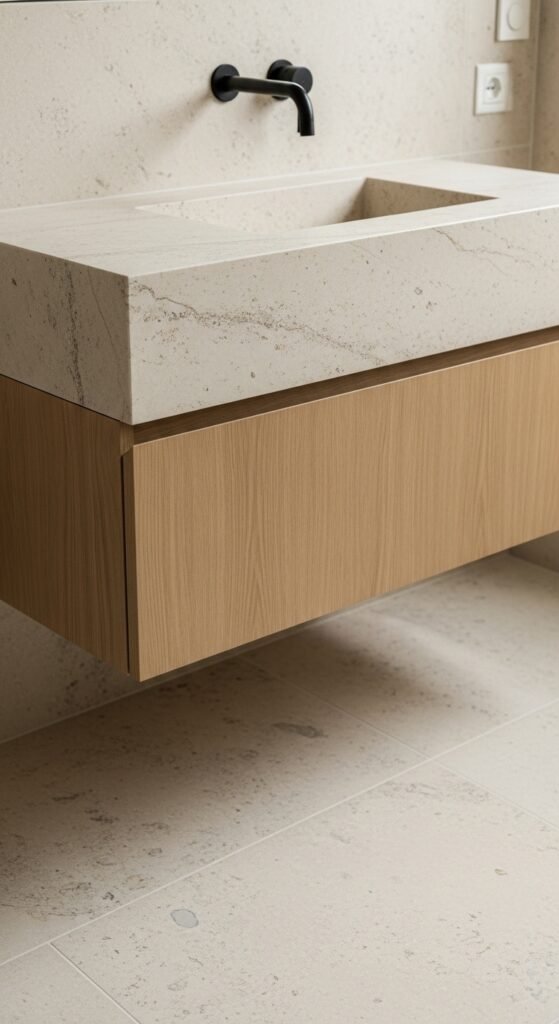
Natural stone in a bathroom is one of those design choices that photographs beautifully and requires a genuinely honest conversation before committing. I’ve had clients fall completely in love with Carrara marble on Instagram and then call me frustrated six months later because their countertop has etched rings from a forgotten glass of face wash.
Marble is calcium-based, which means it reacts to acids. Citrus products, certain cleansers, even some toothpastes will leave dull marks on a polished marble surface over time. In a high-use ensuite, that’s a real consideration.
Limestone is my recommendation for homeowners who want that soft, organic, European stone look without the high-maintenance reality. It has a naturally matte, earthy surface that aligns perfectly with the Scandi aesthetic — warm, textured, understated. It’s still a natural stone, so it does require sealing once a year, but it’s far more forgiving in daily use than marble.
If natural stone of any kind feels outside the budget, porcelain tiles that convincingly mimic limestone or travertine have gotten remarkably good. MSI and Emser both make large-format options in the $3 to $7 per square foot range that are genuinely hard to distinguish from the real thing at a glance.
11. Embrace the Empty Corner as a Design Choice
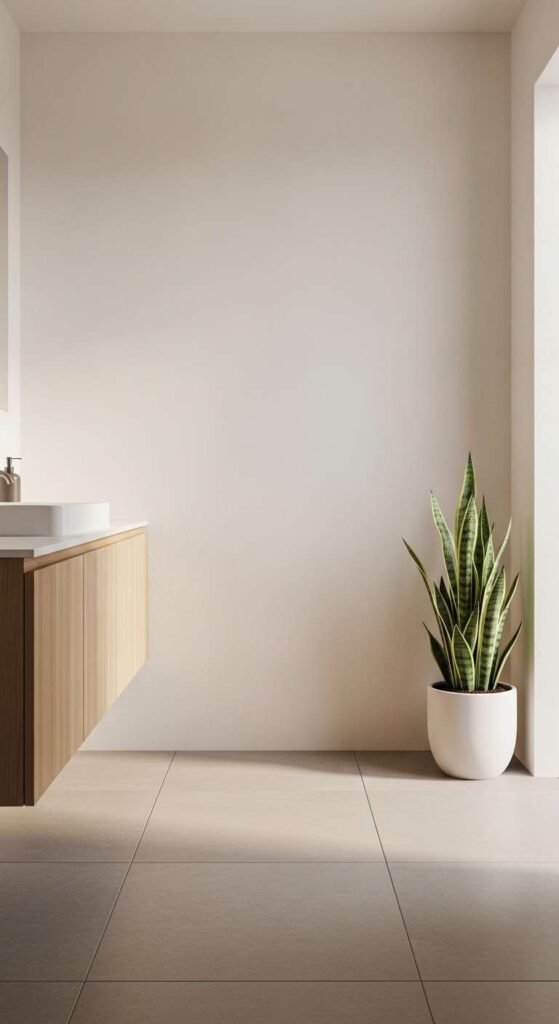
This one is a mindset shift more than a design tip, and it’s probably the hardest sell I make to American clients. We are culturally conditioned to fill space. An empty corner feels unfinished, overlooked, like something is missing. In Scandinavian design, that empty corner is completely intentional — and it’s doing real work.
Negative space in a room gives your eye somewhere to rest. It’s what makes a carefully chosen object — a single ceramic vase, a small potted plant, a folded linen towel on a wooden stool — read as deliberate and beautiful rather than just another item in a crowded room.
I always tell clients to remove everything from their ensuite first. Every bottle, every basket, every decorative item. Then add back only what earns its place. If you can’t explain why something is there, it probably shouldn’t be. That editing process is the core discipline of Scandi design, and most people find it genuinely freeing once they get past the initial discomfort of the empty wall.
12. Use a Fluted Glass Shower Screen for Privacy With Style
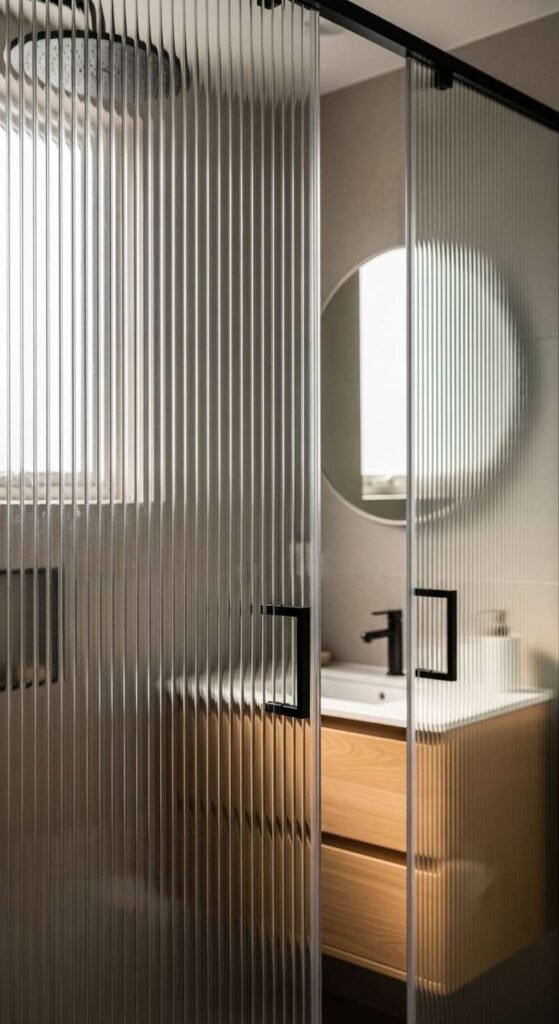
Frameless clear glass is the classic Scandi shower choice, and it works beautifully. But if your ensuite layout puts the shower in direct sightline of the bedroom door or you simply prefer a bit more visual separation, fluted glass is the 2026 answer worth knowing about.
Fluted glass — also called reeded glass — has vertical ridges pressed into its surface. It diffuses light and obscures the view just enough to create privacy without closing the space off the way opaque or frosted glass does. The texture also catches light in a way that adds genuine visual interest to an otherwise simple shower enclosure.
It reads as simultaneously modern and warm, which is a combination that’s surprisingly hard to achieve in bathroom design. A few things to consider:
- Fluted glass panels are slightly harder to clean than flat glass because of the ridges — a narrow squeegee and a good daily shower spray will keep them looking sharp
- Custom fluted glass enclosures typically run $1,200 to $2,800 depending on size and your local market
- For a budget-friendly version, some tile suppliers now carry fluted glass tile inserts that can be incorporated into a standard enclosure for a fraction of the cost
It’s one of those details that makes designers and design-savvy guests stop and ask questions. In the best possible way.
13. Choose Soft Linen Textiles Over Waffle Weave in a Small Ensuite
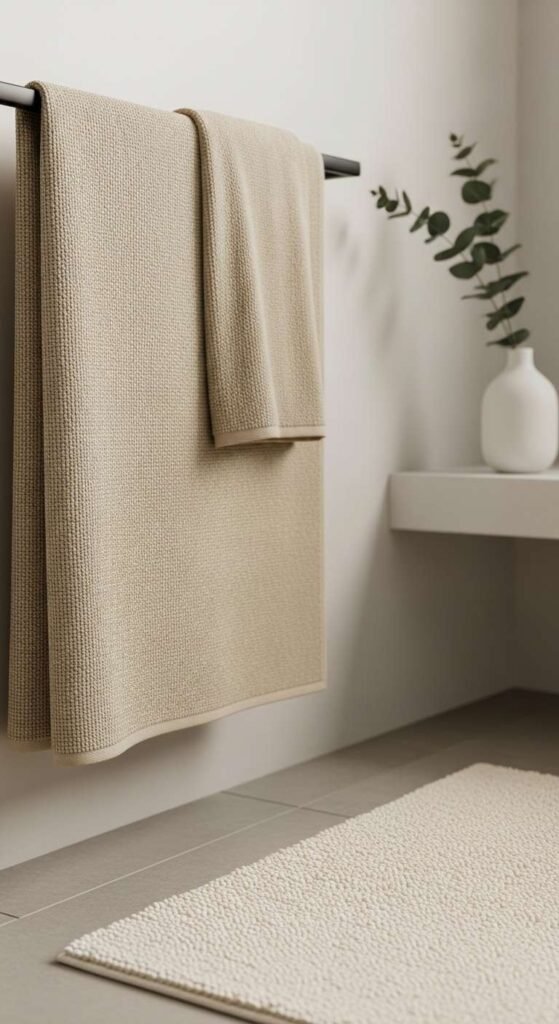
Textiles are the part of bathroom design that most homeowners either overthink or ignore completely. The truth sits somewhere in the middle. In a Scandi ensuite, fabric choices matter because they’re often the only soft element in a room full of hard surfaces — tile, glass, stone, wood. They carry a lot of atmospheric weight for how small they are.
Waffle weave towels are everywhere right now and they look great in larger bathrooms with breathing room. In a compact ensuite, though, their chunky texture can visually compete with everything else going on. Soft linen or Turkish cotton towels in warm oat, ivory, or soft sage tones tend to drape more elegantly and photograph beautifully without demanding attention.
Here’s how I typically style textiles in a Scandi ensuite:
- One set of matching bath and hand towels in a neutral linen tone, folded simply on the towel rail rather than rolled or fanned
- A thin cotton bath mat with a low pile — nothing too fluffy or shaggy, which reads as cluttered in a minimal space
- A linen shower curtain only if you’re working without a glass enclosure — choose one in an off-white or warm oatmeal with minimal or no pattern
The hygge connection here is real. Soft, natural textiles are a sensory layer that no tile or fixture can replicate. They make the room feel genuinely lived-in rather than staged.
14. Go Greige on the Floor and Crisp White on the Walls
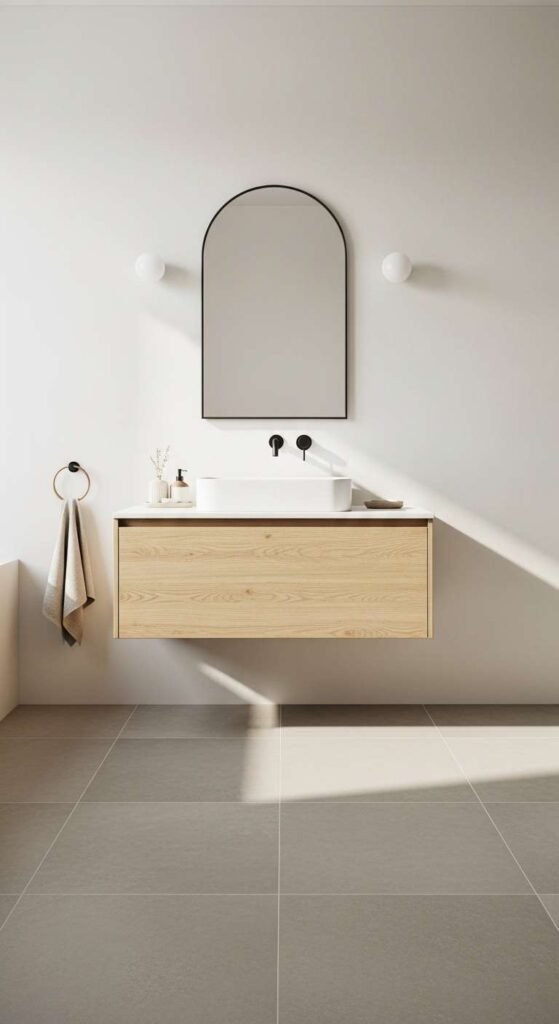
Color palette decisions in a Scandi ensuite are deceptively simple on the surface. White walls, neutral floors — how complicated can it be? But the specific relationship between your wall color and floor tone is what separates a bathroom that feels cohesive from one that feels slightly off without anyone being able to explain why.
The formula I come back to consistently is this: go slightly warmer and darker on the floor, lighter and crisper on the walls. Greige — that perfect blend of gray and beige — on the floor grounds the room and adds just enough warmth to prevent the space from feeling cold. Crisp white or warm white on the walls then lifts everything and bounces light around beautifully.
What doesn’t work as well, despite being intuitive, is matching your floor and wall tones too closely. When everything is the same temperature and value, the room loses definition. Your eye has nothing to anchor to and the space can feel flat rather than calm.
A quick trick I’ve used on several projects is to bring actual tile samples and paint swatches into the bathroom at the same time, hold them next to each other in the specific light of that room, and look at them for at least 60 seconds before making a call. Colors behave differently in every space, and what looks perfect in a showroom can read entirely differently under your specific window light and fixture temperature.
15. Add One Living Element With the Right Plant for Humid Ensuites
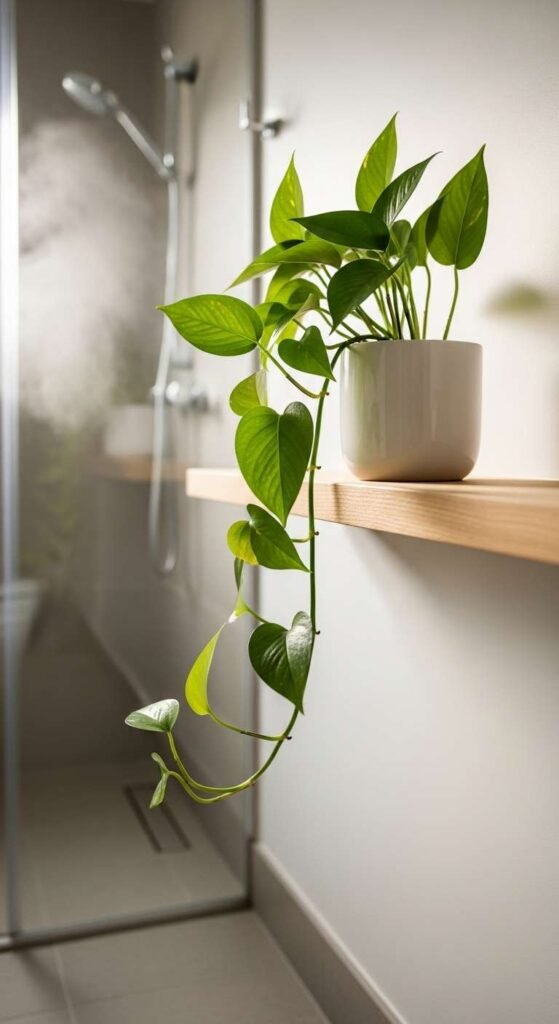
Greenery in a Scandi bathroom isn’t decoration — it’s philosophy. The Nordic design tradition has always emphasized a connection to the natural world, and in a bathroom context, a single well-chosen plant does more for the atmosphere than almost any accessory you could buy.
The key word there is well-chosen. Not every plant thrives in a bathroom environment, and nothing looks worse in a carefully designed ensuite than a struggling, yellowing plant that clearly wants to be somewhere else.
These three varieties genuinely thrive in the warm, humid conditions of a regularly used ensuite:
- Pothos — nearly indestructible, trails beautifully from a shelf, tolerates low light exceptionally well
- Snake plant — architectural and upright, perfect for a corner, requires almost no maintenance and actually absorbs bathroom moisture
- ZZ plant — glossy, sculptural, extremely drought-tolerant, and happy in the lower light levels most ensuites provide
Place one plant, not three. In a small Scandi ensuite, a single healthy pothos trailing from a floating shelf or a snake plant in a simple white ceramic pot on the floor makes the statement you need. More than one starts to feel like a garden, which tips the balance away from that clean Nordic calm you’re working toward.
If you could change just one thing about your ensuite this weekend, what would it be?
16. Use an Arched Mirror to Soften All Those Clean Lines
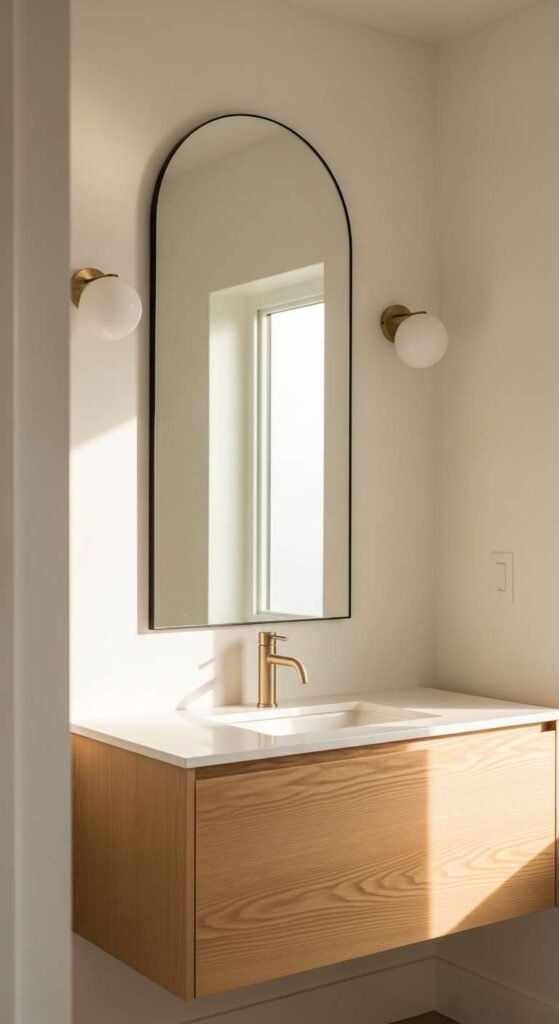
At first glance, an arched mirror seems like it might conflict with Scandinavian design’s preference for clean geometry and straight lines. In practice, it does exactly the opposite — it provides the perfect counterbalance to all that angular precision.
A room full of straight lines and hard edges can start to feel tense rather than calm if there’s no softness anywhere. The arch introduces a single organic curve that relaxes the whole space without disrupting the minimalist logic. It’s a small move with a disproportionately large effect on how the room feels.
I’ve used arched mirrors in at least a dozen Scandi-leaning ensuite projects over the past few years, and they work across a surprisingly wide range of sizes and layouts. In a narrow ensuite, a tall, slim arch above a single-sink floating vanity draws the eye upward, making the ceiling feel higher. In a wider bathroom, a broader arch creates a soft focal point that anchors the vanity wall beautifully.
For finish, lean toward simple metal frames in matte black, brushed brass, or natural wood. Avoid ornate detailing — the arch itself is doing the decorative work. You don’t need it to do anything else. West Elm, CB2, and Anthropologie Home all carry solid options in the $150 to $450 range that work well in this context.
17. Install Open Shelving But Edit Ruthlessly
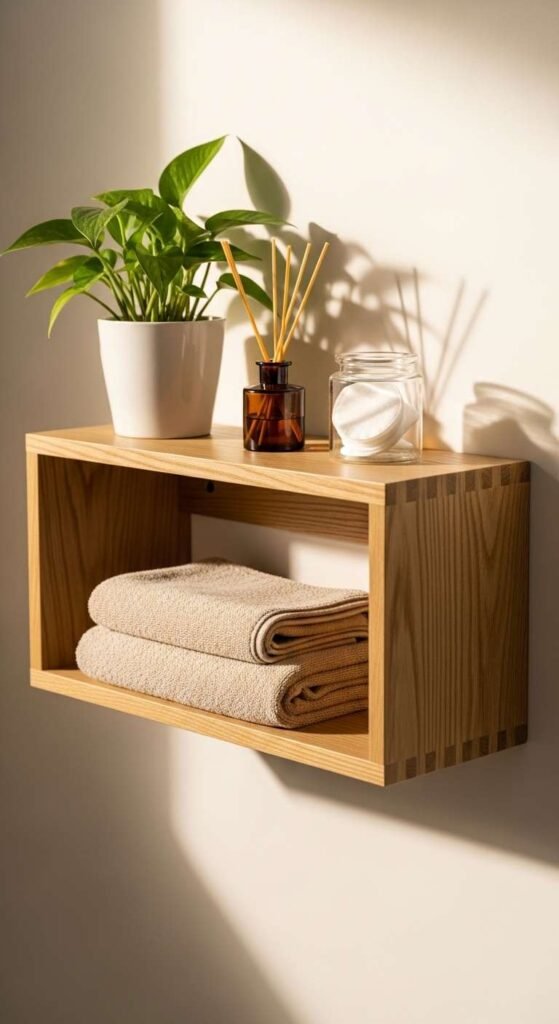
Open shelving in a Scandi ensuite is one of those ideas that looks effortless in design photos and requires genuine discipline in real life. I want to be honest with you about that upfront, because I’ve seen it go beautifully and I’ve seen it become an accidental clutter display within three weeks of installation.
The shelving itself is simple. A floating wooden shelf in light oak or walnut, mounted cleanly to the wall with no visible brackets, is affordable, easy to install, and looks completely at home in a Nordic-inspired space. The hard part is what goes on it.
I use what I call the ten-item rule with my clients. After installation, you get ten items maximum on an open shelf in a small ensuite. That includes everything — plants, folded towels, a candle, a small ceramic dish, a glass jar of cotton rounds. Count them. If you hit eleven, something comes off. It sounds rigid but it works, and after a few weeks it becomes instinctive.
Here’s what tends to work well on a Scandi ensuite open shelf:
- Two or three neatly folded hand towels in a neutral tone
- One small plant in a simple ceramic pot
- A single candle or diffuser
- One glass jar with a practical purpose — cotton balls, bath salts, or hair ties
That’s it. The shelf should look like it was styled, not stored.
18. Choose a Wood Vanity With a Waterproof Finish, Not Raw Wood
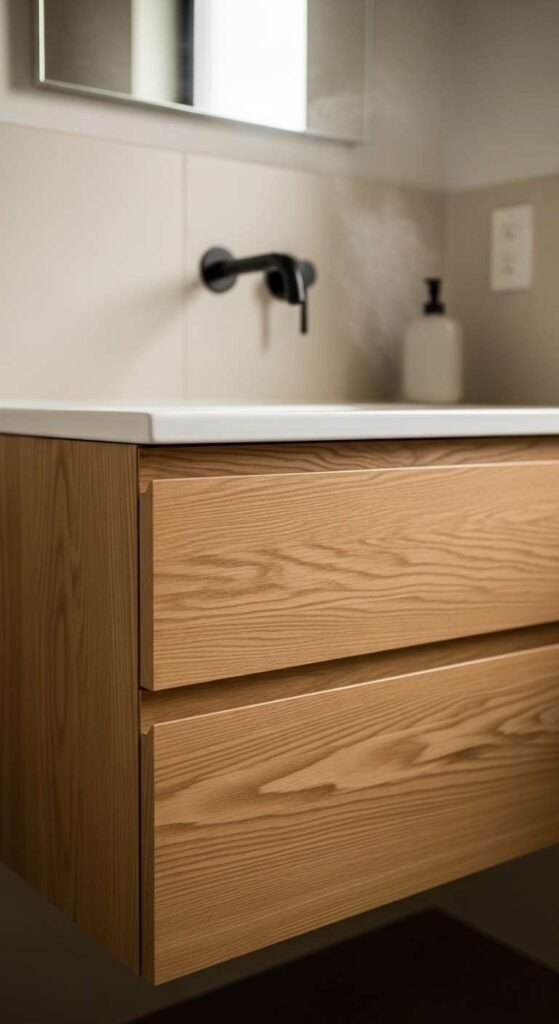
I cannot stress this enough, and I say it because I’ve watched homeowners learn this lesson the hard way. A raw wood vanity in a bathroom is a beautiful idea that becomes a maintenance problem within one year of daily use. Steam, splashing water, and the general humidity of a regularly used ensuite will cause untreated wood to swell, warp, discolor, and eventually crack along the grain.
The good news is that you don’t have to choose between the warmth of real wood and practical durability. The finish is everything.
What to look for when shopping for a wood vanity for your ensuite:
- UV-cured lacquer finish — extremely durable, resists moisture and scratching, maintains the natural wood appearance
- Thermofoil or wood-look laminate over MDF — a budget-friendly option that performs very well in humid environments, though it lacks the texture of real wood grain
- Teak — one of the few naturally water-resistant hardwoods, used traditionally in boat-building, and absolutely stunning in a Scandi bathroom context
If you fall in love with a vanity that comes in a raw or lightly oiled finish, don’t walk away from it immediately. Ask the manufacturer or your contractor about applying a water-based polyurethane sealant before installation. Two to three coats properly applied will buy you years of performance and keep that wood looking the way it did on day one.
19. Use Matte Concrete or Terrazzo Flooring for That Nordic Edge
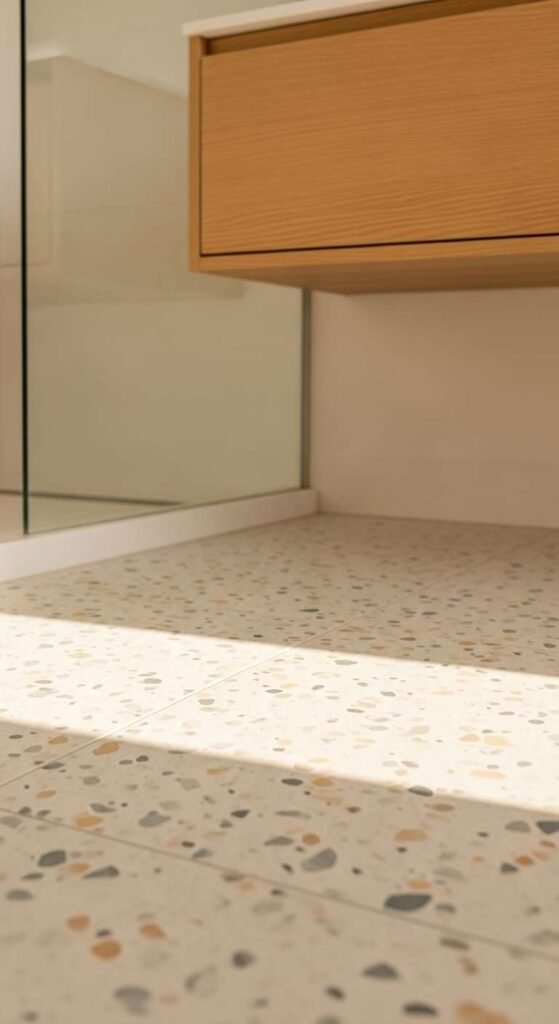
There’s a moment in Scandinavian design history worth understanding here. The Nordic countries, particularly Denmark and Finland, embraced industrial and craft materials in residential spaces long before it became a global trend. Concrete and terrazzo weren’t reserved for commercial spaces — they were used in homes because they were honest, durable, and beautiful in their simplicity.
In a modern American ensuite, both materials bring that same quality to the floor.
Polished concrete flooring has a raw, considered quality that pairs exceptionally well with warm white walls and wood accents. It’s cool-toned but not cold-feeling when paired correctly, and it photographs with a depth and texture that porcelain simply can’t replicate. The practical reality is that poured concrete requires professional installation and sealing, and can run $8 to $15 per square foot depending on your market.
Terrazzo is having a genuine revival right now and for good reason. The speckled, multi-tonal surface adds visual interest without pattern, which is a subtle but important distinction in minimalist design. It works within a Scandi palette beautifully when kept in soft tones — warm grays, creamy whites, and muted blushes rather than bold color combinations.
For homeowners who love the look but not the price point of either material, terrazzo-look and concrete-look porcelain tiles have improved dramatically in recent years. Large-format options from brands like MSI’s Arterra collection or Bedrosians give you that Nordic edge at a fraction of the material and labor cost of the real thing.
Are you starting your Scandi ensuite from scratch, or giving an existing bathroom a refresh?
20. Bring In Scent as Your Final Design Layer
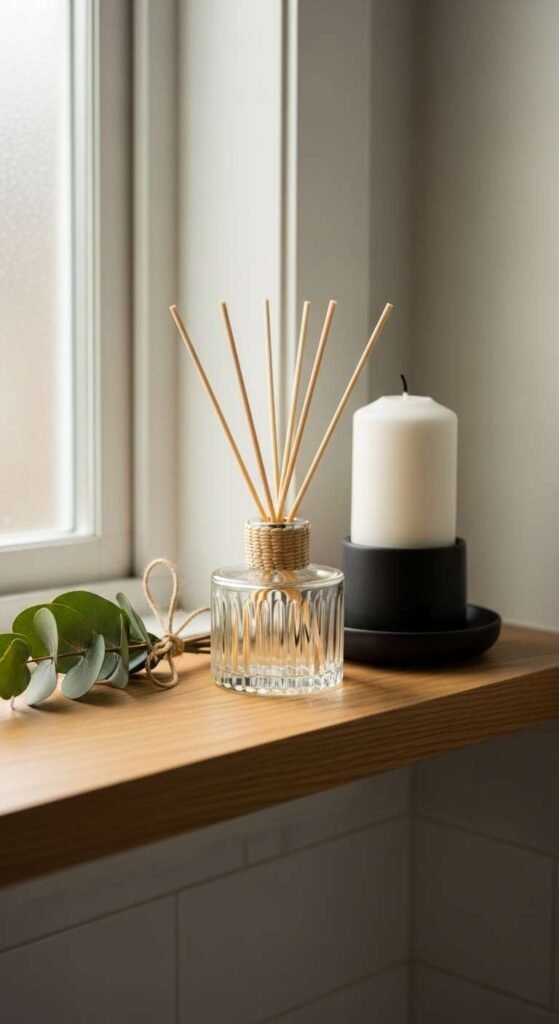
Every element we’ve covered so far has been visual. But a truly Scandi ensuite engages more than just your eyes, and this is the layer that most design guides never mention because it doesn’t photograph. Scent is the final piece of the hygge puzzle, and it has a measurable effect on how relaxed and at ease you feel in a space.
The Scandinavian approach to scent in the home leans toward clean, natural, and understated. Think eucalyptus, cedarwood, white tea, birch, and cool linen — not floral, not sweet, not heavily perfumed. The goal is to create a subtle olfactory backdrop that reinforces the calm you’ve built visually.
Here’s how I recommend layering scent in an ensuite practically and without overwhelm:
- A reed diffuser in a simple glass vessel on your open shelf — replace reeds every 30 days for consistent diffusion
- A single unscented or lightly scented soy candle for evening use — the flickering light does double duty as hygge ambiance
- A small eucalyptus bundle hung from your shower head, where steam activates the natural oils every time you shower — this lasts two to three weeks and costs almost nothing
Scent is the detail that guests notice without knowing why the room feels so good. It’s the difference between a bathroom that looks Scandi and one that genuinely feels like a Nordic retreat. And after everything you’ve invested in tile, fixtures, wood, and lighting, it’s the easiest and most affordable final touch you can add.
Your 2 Minute Scandi Ensuite Decision Map
By Budget
Starter Scandi (Under $3,000)
- Swap to a floating vanity in light oak or matte white
- Paint walls in warm white (Alabaster or Swiss Coffee)
- Add an arched mirror and matte black fixtures
- Layer in linen towels, a single plant, and a reed diffuser
- Install a dimmer switch on your existing overhead light
Luxury Nordic ($8,000 and above)
- Full frameless or fluted glass walk-in shower enclosure
- Heated towel rail hardwired into the wall
- Large format limestone or terrazzo flooring
- Custom floating vanity in sealed teak or light oak
- Three-layer lighting system with backlit mirror and wall sconces
By Lifestyle
Busy Households With Kids or Multiple Users
- Choose brushed nickel over matte black — far easier to maintain
- Skip raw wood entirely, go sealed oak or thermofoil
- Built-in niche shelves over open shelving — less daily tidying
- Large format tiles mean fewer grout lines to scrub
Calm Seekers and Minimalists
- Commit to the empty corner — resist the urge to fill it
- One plant, one candle, one scent — no more
- Edit your shelf down to ten items and hold that line
- Let the materials do the work — no extra decor needed
Frequently Asked Questions
What is the best color palette for a Scandi ensuite bathroom?
Warm white walls paired with greige or soft stone flooring is the most reliable starting point. Add light oak wood accents and one or two matte black or brushed brass fixtures to complete the look without overcomplicating it.
How much does a Scandinavian ensuite renovation cost in the USA?
The average cost runs between $8,000 and $20,000 for a full Scandi ensuite remodel depending on your market and material choices. Budget builds focusing on paint, fixtures, and vanity swaps can come in closer to $2,500 to $4,000.
Can I achieve a Scandi bathroom look in a small ensuite?
Yes, and small ensuites actually suit Scandi design better than large ones. A floating vanity, frameless glass shower, large format tile, and warm white walls will make even a 45 square foot ensuite feel intentional and open.
What wood finish works best in a humid bathroom environment?
Sealed light oak or teak with a UV-cured lacquer finish holds up best. Raw or untreated wood will warp and discolor within a year in a regularly used ensuite, so always confirm the finish before purchasing.
Are matte black fixtures hard to maintain in a daily-use bathroom?
Yes, more so than brushed nickel or brass. Matte black shows water spots and soap residue quickly and needs a soft cloth wipe every few days. For high-traffic bathrooms, brushed finishes are a more practical long-term choice.
Conclusion
Your calm ensuite isn’t waiting on a massive budget or a full gut renovation — it’s waiting on a decision. Pick one idea from this list that feels achievable this week. Maybe it’s ordering a warm white paint sample, swapping out your vanity hardware for matte black, or finally clearing that shelf down to ten items. Small moves made with intention add up faster than you’d think, and your bathroom — the room you start and end every single day in — deserves that attention.
