
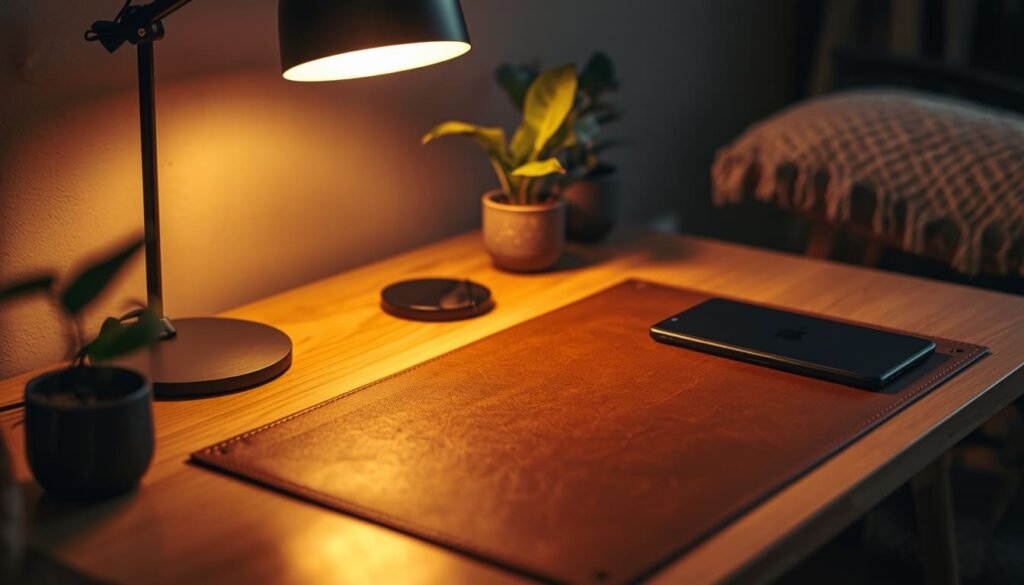
The place where you spend 40+ hours a week deserves way more than a sad sticky note and a generic motivational poster. I’ve walked into hundreds of workspaces across the US, and the people who feel the happiest and most focused at work almost always share one thing in common they’ve made their space feel like them. Decorating your office at work doesn’t require a big budget or a design degree. With a few intentional choices, even the most lifeless cubicle can become a space you genuinely look forward to sitting in every single morning.
My Design Notes
A couple of years ago, I worked with a client named Sarah a marketing manager at a mid-size firm in Chicago. She had a standard grey cubicle, zero natural light, humming fluorescent lights overhead, and a strict no-nails policy from HR. Her budget? Exactly $75. When I first walked in, I noticed three things immediately the lighting was killing her mood, random cables were crawling across her desk like vines, and nothing in the space felt intentional. We fixed all of it in one weekend. A $22 warm-toned desk lamp from Target, a small Command strip ledge, two framed prints in matching black frames, a pothos plant, and a blush-and-white color story pulled the whole thing together. The total came in at $68. The following Monday, three coworkers stopped by to ask who decorated her cubicle. Sarah told me later that she actually started enjoying her mornings again and honestly, that reaction never gets old for me. That project is exactly why I believe so strongly that decorating your office at work, no matter how small or corporate the space, is always worth the effort.
Elevated Workspace Decor Ideas That Make Your Office Impossible to Ignore
1. Know Your Office Rules Before You Touch Anything
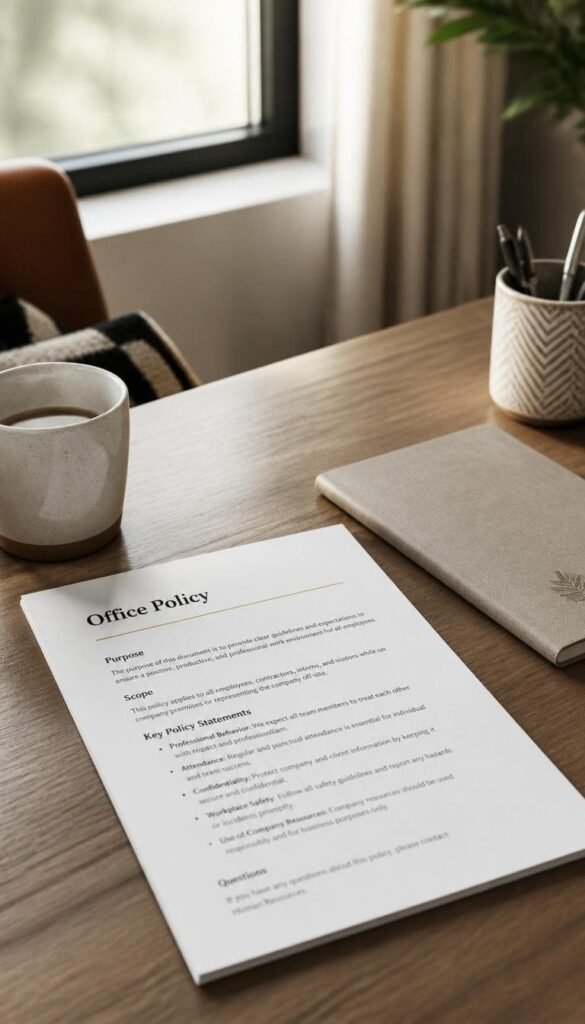
Before you order a single throw pillow or start planning that gallery wall you saved on Pinterest, take five minutes to actually read your company’s workspace policy. This is the step most people skip and then end up frustrated when HR asks them to take down their Command strip shelves or remove a scented diffuser. I’ve seen it happen more times than I’d like to admit.
Most corporate offices have specific rules around:
- What you can hang on walls (no-nails policies are extremely common)
- Scented products in shared or open-plan spaces
- Additional electrical items like personal lamps or space heaters
Once you know your boundaries, decorating becomes focused and intentional. You won’t waste a single dollar buying something you’ll have to bring right back home.
2. Start With Lighting Because Fluorescent Is the Enemy
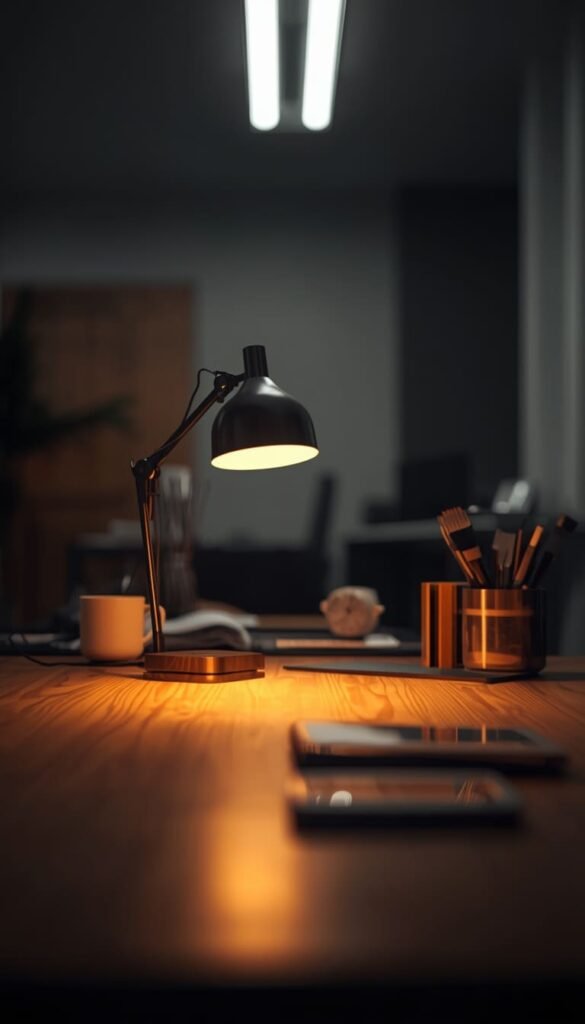
Here’s something I tell every client who works in a traditional office building: fluorescent overhead lighting is the fastest way to feel drained by 2 p.m. It flattens your energy, your mood, and honestly your decor too. The fix is simpler than most people expect. A small warm-toned desk lamp somewhere in the 2700K to 3000K color temperature range will completely shift the entire atmosphere of your workspace. Target, IKEA, and Amazon all carry solid options under $30, and the difference is genuinely night and day.
A quick trick I’ve picked up over the years is to position your lamp slightly behind your monitor rather than directly in front of it. This cuts down on eye strain and creates a soft ambient glow that makes your whole desk setup look far more intentional.
3. Pick One Color Story and Stick to It
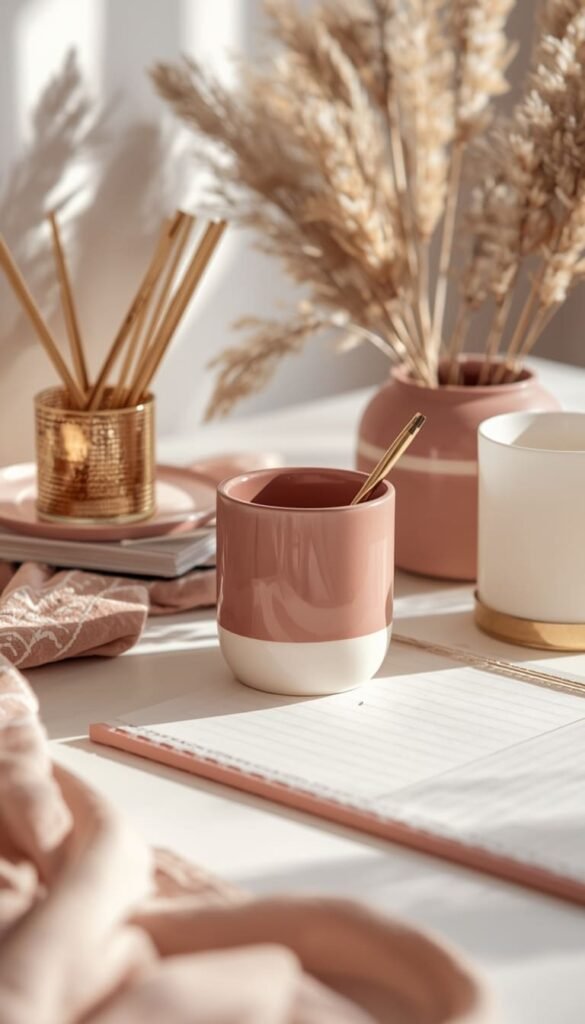
This is probably the single most important piece of advice when it comes to decorating your office at work. People bring in a blue pen holder, a pink notepad, a terracotta plant pot, and a red picture frame, and then genuinely wonder why the space feels chaotic. Pick two or three colors and let absolutely everything live within that story. For a polished, professional setting, my go-to formula is a soft neutral base, one accent color like dusty rose, sage green, or navy, and one metallic finish in either gold or brushed silver. Even the most budget-friendly accessories look curated and deliberate when they share a common color language.
4. The Right Desk Mat Changes Everything
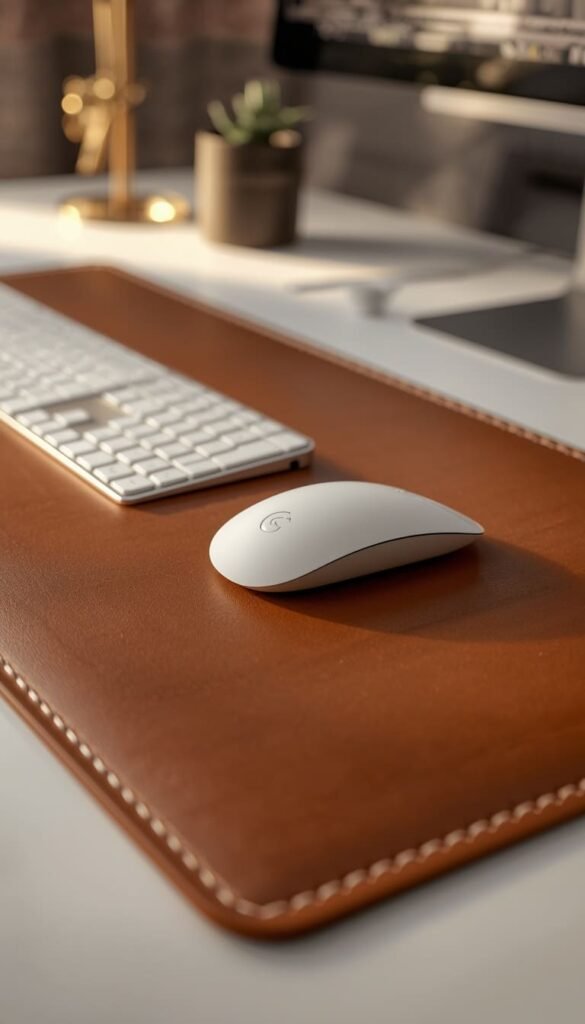
If a desk mat isn’t already on your radar, you’re leaving one of the easiest styling wins on the table. A leather or vegan leather desk mat anchors your entire desktop the same way a rug ties together a living room quietly, without making a big statement, but you’d notice immediately if it were gone. I started recommending them to clients about four years ago and now it’s genuinely one of the first things I mention during any office refresh conversation.
One thing to watch out for is sizing. A mat that’s too small looks awkward and almost worse than having no mat at all. Aim for something that comfortably fits your keyboard, mouse, and a small notepad side by side. Around 31 x 15 inches works well for most standard office desks.
Top 6 Office Decor Ideas:
| Idea | Estimated Price | Maintenance |
|---|---|---|
| Warm Toned Desk Lamp | $18 to $28 | Low |
| Leather or Vegan Leather Desk Mat | $16 to $24 | Low |
| Matching Desk Accessory Set | $22 to $35 | Low |
| Small Area Rug Under Desk | $25 to $55 | Low |
| One Office Safe Plant | $8 to $14 | Medium |
| Command Strip Gallery Wall | $10 to $20 | Low |
5. Layer In a Small Rug Even in a Cubicle
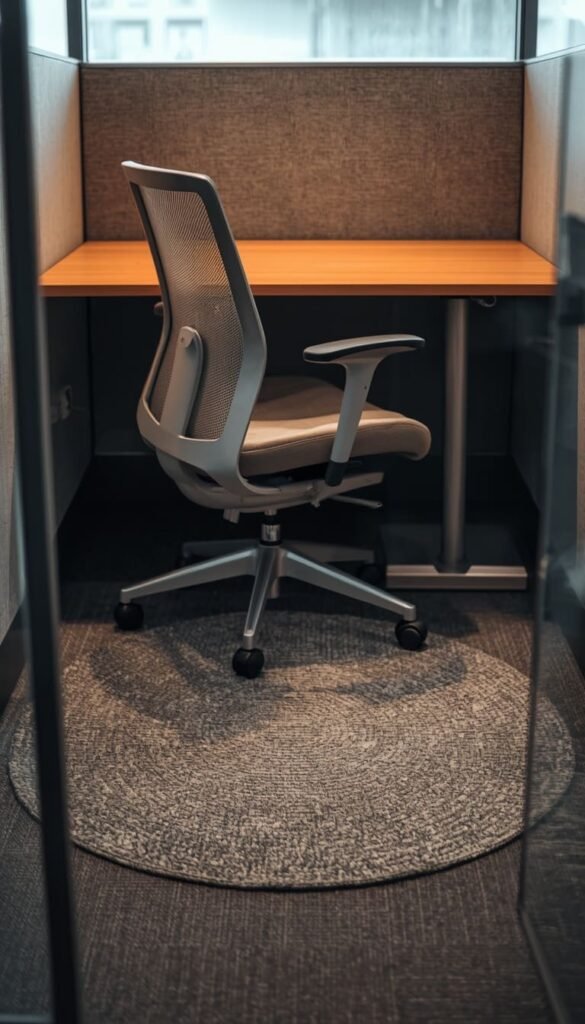
I know what you’re thinking a rug in a cubicle? Trust me on this one. A small 2×3 or 3×5 rug under your desk chair does something almost magical to the feel of a workspace. It creates a visual boundary that separates your zone from the rest of the office, and it adds warmth and texture that no amount of desk accessories can replicate on their own. Low-pile rugs work best in office settings since they don’t interfere with rolling chairs and are much easier to keep clean throughout the week.
For color, I always steer clients toward something with a simple geometric pattern in neutral tones. It reads as intentional and professional without screaming “I redecorated my cubicle over the weekend.”
Which area of your office do you think needs the most attention right now your lighting, your desk organization, or your walls?
6. Command Strips Are Honestly Your Best Friend
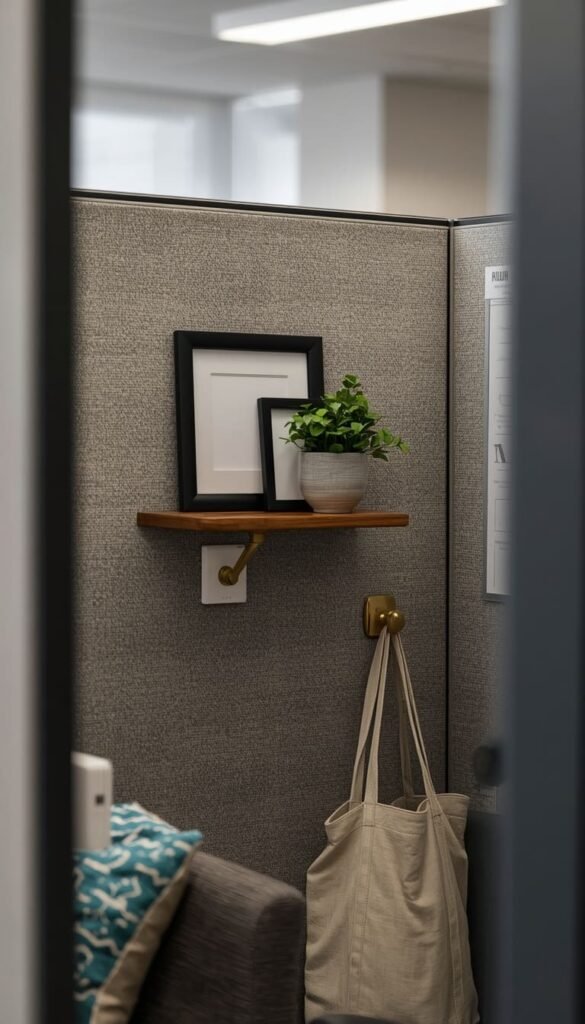
If your office has a no-nails policy and a huge number of US corporate offices do Command strips and adhesive hooks are about to become the most valuable tools in your decorating arsenal. They’ve come a long way from the basic white strips most people picture. You can now find them in different weight capacities, clear finishes, and even decorative styles that practically disappear against a wall.
Here’s what actually works well with Command strips in an office setting:
- Lightweight floating ledges for small plants or framed photos
- Small hooks on the side of your desk for bags, headphones, or a cardigan
- Adhesive picture hanging strips for prints and frames up to around 16×20 inches
One thing to watch out for is surface compatibility. Command strips don’t bond well to textured cubicle fabric walls, so for those situations, look into cubicle hooks that clip directly over the panel edge. They’re inexpensive, damage-free, and actually hold quite a bit of weight.
7. Build a Mini Gallery Wall With Twine and Clips
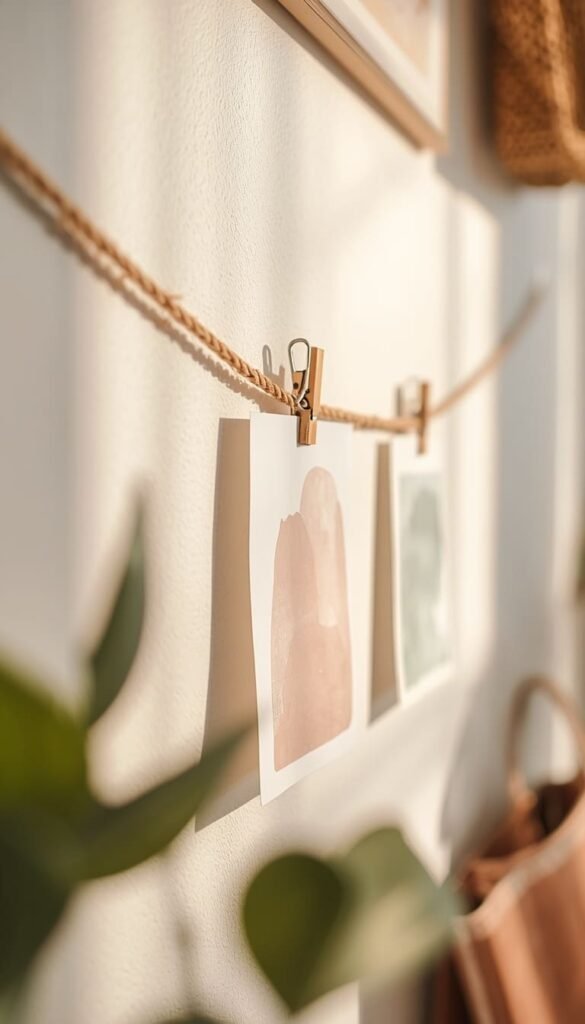
This one is a personal favorite of mine because it costs almost nothing and looks genuinely designer when done right. A simple strand of thin twine stretched between two Command hooks, paired with small brass binder clips or wooden clothespins, gives you a completely flexible display for prints, postcards, photos, or even small calendar pages. You can swap things out seasonally without any damage, which makes it perfect for a workspace where you can’t commit to permanent fixtures.
The secret to making it look polished rather than like a college dorm wall is keeping the items you hang consistent in size and sticking to your color story. Three to five small prints in the same color family look far more intentional than ten random photos in every size imaginable.
8. Add One Plant But Pick the Right One
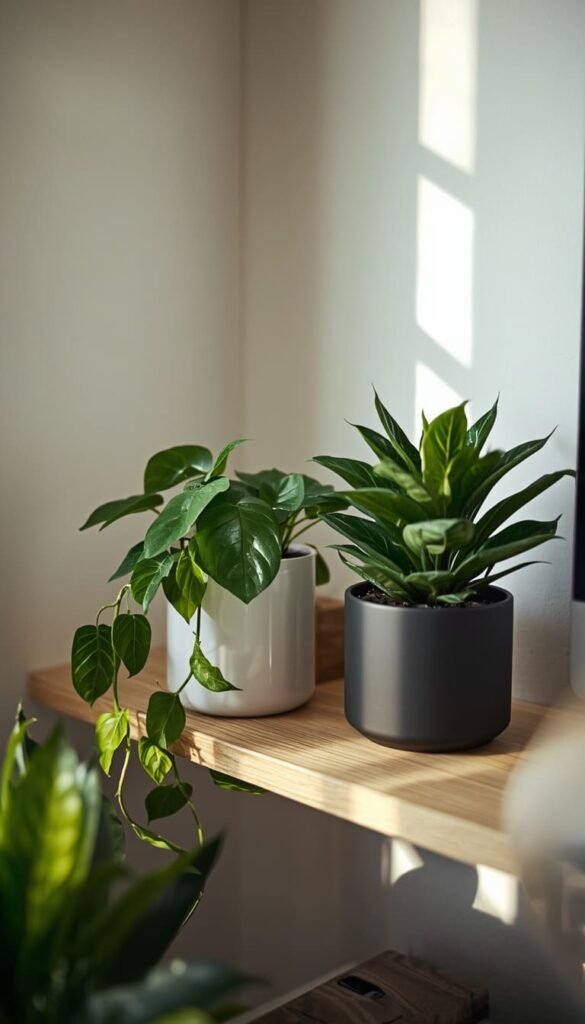
Plants bring life into a workspace in a way that no decor item can fully replace. But I want to be honest with you here most offices are genuinely rough environments for plants. Low natural light, dry air from HVAC systems, and long weekends with no one around to water anything means your plant situation needs to be strategic, not just pretty.
The varieties that actually survive and thrive in office conditions:
- Pothos: nearly indestructible, trails beautifully, tolerates low light
- ZZ Plant: thrives on neglect, looks incredibly sculptural on a shelf
- Snake Plant: air-purifying, upright silhouette, goes weeks without water
Stay away from fiddle leaf figs or monsteras in a cubicle or interior office. They need bright indirect light and consistent humidity two things most American office buildings simply don’t offer. One healthy, thriving plant always looks better than three struggling ones.
9. Tame Your Cables First Then Decorate
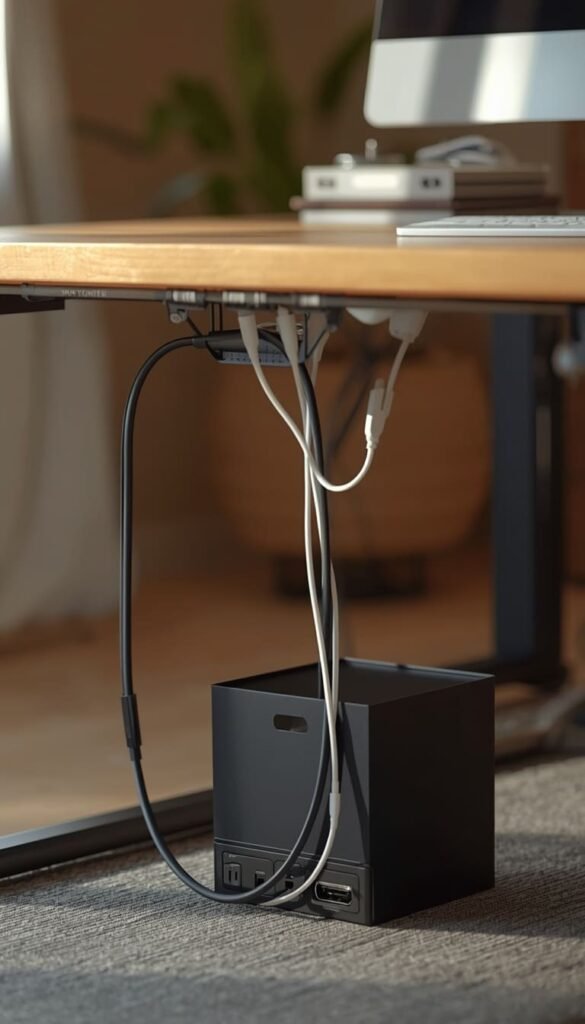
Here’s something I wish more decorating guides would say out loud: no amount of pretty desk accessories will save a workspace that has cables running wild in every direction. Loose charging cords, tangled monitor cables, and a power strip sitting out in the open will visually undercut even the most thoughtfully styled desk setup. Cable management isn’t glamorous, but it is the foundation that every good office aesthetic is quietly built on. I always tell my clients get the cables under control first, then start styling. Never the other way around.
The good news is that cable management has gotten genuinely easy and affordable in recent years. A few specific things that work really well in office settings:
- Adhesive cable clips that press directly onto the underside or back edge of your desk to route cords neatly out of sight
- A small cable management box that sits on the floor beside your desk and swallows your power strip and excess cord length completely
- Velcro cable ties instead of plastic zip ties, since they’re reusable and you can adjust them any time without cutting anything
One thing I’ve noticed time and time again is that people underestimate how much visual noise cables create. Once they’re hidden, the desk instantly looks twice as expensive and twice as organized without a single new purchase. Spend thirty minutes on cable management before you do anything else and you’ll understand exactly what I mean.
10. Match Your Desk Accessories for an Instant Cohesive Look
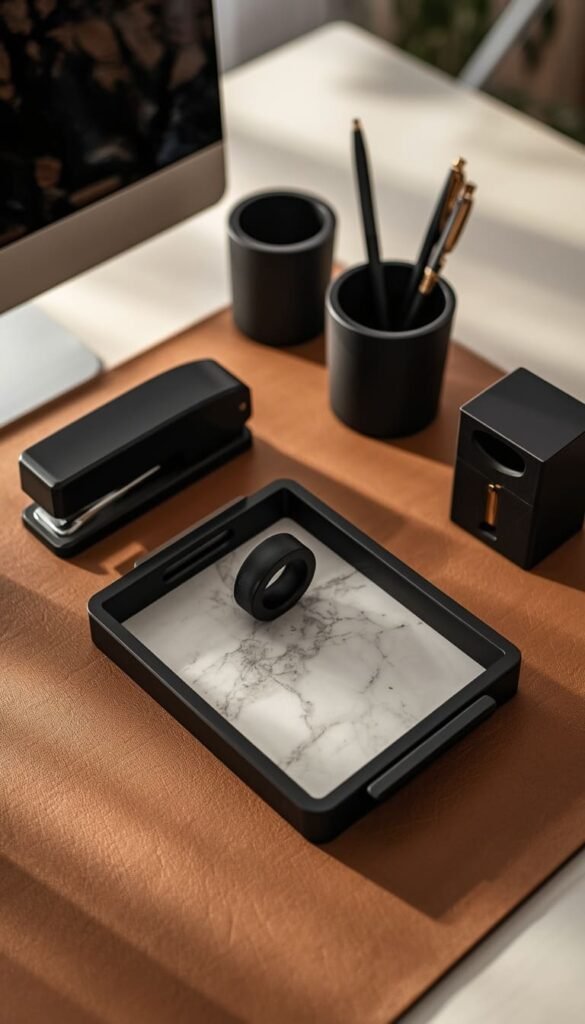
Walk into any home goods store in the US right now and you’ll find full desk accessory sets a stapler, tape dispenser, pen cup, and paper tray all in the same finish and color. Retailers like Target, TJ Maxx, and HomeGoods sell these collections for well under $40 for the whole set, and the impact they make on a workspace is disproportionate to what they cost. When every item on your desk speaks the same visual language, the entire setup looks intentional and put-together even if nothing else around it has been touched yet.
My personal recommendation for most professional office environments in the US is to go with matte black, warm white, or brushed gold as your accessory finish. These three options photograph well, age gracefully, and pair easily with almost any color story you’ve already established. Avoid mixing too many metallic finishes chrome next to gold next to rose gold starts to feel visually restless, and that low-level chaos affects your focus more than you’d expect. Pick one metallic, commit to it across every small item on your desk, and watch how quickly the space starts to look like something out of a design blog.
A quick trick I’ve used on dozens of office projects is to keep a small tray marble, wood, or acrylic all work beautifully as a “corral” for your accessories. Grouping your pen cup, a small candle or plant, and your phone stand all within one tray creates an intentional vignette on your desk that looks styled rather than just functional.
What’s the one item sitting on your desk right now that absolutely does not belong there?
11. Frame Your Photos Like a Designer Not a Hoarder
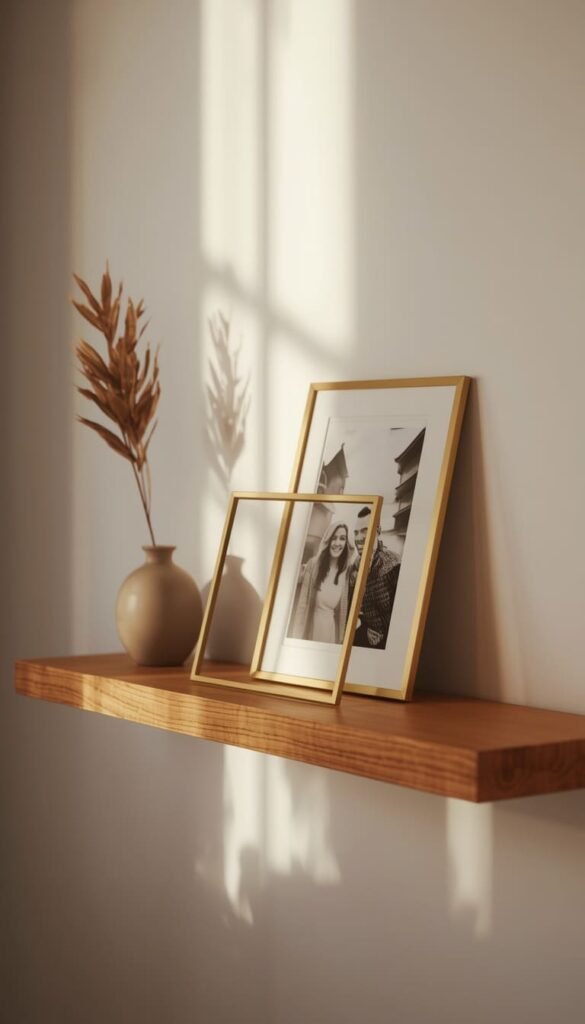
Photos are deeply personal, and I would never tell someone not to display the people they love in their workspace. But there’s a significant difference between a thoughtfully styled photo arrangement and a scattered collection of mismatched frames in six different sizes that creates visual noise every time you look up from your screen. The way you frame and display your photos matters just as much as which photos you choose.
The rule I use consistently across client projects is simple: pick one frame finish and stick to it across every single photo you display. Matching black frames, matching warm wood frames, or matching thin brass frames — all of these read as intentional. A mix of chunky silver, thin black, and chunky white frames scattered across a desk reads as an afterthought, no matter how meaningful the photos inside them are.
For actual display strategy, here’s what works best in a workspace setting:
- Limit yourself to three to five photos maximum this keeps the display feeling curated rather than cluttered
- Vary the frame sizes slightly but keep the finish identical throughout
- If you’re displaying on a desk rather than a wall, use frames with a built-in easel back and arrange them in a slight arc rather than a straight rigid line
One thing to watch out for is going overboard with personal photos in a corporate or open-plan office. A few beautifully framed images feel warm and personal. A full desk covered in family snapshots can read as unprofessional in certain work cultures, particularly in client-facing roles. One or two deeply meaningful photos styled with intention will always carry more weight than fifteen crammed into every available surface.
12. Introduce Scent Without Annoying Your Coworkers
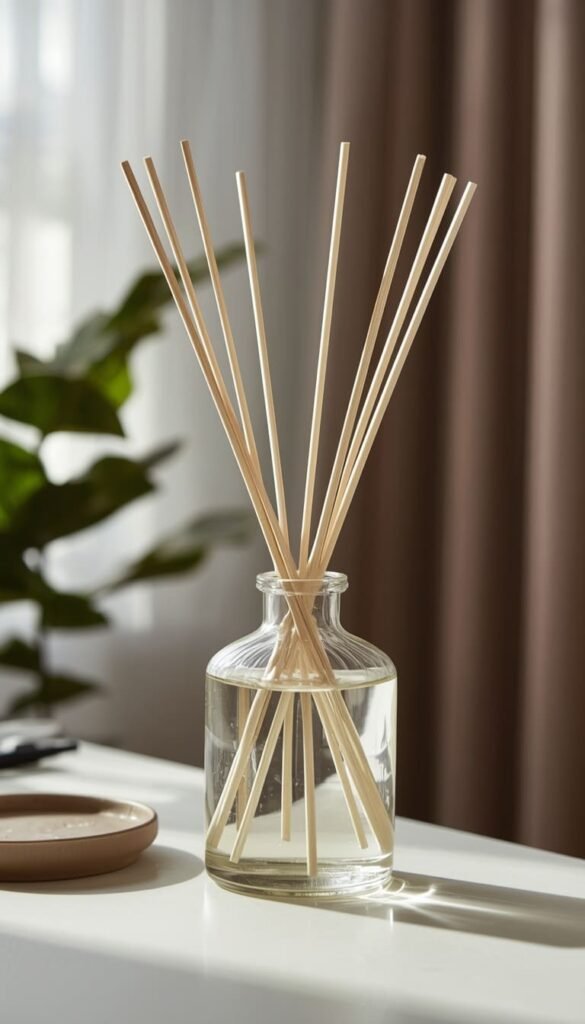
Scent is one of the most powerful mood tools available to us, and it is also the most socially complicated one to use in a shared workplace. I’ve had clients come to me genuinely confused about why their coworkers seemed irritated, and more than once the culprit was a heavily scented candle burning away at peak office hours. Shared offices and open-plan spaces require a much more restrained approach to scent than a private home office does, and getting this wrong can create real friction with the people you work alongside every day.
The safest and most universally well-received option for workplace scent is a small reed diffuser using a clean, light fragrance. Scents in the linen, light citrus, or soft eucalyptus family tend to be the least polarizing in a shared environment. They diffuse slowly, stay close to your immediate area, and don’t create the kind of heavy scent cloud that can trigger headaches or allergies in sensitive coworkers. Avoid anything in the vanilla, patchouli, or heavily floral categories in a shared space these fragrances are beautiful in a home setting but can feel overwhelming when someone is just trying to get through their afternoon emails three feet away from your desk.
If you work in a fully private office, a soy wax candle is a genuinely lovely addition to your workspace ritual. Light it when you arrive in the morning, blow it out after thirty minutes, and let the residual warmth carry you through the first part of your day. A quick trick I always suggest is placing your diffuser or candle on the far corner of your desk rather than directly in front of you the scent still reaches you naturally, but it disperses more gently into the surrounding air rather than hitting you in a concentrated wave every time you lean forward.
13. Style Your Shelf or Ledge in Three Layers
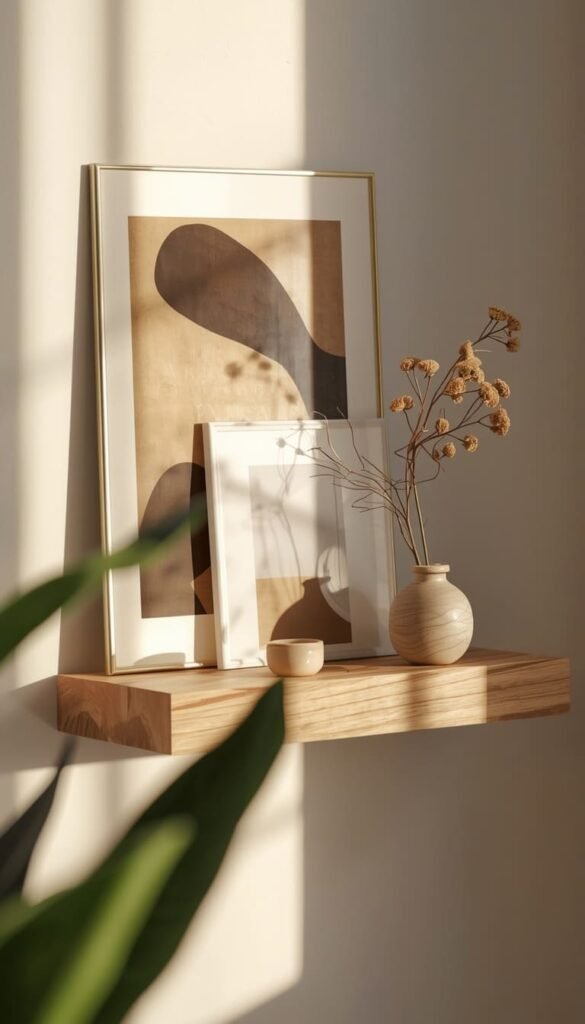
Floating shelves and built-in ledges are some of the most underutilized real estate in any office space. Most people either leave them completely empty or pile them with random items that have nowhere else to go and both approaches waste what is genuinely one of the best styling opportunities your workspace offers. When I approach a shelf in any office project, I always work with the same three-layer formula that professional stylists use, and it works every single time regardless of the size of the shelf or the overall aesthetic of the space.
The three layers break down like this. Your back layer should be your tallest item a piece of framed art leaned against the wall, a larger plant, or a stack of two or three hardcover books standing upright. Your middle layer brings in a medium-height element like a small decorative object, a succulent in a ceramic pot, or a little sculpture that reflects your personality. Your front layer is where you tuck in the smallest items a tiny candle, a single stem in a bud vase, or a small framed photo. The visual depth this creates makes even a basic IKEA ledge look like it was styled by someone who genuinely knows what they’re doing.
One thing I’ve noticed consistently is that odd numbers almost always look better on shelves than even numbers. Three items or five items arranged with that three-layer approach will feel balanced and intentional in a way that two or four items rarely achieve. It sounds like a small detail, but your eye picks up on it immediately even when your brain doesn’t consciously register why.
14. Create Two Desk Zones a Work Zone and a You Zone
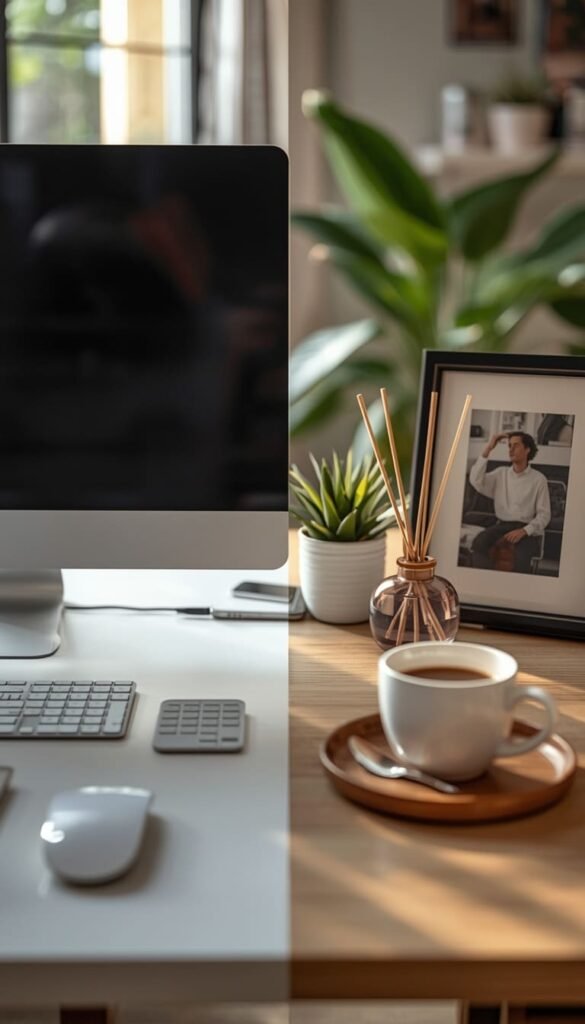
This is a concept I developed over years of working on office projects across the US, and I genuinely haven’t seen it written about anywhere else in the way I think about it. The idea is simple but the impact is significant. Rather than treating your entire desk surface as one big functional workspace, deliberately divide it into two distinct zones a Work Zone and a You Zone and keep those two areas visually and physically separate from each other.
Your Work Zone is the primary area directly in front of you. This is where your monitor, keyboard, mouse, and any active documents or notepads live. Everything in this zone should be clean, organized, and completely free of decorative clutter. Function is the only priority here, and keeping it that way protects your focus and makes you feel professionally in control the moment you sit down.
Your You Zone is the side area of your desk typically to the left or right depending on your dominant hand and setup. This is where your personality lives. A small framed photo, your plant, your candle or reed diffuser, a beautiful coffee mug, a small stack of books with spines you love all of that belongs here. Having a dedicated space for the personal and decorative elements of your desk means they enhance your environment without ever competing with your workflow.
Here is why this matters more than most people realize:
- It prevents the slow creep of clutter that happens when decor and work items mix without any intentional boundary between them
- It makes tidying up at the end of the day faster and more intuitive because everything already has a clearly defined home
- It creates a psychological separation between “working” and “being a person,” which sounds small but genuinely affects how you feel at your desk over the course of a long day
I introduced this concept to a client in Austin who had been struggling with feeling overwhelmed at her desk despite keeping it relatively tidy. Within two weeks of implementing the two-zone approach, she told me the desk felt calmer and she was ending her days feeling less mentally exhausted. The physical space had not changed at all only the intentionality behind how it was organized.
15. Rotate Seasonal Accents to Keep It Fresh
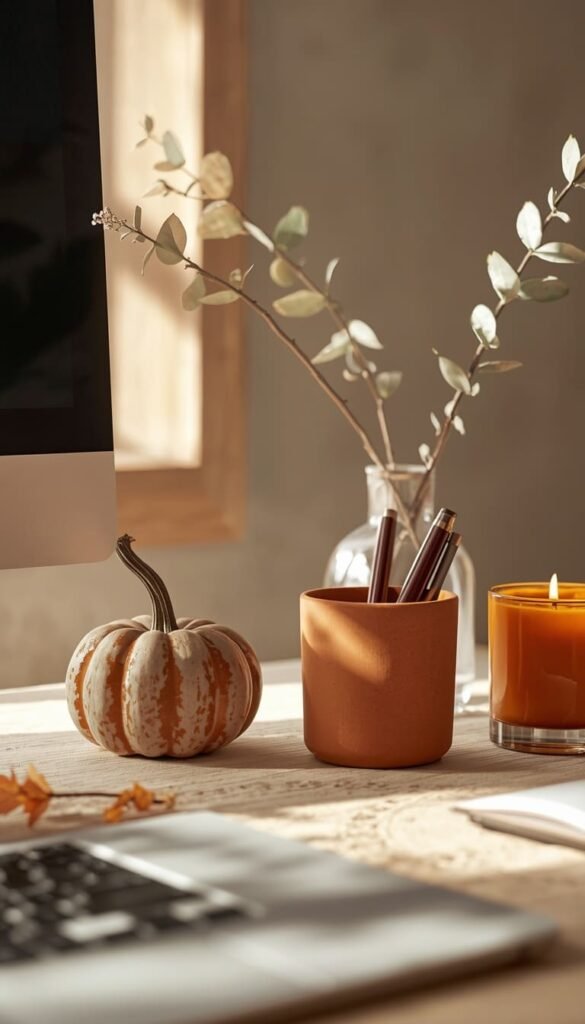
One of the quietest mistakes I see in long-term office decorating is the static workspace a desk or office that looks exactly the same in January as it does in October. The same frame, the same plant, the same accessories, year after year. There’s nothing technically wrong with this, but there’s also a subtle psychological cost to it. When your environment never changes, your brain starts to tune it out entirely, and the mood-boosting effects of a well-decorated space quietly fade into the background.
The solution is seasonal rotation, and it doesn’t have to be complicated or expensive to work really well. The idea is to keep your core, foundational pieces permanent your desk mat, your framing, your major accessories and swap out just two or three small accent items every season to keep the space feeling fresh and current.
Some simple seasonal swaps that work beautifully in an office setting without going overboard:
- Spring: a small bud vase with fresh or faux stems in blush or yellow, a lighter-colored candle scent like fresh linen or light peony
- Summer: a bright green trailing plant, a linen-textured pen cup, something in a warm terracotta or ocean blue tone
- Fall: a small pumpkin or pinecone in a neutral tone, a warm amber candle, deeper toned accessories in rust or burgundy
- Winter: a simple evergreen sprig in a small vase, cozy textures like a small knit wrist rest, a clean crisp scent like cedarwood or white tea
A quick trick I always share with clients is to buy seasonal accents right after the season peaks rather than at the height of it. Post-holiday sales at Target, HomeGoods, and West Elm consistently offer seasonal decor at 50 to 70 percent off, which means you can build an entire year’s worth of office accent rotations for well under $60 total. Your workspace stays interesting, your budget stays intact, and Monday mornings feel just a little bit better because something small and intentional is always changing.
If you could change just one thing about your workspace tomorrow morning, what would it be?
16. Budget Breakdown Real Office Decor Under $100
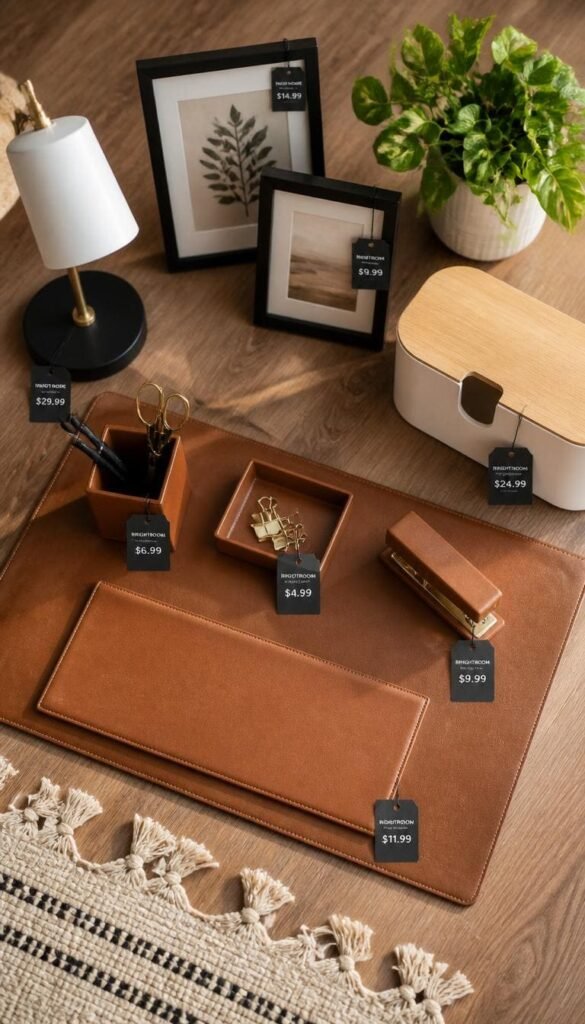
I want to end this with something that most design articles skip entirely actual numbers. Because “decorate your workspace” sounds lovely until you’re standing in HomeGoods wondering whether you’re about to overspend on a pen cup. So let me break this down in a way that’s genuinely useful, based on real shopping I’ve done with clients at accessible US retailers like Target, TJ Maxx, IKEA, and Amazon.
Here’s a realistic $100 office refresh broken into clear priorities:
- Desk lamp in warm tone: $18 to $28 (Target or Amazon)
- Matching desk accessory set, pen cup plus tray plus one organizer: $22 to $35 (TJ Maxx or HomeGoods)
- One small plant plus a simple ceramic pot: $8 to $14 (IKEA or a local nursery)
- Two matching frames for photos or prints: $10 to $16 for the pair (IKEA RIBBA frames are a genuine designer secret)
- Small desk mat in leather or vegan leather: $16 to $24 (Amazon has excellent options)
- Command strips, cable clips, and a cable management box: $12 to $18 total
That brings your total to somewhere between $86 and $135 depending on where you shop and what sales you catch. If you need to stay strictly at or under $100, prioritize the lamp and the cable management first since those two changes alone will do more for the look and feel of your workspace than anything else on the list.
The honest truth I’ve learned after years of doing this is that a beautifully decorated office at work is never really about how much money you spend. It’s about intentionality. One cohesive color story, one great light source, one living plant, and cables that are actually hidden will outperform a desk covered in expensive but mismatched accessories every single time. Your workspace should feel like a place you chose not a place you ended up.
Your 30-Second Office Decor Decision Map
By Budget
💰 Starter Desk Refresh (Under $50)
- Start with cable management first biggest visual impact, lowest cost
- Add a warm-toned desk lamp from Target or Amazon
- Pick one matching desk accessory set from TJ Maxx
- Use Command strips for a no-nail mini gallery wall
- Grab one pothos or ZZ plant from IKEA
✨ Intentional Workspace Investment ($50 to $100)
- Layer in a vegan leather desk mat as your foundation
- Add a small low-pile rug under your desk chair
- Upgrade to matching frames in brass or matte black
- Introduce a reed diffuser in a clean neutral scent
- Style a floating ledge using the three-layer formula
By Lifestyle
🏃 Always Busy and Low Maintenance
- Stick to faux botanicals over real plants
- Choose a desk mat over a rug for easy cleaning
- Keep accessories to a matching three-piece set maximum
- Use a cable management box one purchase, problem gone permanently
🎨 Creative and Loves to Refresh Often
- Build a twine and clip gallery wall for easy seasonal swaps
- Rotate just two accent items every season
- Use removable wallpaper on one cubicle wall for drama
- Shop post-holiday sales for accent pieces at 50 to 70 percent off
Frequently Asked Questions
How Can I Decorate My Office at Work Without Spending a Lot of Money?
Start with what you already own a lamp from home, a framed photo, or a kitchen jar repurposed as a pen holder costs nothing. The biggest free upgrade? Taming your cables first.
What Are the Best Plants for an Office With No Windows?
Pothos, ZZ plants, and snake plants are your best options. All three survive fluorescent lighting and can go one to two weeks without water easily.
Is It Okay to Decorate a Cubicle at Work?
Yes, but check your company policy before buying anything. Most US offices allow personal decor as long as nothing is permanently mounted or scented too strongly.
How Do I Make My Work Desk Look Aesthetic on a Budget?
Pick one color story and match every accessory to it. A cohesive $30 desk set from TJ Maxx will always look better than expensive items in mismatched finishes.
What Should I Put on My Office Desk to Stay Organized and Stylish?
A desk mat, a three-piece matching accessory set, and one small plant cover both function and style. Keep your Work Zone clean and let your You Zone hold everything personal.
Conclusion
Your workspace is where you spend a massive chunk of your life, and you deserve to actually like being there. You don’t need a full makeover budget or a design background to make it happen just start with one thing today. Clear your cables, order that lamp, or finally swap out those mismatched frames. Small moves made with intention add up faster than you’d expect, and once you feel the shift in your energy on a Monday morning, you’ll wonder why you waited this long. So tell me what’s the one change you’re making to your office this week? Drop it in the comments, I’d genuinely love to hear it.
