
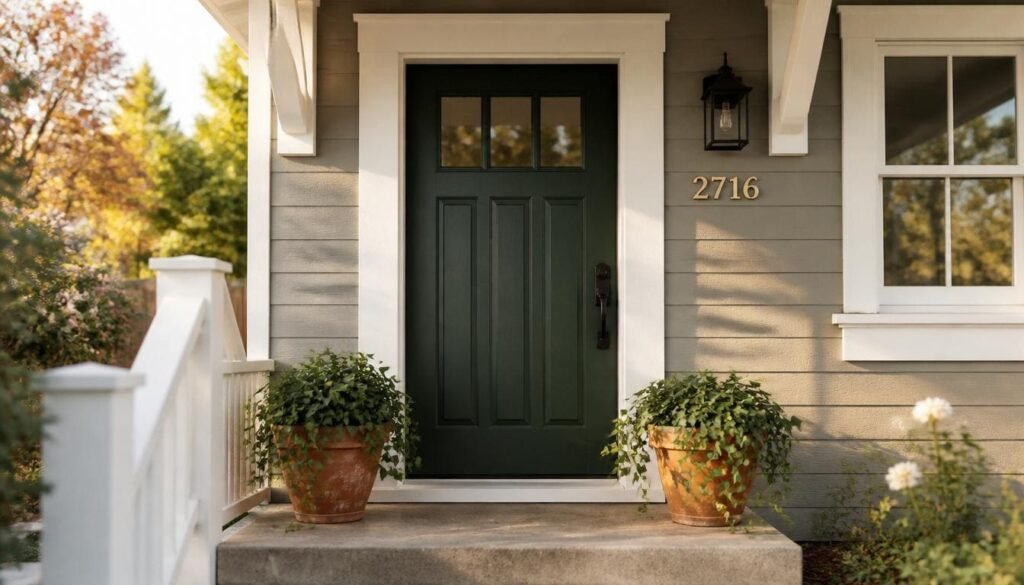
Your front door is doing a lot of heavy lifting especially when your home is small. Unlike sprawling suburban houses with long driveways and grand porches to ease the first impression, a small home or apartment puts your front door front and center, immediately. There’s no hiding behind a three-car garage or manicured hedgerows. What you’ve got is that door, that stoop, and maybe four feet of space to work with. The good news? I’ve seen a $300 front door refresh completely change how a small home feels from the street and that’s exactly what this guide is built to help you do.
My Design Notes
When I was working with a first-time homeowner in Austin, Texas, her biggest fear was commitment. She’d spent six years renting and the idea of actually painting her front door felt permanent in a way that paralyzed her. Her 1,100 square foot craftsman bungalow had a forgettable beige door, one sad overhead light, and a five foot stoop that felt more like an afterthought than an entrance. We mapped out a plan together that totaled $340. New paint in Sherwin-Williams Romney Wool, a deep forest green that photographed like a dream. Two matte black sconces from Home Depot. A brushed brass handle set. Two terracotta pots with trailing ivy. I still remember her texting me a photo the following weekend saying her neighbor had knocked on her door asking what contractor she’d hired. There was no contractor. Just a clear plan, the right products, and the confidence to go for it. That project is the reason I believe so strongly that small homes don’t need big budgets they just need smarter decisions.
Stunning Exterior Door Ideas That Give Every Small Home an Unforgettable First Impression
1.Why Your Front Door Matters More When Your Home Is Small
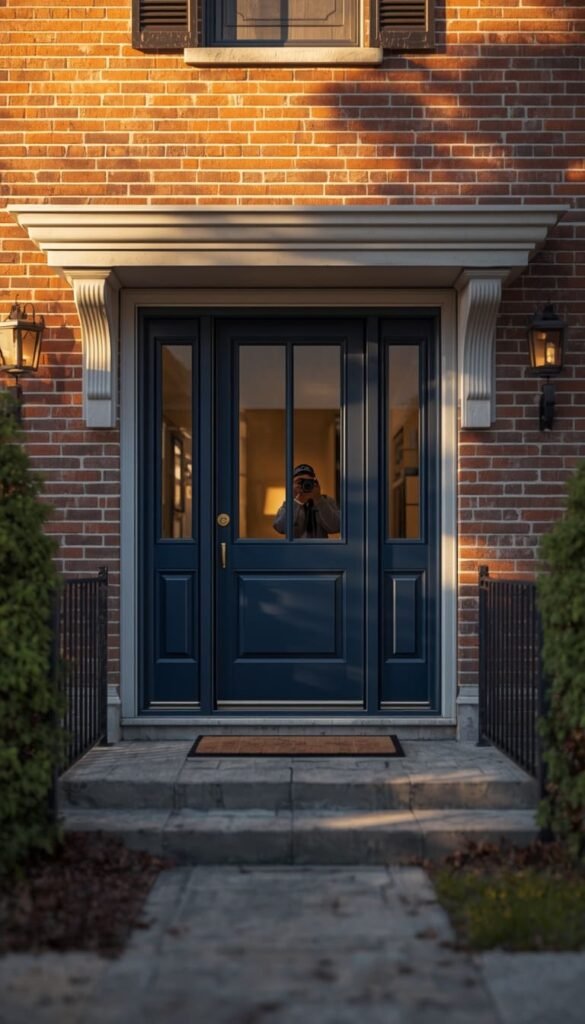
When your home is compact, every single design decision carries more weight. A large house can absorb a bad color choice or an awkward light fixture a small home cannot. Your front door is essentially your entire first impression, and in many cases, it’s the only architectural feature a visitor or passerby will actually notice and remember.
I’ve worked on enough small home projects to know that homeowners often underestimate this. They’ll spend weeks agonizing over kitchen countertops but pick a front door color in five minutes. That imbalance shows. The entry sets the emotional tone before anyone even steps inside, and when square footage is limited, that tone matters even more.
A quick trick I’ve learned over the years is to photograph your front door from across the street the same distance a neighbor or guest would first see it from. Most people are shocked by what they see. The door that looked “fine” up close suddenly looks faded, flat, or just completely forgettable against the exterior. That photograph is your honest starting point.
2.Know Your Door Before You Decorate It
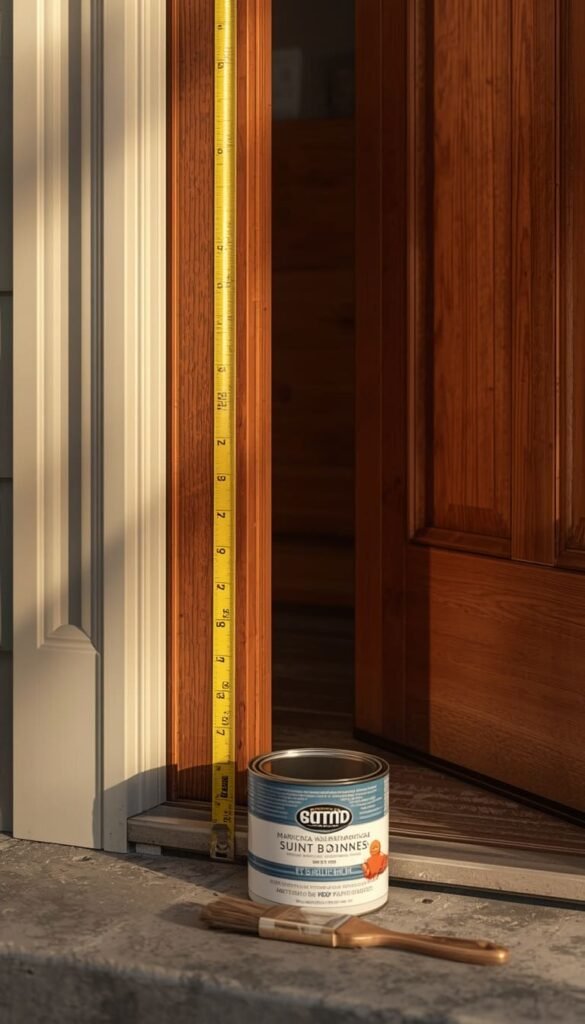
Before you buy a single can of paint or a new handle set, spend ten minutes getting familiar with what you’re actually working with. This is the step most online guides skip entirely, and it’s the one that saves you from wasting money.
A few things worth checking before anything else:
- Measure your door opening. Standard exterior doors are 80 inches tall and 36 inches wide, but many older homes and apartments run narrower at 32 or even 30 inches. This affects what hardware, storm doors, and decorative trim will actually fit.
- Check your door’s sun exposure. A south-facing door in a sunny climate absorbs significantly more heat. Dark colors like black or navy on south-facing doors can cause wood to expand, warp, or crack faster than you’d expect.
- Renter or owner? If you’re renting, your options aren’t zero but they do shift. Focus on removable, non-permanent updates like wreaths, doormats, potted plants, and peel-and-stick house numbers.
One thing to watch out for is assuming all exterior paints are equal. If you’re painting a wood door, you need a 100% acrylic exterior paint with a semi-gloss or gloss finish. Flat paint on a front door is a mistake I see constantly it scuffs, it stains, and it doesn’t hold up against weather the way gloss finishes do.
3.Bold Color Small Canvas Front Door Color Ideas That Actually Work
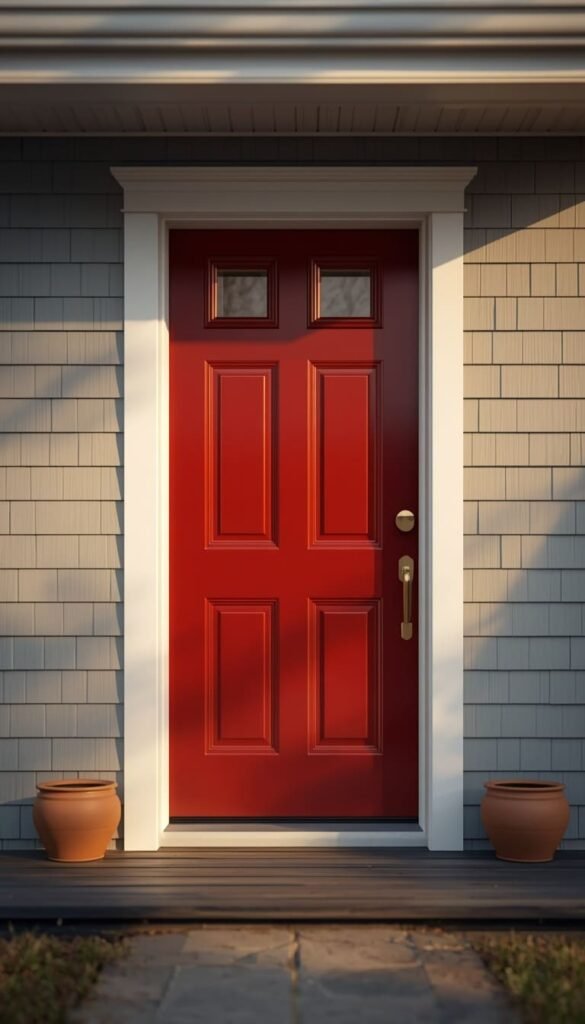
Color is where small home entryways either come alive or fall completely flat. The instinct for many homeowners is to play it safe beige, gray, greige. And I understand the fear. But safe colors on small doors tend to disappear rather than invite. They blend into the exterior instead of creating that moment of visual arrival that a front door is supposed to deliver.
What actually works on a small facade is contrast. Not necessarily loud color, but deliberate contrast with whatever your exterior is doing. A cream brick home looks stunning with a deep navy or forest green door. A gray clapboard exterior comes alive with a warm terracotta or a dusty sage. The goal is for the eye to land on that door and stay there for a second.
Colors that consistently perform well on small home entryways:
- Deep forest green (Sherwin-Williams Jasper or Romney Wool)
- Warm navy (Benjamin Moore Hale Navy is a classic for good reason)
- Rich burgundy or oxblood for homes with brick or stone exteriors
- Soft black with warm undertones rather than cool blue-black for a less harsh look
One thing I always tell clients finish matters as much as color. A semi-gloss or high-gloss finish on a front door reflects light, makes the color look richer, and photographs beautifully. Matte finish doors look stunning in magazine spreads but show every fingerprint, scuff, and water streak within a week of real life.
4.The Black Front Door Obsession Is It Right for Your Small Home
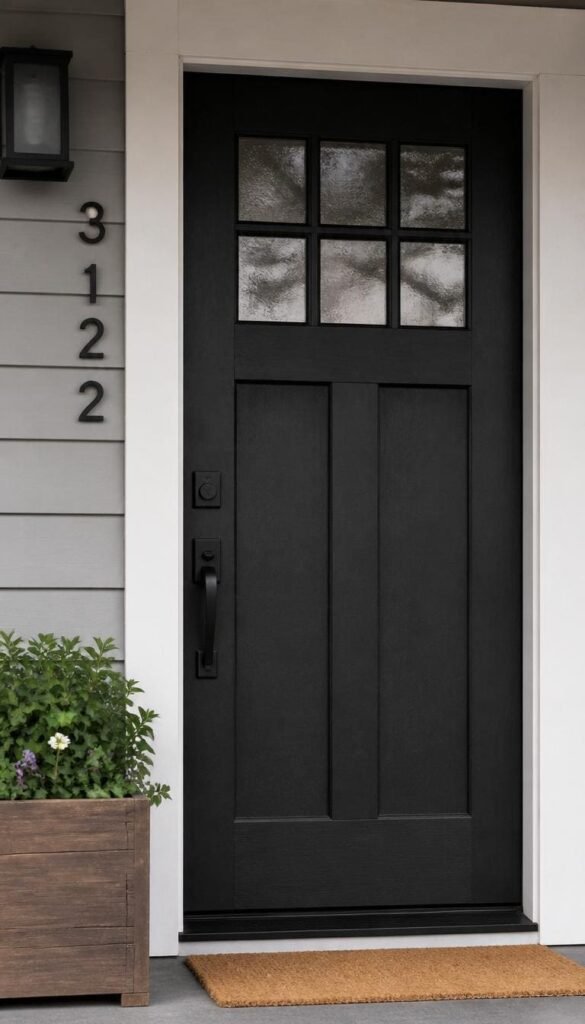
Black front doors are everywhere right now, and honestly, I get it. There’s a reason this trend has legs black is grounding, it’s versatile, and it makes almost every exterior color look more intentional and polished. On a small home, a black door can create a strong focal point that makes the whole facade look more designed, more deliberate.
But here’s the honest conversation nobody online seems to want to have. Black absorbs heat. On a south or west-facing door in states like Texas, Arizona, Florida, or Southern California, a black door in direct sun can reach surface temperatures that cause real damage to wood doors over time warping, cracking, paint peeling within a single summer. If your door faces south and gets direct afternoon sun, you have two smarter options: choose a very dark charcoal with slight warm undertones instead of true black, or invest in a fiberglass door that handles heat expansion far better than wood.
The other reality check with black doors is fading. Exterior black paint, even high-quality formulas, will show chalking and fading within two to three years in sun-heavy climates. Budget for a refresh coat every few years, or look at doors that come factory-finished in black with UV-resistant coatings those hold up significantly better than a DIY paint job.
5. Wooden Front Door Ideas for Small Homes The Real Maintenance Talk
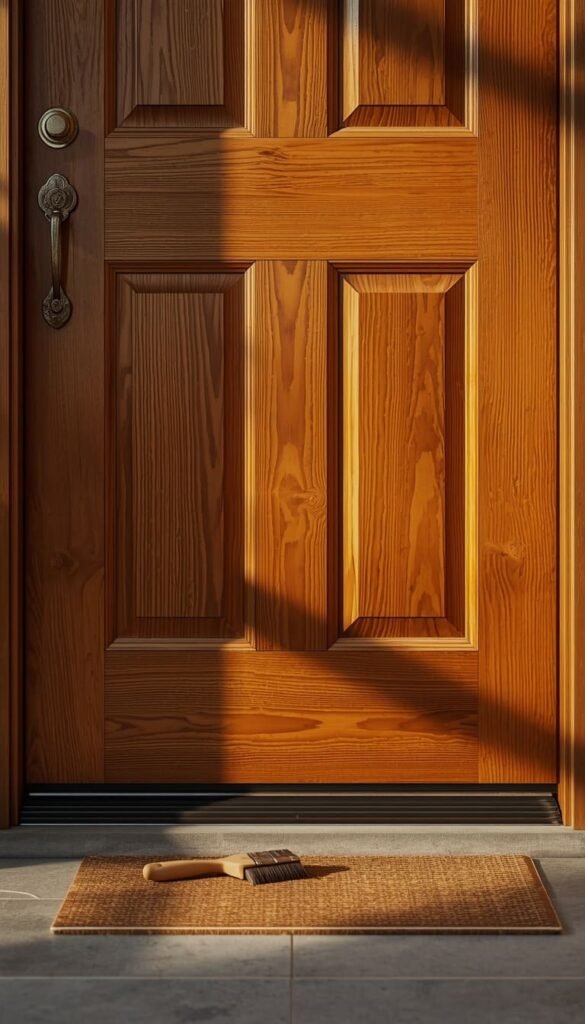
There is something about a wood front door that no other material can fully replicate. The warmth, the grain, the way it photographs in natural light it genuinely elevates a small home in a way that fiberglass and steel doors spend their whole lives trying to imitate. I’ve specified wood doors on small craftsman bungalows, cottage style homes, and even modern farmhouse builds, and the client reaction when they see it installed for the first time is always the same. It just feels right.
But I’d be doing you a disservice if I stopped there. Wood doors are a commitment, and small home or apartment owners especially need to hear the full picture before spending $800 to $2,500 on one.
Here’s what real ownership of a wood front door looks like:
- Refinishing cycle: Expect to sand, re-stain, or repaint every 3 to 5 years depending on your climate and sun exposure. Skip this and the wood begins to grey, crack, and absorb moisture.
- Seasonal swelling: Wood expands in humidity and contracts in dry cold. In climates like the Southeast or Pacific Northwest, this can mean a door that sticks in summer and drafts in winter if it wasn’t properly sealed during installation.
- Cost of upkeep: The door itself might be $1,200. But factor in professional refinishing every few years at $200 to $400, and the true cost of ownership climbs significantly.
The smarter middle ground for most small home owners? A fiberglass door with a wood grain finish. Modern fiberglass has gotten remarkably convincing it can be stained exactly like real wood, it doesn’t warp or swell, and it holds paint far better in extreme climates. I specify it constantly for clients who want the wood look without the wood anxiety.
Which one of these ideas are you most excited to try first a bold new door color or updated hardware?
6. Modern and Minimalist Front Door Ideas for Contemporary Small Spaces
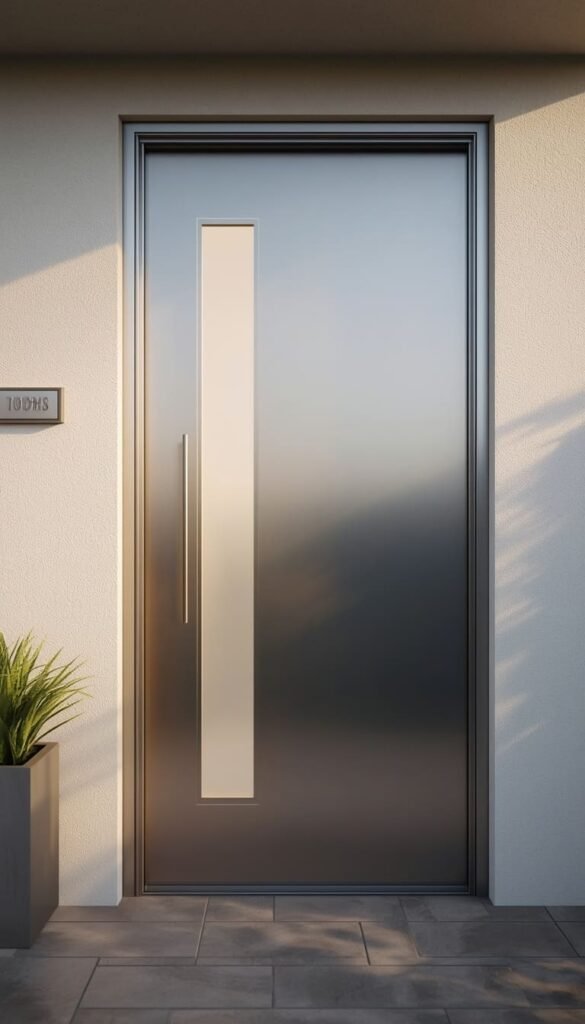
If your home leans contemporary clean lines, flat facades, minimal ornamentation then your front door should speak that same language. The worst thing you can do to a modern small home is slap a traditional paneled door with decorative hardware on it. The mismatch reads immediately, even to people who can’t articulate why something feels off.
Modern front door design for small homes is really about three things: proportion, material, and restraint. A flush door with a simple linear handle pull. A steel door with a narrow glass panel running vertically alongside it. A pivot-style door in a dark finish that swings open with that satisfying, architectural weight. These choices don’t need to be expensive to look intentional.
A quick trick I’ve learned when working on tight modern entryways is to go taller rather than wider. A door with a transom window above it even a fixed, non opening one draws the eye upward and makes a small entry feel significantly more generous. It costs less than you’d think and the visual impact is immediate.
For hardware on modern doors, keep the finish consistent and keep it simple. Brushed nickel, matte black, or satin brass pick one and repeat it across your handle, house numbers, and light fixture. The cohesion is what makes it look designed rather than assembled.
Top 6 Door Exterior Ideas:
| Idea | Estimated Price | Maintenance |
|---|---|---|
| Bold Door Color (Paint) | $30 to $80 DIY / $150 to $300 professional | Low |
| Black Front Door (Fiberglass) | $400 to $1,200 installed | Low |
| Wood Front Door | $800 to $2,500 installed | High |
| Modern Steel or Fiberglass Door | $500 to $1,500 installed | Low |
| Farmhouse Style Door with Trim | $80 to $400 depending on DIY vs pro | Medium |
| Updated Hardware and House Numbers | $60 to $200 total | Low |
7. Farmhouse and Cottage Front Door Ideas Without the Sprawling Porch
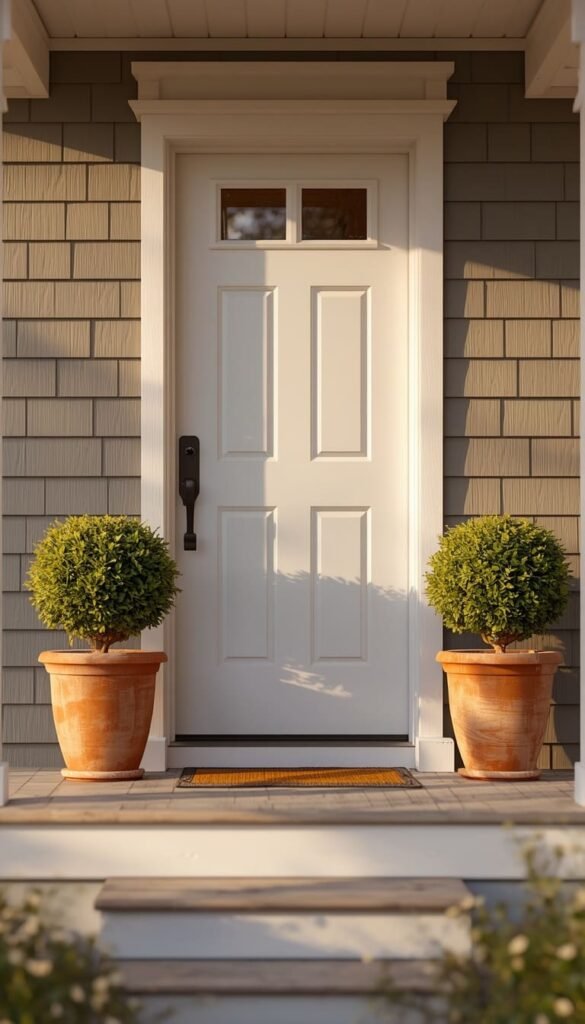
Here’s something the Pinterest boards won’t tell you most farmhouse front door inspiration photos are shot on homes with 10 foot wide porches, board and batten siding running the full facade, and enough square footage to park a truck. If your small home has a three-step stoop and 900 square feet behind it, recreating that look requires a different strategy entirely.
The good news is that the farmhouse and cottage aesthetic is incredibly forgiving on small homes when you focus on the right elements. You don’t need the porch. What you need is the texture, the warmth, and the intentional layering that makes farmhouse style feel so livable.
For a small home, here’s how I approach the farmhouse front door look:
- Door choice: A solid wood or wood-look fiberglass door with vertical planking (shiplap-style panels) reads immediately as farmhouse without requiring any porch architecture behind it.
- Hardware finish: Matte black hardware is the farmhouse signature. Handle, hinges, house numbers, light fixture all matte black, all consistent.
- Trim detail: Adding simple board trim around the door frame in a contrasting white or cream color creates that cottage depth even on a flat facade. An intermediate DIYer can do this in a single Saturday for under $80 in materials.
Two potted evergreens or boxwoods flanking even the smallest stoop will do more for the farmhouse feel than almost any other single addition. Keep them symmetrical, keep them clipped, and keep the pots in a natural material terracotta, concrete, or weathered wood. Shiny plastic planters undo the entire vibe immediately.
8. Renter Friendly Exterior Door Decor No Drilling No Damage
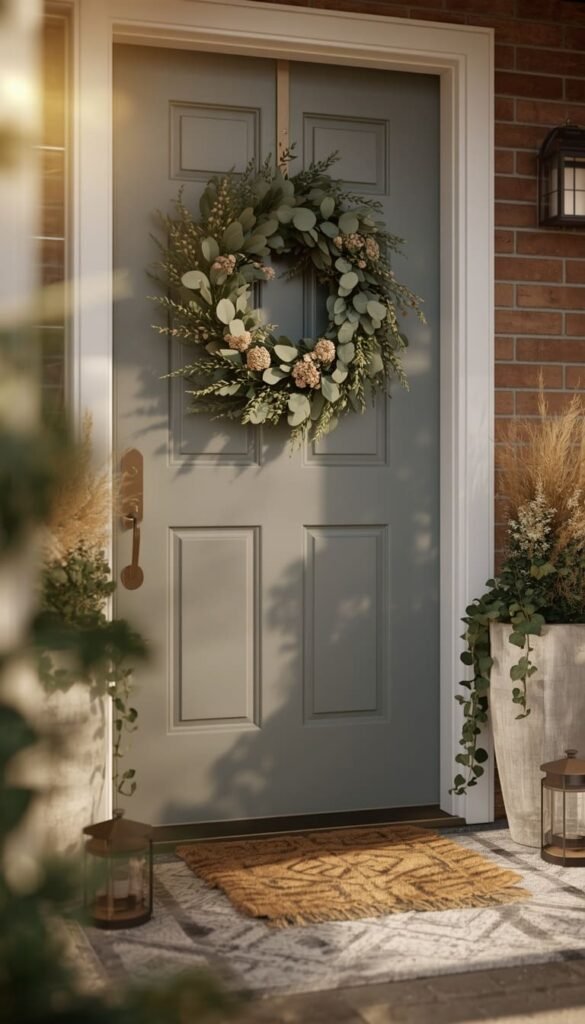
This section is for everyone whose landlord has ever handed them a lease with the phrase “no alterations to the exterior.” Which, if you’ve rented in any major American city in the last decade, is basically all of you. The frustrating reality is that most front door content online assumes you own your home and can do whatever you want to it. Renters are largely ignored, and I think that’s a genuine gap worth filling.
The great news is that a renter-friendly front door refresh, done well, is nearly indistinguishable from a permanent one. The key is working with what the landlord allows which in most cases is anything removable and non damaging.
Command hooks rated for outdoor use are genuinely game-changing here. A wreath hanger that requires zero drilling, holds seasonal wreaths through wind and weather, and removes cleanly when you move out. Pair that with a high quality doormat, two potted plants in attractive containers, and solar-powered lanterns placed on either side of the stoop, and you have a complete entryway look with zero permanent changes.
One thing to watch out for is cheap seasonal decor that looks exactly like what it is. A $12 foam wreath from a big box store reads as an afterthought. Spend $35 to $50 on a wreath made from natural materials dried botanicals, preserved eucalyptus, woven seagrass and the entire entry looks considered and styled rather than decorated.
For apartment doors specifically, a fresh doormat in a pattern that complements your door color does more visual work than most people realize. It signals intentionality before a guest even looks up at the door itself.
9. Lighting The Most Underrated Curb Appeal Move for Small Entryways
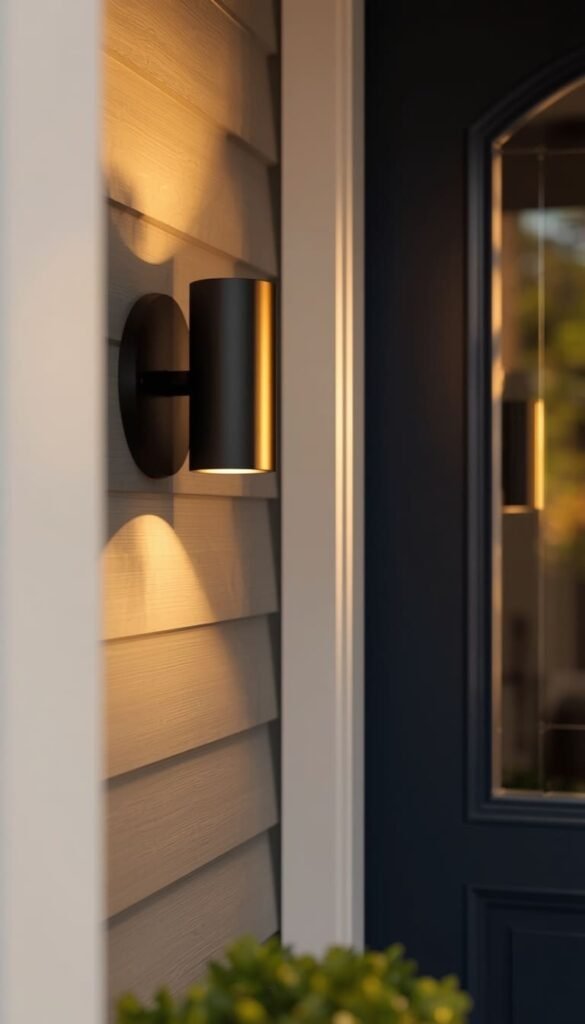
Most small home owners I work with have thought carefully about their door color, their wreath, their welcome mat and then completely forgotten about the light fixture hanging right above all of it. This is one of the most common and most fixable mistakes in exterior design. Bad lighting doesn’t just look wrong after dark. It actively undermines everything else you’ve done during the day, because a dated brass fixture or a builder-grade globe light immediately signals “I stopped caring right here.”
For small entryways, scale is everything with lighting. A fixture that’s too large overwhelms a narrow entry and looks costume-y. One that’s too small disappears entirely. The general rule I follow is that your sconce or pendant should be roughly one quarter to one third the height of your door. So on a standard 80-inch door, you’re looking for a fixture somewhere between 20 and 27 inches tall. That range works on almost every small home proportionally.
Finish matching matters more than most people expect. Your light fixture finish should coordinate with your door hardware. If you’ve chosen matte black handles and house numbers, a matte black or dark bronze fixture ties the whole entry together. Mixing a polished chrome light with an oil-rubbed bronze handle set is the kind of detail that nags at visitors without them knowing why.
A quick trick for renters or anyone not ready to hardwire a new fixture solar-powered wall sconces have genuinely improved in the last few years. Brands like Otdair and Jackyled make solar sconces with realistic flame effects and warm light output that look convincingly like hardwired fixtures from the street. They mount with screws, so check your lease, but many landlords allow exterior light replacements as long as you reinstall the original on move-out.
10. Plants and Greenery That Fit a Tiny Stoop And Won’t Die on You
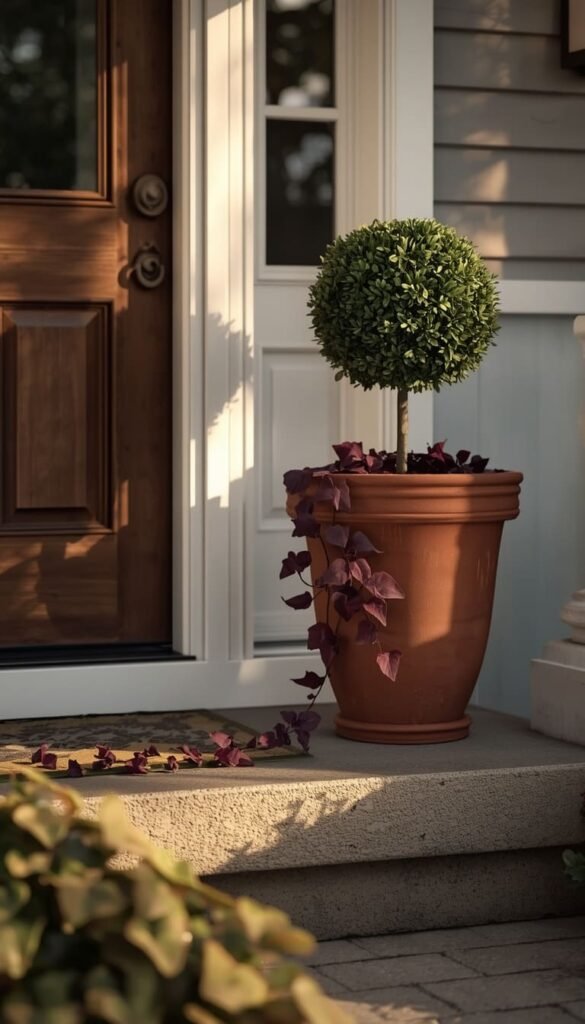
I have a strong opinion about plants at the front door, and it’s this two well-chosen, well-maintained plants will always outperform six mediocre ones crammed onto a small stoop. The temptation when working with limited space is to fill every inch. Resist it. Negative space on a small entry is not emptiness. It’s breathing room, and it makes the plants you do choose look intentional rather than desperate.
For a stoop under five feet wide, I typically recommend one of two approaches. Either two matching containers flanking the door symmetrically which reads as classic and polished or one larger statement planter slightly off-center if the architecture of the entry is more casual and asymmetrical. Symmetry works harder in small spaces because it creates order, and order makes a tight space feel designed.
Plant choices that actually survive American front stoops without constant babysitting:
- Boxwood topiaries in classic ball or cone shapes evergreen, structured, and nearly indestructible in USDA zones 5 through 9
- Trailing sweet potato vine in deep purple or chartreuse fast growing, dramatic, and forgiving if you miss a watering or two
- Dwarf Alberta spruce for cold climates stays compact naturally, needs almost no pruning, looks sculptural year round
- Caladiums for shaded porches in warm climates the leaf color and pattern variety is extraordinary and they thrive where sun-lovers fail
Container choice matters as much as the plant itself. Terracotta breathes well and looks beautiful but cracks in freeze-thaw climates. Fiberglass containers that mimic terracotta or concrete are my practical recommendation for anyone north of zone identical visual impact, zero cracking risk.
11. Hardware House Numbers and the Details That Tie It All Together
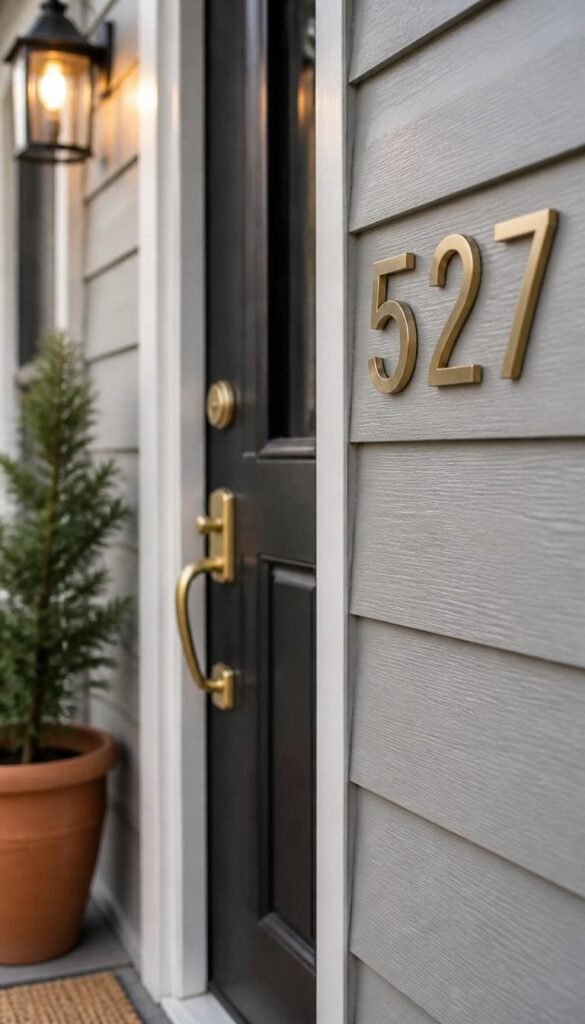
If the front door is the face of your home, hardware is the jewelry. And just like actual jewelry, the wrong pieces in the wrong combination can undermine an otherwise pulled together look completely. I’ve seen gorgeous door colors with mismatched hardware finishes that made the whole entry feel unresolved and I’ve seen plain doors with perfect hardware that looked effortlessly expensive.
The single most important rule with exterior hardware is finish consistency. Pick one metal finish and repeat it across every touchpoint of the entry door handle, deadbolt, house numbers, light fixture, door knocker if you have one, even the mailbox if it’s mounted nearby. This kind of repetition is what separates a designed entry from a collected one.
For small homes specifically, house number sizing is something most people get wrong. Numbers that are too small get lost against the facade and force visitors to squint from the driveway. A good baseline is four to six inches tall minimum, mounted at eye level, in a finish that contrasts with the wall behind them. Dark bronze numbers on a light gray exterior. Brushed brass on a dark navy facade. The contrast is what makes them readable and intentional at the same time.
One thing to watch out for is buying handle sets based on photos alone. Always check the backset measurement the distance from the edge of the door to the center of the hole before ordering online. Most doors are either a 2-3/8 inch or 2-3/4 inch backset, and ordering the wrong one means the handle won’t fit without drilling new holes. Takes two minutes to measure and saves a very frustrating return.
And what is the biggest challenge stopping you from giving your front door a refresh right now budget, time, or just not knowing where to start?
12. My Front Door Makeover Formula for Small Homes
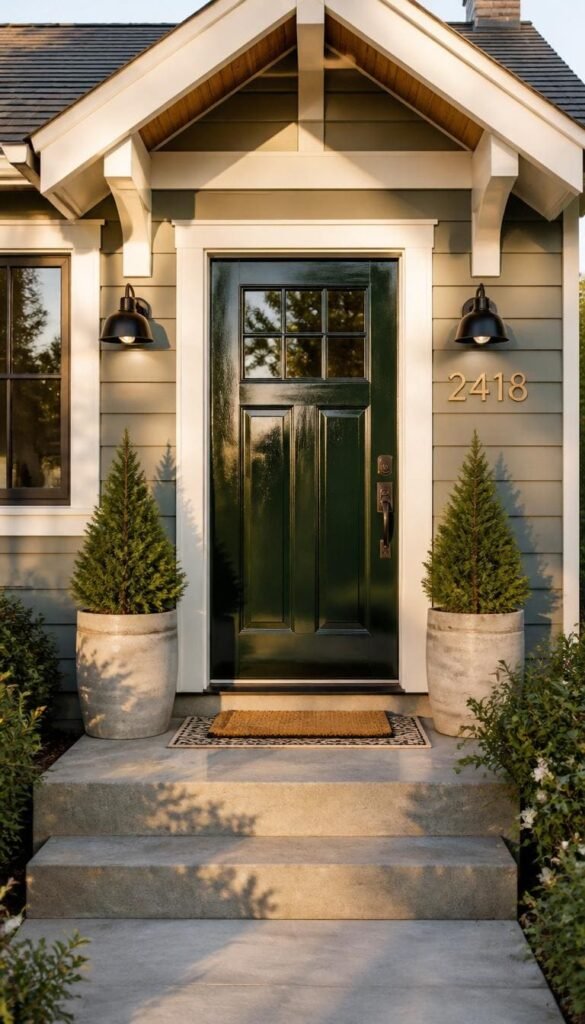
By now you’ve got ideas, you’ve got reality checks, and hopefully you’ve got a clearer picture of what your specific entry actually needs. So let me leave you with the framework I use on every small home exterior project I take on, because I think it makes the whole thing feel less overwhelming and more executable.
I call it the Five Touch Rule. Every small home entry needs exactly five intentional touches to look completely designed. Not fifteen. Not two. Five.
Here’s how those five touches typically break down on a small home:
- Touch one: A fresh door color or a refinished door surface this is always the foundation and the biggest single impact item
- Touch two: Updated hardware in one consistent finish repeated across handle, deadbolt, and house numbers
- Touch three: A lighting fixture that is correctly scaled and finish-matched to the hardware
- Touch four: Greenery in quality containers, either symmetrical flanking plants or one strong statement planter
- Touch five: A ground-level layer a high quality doormat, a small bench if space allows, or a seasonal accent that changes a few times a year
Every project I’ve done that felt successful hit all five of these. Every entry that felt like something was missing was usually skipping one. The budget for all five touches on a small home can realistically land between $200 and $600 depending on your choices which, for the curb appeal return you get, is one of the best investments in residential design I know of.
The 2 Minute Decision Map
By Budget
Starter and Renter Friendly (Under $150)
- Fresh paint in a bold contrast color biggest impact, lowest cost
- Outdoor command hook wreath hanger plus a natural material wreath
- High quality doormat with pattern or typography
- Solar powered sconces on either side of the door
- Peel and stick house numbers in a contrasting finish
- Two small potted plants in terracotta or concrete containers
Investment and Ownership Level (Above $400)
- Full door replacement in fiberglass with wood grain finish
- Hardwired matte black or bronze sconce set professionally installed
- Solid brass or brushed nickel handle and deadbolt set
- Custom pivot or steel and glass door for contemporary homes
- Professional exterior paint job with primer and two finish coats
- Oversized architectural house numbers in premium metal finish
By Lifestyle
Renters and Apartment Dwellers
- Zero drilling solutions only command hooks, freestanding planters, solar lights
- Seasonal swap system one wreath, one mat, one plant rotated quarterly
- Invest in one great doormat and one quality wreath and stop there
- Avoid anything that requires landlord approval or leave-behind damage
Small Home Owners Ready to Commit
- Start with the Five Touch Rule before buying anything
- Photograph the entry from the street before making any decisions
- Pick one hardware finish and buy everything in that finish on the same day
- Do door color first, hardware second, lighting third always in that order
- Plants and mat are last because they frame what you have already built
Frequently Asked Questions
What is the best front door color for a small home?
Deep forest green, warm navy, and soft black with warm undertones consistently perform best on small facades. The key is contrast with your exterior not matching it.
How much does it cost to update a front door on a budget?
The average cost is $30 to $80 for a DIY paint job plus $60 to $150 for new hardware. A full refresh including lighting and plants realistically lands between $200 and $400.
Can renters change their front door without landlord permission?
Yes, but stick to removable updates only. Doormats, command hook wreaths, freestanding planters, and solar sconces require zero drilling and leave zero damage on move-out.
How often should I repaint my exterior front door?
Ideally every 3 to 5 years, sooner in harsh sun climates. South-facing doors in states like Texas or Arizona often need a refresh coat closer to the 2-year mark.
Does a new front door actually increase home value?
Yes a front door replacement consistently ranks among the highest ROI exterior projects in the annual Remodeling Cost vs. Value report. Steel and fiberglass doors typically return 60 to 80 percent of their cost at resale.
Conclusion
Your front door is not a small detail it is the first thing you see when you come home after a long day, and it sets the mood before you even turn the key. You do not need a big budget or a complete renovation to make it feel like it belongs to you. Pick one thing from this guide just one and go do it this week. Buy the paint sample. Order the handle set. Move the sad plastic pot off the stoop. Small homes deserve intentional design just as much as grand ones do, and honestly, the constraints make the creativity better.
