
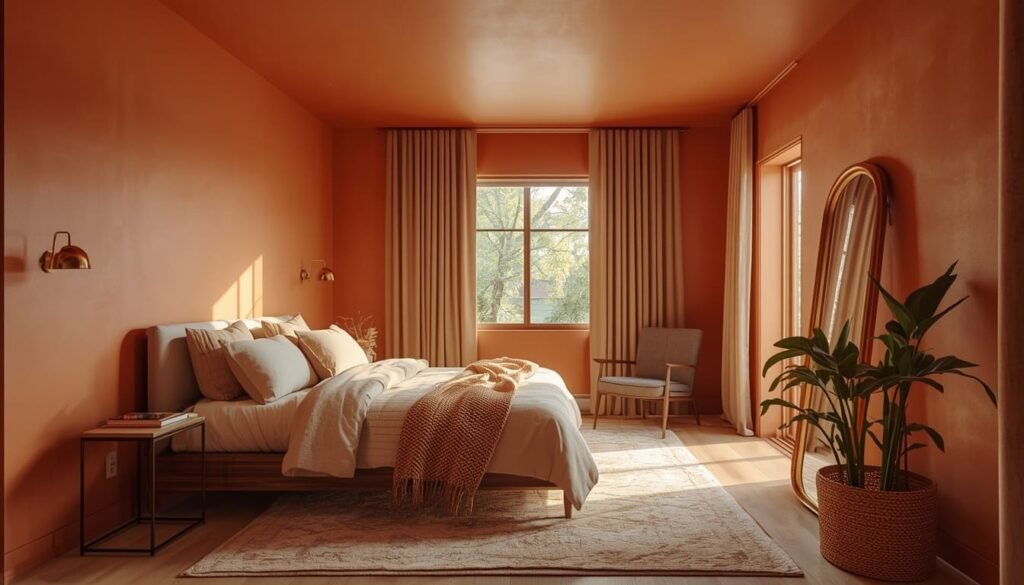
A tiny bedroom doesn’t have to feel like a punishment. I’ve walked into rooms barely big enough to swing a throw pillow, and walked out leaving them looking like something straight out of a boutique hotel in Nashville. The secret isn’t square footage it’s strategy. Most people try to fight the size of their room. The ones with the most beautiful tiny bedrooms? They work with it.
My Design Notes
A few years back, I took on a project in Austin, Texas a guest bedroom tucked inside a 1960s ranch house, just 90 square feet total. One small window, no closet, and a full bed that left about eighteen inches of walking space on each side. My client wanted it to feel like a boutique stay, not a storage closet with a mattress. We painted the walls and ceiling the same soft terracotta, mounted brass sconces instead of table lamps, and brought in a platform bed with built-in drawers underneath. I leaned one oversized vintage mirror against the far wall and kept every other surface intentionally clean. The whole project came in just under $1,400. Her neighbor knocked on the door two weeks later asking for my card. That room taught me the most important lesson I now share with every client: tiny bedrooms don’t need more stuff they need smarter decisions.
Mastering Small Space Design: Proven Bedroom Ideas That Make Every Inch Count
1. Go Vertical With Your Storage Not Horizontal
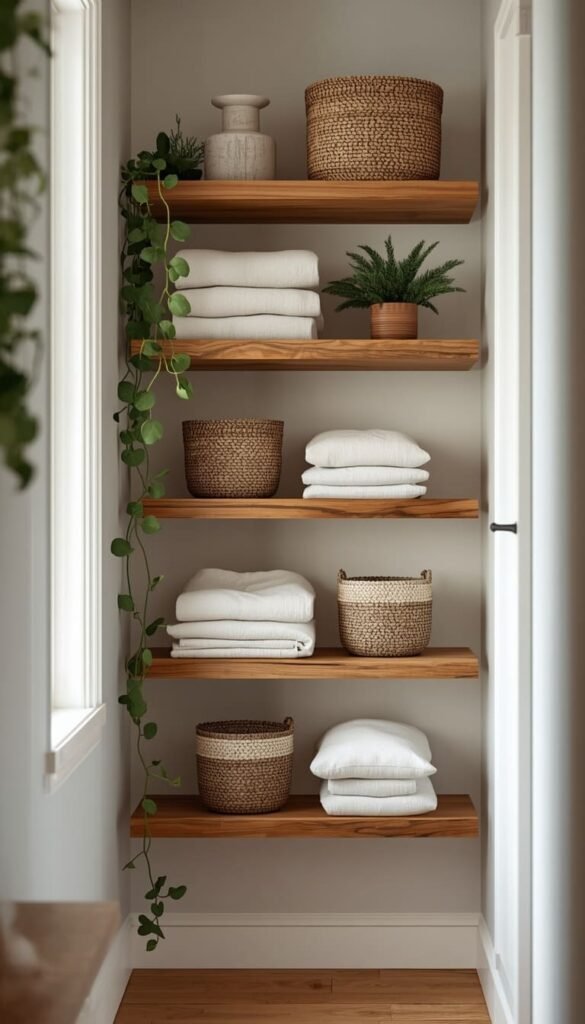
When floor space is gone, the wall becomes your best real estate. I always tell my clients to stop thinking about their tiny bedroom horizontally and start looking up. Floating shelves installed at eye level and above pull the eye upward, which immediately makes the ceiling feel higher than it actually is.
In rooms under 120 square feet, I typically recommend two to three shelves stacked between 12 and 18 inches apart on the wall opposite the bed. Keep the bottom shelf at around 60 inches from the floor. This leaves your lower wall clean and open, which is exactly what a tiny space needs to breathe.
One thing to watch out for here open shelves collect dust fast in a small room because air circulation is limited. If you are not someone who tidies regularly, mix in a few small baskets or bins on the shelves to contain the clutter without closing everything off behind cabinet doors.
2. Ditch the Bulky Bed Frame and Try a Metal or Platform Bed
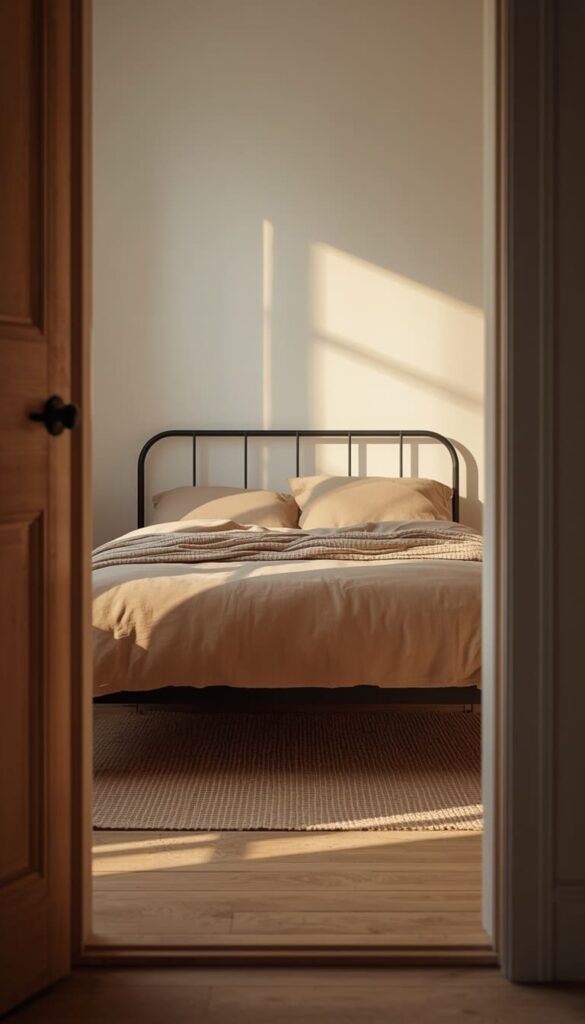
This is one of the first swaps I recommend and honestly one of the most impactful. A thick upholstered bed frame with a tall padded headboard can visually eat up a third of a small room before you’ve added a single accessory. The physical size of the bed doesn’t change but the visual weight is dramatically different depending on the frame you choose.
Metal frames with thin profiles let the eye travel past the bed and around the room. Platform beds sit low to the ground, which makes the ceiling feel taller by contrast. Both options work beautifully in a tiny bedroom.
- A metal bed frame with a simple headboard typically runs between $180 and $450
- A low-profile platform bed starts around $300 and goes up based on material
- Both options leave more visible floor space, which is what creates the feeling of openness
If you love the look of an upholstered headboard, you don’t have to give it up entirely. Just go for a slim, wall-mounted headboard panel instead of a full frame. You get the softness without the bulk.
3. Use a Murphy Bed or Daybed for a Tiny Apartment Bedroom
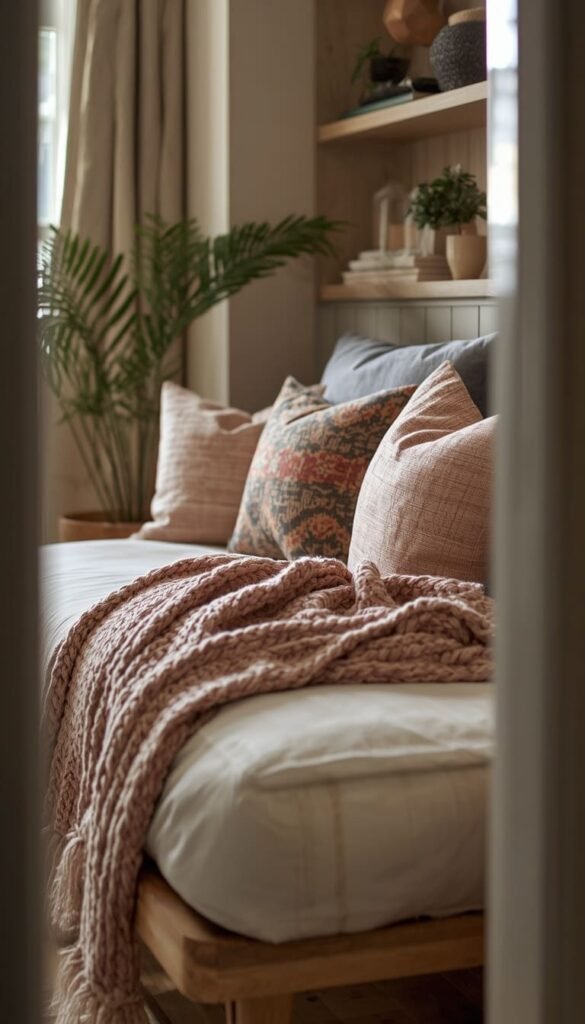
If your tiny bedroom is pulling double duty as a home office or a guest room, this idea changes everything. A Murphy bed folds flat against the wall during the day and turns that same space into a fully functional work area or sitting room. I’ve used this solution in several New York City studio projects and the transformation genuinely shocks people every time.
Daybeds are a slightly softer version of the same idea. They read as a sofa during waking hours and convert to a sleeping space at night with minimal effort. For tiny guest bedrooms especially, a daybed styled with Euro pillows and a throw blanket looks polished and intentional rather than makeshift.
A quick note on budget you do not need to spend $2,000 on a Murphy bed system. Brands like Wayfair and IKEA carry wall bed kits that come in under $700 and install with basic tools over a weekend. The more expensive custom versions are worth it only if the room demands a fully built-in look.
4. Color Drench the Whole Room in One Cozy Hue
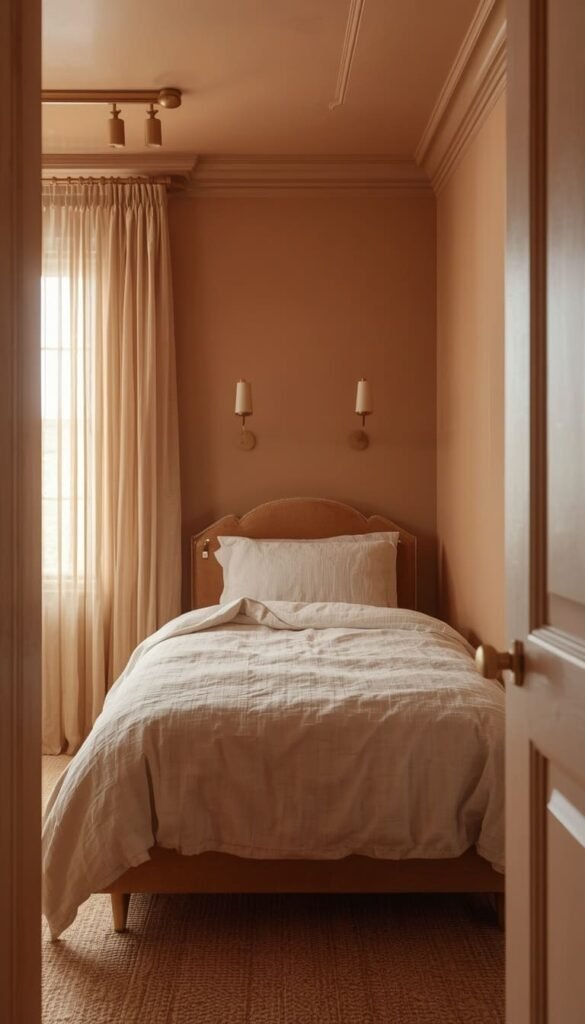
Color drenching is the single most underused trick in tiny bedroom design and I will stand behind that statement confidently. Painting the walls, ceiling, and even the trim in the same shade removes all the visual breaks in the room. Those breaks where one color ends and another begins are actually what make a small room feel chopped up and smaller.
When everything flows in one continuous hue, the eye doesn’t stop and measure. It just moves through the space.
My go-to shades for tiny bedrooms right now:
- Benjamin Moore Pale Oak for a warm, sandy neutral that feels luxurious without being boring
- Sherwin Williams Worn Turquoise for clients who want personality without going too bold
- Benjamin Moore Advance in Hale Navy for a cozy, cocoon-like effect that photographs beautifully
One reality check worth mentioning very bright white on all surfaces in a tiny room can actually feel harsher and more clinical than a soft mid-tone. White works, but only when it has warmth in its undertone. Cool, stark whites in a small bedroom tend to highlight every imperfection in the walls rather than softening the space.
Top 6 Tiny Bedroom Ideas:
| Idea | Estimated Price | Maintenance |
|---|---|---|
| Platform or Metal Bed Frame | $180 – $450 | Low |
| Wall Mounted Sconce and Shelf Combo | $120 – $175 per side | Low |
| Under Bed Storage Bed | $300 – $1,200+ | Medium |
| Ceiling Height Curtains | $80 – $200 total | Low |
| Peel and Stick Accent Wall | $80 – $270 total | Medium |
| Layered Lighting Setup | $150 – $400 total | Low |
5. Swap Your Nightstand for a Wall Mounted Sconce and Shelf Combo
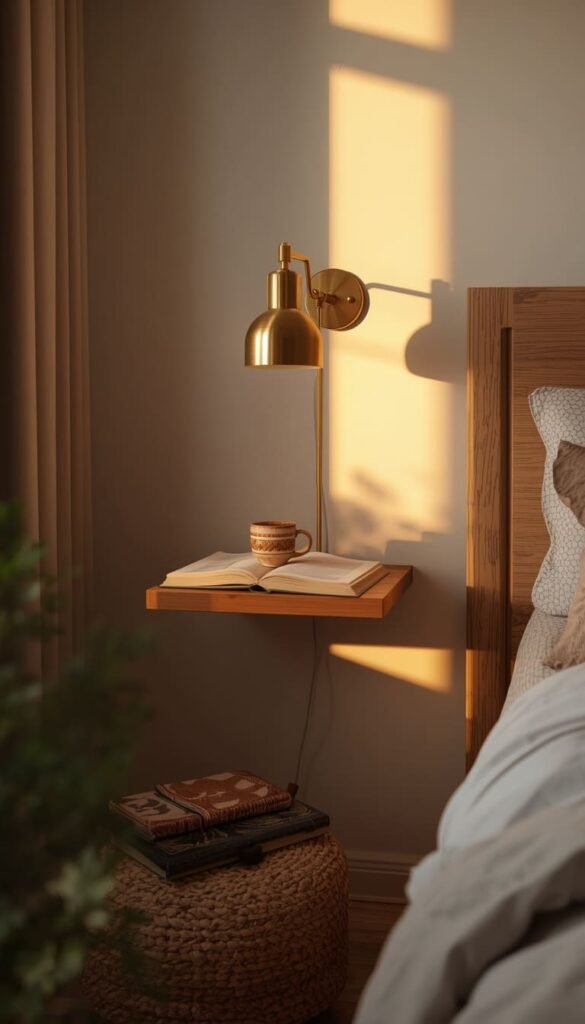
This is one of those changes that sounds small but completely reshapes how a tiny bedroom feels. A standard nightstand takes up roughly 18 to 24 inches of floor real estate on each side of your bed. In a room where every inch is doing double duty, that’s a lot to give up for a surface that holds a lamp, a glass of water, and whatever you’re currently reading.
Replacing it with a wall mounted shelf about 10 to 12 inches deep and a swing arm sconce above it gives you the same function with zero footprint. The floor stays open. The room breathes.
A quick trick I’ve learned from doing this repeatedly: install the shelf at roughly 28 to 30 inches above your mattress top. That puts it in easy reach without stretching, and it keeps the sconce at a comfortable reading height. Brass and matte black are the two finishes I reach for most in this context. Both look intentional rather than afterthought.
Brass swing arm sconces: $60 to $120 each at most home stores Wall mounted floating shelves: $25 to $55 depending on material Total swap cost per side: under $175, and the room instantly looks more designed
6. Hang Curtains at Ceiling Height to Fake a Taller Room
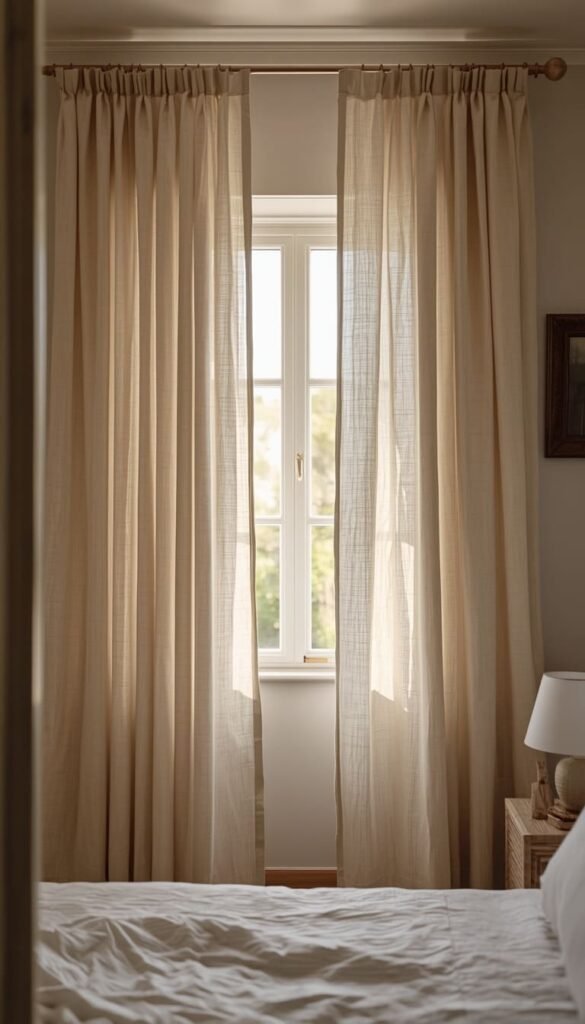
Most people hang curtain rods about four inches above the window frame. I understand why it feels like the obvious place. But in a tiny bedroom, that placement is quietly making your ceiling feel lower and your room feel boxier than it needs to.
The fix is almost embarrassingly simple. Mount your rod as close to the ceiling as possible, even if your window is small. Let the curtain panels drop all the way to the floor. What this does is draw the eye on a long vertical line from top to bottom, and the brain reads that as height.
The window itself doesn’t need to be large for this to work I have used this technique in rooms with a single 24-inch wide window and the effect was still significant. Go for panels in a solid color or a very subtle texture. Patterns break the vertical line and reduce the effect. Linen and cotton blends in soft whites, warm taupes, or dusty greens are my most-reached-for options for tiny rooms specifically.
One thing to watch for: make sure your panels are at least 1.5 times the width of the window, ideally double. Flat, undersized curtains look skimpy and actually shrink the room visually rather than opening it up.
Which of these ideas feels most doable for your bedroom right now the accent wall or the lighting swap?
7. Add a Large Mirror Strategically Not Just Anywhere
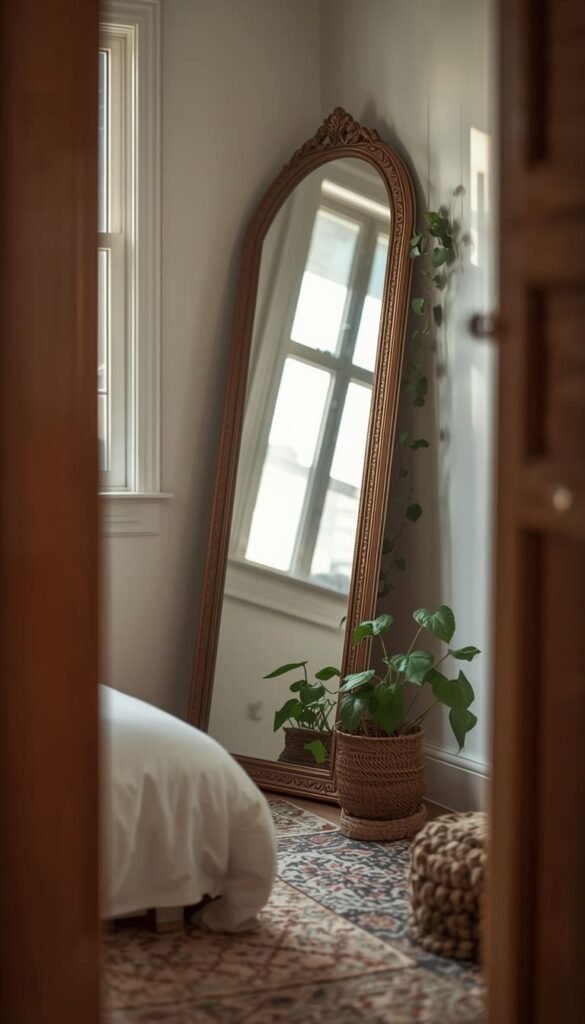
Mirrors in small bedrooms are incredible when placed correctly. The problem is most people treat a mirror like a decoration and lean it wherever there happens to be a wall. That approach misses the actual purpose, which is to reflect light and create perceived depth.
The placement that consistently delivers the most impact: directly across from your window. When a large mirror faces natural light, it bounces that light back across the room and effectively doubles the brightness. On a gray winter morning, that one positioning decision can make a small bedroom feel dramatically different.
I’ve noticed that leaning a floor mirror slightly forward instead of flat against the wall also helps. It reflects the floor rather than just the opposite wall, and floors reflect light more than walls do in most bedrooms. That forward tilt adds warmth and dimension simultaneously.
What doesn’t work and I see this constantly is placing a mirror on the wall behind the door, or tucked into a corner where it catches nothing but shadows. A mirror in the dark is just a dark rectangle. Position it to catch something worth reflecting: light, a green plant, an interesting architectural detail.
8. Build a Cozy Bed Nook or Alcove Effect on a Budget
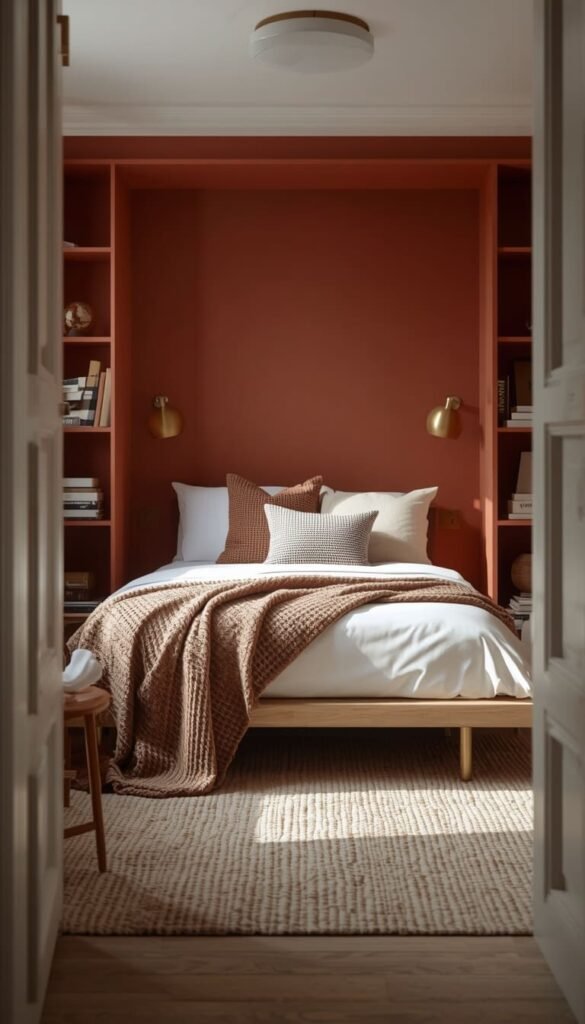
A bed nook transforms a tiny bedroom from a room that just has a bed in it into a room that was designed around the bed. It creates the sense that your sleeping space was intentionally crafted, even if your square footage is modest. And it photographs beautifully, which let’s be honest is a bonus.
The good news is you don’t need a contractor or a custom built-in to achieve this effect. I’ve helped clients create convincing alcove vibes using three IKEA KALLAX units positioned behind and on both sides of a bed, then painted to match the wall color behind them. With the right bedding and a few wall-mounted sconces inside the nook, the result looks like a custom installation.
Here’s how I break down what’s worth hiring out versus doing yourself:
Worth DIYing: painting the nook area a contrasting color, installing a canopy or curtain track above the bed, arranging freestanding shelving around the headboard wall
Worth hiring a carpenter for: actual built-in cabinetry with recessed lighting, any structural wall modifications, bespoke millwork with integrated storage underneath
A budget nook setup using IKEA shelving, paint, and simple curtain hardware typically runs $300 to $500. A fully custom built-in starts around $1,800 and climbs quickly from there. Both look beautiful the custom version just lasts longer and adds to resale value.
9. Use Under Bed Storage the Right Way
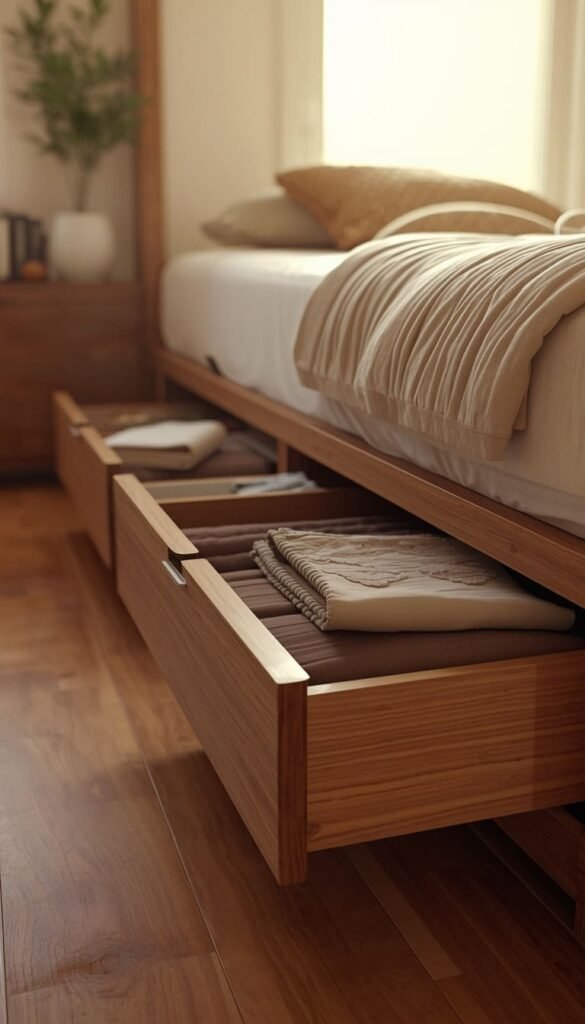
Under bed storage sounds obvious, but most people either ignore it completely or stuff random bins under there and forget about them for six months. Done intentionally, the space under your bed is some of the most valuable square footage in a tiny bedroom easily equivalent to a full dresser drawer set if you approach it with a plan.
The two approaches I recommend are lift-up platform beds and low-profile rolling drawers. Lift-up beds work on a hydraulic hinge system that raises the entire mattress and reveals a large open cavity underneath. These are ideal for bulky seasonal items: extra blankets, luggage, off-season clothing. Rolling drawer beds are better for things you access regularly because you don’t have to lift the mattress each time.
Here is how I break it down by budget:
$300 range: Basic platform beds with two pull-out drawers on one side. Brands like Zinus and Prepac are reliable at this tier. Drawer depth is usually shallow good for folded clothing, not bulky items.
$700 range: You start getting drawers on both sides plus a sturdier frame. This is the sweet spot for most buyers. Wayfair and Birch Lane carry solid options here that don’t look cheap.
$1,200 and above: Full hydraulic lift beds with deep storage capacity. The whole floor of the cavity is usable. Worth the investment if you have zero closet space or are furnishing a tiny apartment bedroom long-term.
One thing I always tell clients: whatever storage bed you choose, use vacuum storage bags inside for seasonal items. You can triple the usable capacity instantly and everything stays clean and compressed.
10. Try a Bold Accent Wall Instead of Redecorating the Whole Room
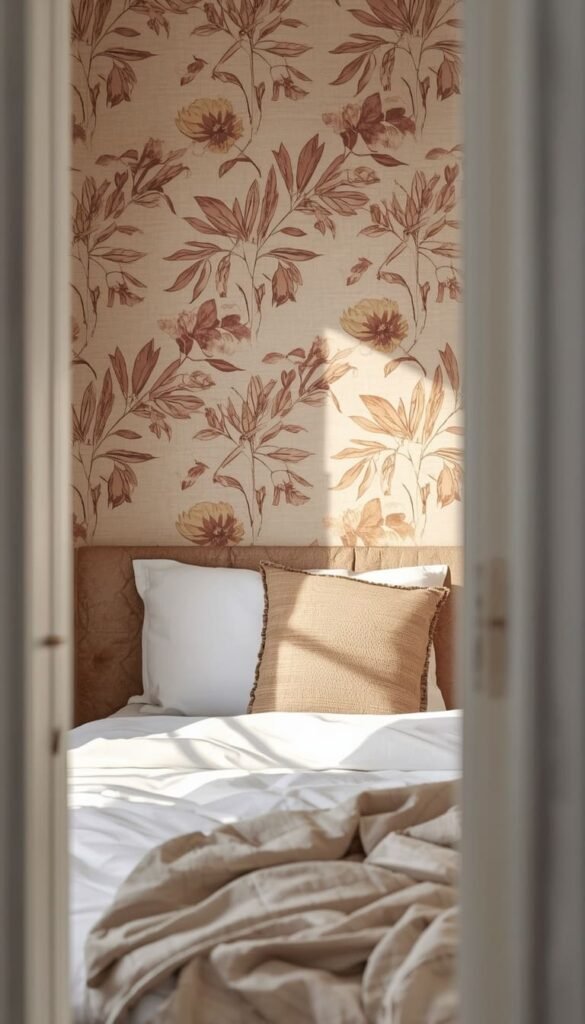
If you are renting, or if you just want to test a look before committing to it fully, a single accent wall is one of the most efficient things you can do in a tiny bedroom. It adds personality, creates a focal point, and costs a fraction of what a full room redesign would run.
The wall behind the bed is almost always the right choice. It frames the bed visually, makes the headboard feel intentional, and draws attention exactly where you want it in a small room.
Peel and stick wallpaper has genuinely improved over the past few years. The quality gap between removable and traditional wallpaper has closed significantly. My current favorites for tiny bedrooms:
Chasing Paper and Tempaper both carry dense, matte-finish patterns that read as premium from across the room. Rifle Paper Co. has a removable line with botanical prints that work especially well in small spaces because the organic shapes keep the pattern from feeling claustrophobic. For something more graphic, Spoonflower lets you order custom designs in any repeat size.
Budget reality: most peel and stick options run between $40 and $90 per roll, and an average accent wall behind a queen bed takes two to three rolls. You are looking at $80 to $270 total for a transformation that takes a Saturday afternoon and zero tools beyond a squeegee.
11. Go for a Tonal Single Color Palette to Make the Room Feel Bigger
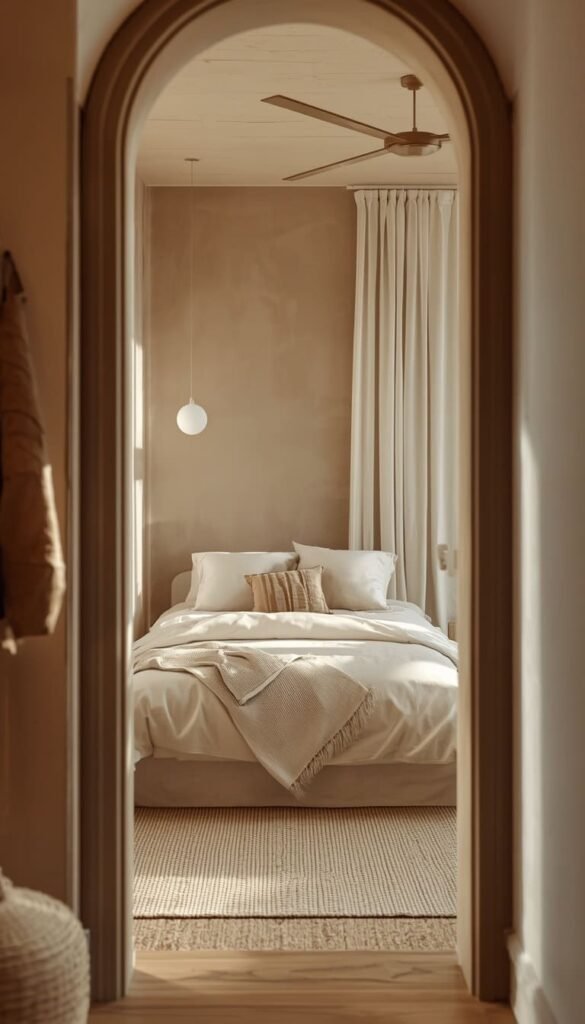
This is the idea that gets the most pushback from clients and delivers the most dramatic results once they try it. A tonal palette means keeping your walls, bedding, curtains, and major surfaces all within the same color family varying only in lightness and texture rather than jumping between different hues.
The reason it works in tiny bedrooms comes down to visual interruption. Every time your eye hits a strong color contrast, it stops and registers that boundary as an edge. Edges define the limits of a space. More edges mean a room reads smaller. A tonal palette removes most of those interruptions and lets the eye move continuously around the room, which makes the space feel uninterrupted and therefore larger.
I used this approach in a 95-square-foot studio bedroom in Chicago. Warm greige walls, natural linen bedding, cream curtains, and a jute rug. The room was objectively tiny. But it photographed like a Scandinavian vacation rental and my client reported that she stopped feeling anxious every time she walked into it. That psychological dimension how a room makes you feel is just as real as the square footage.
The textures are what keep a tonal room from feeling flat. Linen, waffle-weave, matte paint, and natural wood all absorb light differently. That variation is what gives the room depth without introducing contrasting colors.
12. Layer Lighting With Sconces Fairy Lights and One Statement Piece
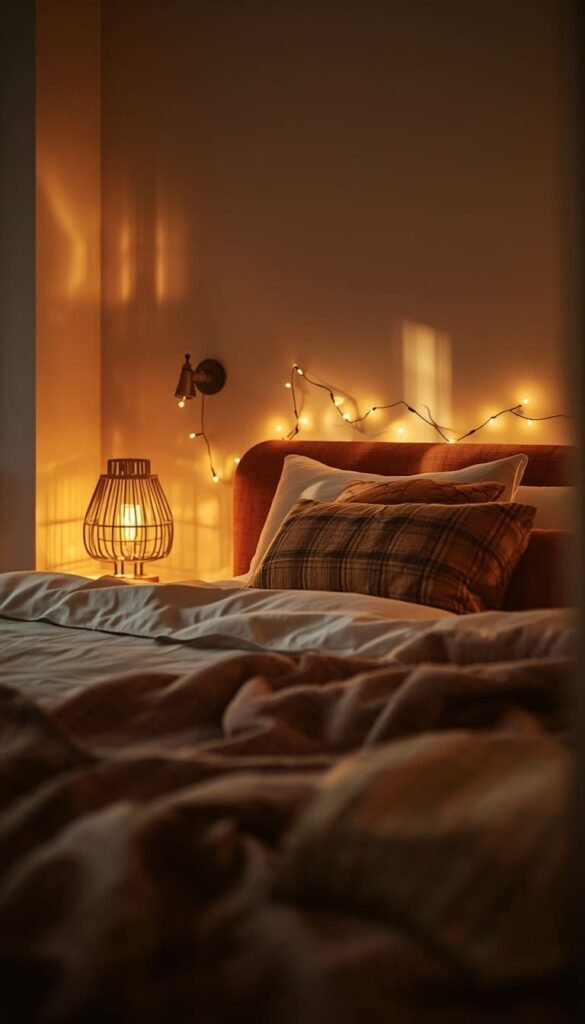
Walk into most tiny bedrooms and you will find a single overhead fixture a flush mount or a bare bulb in the center of the ceiling doing all the work. I understand why. It is the default. The builder put it there and nobody questioned it.
But overhead light in a small room is genuinely one of the worst choices you can make for how the space feels. It casts flat, even light that removes shadows and dimension. Without shadows, a room looks flatter, smaller, and more institutional.
Layered lighting is the fix. Here is how I structure it in a tiny bedroom:
Ambient layer: Swap the overhead fixture for something with a dimmer. Even a basic ceiling light on a dimmer immediately gives you more control over the room’s mood.
Task layer: Wall mounted sconces on each side of the bed handle reading light. This also frees up your nightstand or shelf surface completely.
Accent layer: This is where the room gets personality. Fairy lights tucked behind a headboard or along a ceiling edge add warmth without taking up any visual space. A single statement floor lamp in a corner something with an interesting silhouette reads as decor and light source simultaneously.
A quick reality check on fairy lights specifically: the warm white versions (2700K or lower) are what you want. Cool white fairy lights in a bedroom look clinical and cheap rather than cozy. The color temperature matters more than the brand.
Total cost for a full three-layer lighting setup in a tiny bedroom runs between $150 and $400 depending on the sconces you choose. It is one of the highest-ROI investments you can make in a small space.
13. Use a Room Divider or Curtain Panel in a Tiny Studio Bedroom
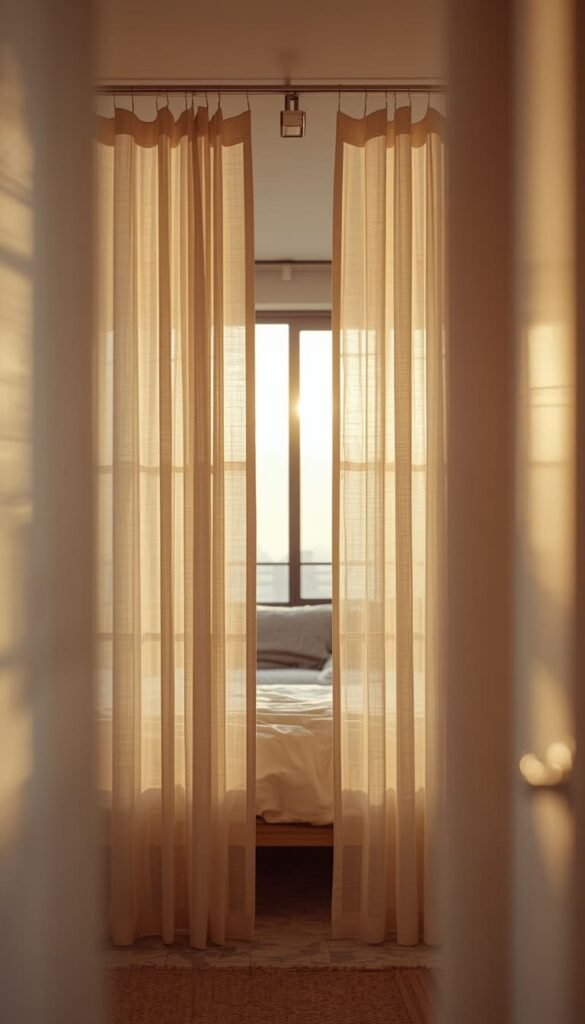
This one is specifically for anyone living in a studio apartment or an open-plan space where the sleeping area blurs into everything else. The psychological impact of having no defined boundary around your bed is real it makes it harder to wind down at night and harder to feel like your home has distinct zones. A room divider solves that without requiring walls, permits, or a landlord’s approval.
The approach I recommend most consistently is a ceiling-mounted curtain track. You install a simple track directly into the ceiling joists and hang floor-length panels that slide open and closed as needed. During the day, the panels stack neatly to one side and the space feels open. At night, you close them and your sleeping area becomes its own quiet cocoon.
The material you choose here matters more than most people realize. Heavy, opaque fabrics like velvet or blackout linen create true visual separation and block light ideal if your partner keeps different hours or if city lights come through your windows. Sheer or semi-sheer panels give you a sense of separation without making the divided area feel closed off or dark. For small studio bedrooms especially, I lean toward sheers in a warm white or soft ivory because they diffuse light beautifully rather than blocking it.
Freestanding room dividers are the rental-friendly alternative when ceiling mounting is not an option. Rattan and cane screens are having a real moment right now and they double as decor. Just make sure whatever you choose is at least 68 to 72 inches tall anything shorter reads as a decorative accent rather than an actual partition and does not give you the privacy effect you are after.
Budget range for ceiling-mounted curtain track systems: $80 to $200 for the hardware, plus the cost of panels. A freestanding rattan divider runs $120 to $350 depending on width and quality.
And what is the one thing about your tiny bedroom that bothers you the most every single day?
14. Add One Statement Furniture Piece and Keep Everything Else Simple
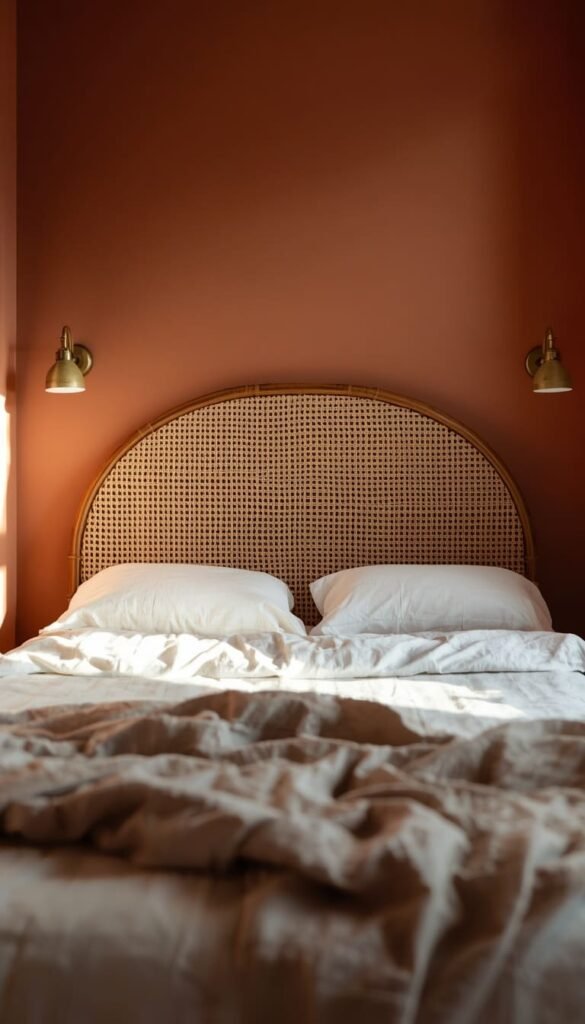
Every tiny bedroom I have ever designed that felt genuinely memorable had one thing in common one piece of furniture that did all the talking and everything else that quietly supported it. I call this the hero piece rule and it is probably the single most useful editing principle I can give you for a small space.
The hero piece earns its title by having strong visual character. It might be a vintage cane headboard that you found at an estate sale for $80. It could be an antique dresser in a deep walnut finish surrounded by pale walls. A bold sculptural floor lamp in a corner. An upholstered bench at the foot of the bed in a rich jewel tone. Whatever it is, it should stop people when they walk in.
Here is why this works so well in a tiny bedroom specifically. Small rooms cannot absorb visual competition. When three or four pieces are all trying to be interesting at the same time, the room feels chaotic and cluttered even if it is technically organized. One strong hero piece with calm, simple supporting pieces around it gives the eye a clear place to land and then relax.
What supporting pieces should look like in practice:
Simple platform or metal bed frame in a neutral finish if the headboard is not the hero Plain white or natural linen bedding so the hero piece reads clearly against it Unobtrusive storage closed drawers, baskets with lids, built-ins painted to match the wall Minimal surfaces one small shelf or floating ledge rather than multiple competing tabletops
I worked with a client in Denver who had a 105-square-foot bedroom and was convinced she needed to gut the whole space. All we did was bring in one vintage rattan headboard, paint the walls a warm clay, and edit out two pieces of furniture that were fighting for attention. The room felt twice as large and completely intentional. She spent $340 total.
The tiny bedroom that looks the most designed is almost never the one with the most in it. It is the one where someone made a decision about what mattered and had the discipline to stop there.
The 2-Minute Decision Map
By Budget
Starter Budget — Under $300
- Rearrange furniture first — it costs nothing and changes everything
- Swap your bed frame for a metal or platform option ($180 – $450)
- Add ceiling-height curtains to fake more height ($80 – $200)
- Try peel-and-stick wallpaper on the accent wall behind your bed ($80 – $270)
- Replace your nightstand with a wall-mounted sconce and shelf ($120 – $175 per side)
Investment Budget — $500 and Above
- Upgrade to a storage platform bed with hydraulic lift ($700 – $1,200+)
- Install a custom Murphy bed for a studio or guest room ($700 – $2,000)
- Build a bed nook with IKEA shelving and paint ($300 – $500 DIY) or go fully custom ($1,800+)
- Layer all three lighting tiers — ambient, task, and accent ($150 – $400)
By Lifestyle
Renters and Movers
- Stick to peel-and-stick wallpaper, freestanding dividers, and removable hardware
- Ceiling-mounted curtain tracks are low-damage and fully reversible
- Avoid built-ins — invest in furniture you can take with you
Minimalists
- Apply the hero piece rule — one strong furniture item, everything else neutral
- Go tonal with walls, bedding, and curtains in one color family
- Keep surfaces intentionally bare — one shelf, one lamp, done
Maximalists in Small Spaces
- Layer your lighting fully before adding any more decor
- Use closed storage only — baskets with lids, drawers, built-ins painted to match the wall
- Pick one bold accent wall and resist the urge to do two
Homeowners Playing Long Game
- Invest in a built-in bed nook or custom storage wall
- Choose a hydraulic lift bed for permanent under-bed organization
- Mount sconces directly into the wall for a clean, hotel-quality finish
FAQ
What is the first thing I should do to make a tiny bedroom look bigger?
Start with paint color drenching the walls, ceiling, and trim in one warm tone removes visual breaks instantly. No furniture purchase delivers a bigger impact for less money.
How do I make a tiny bedroom feel cozy without making it feel cluttered?
Pick one hero piece, keep bedding tonal, and layer your lighting. Cozy comes from warmth and intention, not from adding more stuff.
Can a full-size bed fit in a very small bedroom?
Yes, but clearance is everything. You need at least 24 inches on each side to move comfortably if that is not possible, size down to a twin or go with a daybed.
What type of storage works best in a tiny bedroom with no closet?
A hydraulic lift platform bed is the single most efficient solution. It turns the entire footprint of your bed into usable storage without touching any wall space.
How do I make a narrow bedroom look wider?
Hang curtains at ceiling height, use a large mirror opposite the window, and keep the floor as clear as possible. Horizontal stripes on bedding or a rug can also visually push the walls apart.
Conclusion
Your space does not have to be large to feel like the best room in your home. I have seen $400 budgets outperform $4,000 renovations simply because someone made one smart decision and committed to it. Pick one idea from this list just one and do something about it today, even if that means ordering a paint sample or clearing out the junk under your bed.
The bedroom is the first thing you see in the morning and the last thing you see at night. It deserves to feel intentional.
So tell me which idea are you trying first, and what does your biggest tiny bedroom challenge look like right now? Drop it in the comments and I will give you my honest take.
