12 Neutral Earth Tone Bathroom Ideas That Feel Calm & Luxurious
Your bathroom should feel like the most peaceful room in your house and honestly, nothing gets you there faster than a well-executed neutral earth tone palette. I’ve designed and styled dozens of bathrooms across the US, and the ones clients rave about most aren’t the ones with the most expensive tile or the biggest budgets. They’re the ones that feel grounded, warm, and quietly luxurious the moment you walk in. A neutral earth tone bathroom does exactly that it wraps you in the kinds of colors nature already perfected: warm sand, soft clay, weathered stone, and rich wood. In this guide, I’m sharing 12 real, actionable ideas that go way beyond “paint it beige.”
My Design Notes
A few years ago, I worked with a couple in Austin, Texas who had a builder-grade bathroom straight out of 1994 pink-beige ceramic tile, outdated brass fixtures, and a vanity that had seen better days. Their budget was tight at $4,500, and a full gut renovation simply wasn’t on the table. So we leaned hard into earth tones instead. I suggested Benjamin Moore’s Pale Oak on the walls, swapped the hardware for unlacquered brass, and layered in a peel-and-stick travertine-look floor tile right over the existing one. We added a teak bath mat, a few stems of dried pampas grass, and some open linen shelving. Total spend came in at $3,800. When my clients saw the finished room, the wife actually teared up a little. That project stuck with me because it proved something I now tell every single client earth tones don’t need a big budget. They just need intention. That Austin bathroom is honestly what inspired this entire guide.
Stunning Ways to Master the Neutral Earth Tone Bathroom Aesthetic
1. The Warm Greige Foundation
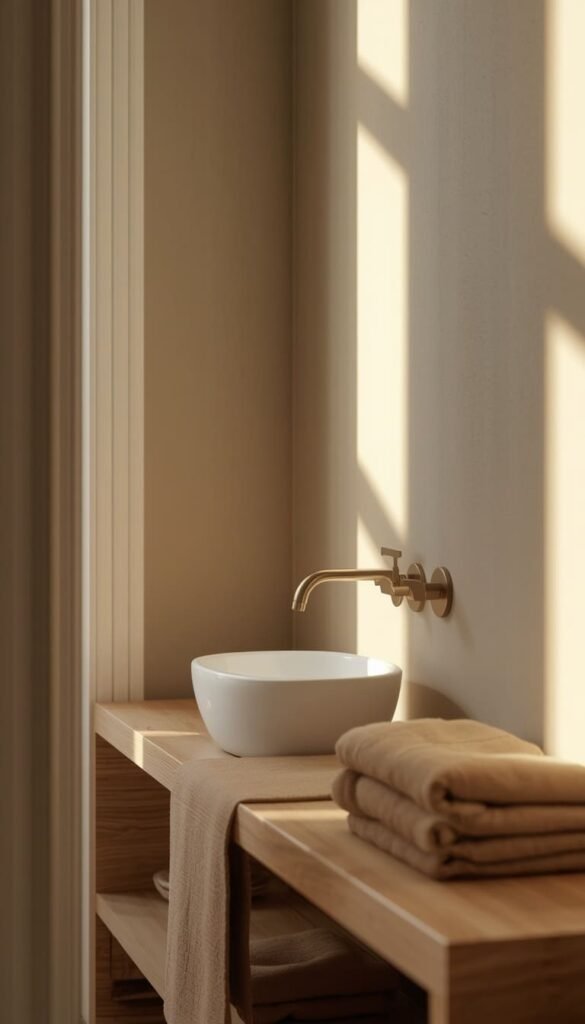
If I had to pick one single color that works in virtually every neutral earth tone bathroom, it would be greige that perfect blend of gray and beige that somehow manages to feel both warm and sophisticated at the same time. Pure white can feel clinical. True beige can feel dated. But greige? It sits right in that sweet spot where your bathroom feels clean without feeling cold.
I’ve used Benjamin Moore’s Pale Oak and Sherwin-Williams’ Accessible Beige more times than I can count, and both perform beautifully under different lighting conditions. Pale Oak leans slightly pink-warm in natural light, which is lovely. Accessible Beige goes a little more golden in the evening, which feels incredibly cozy.
A quick trick I’ve learned over the years always test your greige paint sample on at least two different walls before committing. North-facing bathrooms pull the gray out of greige, and south-facing ones amplify the warmth. Same paint, completely different result depending on where your windows sit.
2. Terracotta Tile Accent Wall
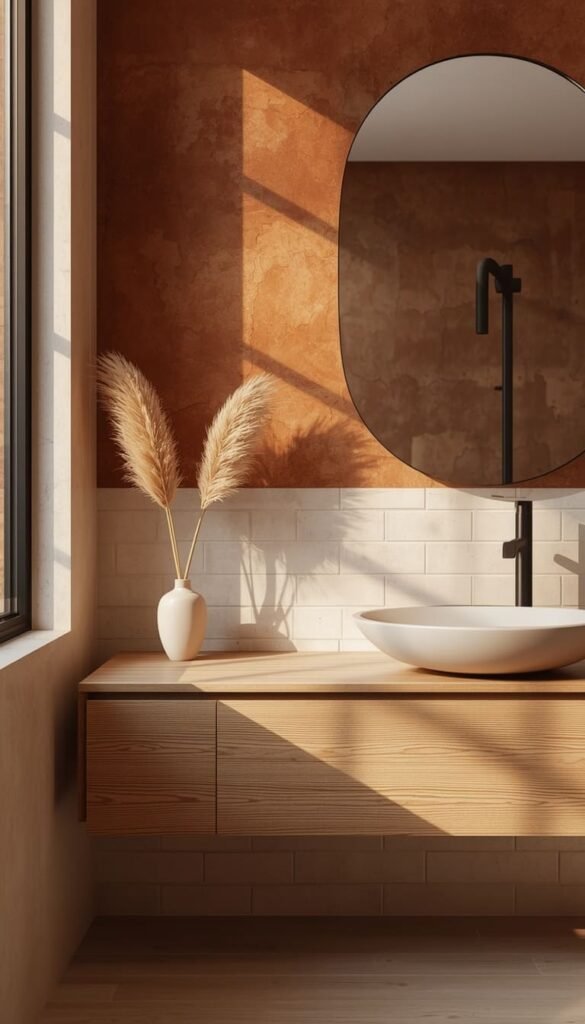
Terracotta is having a serious moment right now, and honestly, I don’t see it slowing down. This warm, clay-inspired tone brings an organic richness to bathrooms that no other color quite replicates. Used as an accent wall behind the vanity or inside the shower niche, it instantly becomes the visual anchor of the entire room.
One thing to watch out for is overcommitting. Full terracotta floor-to-ceiling can feel heavy and overwhelming, especially in smaller bathrooms. The sweet spot is one featured wall let everything else around it stay soft and neutral.
Here’s how I typically approach a terracotta accent wall with clients:
- Pair it with creamy white grout — bright white grout makes terracotta pop without competing
- Balance with natural wood tones — a light oak vanity alongside terracotta feels incredibly organic and collected
- Keep fixtures simple — matte black or unlacquered brass both work beautifully here
Budget-wise, handmade terracotta-look ceramic tiles typically run between $8 and $18 per square foot, which is very reasonable for the impact they deliver.
3. Wood Vanity and Stone Sink Combo
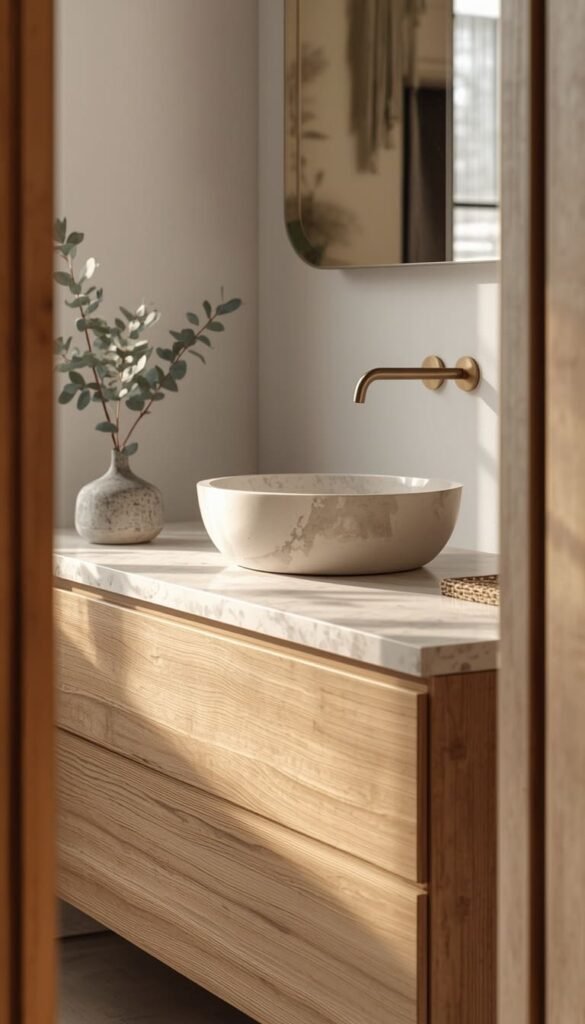
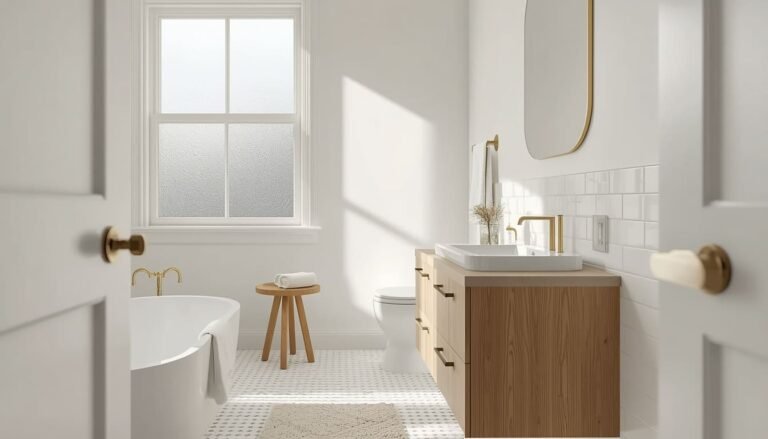
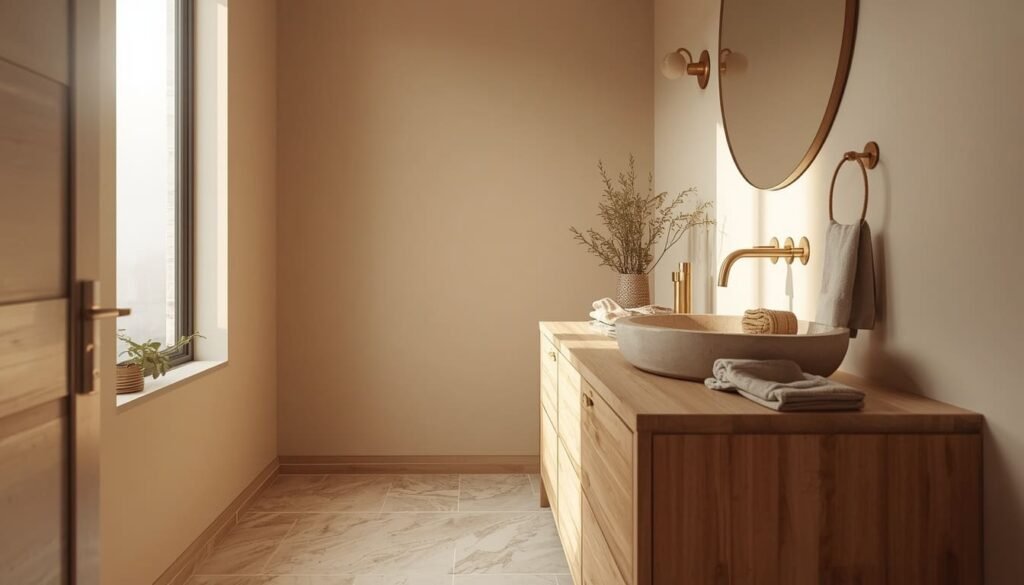
This is what I call the Organic Modern formula, and it is genuinely one of my favorite combinations to execute in a neutral earth tone bathroom. There’s something almost effortless about the way warm wood grain and cool stone complement each other they feel collected and intentional without looking like a showroom display.
The key is contrast. A light white oak vanity paired with a honed travertine or concrete vessel sink creates that push-pull of warm and cool that makes a bathroom feel designed rather than just decorated. If both elements are too similar in tone, the whole thing falls a little flat.
What makes this combo work so well is texture. Wood has grain. Stone has veining. Together they create visual depth that a painted vanity simply cannot replicate. I always tell clients if you’re going to splurge anywhere in a neutral bathroom remodel, make it the vanity and sink combination. It’s the first thing you see every morning, and it sets the tone for the entire space.
A realistic budget for a solid wood vanity with a stone sink sits between $900 and $2,200 depending on size and material. It’s an investment, but it’s the kind of thing that photographs beautifully and holds its appeal for decades.
4. Limewash and Roman Clay Walls
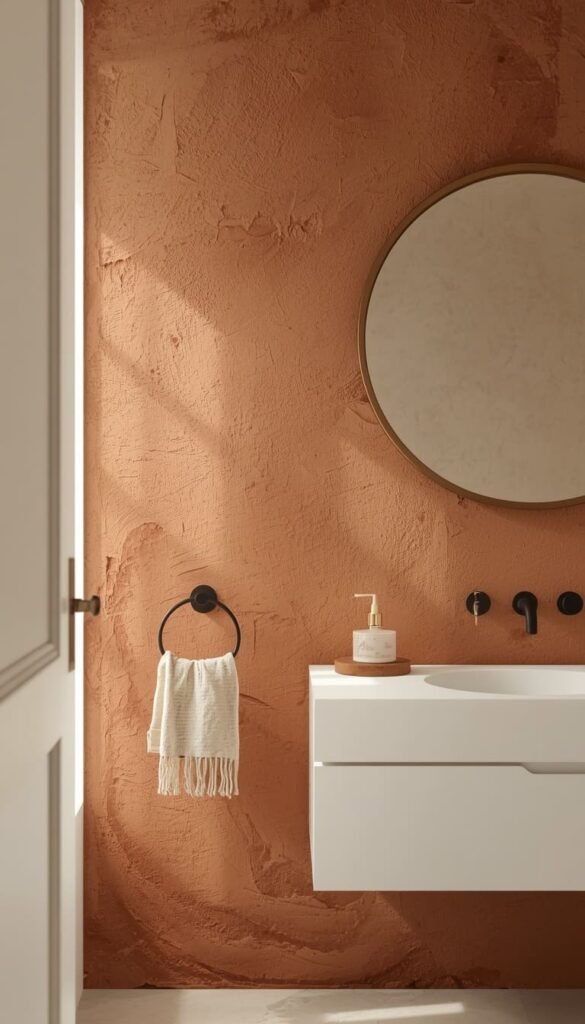
If you’ve been scrolling through interior design accounts lately, you’ve definitely seen limewash and Roman clay walls popping up everywhere and for good reason. These textured wall finishes bring a depth and warmth to a neutral earth tone bathroom that flat paint simply cannot compete with. The way light moves across a limewashed wall throughout the day is genuinely beautiful to watch.
Roman clay, like the popular Portola Paints line, gives you a smoother, more polished finish that works especially well in modern and Japandi-inspired bathrooms. Limewash leans more rustic and aged, which feels right at home in farmhouse or Mediterranean-style spaces.
Now, the reality check nobody tells you upfront not every limewash or Roman clay product is rated for high-humidity spaces. I’ve seen beautiful bathroom walls start to streak and mottle within six months because the wrong product was used near a shower. Always verify that the product you choose is moisture-resistant, and make sure your bathroom has solid ventilation before going this route.
- DIY limewash can cost as little as $80 to $150 for a small bathroom if you’re comfortable with the application technique
- Professional application runs closer to $400 to $900 depending on your region and wall square footage
- Sealing is non-negotiable in any zone within splashing distance of water
Top 6 Neutral Earth Tone Bathroom Ideas:
| Idea | Estimated Price | Maintenance |
|---|---|---|
| Warm Greige Foundation | $80 – $200 (paint + supplies) | Low |
| Terracotta Tile Accent Wall | $8 – $18 per sq. ft. | Medium |
| Wood Vanity and Stone Sink | $900 – $2,200 | Medium |
| Limewash and Roman Clay Walls | $150 – $900 | Medium |
| Sandstone and Travertine Floors | $5 – $25 per sq. ft. | High |
| Spa Style Minimalist Bathroom | $200 – $500 (accessories only) | Low |
5. Sandstone and Travertine Floors
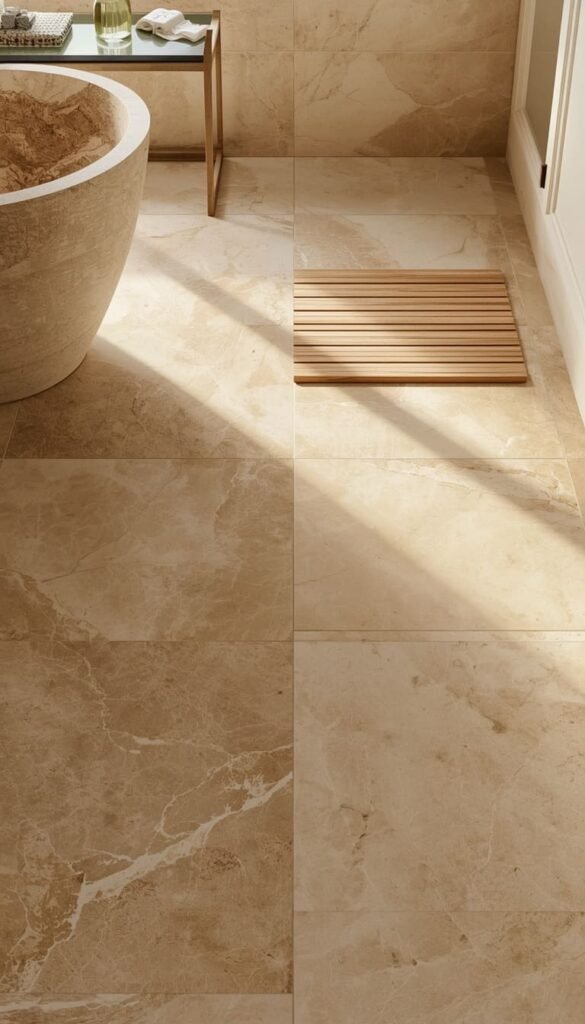
There is something about walking barefoot on a warm travertine floor that feels genuinely luxurious and I say that as someone who has specified tile in well over a hundred projects. Sandstone and travertine bring that ancient, sun-warmed quality to a bathroom floor that porcelain simply cannot fake, no matter how good the printing technology gets.
The tonal variation in natural travertine is what makes it so special. No two tiles are identical. You get creams, warm tans, soft russets, and occasional hints of gold all moving together across the floor. In a neutral earth tone bathroom, that natural variation does a lot of the decorating work for you.
One thing to watch out for here is sealing. Travertine is a porous stone, and an unsealed travertine floor in a wet bathroom will absorb water, soap scum, and bacteria over time. It will stain. I’ve walked into bathrooms where the homeowner skipped sealing to save a little money, and the floors looked aged and dirty within two years. Seal it on installation, and reseal every 12 to 18 months it takes about an hour and costs almost nothing.
Budget reality: natural travertine tile runs between $5 and $25 per square foot for the material alone. Sandstone sits in a similar range. If that feels steep, porcelain travertine-look tile has gotten remarkably good and comes in closer to $3 to $8 per square foot without the maintenance demands.
6. Muted Olive and Linen Neutral Boho
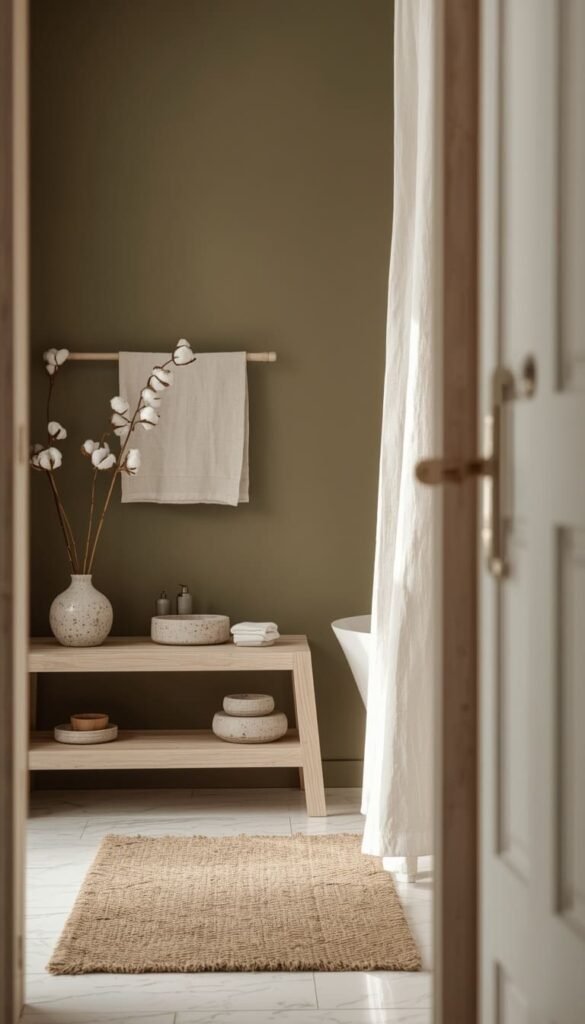
The neutral boho bathroom is one of those aesthetics that looks effortlessly casual but actually requires a pretty intentional hand to pull off well. Get it right and it feels like a beautifully curated retreat. Get it wrong and it starts to look cluttered and chaotic which is the opposite of what a calming earth tone bathroom should feel like.
My personal rule for neutral boho spaces is what I call the three-texture rule: pick three distinct textures and let them do all the work. In a bathroom context, that might look like woven jute, honed stone, and raw linen. Or weathered wood, matte ceramic, and chunky cotton. Three is enough. More than three and the eye doesn’t know where to land.
Muted olive green is the color that makes this aesthetic sing. It reads as a neutral in most lighting conditions but carries just enough personality to prevent the space from feeling washed out. Pair olive walls or accents with:
- Natural linen window treatments or shower curtains — even a simple linen curtain elevates the whole room
- Handthrown ceramic accessories — soap dishes, toothbrush holders, and small planters in creamy or speckled finishes
- Dried botanicals — pampas grass, dried eucalyptus, or cotton stems in a simple vase near the tub
Keep the foundation clean and the layers organic, and this aesthetic lands beautifully every single time.
Which earth tone are you most drawn to warm terracotta or calm greige?
7. Dark Moody Earth Tones in Umber and Espresso
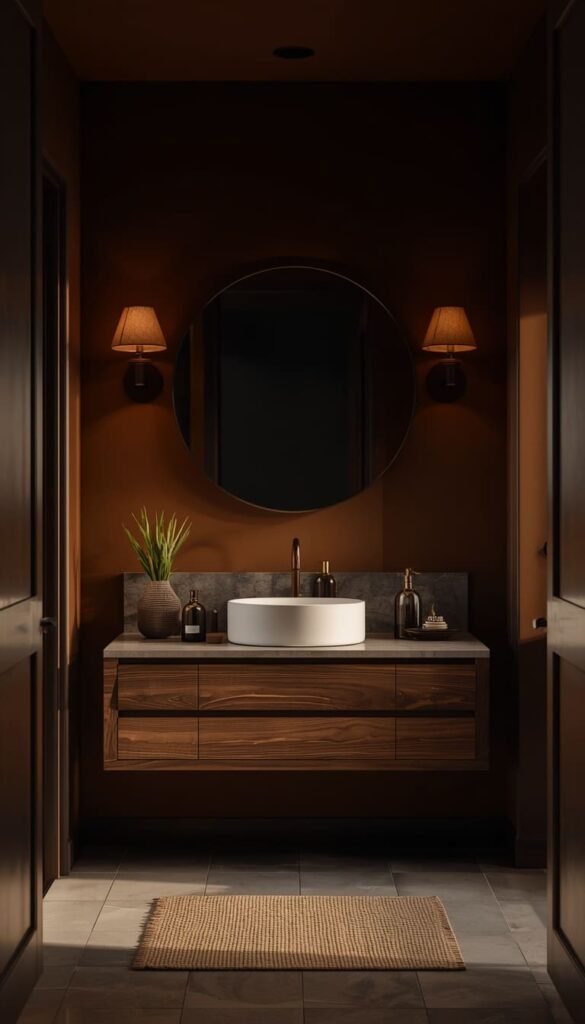
Not everyone wants a light and airy bathroom, and honestly, I respect that completely. There is a particular kind of confidence in a dark, moody neutral bathroom done well rich umber walls, deep espresso cabinetry, and warm bronze fixtures that glow against the darkness. It feels dramatic without being aggressive.
The design challenge with dark earth tones is what I privately call the cave effect. When every surface is pulling dark and warm, the room can start to feel closed-in and heavy rather than cozy and intentional. The fix is always lighting and not just more of it, but the right kind.
In dark earth tone bathrooms, I always push clients toward layered lighting. A single overhead fixture is not enough. You want:
- Warm-toned sconces at eye level on either side of the mirror — this eliminates harsh shadows and keeps skin tones flattering
- Under-cabinet LED strips in a 2700K warm white — they add depth and a soft glow without overwhelming the moody vibe
- A statement pendant or chandelier if ceiling height allows — in a dark room, an interesting light fixture becomes jewelry
Large mirrors are your other best friend in a dark bathroom. They bounce light around the room and create the illusion of depth, preventing that closed-in feeling entirely.
8. Creamy White and Warm Wood with Japandi Influence
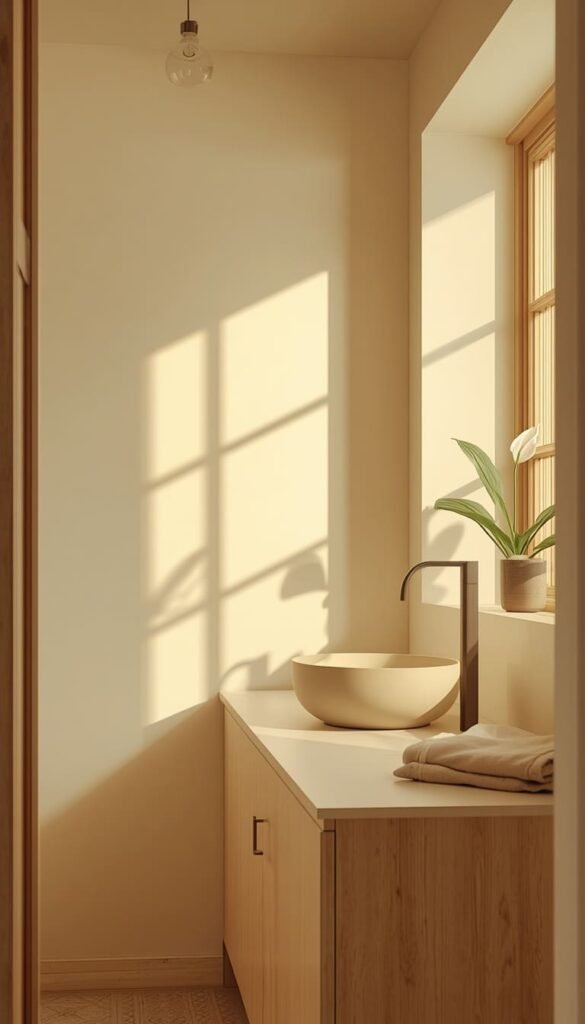
If I had to name the single most requested aesthetic in my practice over the last three years, Japandi would win without question. This Japanese-Scandinavian design philosophy which prizes simplicity, natural materials, and quiet intentionality translates almost perfectly into a neutral earth tone bathroom setting.
The creamy white and warm wood combination is the heart of Japandi bathroom design. We’re not talking stark, cool white here. Japandi whites have yellow or pink undertones think Benjamin Moore’s White Dove or Chantilly Lace warmed up with adjacent wood tones. The wood should be light to medium in tone: white oak, hinoki, or bamboo all work beautifully.
What most people miss when attempting this look is the lighting temperature. Japandi spaces photographed in magazines always feel warm and golden, and that’s not an accident it’s a 2700K bulb doing heavy lifting behind the scenes. Swap out any cool white or daylight bulbs in your bathroom for warm white ones before you do anything else. It costs almost nothing and the difference is immediate and dramatic.
The restraint is what makes this aesthetic feel luxurious. One beautiful ceramic vessel sink. One simple wood vanity with clean lines. One textured linen hand towel. Japandi rewards editing ruthlessly every object in the room should earn its place.
9. Copper and Bronze Hardware as Earth Tone Anchors
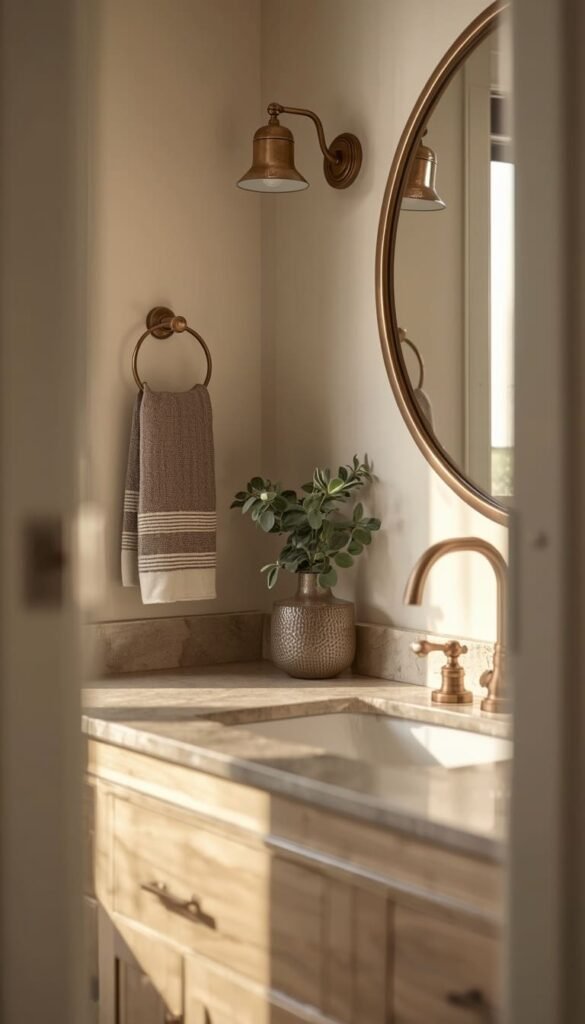
I genuinely believe that hardware is the jewelry of a bathroom, and nowhere is that more true than in a neutral earth tone space. When your walls are soft and your tiles are muted, the fixtures and hardware become the punctuation marks that pull the whole story together. Copper and bronze are, without question, the metals that do this job best in an earthy palette.
What makes copper and bronze so special in these spaces is their warmth. Chrome and nickel have a cool, blue-silver quality that can feel slightly clinical against warm beige and brown tones. Copper and bronze, on the other hand, feel like they belong like they were quarried from the same earth as your travertine floor and your terracotta accent wall.
A quick trick I share with almost every client working on a neutral bathroom remodel you don’t need to replace every fixture to make an impact. Start with the faucet and the towel bar. Those two swaps alone can shift the entire feeling of a bathroom. Add a bronze mirror frame or a copper soap dispenser, and suddenly the room feels cohesive in a way it never did before.
One realistic consideration: unlacquered brass and raw copper will patina over time. Some people absolutely love this it deepens and becomes more characterful with age. Others find it stressful to maintain. If you’re in the second camp, look for PVD-coated bronze or brass fixtures, which hold their finish for years without any special care.
10. Wabi-Sabi Raw Textures in Concrete and Jute
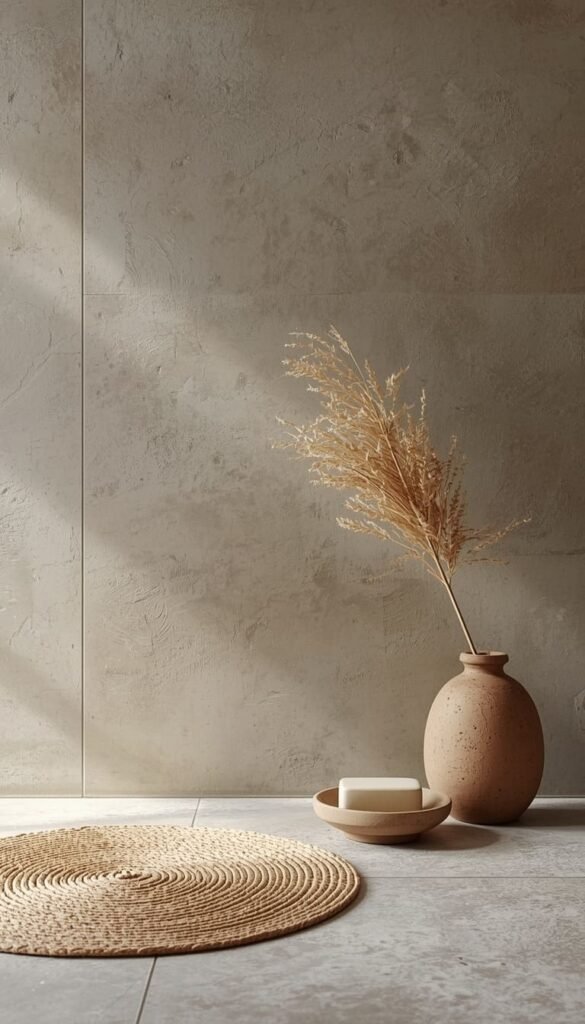
Wabi-Sabi is a Japanese philosophy that finds beauty in imperfection, impermanence, and incompleteness and it translates into bathroom design in the most quietly stunning ways. A raw concrete wall, a jute bath mat, an unglazed ceramic dish sitting on the edge of a stone sink. Nothing is precious. Everything feels real. And somehow, the whole room feels more luxurious for it.
This is one of those aesthetics that genuinely confuses people when they first encounter it, because it looks effortless but requires thoughtful curation. The secret is that every element needs to have authentic texture and material honesty. Faux concrete wallpaper next to a plastic jute-look mat next to a resin “stone” sink that combination reads as cheap no matter how much you spend on it. Commit to real materials wherever possible, even in small doses.
In practice, Wabi-Sabi bathroom elements I come back to again and again include:
- Microtopping or concrete overlay on walls — applied over existing tile or drywall, it costs far less than poured concrete and delivers the same raw beauty
- Handwoven jute or seagrass bath mats — they age gorgeously and feel incredible underfoot
- Unglazed or matte ceramic accessories — nothing shiny, nothing precious, nothing matching
Budget-wise, this is actually one of the more accessible aesthetics on this list. The materials are humble by nature. A fully realized Wabi-Sabi bathroom can come together for well under $1,500 in accessories and surface treatments if you already have a neutral base to work from.
11. Nature-Inspired Greenery Integration
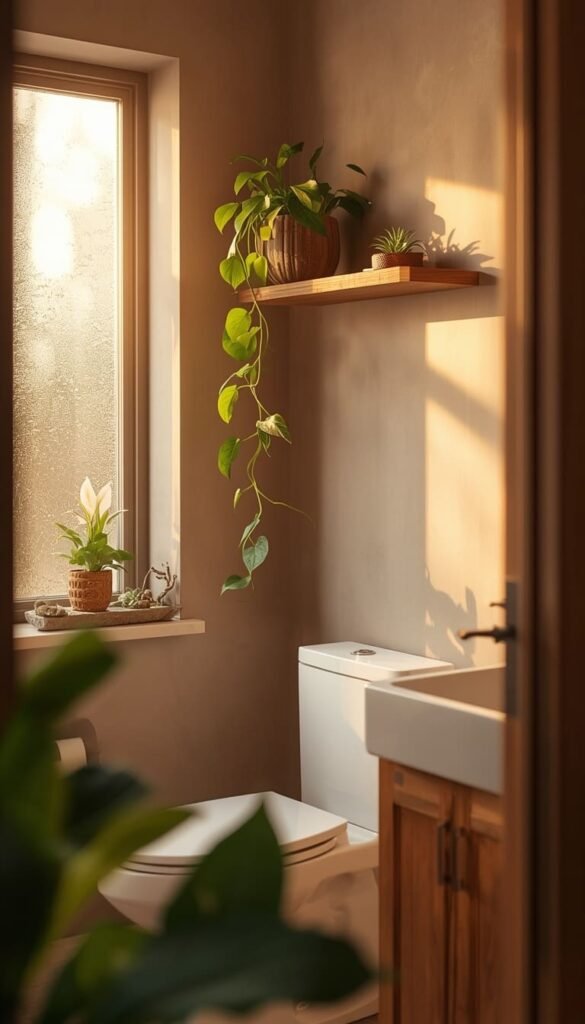
Plants in a bathroom are one of those ideas that sounds obvious until you actually try it and realize your carefully chosen fiddle leaf fig is drooping and yellowing within three weeks. I’ve been there. Most people have. The truth is that not every plant survives bathroom conditions, and choosing the wrong ones is one of the most common styling mistakes I see in neutral earth tone bathrooms.
The good news is that several plants genuinely thrive in bathroom humidity and low light conditions, and they look absolutely beautiful against an earthy neutral backdrop. Pothos, peace lilies, snake plants, and certain ferns are practically made for bathroom living. A trailing pothos on a floating shelf above the toilet, a small peace lily on the windowsill, or a cluster of air plants in a simple stone dish near the sink these additions bring the outside in without requiring a green thumb.
For bathrooms with very little natural light or for anyone who simply doesn’t want to think about plant care, high-quality faux greenery has genuinely improved to the point where it reads as real in most settings. The key is scale and placement one large, well-chosen faux plant looks intentional. Six small plastic ones look like a craft store display. Be selective.
What greenery does for a neutral earth tone bathroom is something no accessory quite replicates it adds a living, organic quality that makes the whole space feel breathed-in and alive rather than staged and still.
And are you working with a tight budget or ready to invest in a full refresh?
12. The Spa Style Minimalist Earth Tone Bathroom
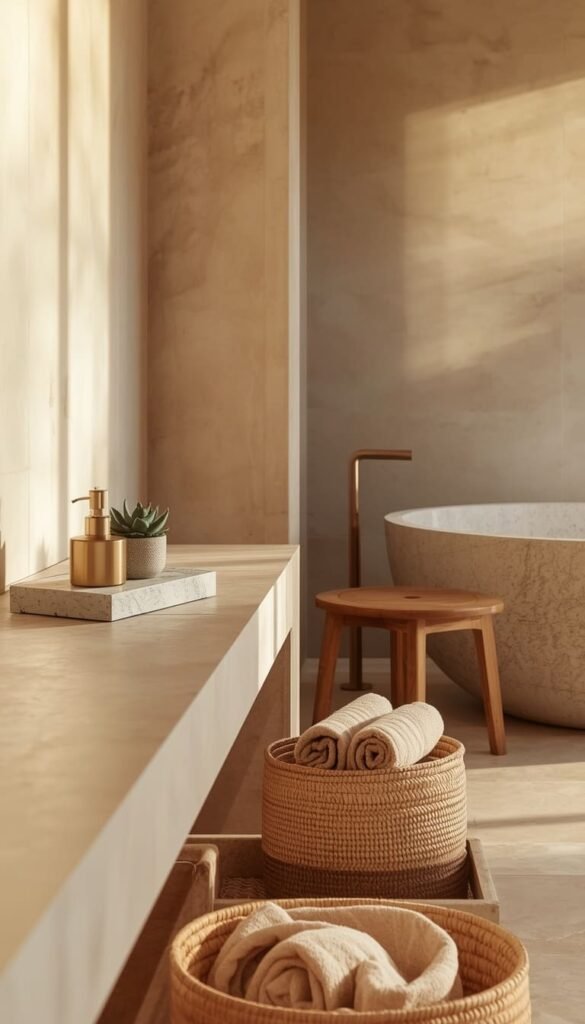
This is the one every single client asks for by name. They show me a photo usually from a boutique hotel in Sedona or a wellness retreat in Vermont and they say “I want my bathroom to feel like this.” And what they’re pointing at, every single time, is a masterclass in restrained, spa-style earth tone design. Warm stone. Warm wood. Warm light. Almost nothing else.
The reason high-end spas feel so luxurious isn’t the price tag on their materials it’s the editing. There is nothing extra. No cluttered countertops. No mismatched towels. No five different wood tones fighting for attention. Every single element is chosen with intention and everything else is removed. That discipline is what creates the feeling of calm luxury, and it’s completely achievable in a residential bathroom on a real budget.
Here’s how I help clients recreate that spa aesthetic without the spa budget:
- Clear the countertop completely — store everything in drawers or a simple cabinet. A single tray with one soap dispenser and one small plant is all that should remain visible
- Invest in two sets of matching, high-quality towels in a warm white or soft sand tone — folded neatly or rolled in a basket, they do more for the room’s feeling than almost anything else
- Switch to a warm white bulb at 2700K around the mirror — spa lighting is never harsh or cool
- Add one natural material element — a teak stool, a stone soap dish, a woven basket for storage — that connects the room back to the earth
The total cost of these four changes? Often under $300. The result feels like a room that costs ten times that. That’s the quiet power of a well-executed neutral earth tone bathroom it doesn’t announce itself. It just makes you exhale the moment you walk in.
Your 2-Minute Earth Tone Bathroom Decision Map
By Budget
Starter and Budget-Friendly (Under $500)
- Greige or limewash paint refresh for instant warmth
- Swap hardware to unlacquered brass or copper
- Add a teak mat, linen towels, and dried botanicals
- Peel-and-stick travertine-look floor tile over existing floors
- Clear the countertop and style with one tray and one plant
Luxury and Investment (Above $1,000)
- Full wood vanity with a honed stone or concrete sink
- Natural travertine or sandstone floor tile with professional sealing
- Roman clay or Portola Paint wall finish applied professionally
- Terracotta handmade tile accent wall with custom grout color
- Layered lighting system with warm sconces and under-cabinet LEDs
By Lifestyle
Busy Families and High-Traffic Bathrooms
- Skip unsealed natural stone go porcelain travertine-look instead
- Choose PVD-coated bronze fixtures that hold their finish without polishing
- Keep accessories minimal fewer items means faster cleaning
- Matte and honed finishes hide water spots far better than polished surfaces
Minimalists and Calm-Seekers
- Lead with the Japandi creamy white and warm wood combination
- One statement material let stone or wood speak on its own
- No more than three visible accessories on any surface
- Spa-style editing is your superpower remove before you add
Small Bathrooms
- Greige walls with large-format travertine-look tile to open the space visually
- One terracotta niche inside the shower instead of a full accent wall
- Wabi-Sabi raw textures add depth without adding visual clutter
- A single oversized mirror doubles perceived space instantly
Open Layouts and Primary Suites
- Go dark and moody with umber or espresso for drama and intimacy
- Layer copper, bronze, and warm wood across multiple zones
- Freestanding stone tub as the anchor build the earth tone palette around it
- Greenery in multiple spots ties the organic modern story together
Frequently Asked Questions
What is the best neutral color for an earth tone bathroom?
Greige is your safest and most versatile starting point. Shades like Benjamin Moore Pale Oak or Sherwin-Williams Accessible Beige work beautifully across different lighting conditions and pair well with wood, stone, and copper accents.
Are earth tone bathrooms going out of style?
No and they won’t anytime soon. Earth tones are rooted in nature, which means they age gracefully rather than feeling trendy and dated two years later.
How do I add warmth to a neutral bathroom without a full renovation?
Swap your hardware to unlacquered brass, add a teak bath mat, and replace cool-white bulbs with 2700K warm white ones. Those three changes alone shift the entire feeling of the room.
Is travertine tile a good choice for bathroom floors?
Yes, but only if you commit to sealing it properly. Unsealed travertine absorbs moisture and stains quickly seal on installation and reseal every 12 to 18 months.
Can a small bathroom pull off dark earth tones like umber or espresso?
Yes, with the right lighting. Layer warm sconces at mirror height, add under-cabinet LEDs, and hang one large mirror darkness becomes cozy rather than cramped.
Conclusion
Your home is the one place in the world that should feel completely, unapologetically yours and your bathroom deserves that same intention. You don’t need a massive budget or a contractor on speed dial to start. Pick one idea from this list that genuinely excites you, and do just that one thing first. Buy the paint sample. Swap the hardware. Roll up that old bath mat and replace it with something that actually makes you smile at 7am. Small moves compound fast in a small space, and a neutral earth tone bathroom has a way of making every single morning feel a little more grounded and a little more human.
So tell me which of these 12 ideas are you actually trying first? Drop it in the comments, I’d love to hear where you’re starting.