
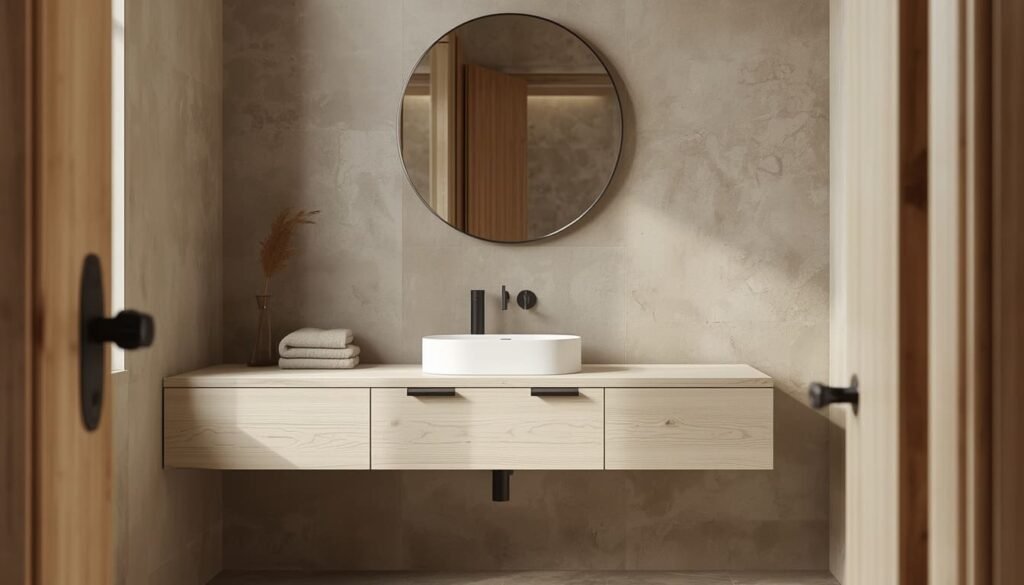
Your powder room is the one space in your home that guests actually notice and yet most homeowners treat it like an afterthought. I’ve redesigned dozens of half baths across the US, and I can tell you this: a well executed Scandi powder room stops people in their tracks. It doesn’t need square footage. It doesn’t need a window. It just needs intention. The good news? Scandinavian design is arguably the easiest style to pull off in a small space and these 14 ideas will show you exactly how.
My Design Notes
A few years back, I worked with a couple in suburban Minneapolis who had a 28 square foot powder room right off their main entryway. No window. Builder grade vanity. The kind of space that made guests feel like they were washing their hands in a broom closet. They wanted something that felt intentional something guests would actually remember. We stripped it back completely. Warm greige limewash on the walls, a floating white oak vanity sourced from a local Minnesota millwork shop, matte black hardware, and one oversized arched mirror that made the whole room feel like it exhaled. Total project cost came in just under $3,200. Now, every single dinner party guest walks out of that powder room and says something. That project cemented something I already believed a powder room doesn’t need square footage. It needs a point of view. That’s exactly what Scandi design gives you.
Stunning Scandinavian Design Secrets for a Powder Room That Guests Will Never Forget
1. The Classic White Square Tile With Warm Wood Vanity
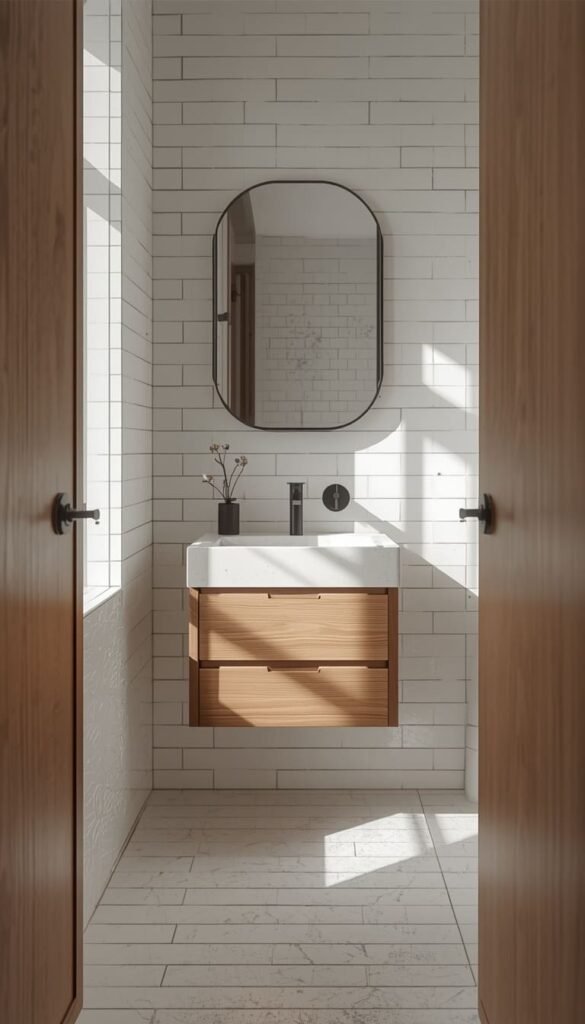
If there’s one combination that defines Scandi powder room design in the US right now, this is it. White square tiles paired with a warm wood vanity is the kind of pairing that looks effortlessly put together without trying too hard. I recommend 4×4 or 5×5 matte white tiles over glossy ones they photograph beautifully and don’t show water spots the way high-shine finishes do.
A quick trick I’ve learned working on smaller half baths: run the tile all the way to the ceiling. It makes the walls feel taller, the room feel bigger, and suddenly that tiny powder room has a boutique hotel energy.
One thing to watch out for is white grout. It looks stunning on day one and becomes a maintenance commitment by month six. If you have kids or a busy household, go with a warm gray grout instead same clean aesthetic, far less upkeep.
Budget reality: a basic tile and vanity refresh like this typically runs between $1,800 and $3,500 depending on your market and whether you’re hiring a contractor or going semi-DIY.
2. Bold Scandi Wallpaper The One Room Where You Should Commit
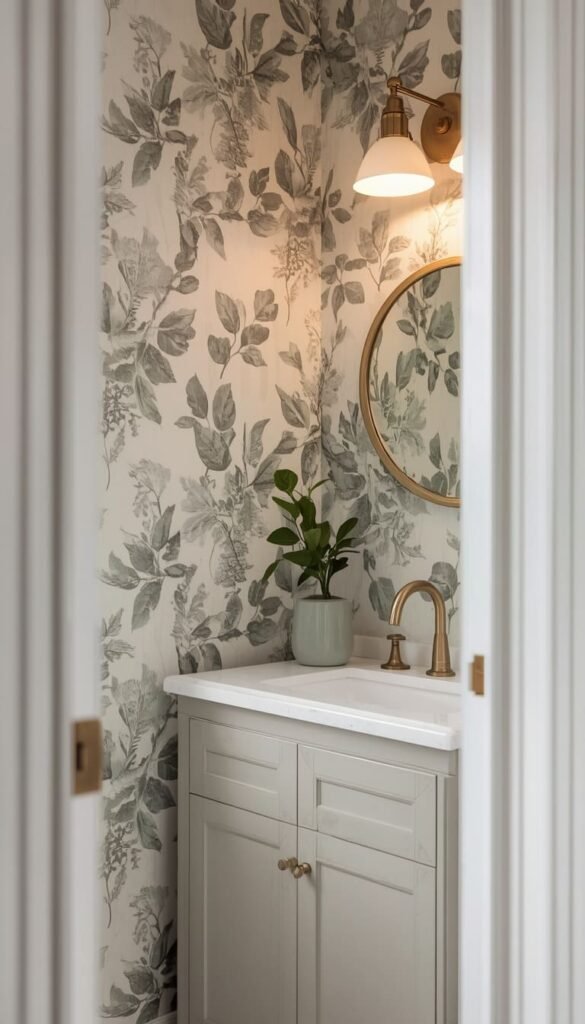
Here’s something I tell every client who’s nervous about wallpaper the powder room is the safest room in the house to go bold. You spend three minutes in there at a time. There’s no risk of waking up and regretting it the way you might in a bedroom. And because the square footage is so small, even a premium wallpaper roll won’t break the bank.
Nordic inspired prints think muted botanical motifs, soft geometric patterns, or abstract organic shapes in sage, clay, or charcoal work beautifully in this space. Brands like Hygge & West and Rifle Paper Co. have options that feel authentically Scandi without veering into novelty territory.
For a budget-friendly route, Chasing Paper offers peel and stick options that look surprisingly elevated and are completely renter-friendly.
3. The Floating Oak Vanity Scandi’s Signature Move
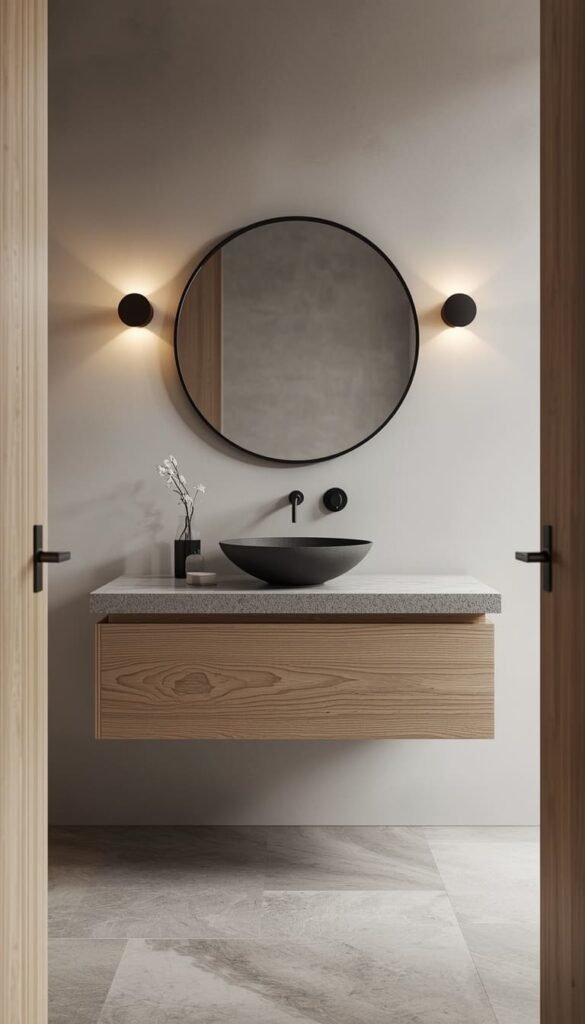
Wall mounted vanities are one of those design choices that work harder than they look. In a powder room where you’re often dealing with 25 to 35 square feet lifting the vanity off the floor visually opens up the space in a way that feels almost architectural. Your eye travels across the floor uninterrupted, and the room instantly reads as larger and more intentional.
White oak is my personal favorite finish for this. It’s warm without being rustic, light without feeling cold, and it ages gracefully. Pair it with a white quartz or honed stone countertop and you’ve got a combination that looks custom even when it isn’t.
A few things worth knowing before you commit:
- Wall-mounted vanities require solid wall blocking for installation factor in a plumber and possibly a carpenter if your walls aren’t already prepped.
- Standard floating vanity height sits around 32 to 36 inches. Go on the taller end if your household skews adult.
- Budget range: $600 to $2,200 depending on the brand and whether it’s solid wood or a veneer finish.
4. The Black, White and Natural Wood Trinity
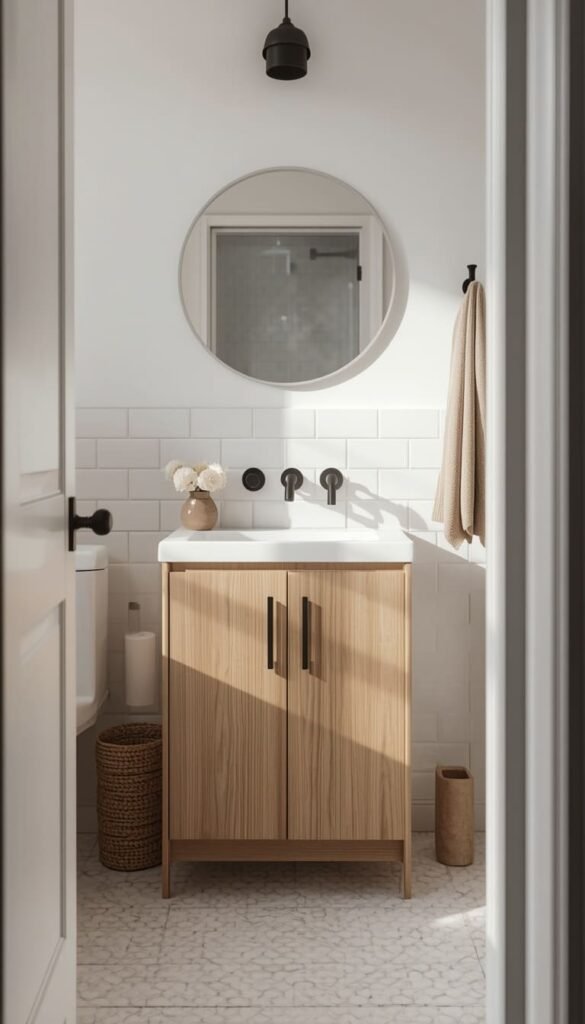
This three material formula is basically the Scandi powder room cheat code. Black, white, and natural wood in the right proportions create a space that feels balanced, sophisticated, and completely timeless. I’ve used this combination in at least a dozen projects and it has never once felt dated by the time the client moves on to their next renovation.
The ratio matters more than most people realize. Think of it as roughly 60% white, 30% wood, and 10% black. White does the heavy lifting on walls and countertops. Wood grounds the space through the vanity or a small accessory like a mirror frame or stool. Black shows up in hardware, faucets, or a light fixture just enough to add contrast and keep the whole thing from feeling too soft.
What I love most about this combination is its forgiveness. You can shift the mood entirely just by swapping the wood tone. Light ash feels more modern and airy. Darker walnut feels warmer and more intimate. Same formula, completely different personality.
Which one feels most like you the warm floating oak vanity, the moody dark walls, or the bold Scandi wallpaper?
5. The Japandi Powder Room The 2026 Evolution of Scandi Style
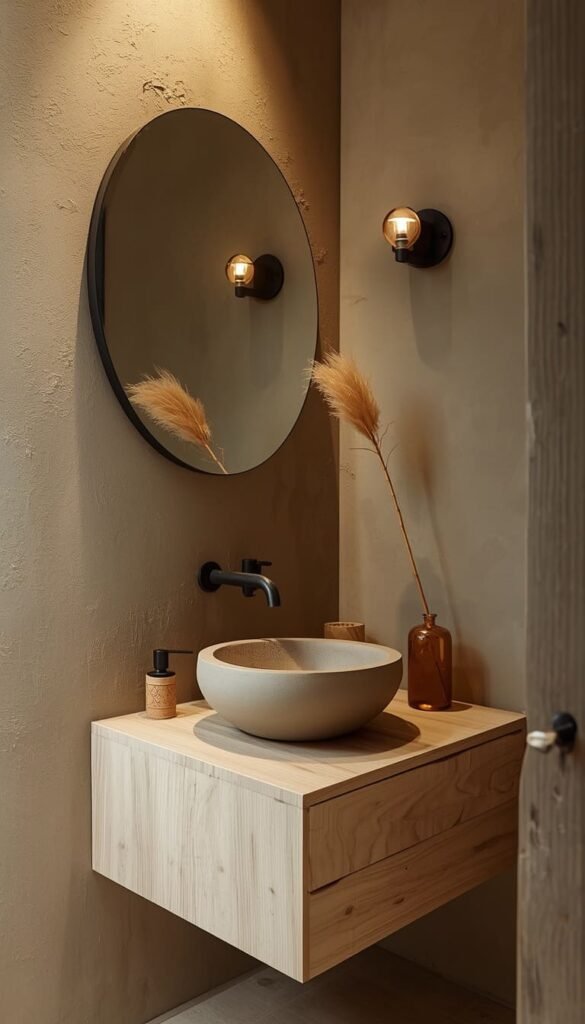
If you haven’t heard the word Japandi yet, you will. It’s the design world’s most exciting current obsession, and honestly, it makes complete sense. Japandi blends Scandinavian minimalism with Japanese wabi sabi philosophy the idea that beauty lives in imperfection, simplicity, and natural materials. In a powder room, this translates into one of the most serene, considered spaces you can create.
The material palette is where Japandi really separates itself from straight Scandi:
- Matte stone or concrete vessel sinks instead of standard ceramic
- Limewash or plaster walls with visible texture and depth
- Bamboo or blackened steel accessories rather than chrome or nickel
- Low, grounded vanity profiles that feel almost furniture-like
One thing to watch out for is going too cold. Pure Japandi can tip into stark territory if you’re not careful. I always recommend adding one warm element a small bud vase with a single dried stem, a linen hand towel, a warm-toned bulb in the sconce. That one layer of softness makes all the difference between a powder room that feels curated and one that feels clinical.
6. The Moody Nordic Powder Room Dark Done Right
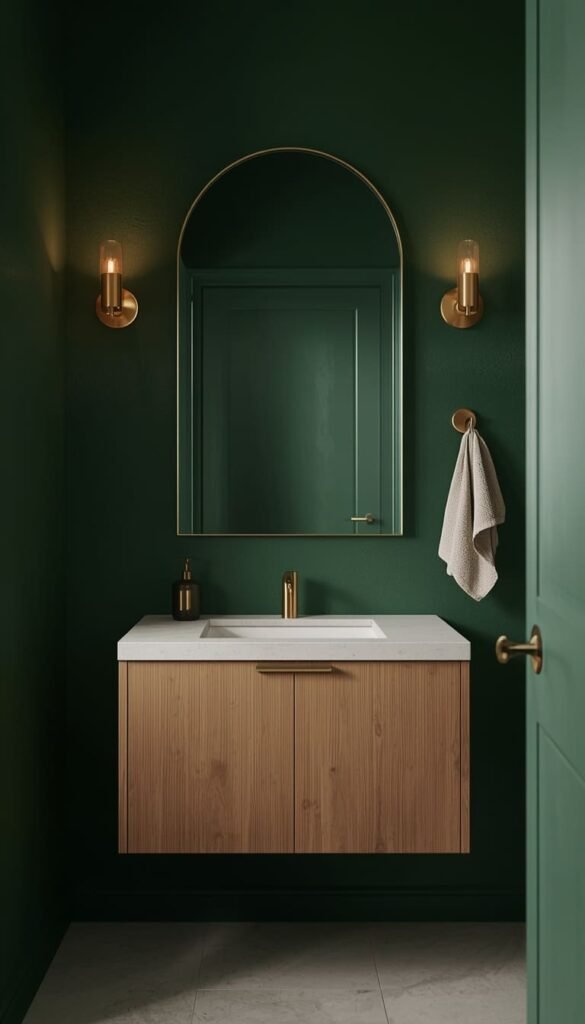
Going dark in a powder room scares a lot of homeowners. I get it. The instinct is always to go light in a small space. But here’s what I’ve seen time and time again in my own projects a deep, moody color in a tiny powder room doesn’t shrink the space. It removes the walls entirely. Suddenly there are no edges, no corners competing for attention. There’s just this enveloping, dramatic little room that guests walk out of talking about.
Deep forest green, charcoal, and navy are the three shades I reach for most often in a Nordic-inspired moody powder room. Pair any of them with brass or warm bronze hardware and the combination is nothing short of stunning.
One thing to watch out for is skimping on lighting. A dark powder room with inadequate light feels like a cave and not the cozy kind. You need at least two light sources: a sconce on either side of the mirror at eye level, and either recessed lighting overhead or a small pendant. Get the lighting right and the dark walls become a feature. Get it wrong and the whole room feels like a mistake.
Top 6 Scandi powder room ideas:
| Idea | Estimated Price | Maintenance |
|---|---|---|
| White Square Tile + Wood Vanity | $1,800 – $3,500 | Medium |
| Bold Scandi Wallpaper | $200 – $800 | Low |
| Floating Oak Vanity | $600 – $2,200 | Low |
| Japandi Powder Room | $1,500 – $4,000 | Medium |
| Moody Nordic Dark Walls | $300 – $1,200 | Low |
| Natural Material Sink | $400 – $1,800 | High |
7. Warm Minimalism With Greige and Linen Textures
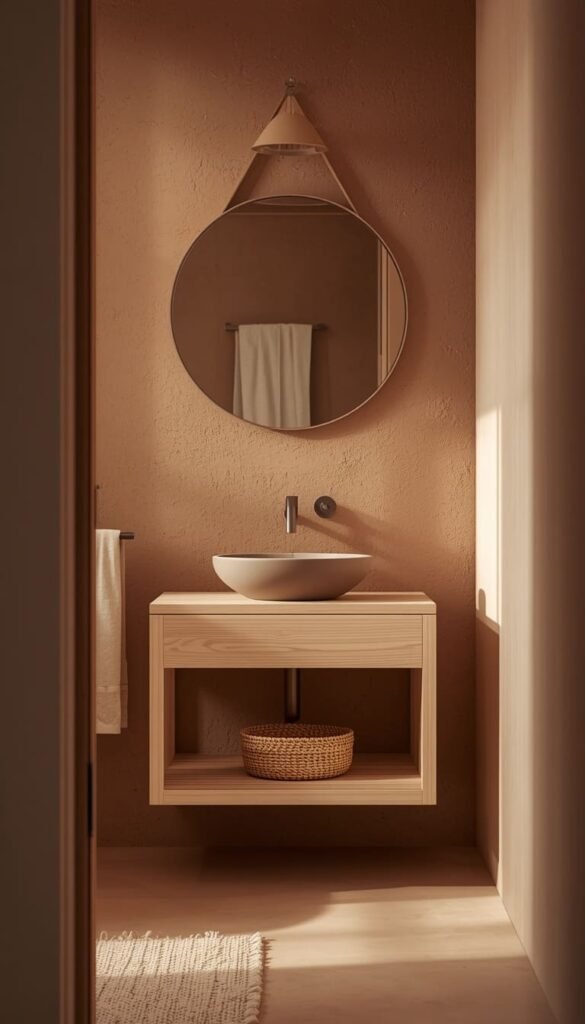
Not everyone wants the drama of a moody room or the crispness of stark white. And honestly, some of the most beautiful Scandi powder rooms I’ve ever designed fall somewhere in between in that warm, quiet zone of greige, oatmeal, and soft linen tones that feels like a deep exhale the moment you walk in.
This is the palette that’s absolutely dominating US interiors right now, and for good reason. It’s universally flattering, it photographs beautifully, and it works with almost every hardware finish brass, matte black, brushed nickel, even unlacquered bronze.
The texture is what keeps this palette from feeling flat. Layer it thoughtfully:
- Limewash or Roman clay paint on the walls for subtle depth and movement
- A linen or waffle weave hand towel folded simply on the vanity
- A woven rattan or seagrass basket under an open shelf for storage
- A small stone or ceramic tray on the countertop to corral everyday items
I’ve done this look at price points ranging from a $900 weekend refresh to a $4,000 full renovation, and at every budget it manages to look considered and calm. That’s the quiet power of warm minimalism it never looks cheap if the textures are right.
8. The Statement Mirror Trick
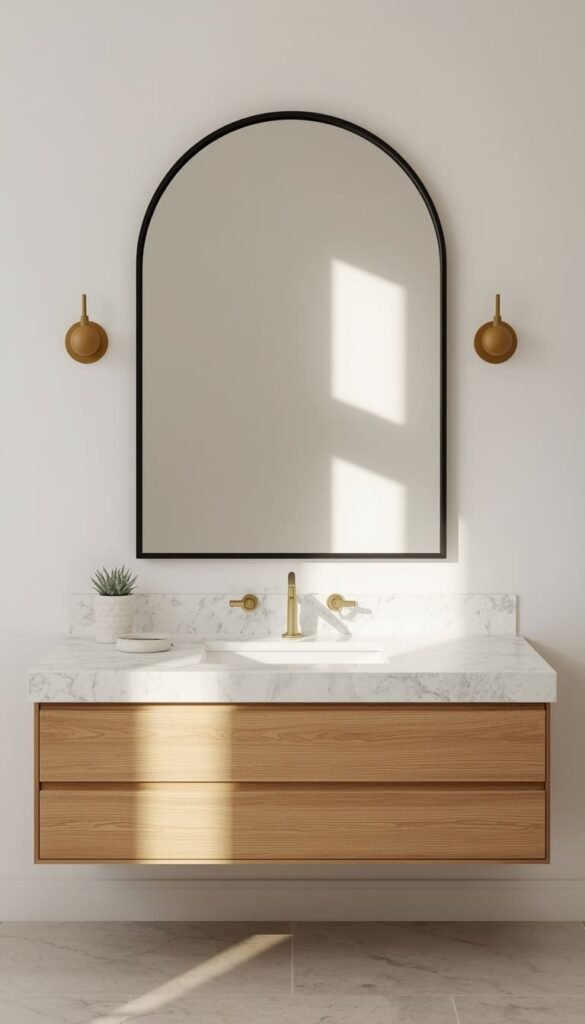
If I had to pick one single upgrade that delivers the highest return in a Scandi powder room, it would be the mirror. Not the vanity. Not the tile. The mirror. A well chosen mirror does more decorating work per dollar than almost anything else in this space, and it’s one of the easiest swaps a homeowner can make without touching plumbing or tile.
The shape matters enormously here. An oversized arched mirror instantly softens a boxy powder room and adds that quiet European Scandi sensibility that feels elevated without being fussy. A simple round mirror in a thin oak or black frame keeps things clean and contemporary. What I’d steer you away from is anything with heavy ornate detailing that’s fighting against the whole spirit of the style.
Size-wise, go bigger than feels comfortable. Most people play it too safe with mirror sizing and end up with something that looks like it belongs in a college dorm bathroom. In a powder room, a mirror that spans 24 to 36 inches wide is rarely too large and often transforms the entire wall.
Budget picks that actually look expensive: the Ikea STOCKHOLM mirror, the Article Mira, and anything from CB2’s minimalist mirror collection. If you want to splurge, custom mirror shops on Etsy can produce beautiful arched or asymmetric styles for $300 to $600 that look completely bespoke.
If you could change just one thing in your powder room today, what would it be the lighting, the mirror, or the overall color palette?
9. Scandi Wallpaper Paired With a Contrasting Vanity Color
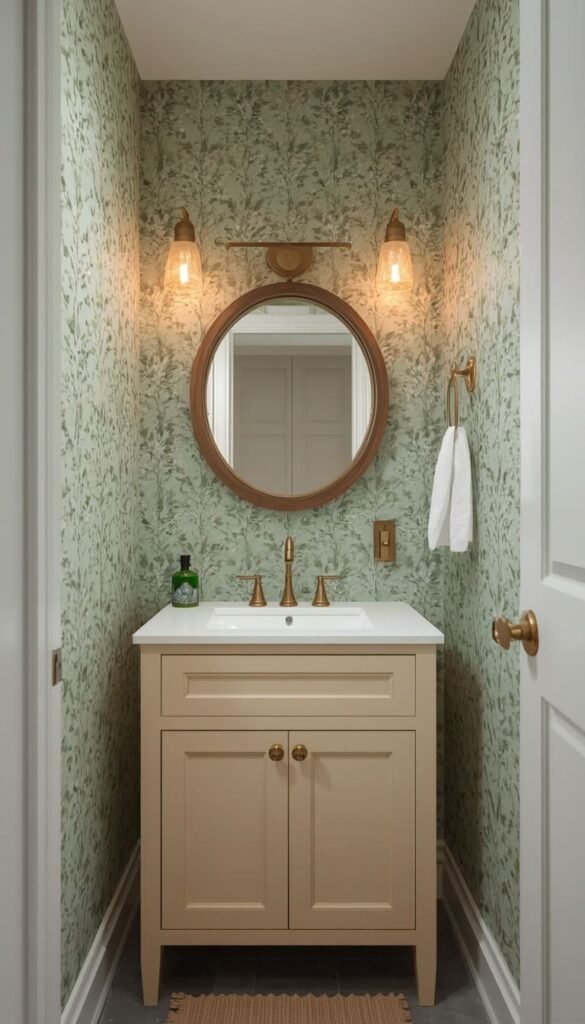
This is one of those combinations that sounds risky on paper and looks absolutely stunning in practice. The key is understanding that in a Scandi powder room, contrast doesn’t mean clash it means intention. When you pair a patterned wallpaper with a vanity in a contrasting but complementary color, the result feels layered and deliberate in a way that a single-tone room simply can’t achieve.
Some pairings I keep coming back to in my own projects:
- Soft sage botanical wallpaper with a warm white or cream vanity
- Muted terracotta print with a light ash wood vanity
- Charcoal abstract pattern with a dusty blue or forest green cabinet
The wallpaper should always be the quieter element in a Scandi space muted tones, organic shapes, nothing too busy or high-contrast on its own. Let the vanity color add the personality. A quick trick I’ve learned is to pull one secondary color directly from the wallpaper for the vanity finish. That single decision ties the whole room together without any guesswork.
One thing to watch out for is scale. In a 30 square foot powder room, a large-repeat pattern can feel overwhelming fast. Stick to smaller repeats or tone-on-tone prints and you’ll be in a much safer place.
10. Lighting Strategy for the Windowless Powder Room
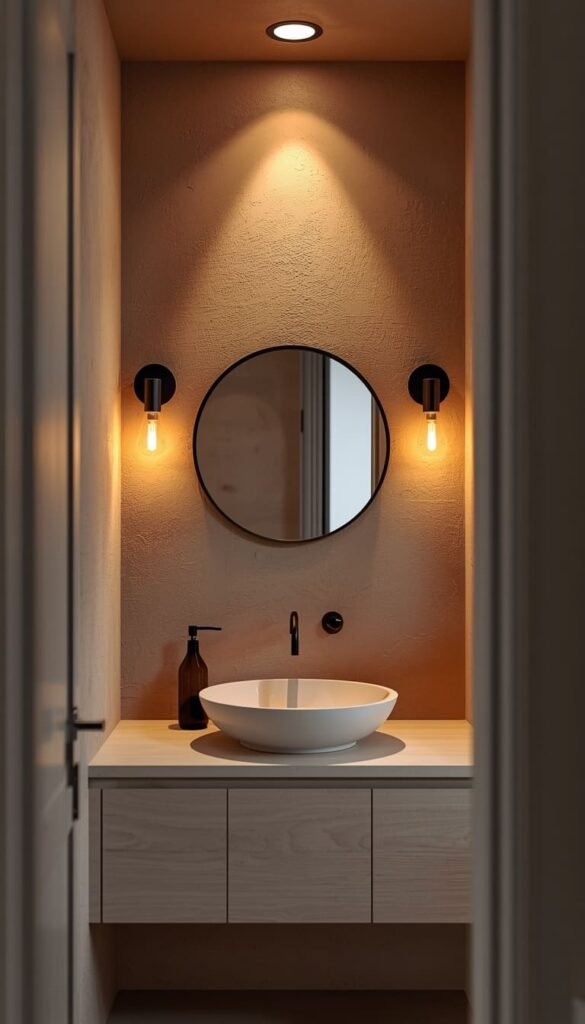
Most powder rooms in American homes have exactly zero natural light. And yet nearly every Scandi bathroom article you’ll find online is photographed in a sun drenched space with a beautiful window. I want to talk about the real scenario the interior half bath with no skylight, no window, and a single overhead fixture that makes everyone look slightly unwell.
The fix is layered lighting, and it’s simpler than it sounds. You need three things working together: ambient light overhead, task lighting at the vanity level, and at least one warm accent source that adds depth. That last one is where most people stop short, and it’s the layer that makes the biggest difference in how the room feels rather than just how well it’s lit.
For that task lighting, sconces mounted on either side of the mirror at eye level roughly 60 to 65 inches from the floor to the center of the fixture are far more flattering and functional than anything mounted above the mirror. It eliminates the harsh downward shadows that make even the most beautiful vanity look unflattering.
Bulb temperature is something I feel strongly about in a Scandi powder room. Stay between 2700K and 3000K. That warm white range mimics natural light closely enough to feel comfortable, and it plays beautifully with wood tones, linen textures, and the warm neutrals that define this style. Anything above 3500K starts to feel institutional which is the opposite of everything we’re going for here.
11. A Natural Material Sink as the Hero Piece
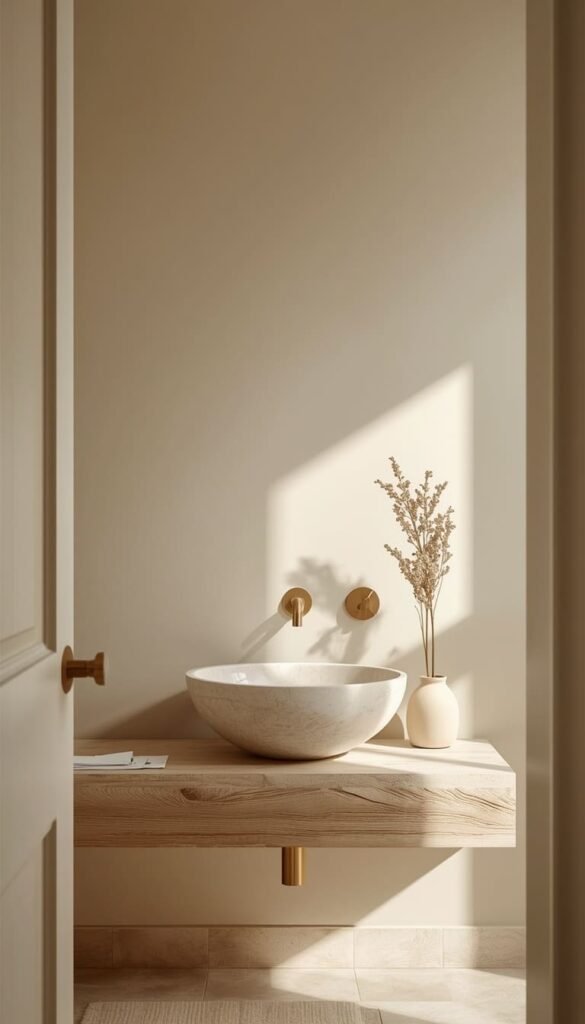
In a powder room, the sink doesn’t just serve a function it’s a focal point. And in a Scandi or Japandi inspired space, swapping a standard ceramic undermount for something in stone, concrete, or honed travertine is one of the most impactful single decisions you can make. It immediately elevates the entire room and signals to guests that every detail here was chosen with care.
Concrete vessel sinks have a raw, sculptural quality that works particularly well in warm minimalist spaces. Honed travertine or limestone basins feel more organic and spa like. Hand carved stone sinks increasingly available through Etsy artisans and specialty tile shops bring a wabi sabi quality that’s perfect for Japandi leaning powder rooms.
Here’s the honest reality check though. Natural material sinks require more maintenance than ceramic. Stone needs to be sealed annually. Concrete can stain if not properly treated and resealed. If your powder room sees heavy daily use say, it doubles as the main family bathroom a honed ceramic that mimics stone might be a smarter long-term choice. If it’s purely a guest bath that gets used a few times a week, go for the real thing without hesitation.
12. The Wood Slat Accent Wall
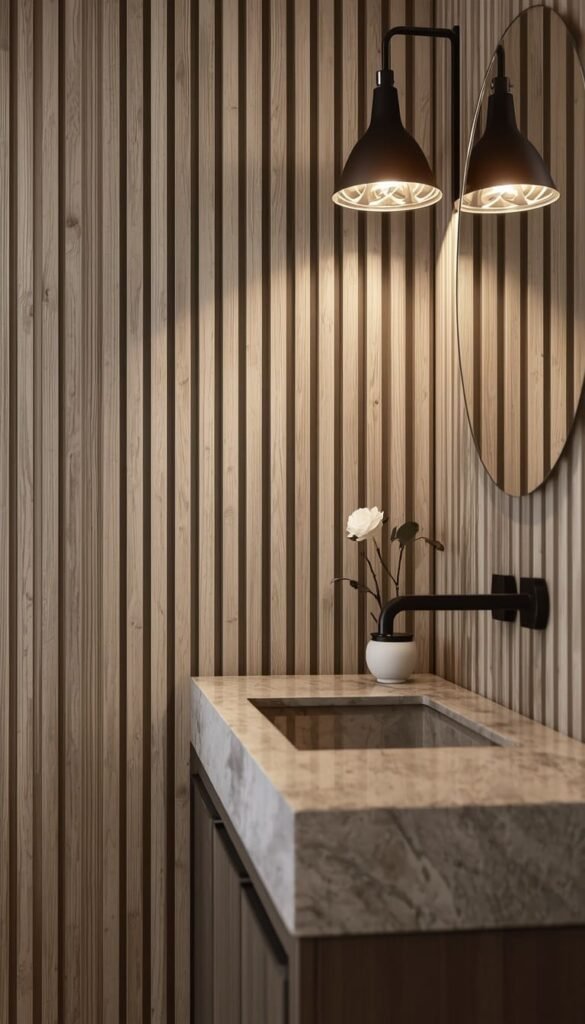
Wood slat walls have been trending hard across the US for the past two years, and honestly I don’t see them slowing down anytime soon. In a Scandi powder room specifically, a wood slat feature wall behind the vanity does something genuinely special it adds warmth, dimension, and texture without a single extra accessory. The wall itself becomes the decor.
White oak and pine are the two most popular options right now. White oak reads more contemporary and pairs beautifully with matte black hardware and neutral palettes. Pine is warmer and more affordable, making it an excellent choice if you’re working with a tighter budget or want to lean into that cozy Nordic cabin feel.
The DIY potential here is real. Pre spaced wood slat panels are available at most major home improvement stores and through online retailers like Amazon and Wayfair, and a confident weekend DIYer can install an accent wall in a powder room in a single afternoon. A quick trick I always share with clients doing this themselves: seal the wood before installation, not after. It’s far easier to get even coverage and you won’t have to worry about getting sealant on adjacent walls or fixtures.
One thing to watch out for is moisture. A powder room has a sink, which means occasional splashing. Make sure your slat wall is not directly behind or immediately adjacent to the sink basin without proper sealing and adequate ventilation. A small exhaust fan goes a long way in protecting your investment here.
Be honest is your powder room currently a space you’re proud to show guests, or is it the room you quietly hope they don’t notice?
13. Open Shelving Done the Scandi Way
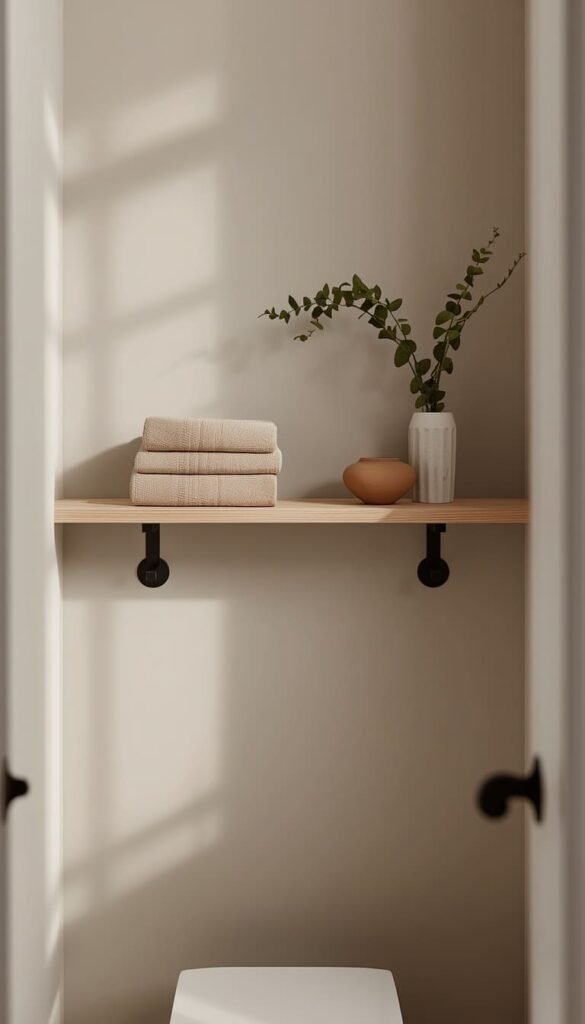
Open shelving in a powder room is one of those ideas that looks incredible in design magazines and goes sideways fast in real life unless you approach it with genuine Scandi discipline. The philosophy here isn’t “display everything.” It’s “display almost nothing.” And that restraint is exactly what makes it work.
In a well executed Scandi powder room, an open shelf holds maybe three to five items total. A small stack of folded hand towels in a single neutral color. One ceramic or stone vessel. A single small plant something structural like a pothos cutting in a simple bud vase rather than a sprawling fiddle leaf. That’s it. The negative space around those items is doing just as much work as the items themselves.
Shelf material matters here too. A simple floating shelf in white oak or pine with a barely there bracket keeps things light and airy. Thick chunky shelves in a small powder room can feel heavy and overwhelming. I typically recommend a shelf depth of no more than eight to ten inches in this space deep enough to be functional, shallow enough to stay visually clean.
One thing to watch out for is the creep. Open shelving has a way of accumulating things over time extra soap bottles, random hair ties, a backup candle that doesn’t quite match. Set a rule for yourself from day one: if something doesn’t belong in the original three to five items, it lives in a closed cabinet somewhere else. Scandi style rewards that kind of discipline every single day.
14. The Hygge Finishing Layer Textiles, Candles and Botanicals
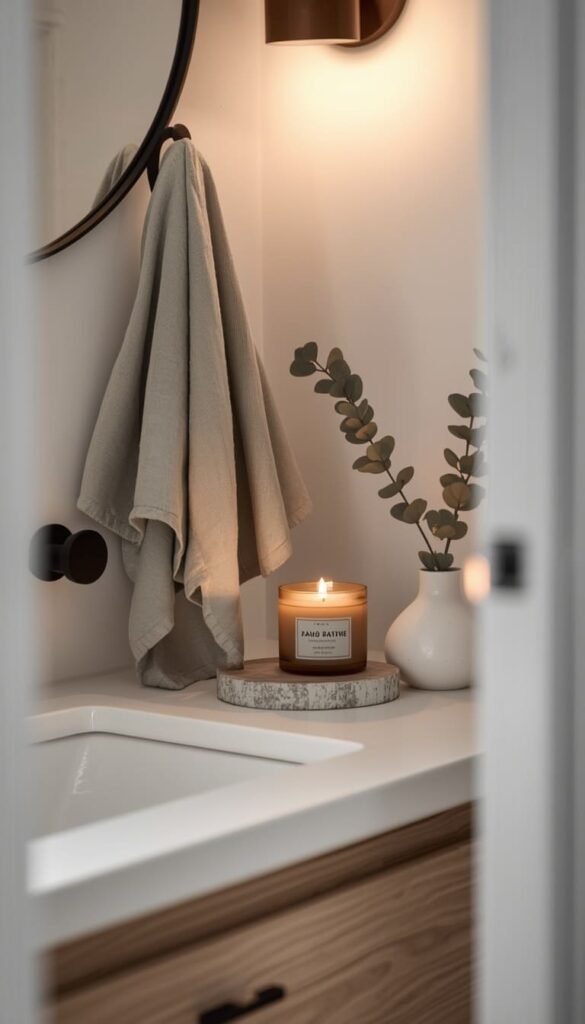
This is the section I save for last in every client presentation, and it’s always the one that gets the most emotional response. Because here’s the truth you can nail the tile, the vanity, the mirror, and the lighting, and still walk into a powder room that feels cold and unfinished. The hygge layer is what breathes life into all of it. It’s the difference between a room that looks designed and a room that feels lived in in the very best way.
Hygge, for anyone who hasn’t encountered the concept yet, is the Danish and Norwegian idea of coziness and convivial warmth. In a powder room context it translates into a handful of very specific, very deliberate touches that cost relatively little but land with enormous impact.
Here’s how I approach it with my own clients:
- Textiles first. A single linen or waffle weave hand towel in a warm oatmeal or sage tone, folded simply and hung on a matte black hook or a small wood peg rail. Not a towel bar stuffed with four mismatched towels one beautiful towel, displayed with intention.
- One candle. A simple vessel candle in an unscented or lightly scented option cedar, sandalwood, or clean cotton work beautifully in a small space without overwhelming guests. Place it on the countertop or a small tray, never on the floor.
- Something living. A single stem in a bud vase, a small trailing pothos, or a sprig of eucalyptus tucked into a simple ceramic. It doesn’t need to be elaborate. It just needs to be there because nothing signals care and intention to a guest quite like a living thing in the room.
The total cost of this finishing layer? Realistically $40 to $120 depending on where you shop. The impact it has on how your powder room feels? Completely disproportionate to that number. That’s the quiet genius of Scandi design it never asks you to spend a fortune. It asks you to be intentional. And in a space as small and personal as a powder room, intentionality is everything.
Your 2 Minute Scandi Powder Room Decision Map
By Budget
Starter Scandi ($300 – $1,500)
- Swap the mirror first biggest visual impact, lowest cost
- Add peel-and-stick Scandi wallpaper for a zero commitment statement
- Replace builder hardware with matte black instant transformation
- Layer in hygge touches: one linen towel, one candle, one plant
- Paint walls in warm greige with Roman clay for texture on a budget
Investment Nordic ($1,500 – $4,000+)
- Install a floating white oak vanity with wall blocking
- Commission a natural stone or concrete vessel sink as the hero piece
- Go full Japandi with limewash walls and artisan brass hardware
- Invest in custom arched mirror from an Etsy millwork artisan
- Hire a professional for wood slat accent wall with proper moisture sealing
By Lifestyle
Busy Households and Family Homes
- Choose gray grout over white same look, fraction of the upkeep
- Skip natural stone sinks sealed ceramic mimics the look without the maintenance
- Avoid open shelving a simple closed vanity keeps clutter invisible
- Wood slat walls need proper sealing non negotiable with kids around
Minimalists and Guest Bath Purists
- Commit to the three item open shelf rule no exceptions
- One statement piece only: mirror, wallpaper, or sink never all three
- Keep the counter completely clear except for one small tray
- Let negative space do the decorating restraint is the whole point
Frequently Asked Questions
How do I make a tiny powder room look bigger?
A floating vanity and an oversized mirror are your two best moves. Lifting the vanity off the floor creates visual breathing room, and a large mirror doubles the perceived depth instantly.
What colors are considered Scandinavian?
Warm whites, soft greiges, muted sage, and charcoal are the core Scandi palette. Think quiet and nature inspired nothing saturated or loud.
Is Japandi the same as Scandinavian design?
Close, but not identical. Scandi leans warmer and cozier while Japandi adds Japanese wabi sabi rawer textures, lower profiles, and a slightly more austere finish.
What flooring works best in a small powder room?
Matte porcelain or honed stone tile are my top picks. Both handle moisture well, look elevated, and don’t show every scuff the way polished finishes do.
How do I add warmth to a minimalist powder room without cluttering it?
One linen towel, one candle, one small plant. That hygge trio adds warmth without visual noise and keeps the space feeling intentional rather than decorated.
Conclusion
Your powder room is small but its impact on how your home feels is anything but. I’ve watched a single mirror swap or a fresh coat of Roman clay paint completely change the energy of a space that homeowners had ignored for years. You don’t need a full renovation budget or a design degree to pull this off. Pick one idea from this list today order that wallpaper sample, clear that shelf, or finally replace those builder-grade hardware pulls and let that first step build its own momentum.
