
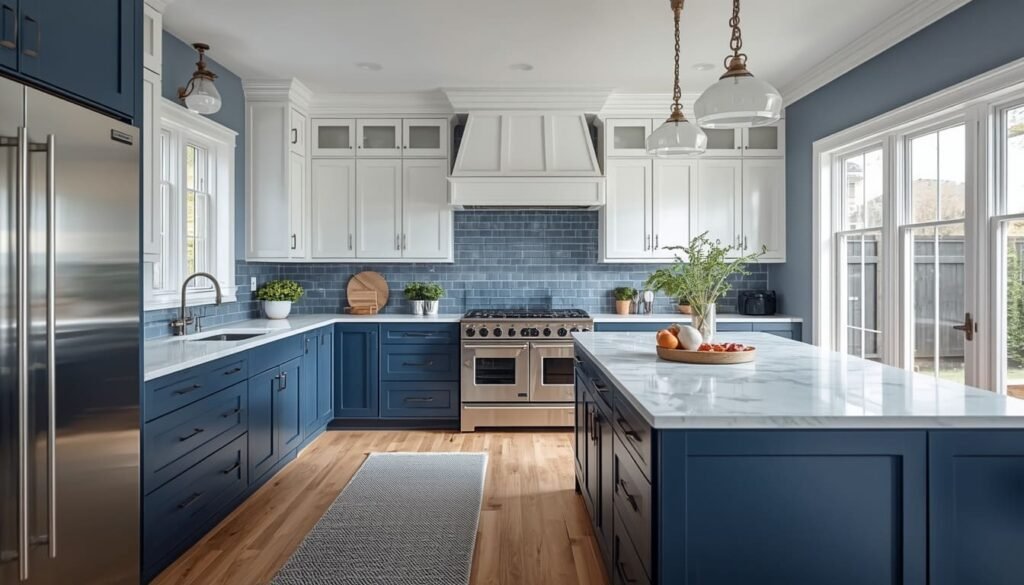
Blue and white is the kitchen color combination that designers keep coming back to — and honestly, it is not hard to see why. It works in a cramped galley in Brooklyn just as well as it does in a sprawling open-concept home in Austin. I have used it across dozens of projects, different budgets, and wildly different client personalities and it has never once let me down. Whether you are planning a full renovation or just hunting for one smart update, these ten ideas will show you exactly how to make this classic pairing work in your home.
My Design Notes
One project I always come back to is a galley kitchen renovation I did in Charleston, South Carolina. My client was terrified of color — she had lived with gray her whole life and genuinely believed that painting her cabinets anything other than white or greige would make her small kitchen feel like a closet. We spent two full consultations just talking her off the ledge. Eventually, we landed on a soft powder blue for the lower Shaker cabinets, white uppers, unlacquered brass cup pulls, and a honed butcher block island top. The day we did the reveal, she stood in her kitchen doorway and cried. I have never forgotten that moment. It reminded me that blue and white is not just a color scheme — it is a confidence builder. When it works, and it almost always does, it makes people fall in love with a room they used to avoid.
1. Navy Blue Lower Cabinets With Crisp White Uppers
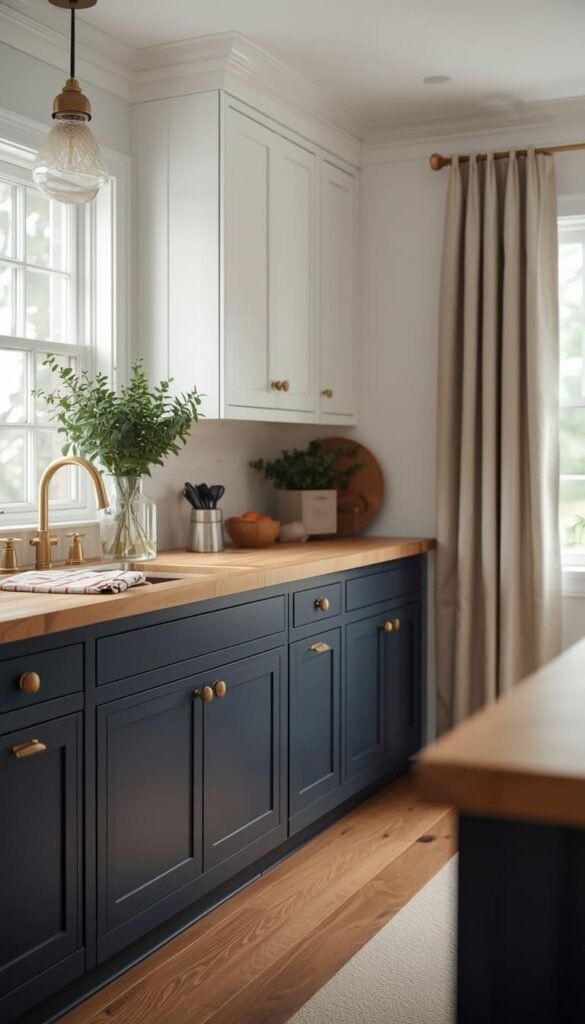
This is the idea I recommend most often, and for good reason. Two-tone kitchens have been a staple in American homes for years now, but navy on the lowers with white on the uppers is the version that actually has staying power. It grounds the space without making it feel heavy, and those white uppers keep everything feeling open and airy especially important in kitchens that do not get a lot of natural light.
For paint, I keep coming back to Hale Navy by Benjamin Moore. It is rich without tipping into darkness, and it holds up beautifully under both warm Edison-style bulbs and cooler recessed lighting. Finish matters more than most people realize. Always go semi-gloss or satin on cabinetry — it is wipeable, durable, and it catches the light in the best possible way. Flat paint on kitchen cabinets is a mistake I have watched homeowners regret within six months of moving in.
A few things worth knowing before you commit:
- Repainting existing cabinets in this two-tone style typically runs between $1,500 and $4,000 depending on cabinet count and your location
- Full semi-custom cabinet replacement with navy lowers will push you closer to $8,000 to $15,000
- Navy does show dust and pet hair more than lighter shades — totally manageable, but worth knowing upfront if you have dogs or young kids at home
2. Blue Kitchen Island in an All White Kitchen
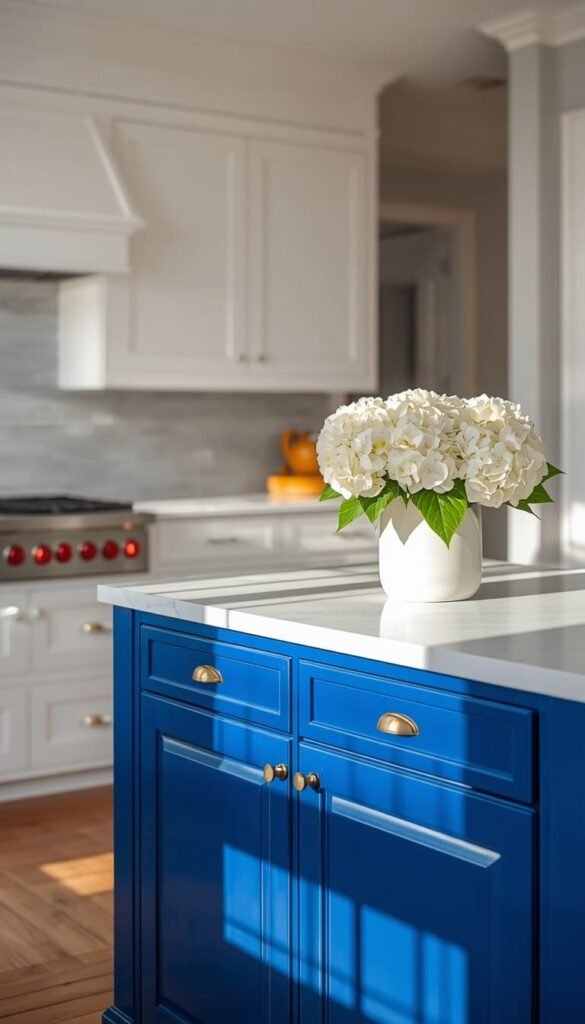
If you are not ready to commit to color on every cabinet door but still want a genuine statement, the island is your best friend. Painting just the island blue while keeping everything else white is one of the lowest-risk, highest-reward moves in kitchen design. I have done this in at least a dozen projects and it never fails to anchor the entire room.
The shade you choose changes everything. A cobalt or royal blue island feels bold and almost Mediterranean — perfect for sun-drenched homes in Florida or Southern California. A dusty, muted blue leans more farmhouse or cottage-style. Deep navy reads sophisticated and transitional, which works in just about any American home regardless of the surrounding architecture.
Hardware is where people tend to get this wrong. Unlacquered brass or antique brass pulls are my first choice on a blue island every single time. Matte black works too, but it adds an industrial edge that does not suit every kitchen. Polished chrome can read a little cold against blue tones — I almost always steer clients away from that combination unless the rest of the space has a very sleek, high-gloss modern aesthetic going on.
One quick thing to watch out for — if your island has a white marble or quartz top, make sure the undertones in the stone do not clash with the undertones in your blue. A blue with green undertones paired with a marble that pulls warm and creamy can look slightly off. Pull samples in your actual kitchen light before you finalize anything.
3. Powder Blue Shaker Cabinets With Brass Hardware
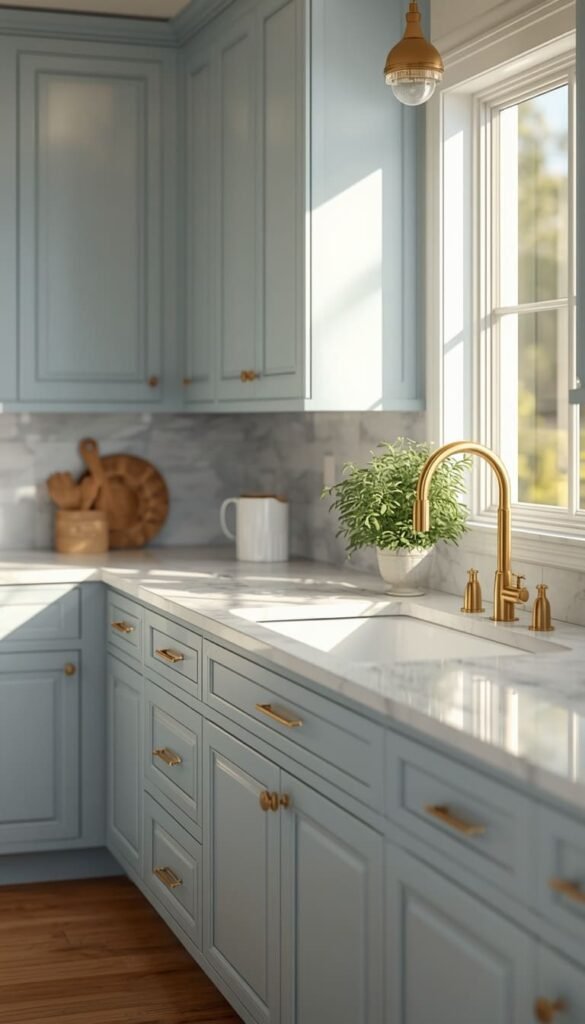
Soft. Charming. Quietly confident. Powder blue Shaker cabinets with brass hardware is the combination I reach for when a client wants personality without drama, and it works in kitchens of almost every size.
Shaker-style doors are the right call here because the clean, simple profile lets the color do the work. Ornate cabinet doors with this shade can start to feel fussy and overworked. Keep the door profile understated and let the hardware be the jewelry. I love Pale Smoke by Farrow and Ball for this look — it is soft enough to read almost neutral in strong light, but it has real depth and character in the evenings.
Brass pulls tie the whole thing together in a way that chrome or nickel simply cannot. There is a warmth to brass that makes powder blue feel lived-in and intentional rather than cold or trendy. If full cabinet replacement is not in your budget, a skilled cabinet painter can transform your existing Shaker boxes for a fraction of the cost. This is genuinely one of the best value moves in any kitchen refresh, and the results are hard to distinguish from new.
Which of these ten blue and white kitchen ideas felt the most “you” the moment you saw it?
4. Bold Blue Tile Backsplash Against White Countertops
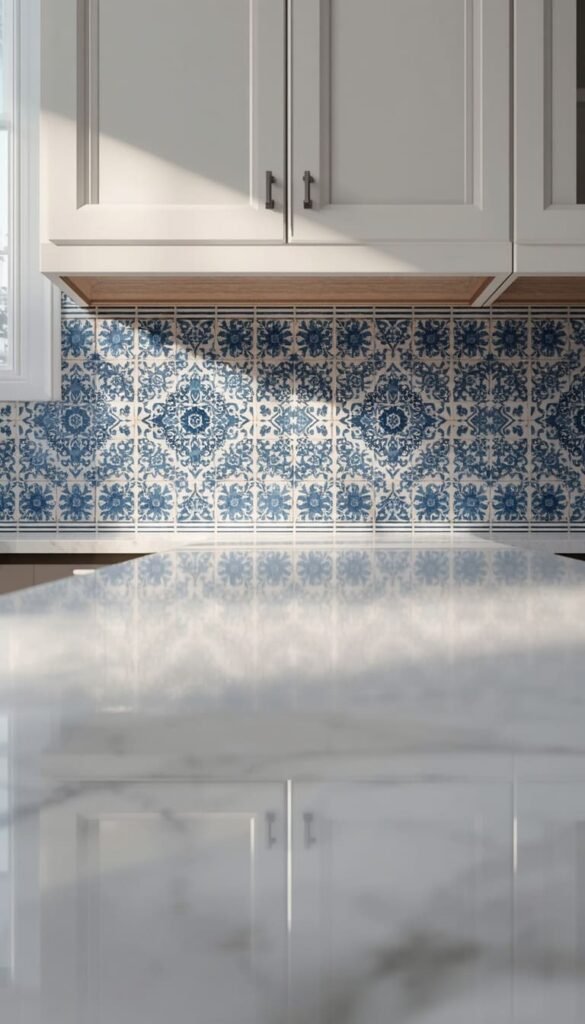
Not everyone wants to commit to blue cabinetry — and I completely understand that. If that sounds like you, the backsplash is where you get to take your color risk without it feeling permanent or overwhelming. Tile carries far less emotional weight than a cabinet color decision, even though swapping it out is arguably more disruptive.
A bold blue backsplash against white countertops is visually stunning across multiple styles:
- Moroccan-inspired patterned tiles in blue and white bring a global, well-traveled feel that works beautifully in eclectic or bohemian kitchens
- Solid glossy cobalt subway tile is graphic and modern — great for contemporary spaces that want edge without going dark on the cabinets
- Hand-painted ceramic tiles feel artisanal and layered, like a detail lifted straight from a high-end kitchen renovation in Santa Fe or Savannah
Grout color is a design decision, not just a functional one — and this is where a lot of DIY projects go sideways. White grout with a blue tile creates a high-contrast, graphic look. Gray grout softens the overall pattern. I usually choose a grout that pulls from one of the mid-tones already present in the tile, so the finished wall reads cohesive rather than choppy and busy.
White countertops do not have to mean marble. A matte white quartz gives you that same clean backdrop at a more approachable price, with none of the sealing anxiety that comes with natural stone.
5. Two Tone Blue and White Farmhouse Kitchen
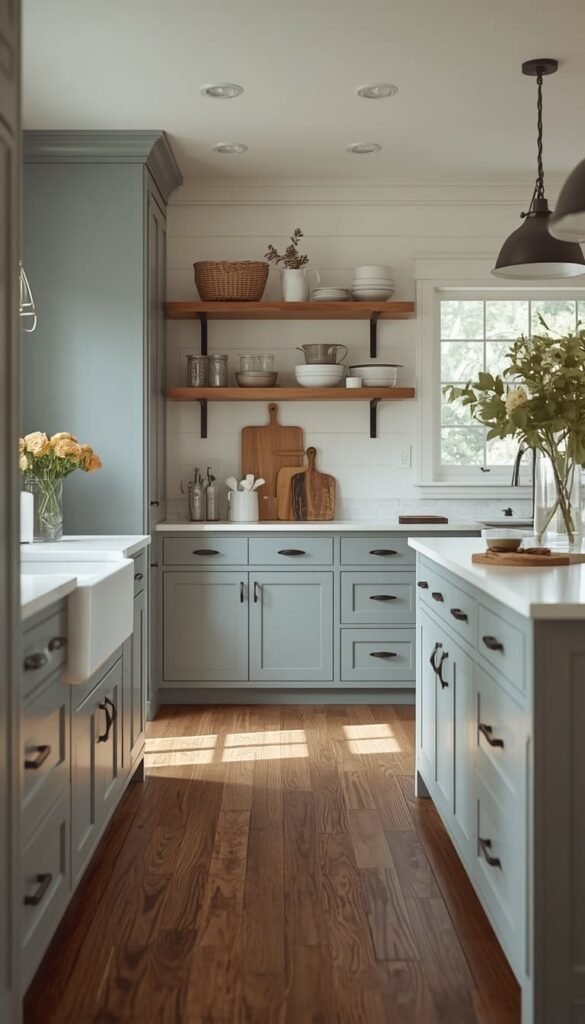
There is something about a farmhouse kitchen that just invites color in a way that more formal spaces do not. The style is inherently relaxed, warm, and unpretentious — which makes it the perfect canvas for a two-tone blue and white treatment that feels collected rather than designed.
The approach I love most here is pairing a medium dusty blue on the perimeter cabinets with bright white on a large farmhouse island. Think wide plank wood floors, an apron front sink, open shelving with ironstone and wooden cutting boards on display, and simple bin pulls in a matte black or aged bronze finish. It is a combination that feels like it has been there for decades, which is exactly the point with farmhouse style.
A quick trick I have learned — avoid going too saturated with your blue in a farmhouse kitchen. Muted, slightly grayed blues like Cloudy Sky by Benjamin Moore or Mizzle by Farrow and Ball will feel authentic to the style. Bright, punchy blues can tip the whole look into something that feels more beachy than rustic, which is a different aesthetic entirely.
Budget reality here is friendlier than most people expect. Painting existing cabinets, swapping hardware, adding open shelving brackets, and sourcing a secondhand farmhouse sink can completely transform a kitchen for under $5,000 if you are strategic about it.
6. Coastal Cottage Kitchen With Pale Blue Cabinets
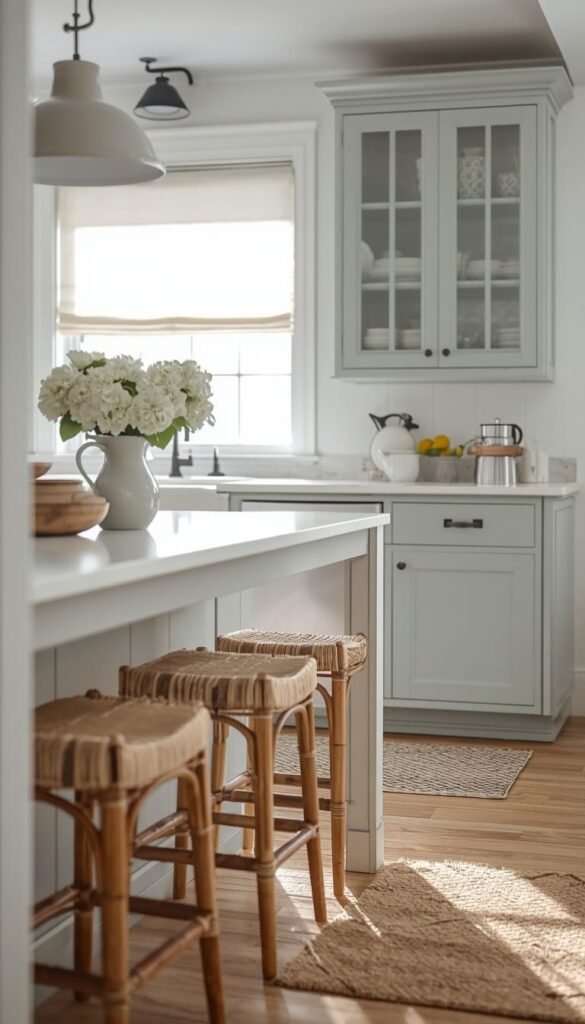
Pale blue and white in a cottage kitchen is one of those combinations that makes a room feel like a deep breath. It is light, it is effortless, and it has a nostalgic quality that heavier or trendier color schemes simply cannot replicate. I designed a version of this for a beach house client in the Outer Banks of North Carolina and the owners told me they could not imagine ever changing it.
The key to getting this right is restraint. Pale blue works best when you let the white carry most of the room:
- Keep walls, countertops, and ceilings white or very close to it
- Choose a pale blue that leans slightly gray or green — pure sky blue can feel too sweet in a kitchen setting
- Layer in natural textures like rattan barstools, linen window treatments, and a jute rug to keep things feeling grounded and organic
Lighting matters enormously with pale blue cabinets. Under warm incandescent or Edison bulb lighting, pale blue can shift slightly green. Under cooler daylight bulbs, it stays true and crisp. I always recommend my clients do a paint sample and live with it for a full 48 hours across different times of day before committing. What looks perfect at noon can look completely different at 7pm with the overhead lights on.
10 Stunning Blue and White Kitchen Ideas
| Idea | Estimated Price | Maintenance |
|---|---|---|
| Navy Blue Lower Cabinets With White Uppers | $1,500 to $15,000 | Medium |
| Blue Kitchen Island in All White Kitchen | $300 to $3,500 | Low |
| Powder Blue Shaker Cabinets With Brass Hardware | $1,200 to $12,000 | Medium |
| Bold Blue Tile Backsplash With White Countertops | $800 to $4,500 | Low |
| Modern Navy Kitchen With White Marble Countertops | $5,000 to $20,000 | High |
| Soft Periwinkle Blue in a Small White Kitchen | $200 to $2,500 | Low |
7. Modern Navy Kitchen With White Marble Countertops
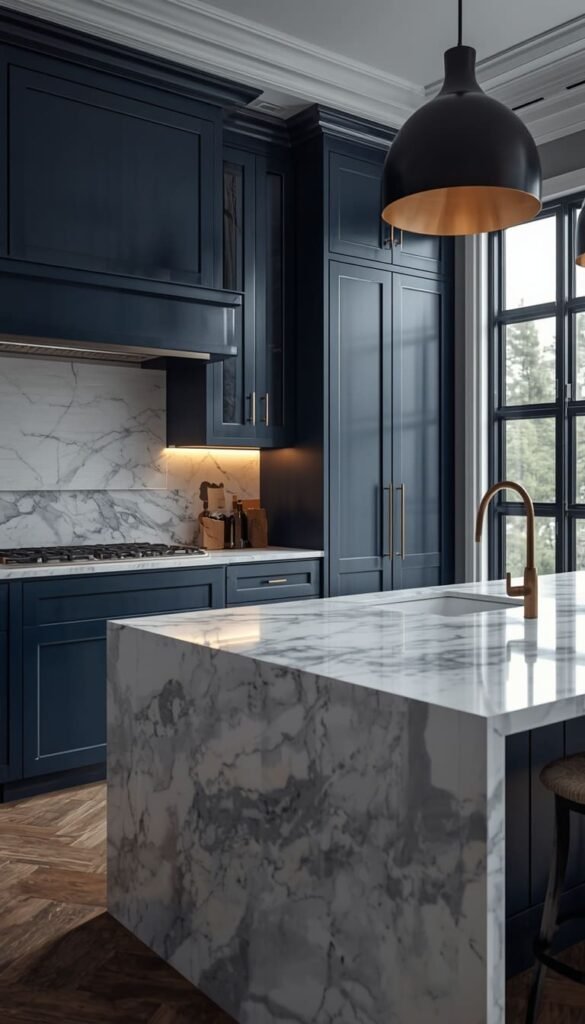
This is the combination I reach for when a client wants their kitchen to feel genuinely luxurious. Navy and white marble is bold, it is high contrast, and it photographs like something out of a design magazine. Done well, it is the kind of kitchen that stops people in their tracks.
Navy cabinets want to be dark and committed — not a wishy-washy in-between shade. I love Newburyport Blue by Benjamin Moore or Hague Blue by Farrow and Ball for this application. Both have enough depth to hold their own against the brightness of white marble without competing with it.
Now, the marble conversation. Real Carrara or Calacatta marble with navy cabinetry is absolutely stunning. The cool gray veining ties directly into the cool blue of the cabinets and the whole thing feels cohesive and intentional. That said, marble etches and stains. If you cook regularly, make pasta from scratch, or have children who treat the kitchen island as a homework station, I would point you toward a high-quality marble-look quartz instead. Brands like Calacatta Nuvo from MSI or Eternal Calacatta from Silestone are genuinely impressive and hold up to real kitchen life.
One thing to watch out for with a very dark navy kitchen — lighting placement becomes critical. Dark cabinets absorb light rather than reflect it, so under-cabinet lighting is not optional here. It is essential.
8. Blue Painted Cabinets With Open White Shelving
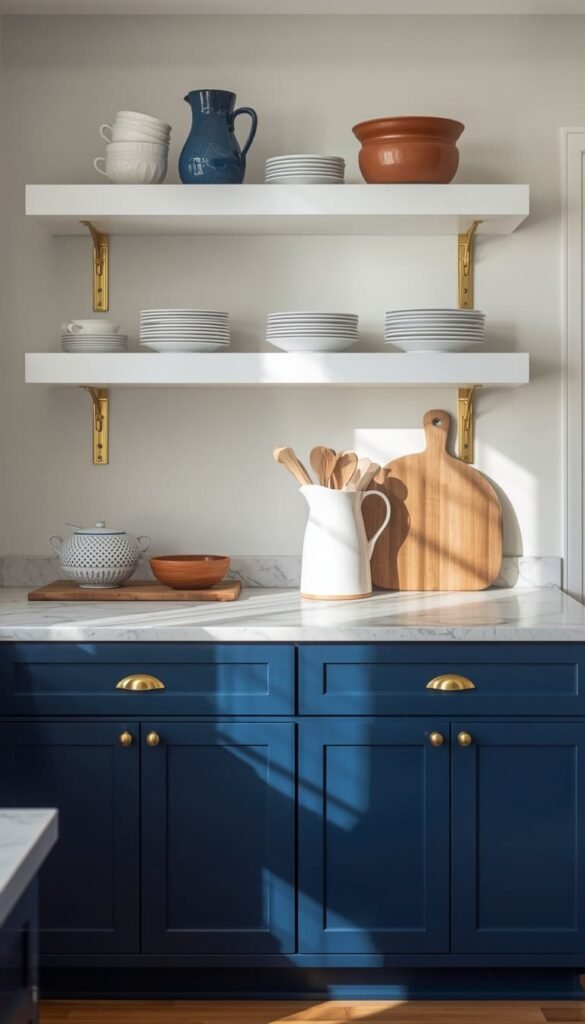
Replacing upper cabinets with open white shelving is one of the most impactful and relatively affordable changes you can make to a kitchen. When you pair that open shelving with blue painted lower cabinets, the result is a layered, curated look that feels both modern and deeply personal.
The blue on the lowers anchors the space and gives it weight. The open shelving above keeps the room from feeling closed in or heavy. Between the two, there is this natural visual breathing room that makes even a modest-sized kitchen feel considered and intentional.
What you put on those shelves matters just as much as the shelves themselves. I always style open kitchen shelving in a mix of functional and decorative:
- Stack white dishes and simple glassware toward the center for a clean, cohesive backdrop
- Add one or two pieces in a complementary color — a blue ceramic pitcher, a terracotta bowl, a wooden cutting board leaning against the back
- Leave a little negative space. Packed shelves look chaotic; curated shelves look designed
The blue you choose for the cabinets should inform the shelving bracket finish. Brass brackets against a dusty blue look incredibly chic. Black iron brackets work beautifully with deeper navy or slate blues. Matching the bracket to the cabinet hardware pulls the whole thing together without looking overthought.
Are you working with a small kitchen or do you have more space to play with — because that changes everything about which direction I would point you in?
9. Deep Midnight Blue Kitchen With White Subway Tile
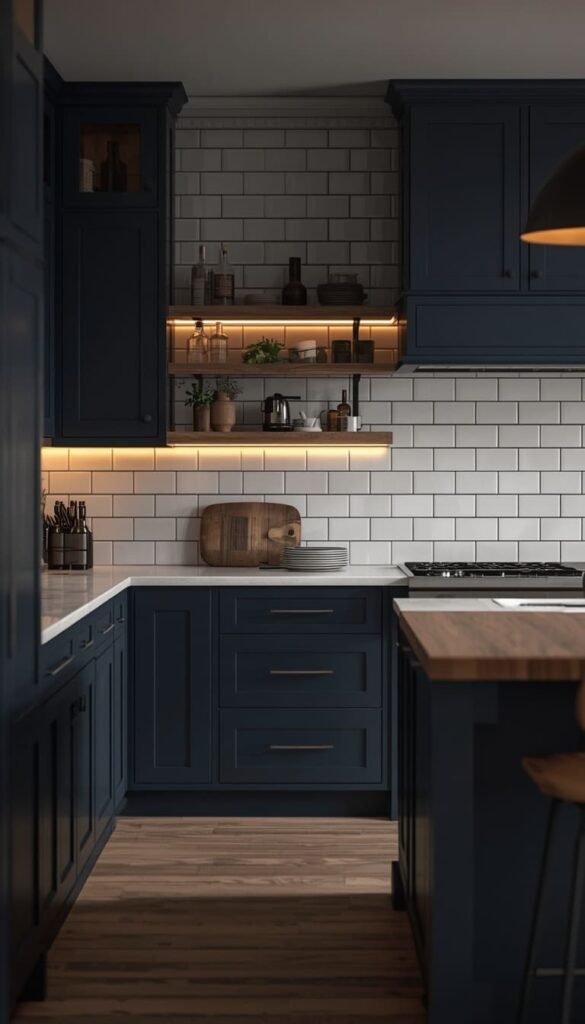
Midnight blue is not for the faint of heart — and that is exactly what I love about it. It is the shade that walks the line between navy and almost-black, and in the right kitchen, it creates an atmosphere that feels moody, sophisticated, and completely unforgettable. I specified a version of this for a client in Nashville who wanted her kitchen to feel like a high-end restaurant after dark. We nailed it.
White subway tile is the perfect counterbalance here. It is crisp, it is classic, and it keeps the deep blue from tipping into something that feels oppressive or cave-like. The contrast between the two is sharp and intentional — which is exactly the energy midnight blue demands. Soft or muted backsplash choices tend to disappear against a cabinet this dark, so you want something with real presence on the wall.
A few details that elevate this combination from good to genuinely great:
- Lay the subway tile in a vertical stack bond rather than the traditional horizontal brick pattern — it feels more current and adds height to the room
- Choose warm white grout rather than bright white — it softens the contrast just slightly and keeps the overall palette from feeling sterile
- Bring in one warm material — a wood floating shelf, a butcher block section, or even just a wooden fruit bowl on the counter — to stop the space from reading too cold
Lighting is the thing that makes or breaks a midnight blue kitchen. Recessed lighting alone is not enough. You need layered light — under-cabinet strips, pendant lights over the island, and ideally a statement fixture overhead that adds warmth. Without it, the space will feel dim rather than dramatic. The difference between those two outcomes is entirely in the lighting plan.
10. Soft Periwinkle Blue in a Small White Kitchen
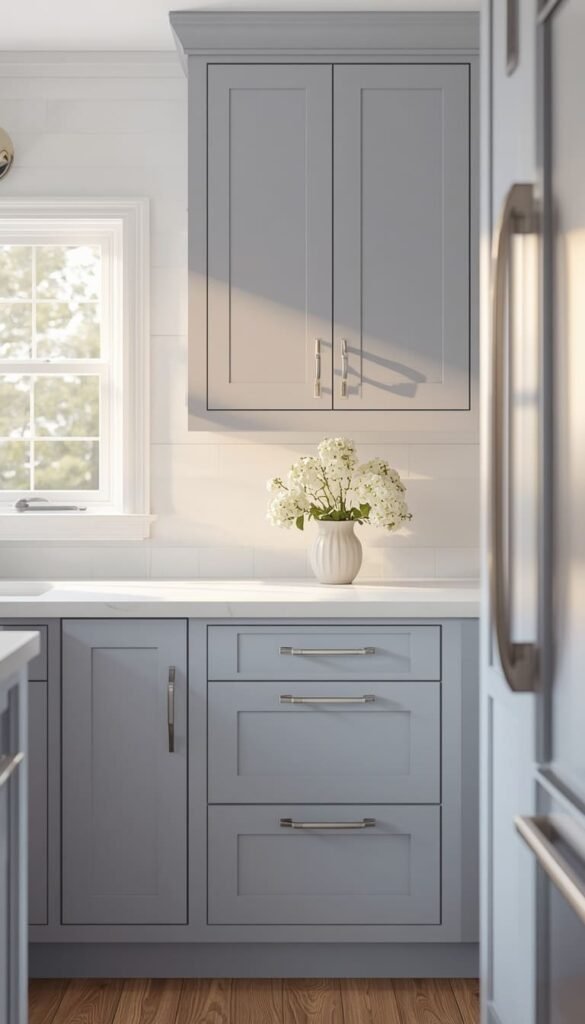
I saved this one for last because it is the idea that surprises people the most. Periwinkle — that soft, dreamy shade that sits right between blue and violet — is genuinely one of the most underused colors in American kitchen design. And in a small white kitchen, it does something almost magical.
Small kitchens need color to give them personality without sacrificing the sense of space. Periwinkle is light enough to keep the room feeling open, but it has enough character to make the kitchen feel genuinely designed rather than just neutral and forgettable. Paired with crisp white walls, white countertops, and simple silver or brushed nickel hardware, it reads clean, modern, and quietly beautiful.
The paint shade I reach for here is Forget Me Not by Benjamin Moore or Parma Gray by Farrow and Ball. Both sit in that perfect periwinkle zone — not too purple, not too blue, with just enough complexity to shift beautifully across different light conditions throughout the day.
One thing worth knowing — periwinkle is a shade that can read differently depending on your kitchen’s light source. In rooms with warm lighting it leans slightly lavender, which is lovely. In rooms with cool or northern light it stays true blue. Neither is wrong, but knowing this ahead of time saves you from a surprise after the paint dries. Always, always sample on the actual wall first.
For small kitchens specifically, I recommend keeping the hardware finish consistent throughout — mixing metals in a tight space can fragment the eye and make the room feel even smaller. Pick one finish and commit to it across cabinet pulls, faucets, and light fixtures. That consistency is what makes a small kitchen feel intentional and put-together rather than pieced together over time.
our Blue Kitchen Decision Map
By Budget
Fresh Start (Under $2,500)
- Periwinkle blue in a small white kitchen — paint only, big personality
- Bold blue tile backsplash — swap the tile, skip the cabinet work entirely
- Blue island repaint — one surface, maximum impact, minimal spend
Investment Kitchen (Above $5,000)
- Navy lower cabinets with white uppers — full two-tone cabinet replacement
- Modern navy with white marble countertops — the full luxury treatment
- Powder blue Shaker cabinets with brass hardware — custom finish, long-term value
By Lifestyle
Busy Families and Pet Owners
- Stick to quartz over marble — it forgives spills and scratches
- Choose medium blues over midnight shades — dust and paw prints show less
- Open shelving looks beautiful but collects grease — keep it minimal if you cook daily
Design Lovers and Empty Nesters
- Go bold with midnight blue or full navy cabinetry — you have the time to maintain it
- Real marble countertops are worth it when little hands are not in the picture
- Layer your lighting properly — pendants, under-cabinet strips, and a statement fixture
Renters and First-Time Refreshers
- Blue island or backsplash tile only — avoids permanent commitment
- Peel and stick blue tile exists and it is better than it used to be
- Blue textiles, barstools, and ceramics can shift the whole mood for under $300
Frequently Asked Questions
What is the most popular shade of blue for kitchen cabinets in the USA right now?
Hale Navy by Benjamin Moore is leading the pack. It is deep, versatile, and works across farmhouse, coastal, and transitional styles without feeling trendy.
Do blue and white kitchens increase home resale value?
Yes, when done right. Neutral blues like navy or powder blue read as timeless to buyers rather than personal or risky — unlike bolder color choices that can turn people away.
What hardware finish works best with blue kitchen cabinets?
Brass or unlacquered brass, without question. It adds warmth that blue needs. Matte black is a solid second option if you want a more modern, edgier feel.
Can I use blue cabinets in a small kitchen without making it feel cramped?
Absolutely. Stick to pale or periwinkle blues, keep walls and countertops white, and add good lighting. Light blues actually reflect brightness and open a small space up.
Is blue and white a timeless kitchen color combination or just a trend?
Timeless. Blue has been used in American kitchen design for decades across colonial, coastal, and farmhouse homes. It is not going anywhere anytime soon.
Conclusion
Your kitchen does not need a full renovation to feel completely different — sometimes all it takes is one bold decision on a single cabinet door or backsplash wall. Blue and white is a combination that has earned its place in American homes for a reason, and I genuinely believe there is a version of it that belongs in yours too. Pick the idea that made you stop scrolling, grab a paint sample this weekend, and just live with it for a couple of days. That first small step is usually all it takes to get the ball rolling.
