12 Built In Coffee Bar Ideas That Make Kitchens Look Expensive
Most homeowners spend thousands on new countertops or cabinet hardware trying to get that high-end look and completely overlook the one feature that actually signals luxury: a dedicated, built-in space for coffee. Not a cart shoved in the corner. Not a Keurig sitting on a random stretch of counter. A real, thoughtfully designed built-in coffee station that looks like it was always meant to be there. I’ve designed dozens of these across the country, and nothing earns more compliments per square foot. These 12 built-in coffee bar ideas will show you exactly how to pull it off, whether you’re working with a $1,500 budget or a $15,000 full kitchen renovation.
My Design Notes
A few years back, I was working on a kitchen renovation in Naperville, Illinois a Chicago suburb where the kitchens are often laid out in the most frustrating ways. My clients, a busy couple with two kids and a serious espresso habit, had a 28-inch gap between their refrigerator and pantry wall that was doing absolutely nothing. We transformed that dead space into a fully flush built-in coffee bar with white oak cabinet doors, a Miele built-in espresso machine, a compact drawer dishwasher for cups, and a zellige tile backsplash in warm sage green. The total build with a local cabinet maker came to around $4,200. Three months after installation, my client called and said it was the feature she uses more than anything else in that kitchen including the $15,000 island we built together. That phone call is exactly why I keep designing these.
Stunning Built-In Coffee Bar Designs That Instantly Elevate Your Kitchen
1. The Flush Cabinet Built-In That Disappears Into Your Kitchen
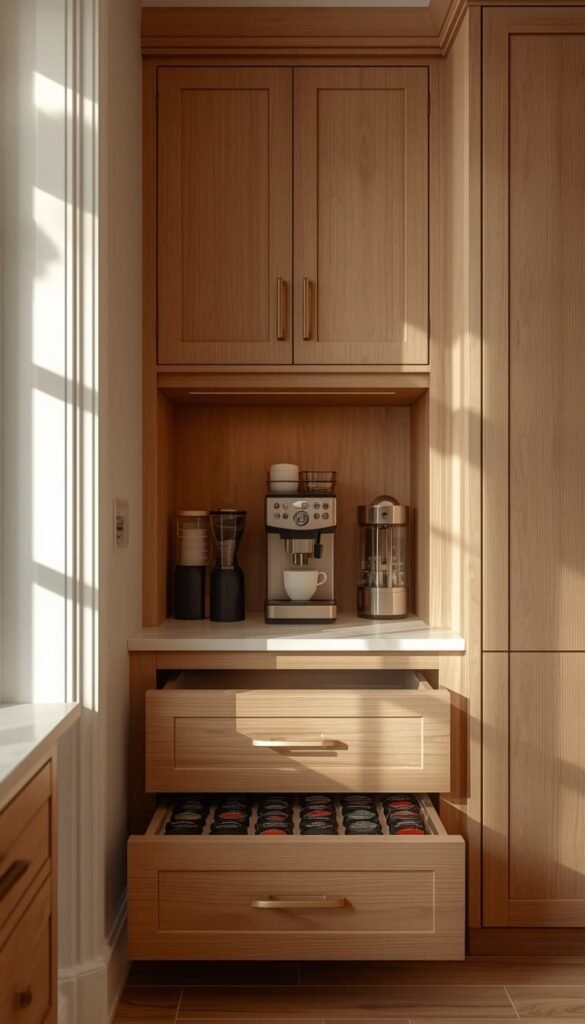
This is the approach I recommend most often, and it’s genuinely the most underrated built-in coffee bar idea on this list. The entire setup sits flush with your existing cabinetry same door style, same hardware, same finish so it looks completely intentional rather than added on. When the doors are closed, it just looks like more kitchen. When they open, it’s a fully functioning coffee station.
The key is working with your cabinet maker to size the interior around your specific machines. A standard Miele or Wolf built-in espresso unit needs roughly 24 inches of width and 18 inches of height clearance. Plan for that upfront, because retrofitting around appliances you already own is where budgets spiral fast. Add interior pull-out shelves and soft-close drawers below for pods, filters, and a spare bag of beans that combination is what makes this feel truly custom rather than improvised.
Budget reality: expect to spend between $2,500 and $6,000 depending on your cabinet material and whether you’re tying into existing plumbing for a water line. White oak with shaker-style doors sits comfortably in the middle of that range and photographs beautifully every single time.
One honest con worth mentioning here: flush built-ins require precise measurements. If your walls aren’t perfectly square and in most American homes, they aren’t you’ll need a skilled installer. This is not a weekend DIY project if you want it to look expensive.
2. White Oak and Quartz: The Combination That Always Looks Expensive
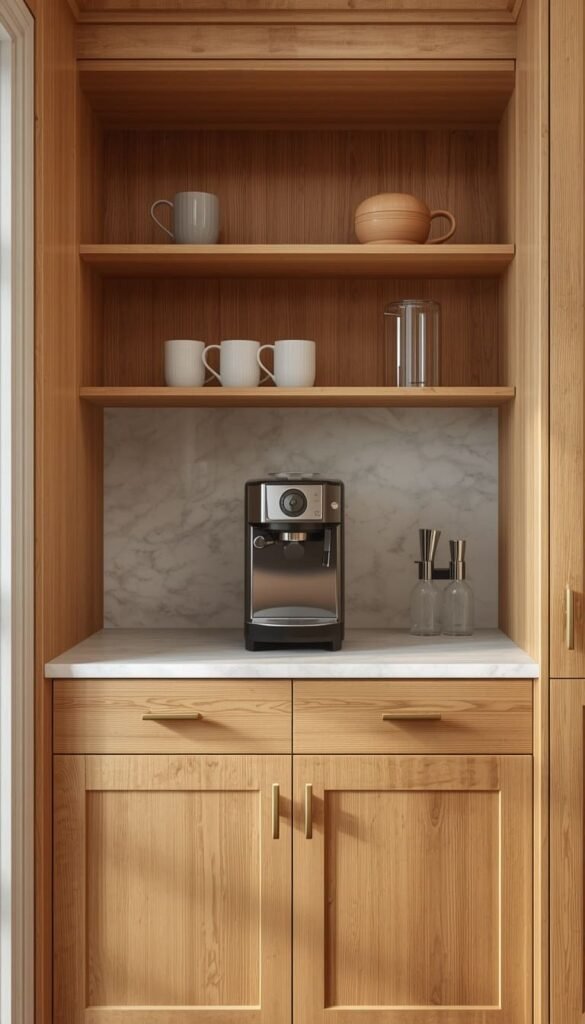
I’ve specified this pairing more times than I can count, and it never gets old. White oak cabinetry with a honed quartz countertop is the built-in coffee station combination that photographs like a magazine spread, holds up beautifully to daily spills, and works across virtually every kitchen style Modern Farmhouse, Transitional, Contemporary, even softer versions of Mid-Century Modern.
The warm grain of white oak does something painted cabinets simply can’t. It adds texture and visual depth without trying too hard. Pair it with a quartz surface in a soft white or warm greige tone and you’ve got a coffee bar that looks like it cost twice what you actually paid. Add brass or unlacquered bronze hardware and the whole thing reads as genuinely luxurious.
From a practical standpoint, quartz is the right countertop choice for a coffee station specifically because it’s non-porous and stain-resistant. Coffee grounds, espresso drips, oat milk splashes none of it soaks in. Marble looks stunning but requires sealing every year and will stain if you’re not obsessive about wiping up immediately.
3. The Hidden Coffee Station Behind Pocket Doors
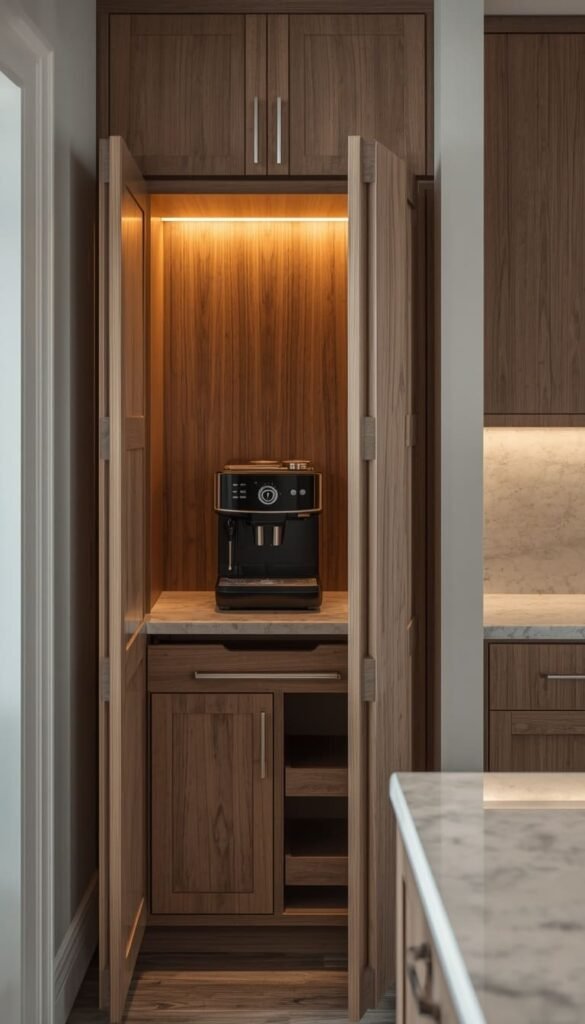
Not everyone wants their coffee setup on display 24 hours a day. If you have a clean, minimal kitchen and the idea of visible appliances makes you twitch, a hidden coffee station behind pocket doors is exactly what you need. The doors slide neatly into the wall cavity when open, giving you full access without anything swinging into your workspace. When closed, the wall looks seamless.
What makes this work visually is matching the pocket door panels to your existing cabinetry. Same finish, same hardware pull nobody walks into your kitchen and sees a coffee bar. They just see a beautiful, cohesive kitchen. That’s the whole point.
A few things worth planning around before you commit:
- Pocket doors need at least 3 inches of clear wall cavity on each side, so check for electrical wiring or plumbing before your contractor starts cutting
- Interior depth should be a minimum of 16 inches to fit a standard espresso machine comfortably
- Under-cabinet lighting inside the nook makes a huge difference — without it, the whole thing feels like a closet
The honest con here is cost. Pocket door hardware is more expensive than standard hinged doors, and the framing work adds labor. Budget an extra $400 to $800 above a standard built-in for this detail alone. Worth every penny if a clean kitchen is your priority.
4. A Zellige Tile Backsplash That Turns Your Coffee Nook Into a Focal Point
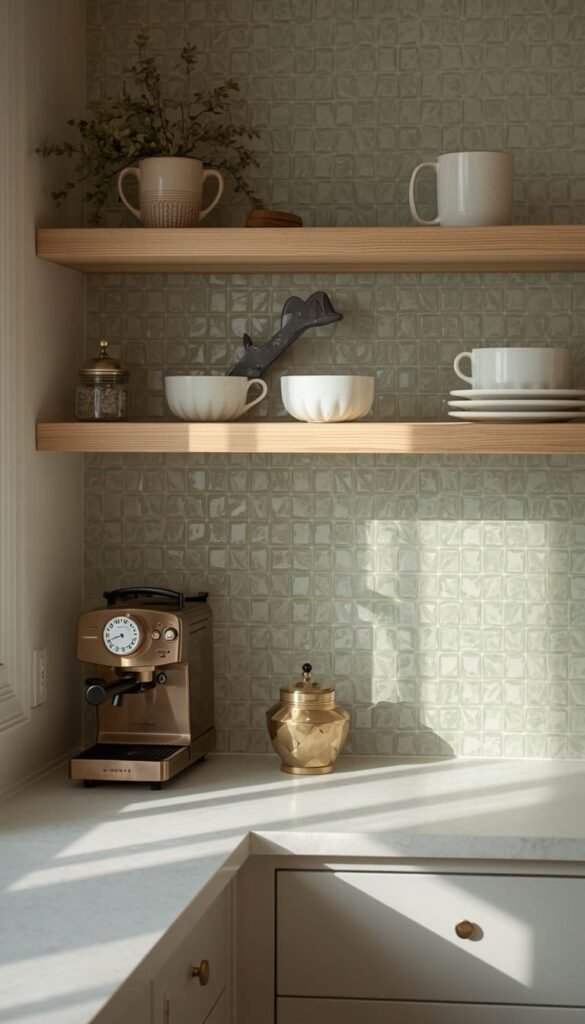
I’ve used zellige tile in coffee nooks more than any other backsplash material, and the reason is simple nothing else gives you that combination of texture, warmth, and handmade character at a relatively approachable price point. These are the hand-pressed Moroccan clay tiles with the slightly irregular surface that catches light differently throughout the day. In a coffee nook, that visual quality is everything.
Warm sage, soft terracotta, creamy white, and deep forest green are the colorways I reach for most often in American kitchens. Pair any of those with white oak shelving and unlacquered brass fixtures and the nook immediately becomes the most photographed corner of the entire kitchen.
One thing to watch out for with zellige specifically: the grout color matters enormously. A bright white grout will flatten the tile and kill its handmade quality. Go with a warm putty or greige grout instead — it lets the tile’s natural variation read the way it’s supposed to. Also, zellige is not the tile for someone who hates maintenance. The slightly porous surface needs sealing once a year, and heavy espresso splatter should be wiped down promptly. It’s not high-maintenance, but it’s not zero-maintenance either.
The scale of the nook matters too. In a tight 24-inch wide coffee station, keep the zellige tile contained to the backsplash only. Taking it up a full accent wall works beautifully in larger kitchen beverage centers but can feel overwhelming in compact spaces.
Top 6 built in coffee bar ideas kitchen ideas:
| Idea | Estimated Price | Maintenance |
|---|---|---|
| Flush Cabinet Built-In | $2,500 to $6,000 | Medium |
| White Oak and Quartz Station | $3,000 to $7,000 | Low |
| Hidden Station Behind Pocket Doors | $3,500 to $8,000 | Low |
| Zellige Tile Backsplash Nook | $1,500 to $4,500 | Medium |
| Built-In Espresso Station With Pot Filler | $5,000 to $12,000 | Medium |
| Small Kitchen Dead Corner Built-In | $800 to $2,500 | Low |
5. The Butler’s Pantry Coffee Bar That Keeps Your Main Kitchen Clutter Free
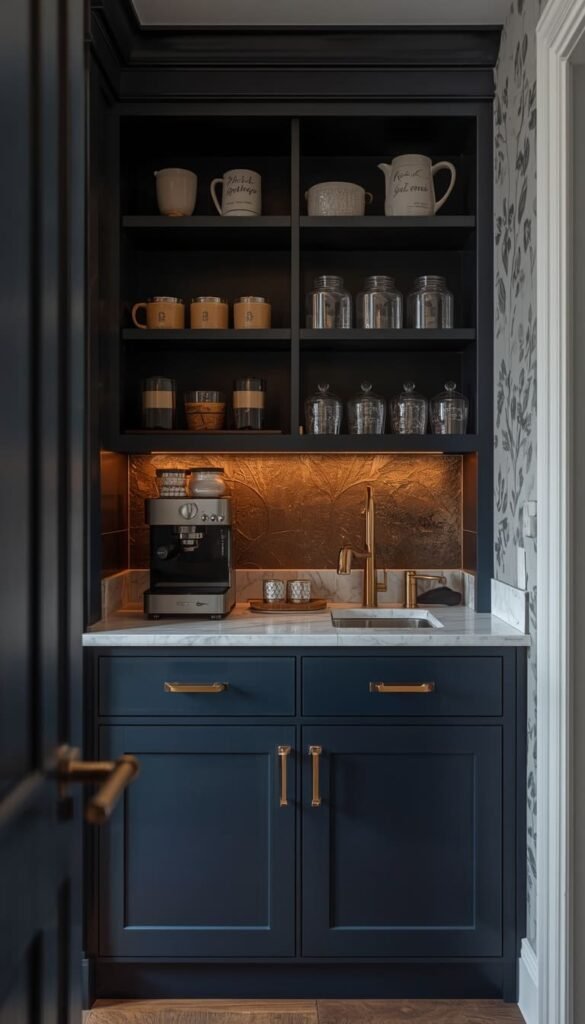
If your home has a butler’s pantry or even a deep narrow hallway between your kitchen and dining room you are sitting on the single best location for a built-in coffee bar. Moving the entire coffee operation out of the main kitchen is one of those decisions that seems small on paper but completely transforms how your kitchen feels day to day. No machines on the counter. No pod storage in plain sight. No coffee ring stains next to the stove.
The setup I love most in a butler’s pantry coffee bar combines a built-in espresso machine at counter height, open shelving above for mugs and glass canisters, and a small prep sink to the side. That sink detail is the real game-changer. Filling water tanks, rinsing the portafilter, dumping used grounds all of it happens in one contained zone. Your main kitchen stays clean.
Material-wise, this is your chance to do something a little different from the main kitchen without it feeling disconnected:
- Deep navy or forest green cabinetry with unlacquered brass hardware reads as sophisticated and intentional
- A leathered quartzite or honed marble countertop adds texture that feels appropriate in a secondary space
- Wallpaper on the upper portion of the walls adds personality without competing with the main kitchen design
Budget range for a full butler’s pantry coffee bar conversion sits between $6,000 and $14,000 depending on whether plumbing already exists in that space. If the sink rough-in is already there, you’re looking at the lower end of that range comfortably.
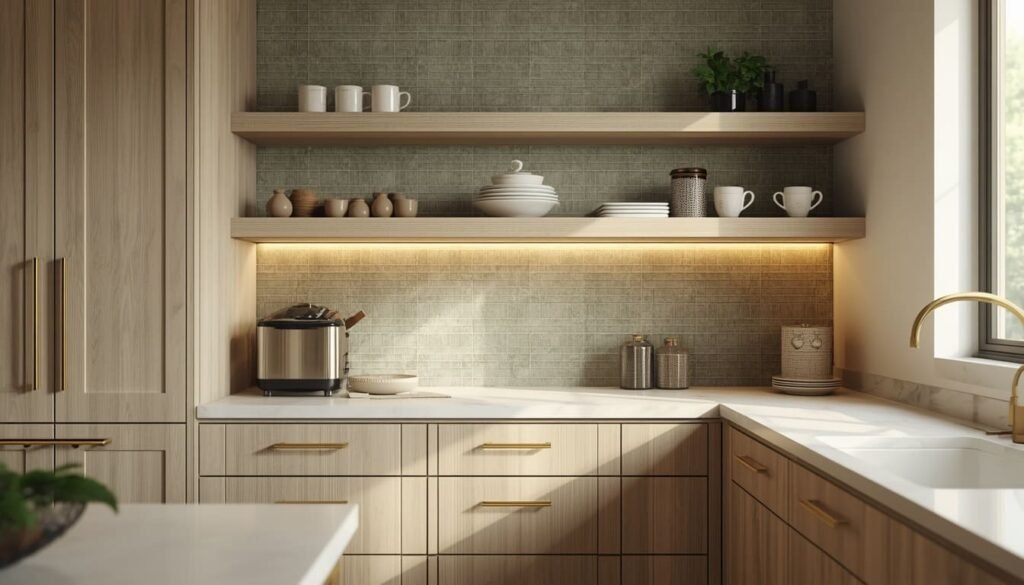
6. Floating Brass Shelves and a Wallpaper Backdrop for the Hallway Coffee Bar
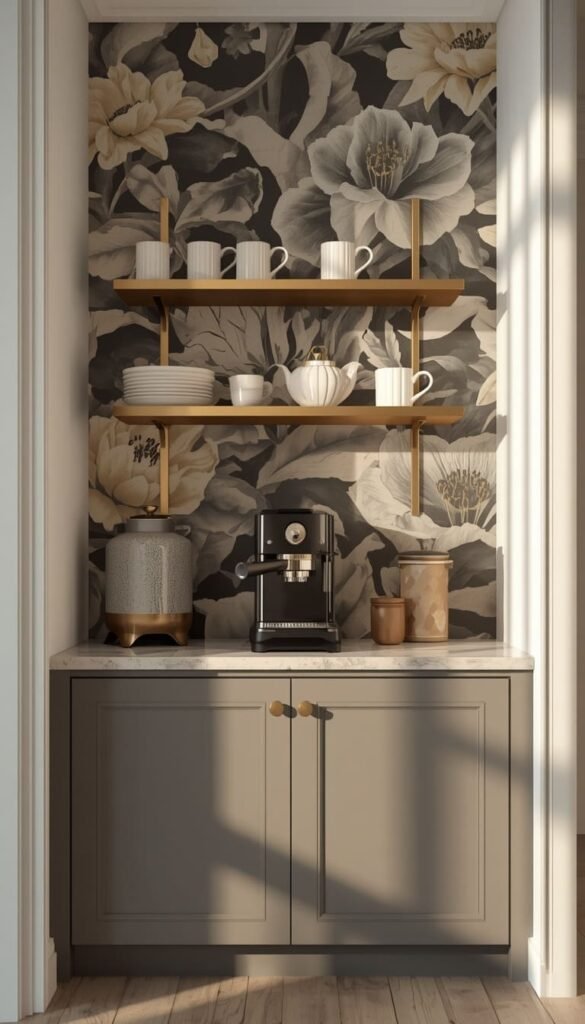
This one surprises people every single time. Most homeowners never consider the hallway as a viable location for a built-in coffee station, but some of my favorite projects have happened in exactly that space. A stretch of hallway wall even just 36 inches wide is genuinely enough to create a fully functional, visually stunning coffee bar that feels like a deliberate design feature rather than an afterthought.
The formula that works beautifully here is a base cabinet with a stone countertop, floating brass shelves above, and a dramatic wallpaper backdrop behind the shelves. The wallpaper does the heavy lifting visually. It frames the whole vignette and gives it a collected, layered quality that no tile backsplash can quite replicate in a narrow space.
A quick trick I’ve learned from doing this in several projects: keep the wallpaper pattern in the medium scale range. Something too large gets cropped awkwardly by the shelves. Something too small reads as busy and restless. A medium-scale botanical, abstract, or geometric pattern sits in that sweet spot where it feels intentional and curated.
Brass shelf brackets are worth the splurge here. The thin profile keeps the look airy and modern while the warm metal tone connects beautifully to cabinet hardware and faucet fixtures elsewhere in the space.
Which of these 12 built-in coffee bar ideas fits your kitchen layout best a flush cabinet nook or an open shelf setup?
7. The Farmhouse Built-In With Shiplap and Open Mug Display
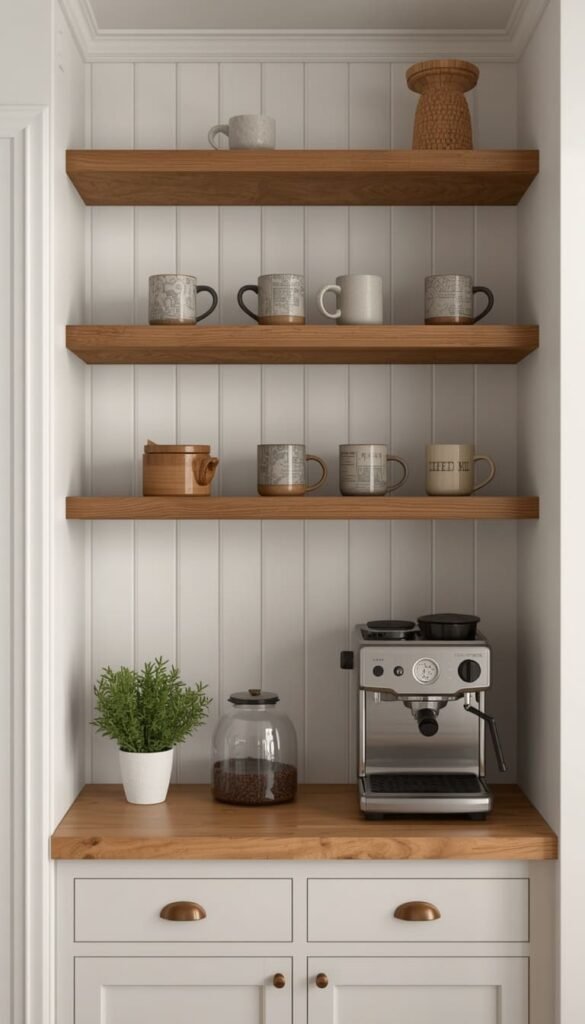
For homes with a Modern Farmhouse interior and there are a lot of them across the American Midwest and South this built-in coffee bar style feels completely at home without looking costumey or overdone. The key is restraint. Farmhouse style in 2025 is much more refined than the shiplap-everything approach of a decade ago. You want warmth and texture, not a Pinterest board from 2014.
The setup I recommend for a farmhouse built-in coffee bar:
- Shiplap or vertical wood planking as the backsplash rather than tile — it adds warmth and keeps the look cohesive with the rest of the home’s architecture
- Open floating shelves in a natural or whitewashed wood finish for mug display and coffee canister storage
- A farmhouse apron sink integrated into the bar if the footprint allows — even a small 18-inch version looks incredible here
The open mug display is something I always encourage clients to commit to fully or skip entirely. Half-committed open shelving where mugs are lined up but everything else is shoved behind closed doors in a chaotic way always reads as cluttered. If you go open, edit ruthlessly. Eight to ten matching or intentionally mismatched mugs, a glass canister of beans, maybe a small plant. That’s your limit. The moment you start stacking things two deep, the whole thing loses its appeal.
8. A Built-In Espresso Station With Pot Filler: The Real Luxury Upgrade
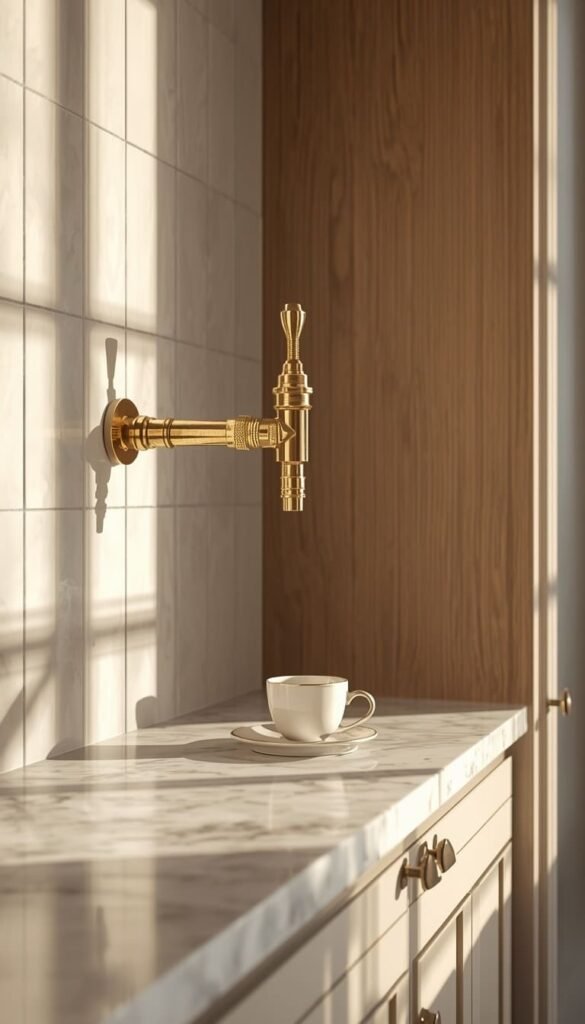
If there is one single feature that separates a genuinely luxury built-in coffee bar from everything else on this list, it is a dedicated pot filler mounted directly above the espresso machine or coffee maker. It is the kind of detail that makes guests stop mid-conversation and ask about it. And from a pure functionality standpoint, it eliminates one of the most annoying parts of the morning routine hauling a full water tank across the kitchen to the sink and back.
A pot filler for a coffee station is installed the same way as a kitchen pot filler above a range, but positioned at a lower height to suit countertop appliances. Articulating styles work best here because they fold flat against the wall when not in use. Unlacquered brass and matte black are the two finishes I specify most often both photograph beautifully and work across a wide range of cabinet styles.
The plumbing reality is worth being straightforward about. If you don’t already have a water line in that wall, adding one typically costs between $300 and $700 in labor depending on your location and how accessible the pipes are. It’s not a massive expense in the context of a full built-in project, but it’s not free either. Plan for it in your initial budget rather than treating it as an add-on, because retrofitting plumbing after cabinetry is installed is an expensive mistake.
One thing that genuinely surprises most of my clients: once they have a pot filler at their coffee station, they use it constantly. Not just for coffee. For filling pasta pots, electric kettles, even flower vases sitting on the counter nearby. It earns its keep every single day.
9. Dark Wood Cabinetry and Undercabinet Lighting for a Moody Coffee Corner
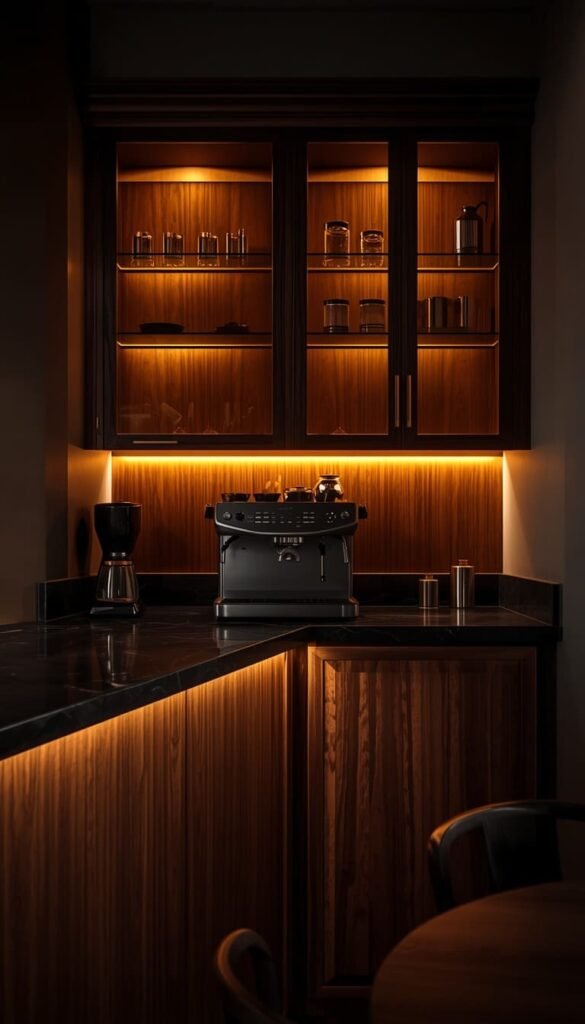
There is something genuinely compelling about a dark wood coffee corner in an otherwise light kitchen. It creates contrast, draws the eye, and gives that one section of the kitchen a completely different energy from the rest of the space. Done correctly, it looks intentional and sophisticated. Done carelessly, it looks like a mistake.
The wood tones that work best for this approach are walnut, dark-stained red oak, and smoked white oak. All three have enough grain variation to feel rich and textured under lighting rather than flat and heavy. Pair any of them with a honed black granite or leathered soapstone countertop and the whole coffee corner takes on a genuinely moody, cafe-inspired quality that I personally find irresistible.
The undercabinet lighting piece is non-negotiable here. Dark cabinetry absorbs light, and without a dedicated light source inside and beneath the upper cabinets, the whole setup feels dim and uninviting. What actually works:
- Warm-toned LED strip lighting under upper cabinets positioned toward the front edge, not the back wall
- A dimmer switch so you can drop the brightness at 6 a.m. without feeling like you’re standing under a spotlight
- Interior cabinet lighting if you have glass-front upper doors — the glow through glass at night looks genuinely stunning
The con worth acknowledging is fingerprints. Dark wood cabinetry shows fingerprints and smudges more readily than lighter finishes, especially in a high-touch area like a coffee station. A satin finish rather than high-gloss helps significantly, and a quick wipe-down every couple of days keeps it looking sharp.
10. The Small Kitchen Coffee Bar Built Into Dead Corner Space
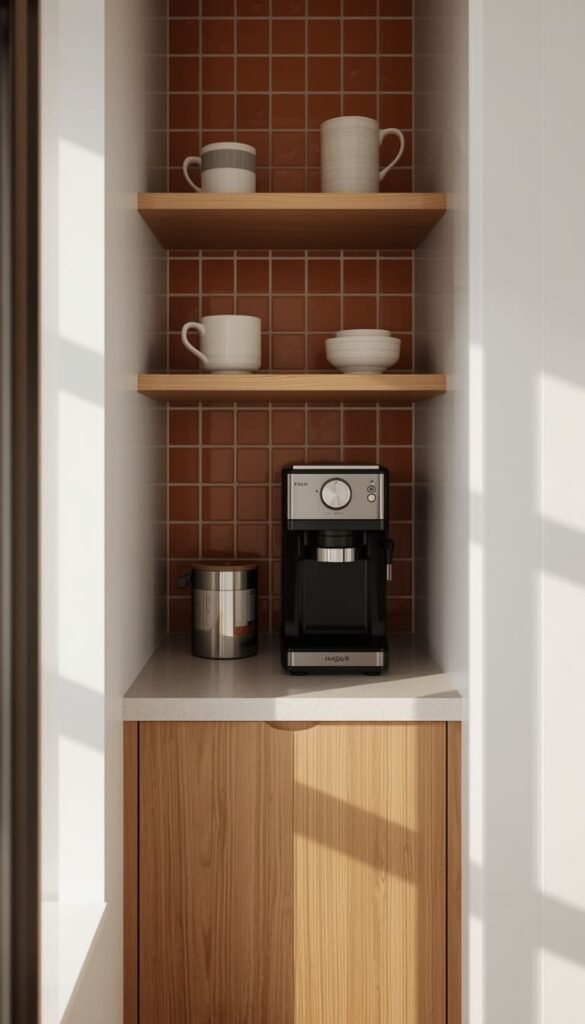
Dead corner space is one of the most consistently wasted areas in American kitchen layouts. That awkward diagonal cabinet, the blind corner that nothing fits into properly, the 22-inch stretch of wall between the refrigerator and the door frame these are not problems. They are disguised opportunities for the most efficient small kitchen coffee bar you’ve ever seen.
I worked on a galley kitchen in a Brooklyn brownstone where the entire coffee bar was built into a 26-inch wide recessed niche beside the refrigerator. Full espresso machine, two open shelves above for mugs, a small pull-out drawer for pods and filters, and a single strip of zellige tile as the backsplash. The homeowner told me it made the entire kitchen feel designed rather than assembled. That’s exactly the effect a well-executed small kitchen coffee bar delivers.
A few principles that make compact coffee bars work hard without feeling cramped:
- Vertical storage is your best friend — go up with shelving rather than spreading out horizontally
- A single large-format tile or a full slab backsplash in a tight space reads cleaner than small mosaic tiles, which can feel visually chaotic at close range
- Pull-out drawer inserts designed specifically for coffee pod storage keep the counter completely clear
The budget here is genuinely accessible. A small built-in coffee corner in dead space — without plumbing typically runs between $800 and $2,500 depending on materials. That is the most affordable entry point on this entire list, and the visual return is disproportionately high.
11. Custom Pull-Out Drawers and an Appliance Garage for the Clean Line Look
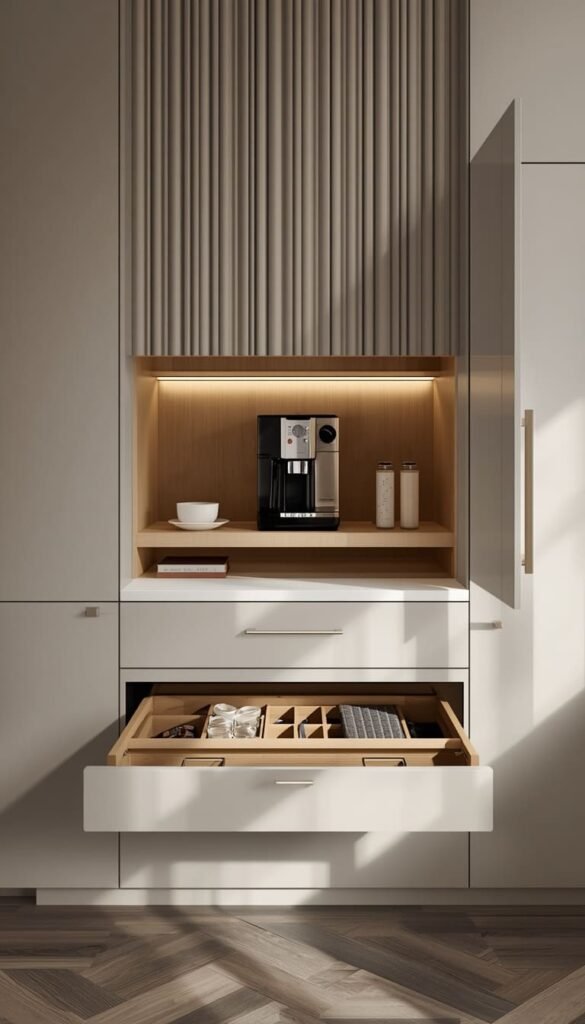
This is the built-in coffee bar idea for the person who genuinely cannot stand anything sitting on a countertop. Every appliance hidden. Every pod, filter, and coffee bag tucked away behind a door. The counter surface completely clear except for whatever you’re actively using at that exact moment. If that description sounds like your dream kitchen, an appliance garage with custom pull-out drawer inserts is exactly what you need.
The appliance garage concept is straightforward a section of upper cabinetry with a tambour door or a lift-up panel that conceals the espresso machine or coffee maker completely when not in use. The machine sits on a pull-out shelf inside so you can slide it forward to operate without dragging it across the countertop. Slide it back, close the door, and it disappears entirely.
What makes this feel truly custom rather than just functional is the interior finishing. Most people spec the exterior beautifully and then leave the interior in raw cabinet box material. A quick trick I’ve learned from doing several of these: finish the interior of the appliance garage in the same material as the exterior, add a small interior LED light, and line the pull-out shelf with a textured rubber mat in a matching tone. The whole thing looks considered every time the door opens.
Storage below deserves equal attention. Deep pull-out drawers with custom inserts dedicated compartments for pods, a drawer with a bag clip built in for open coffee bags, a slim drawer lined with felt for delicate espresso tools turn a good coffee bar into a great one. These drawer inserts typically add $200 to $500 to the project cost and are absolutely worth it.
Are you working with a tight corner or do you actually have a full wall to dedicate to a coffee station?
12. The Bedroom Built-In Coffee Bar That Makes Every Morning Feel Like a Hotel Stay
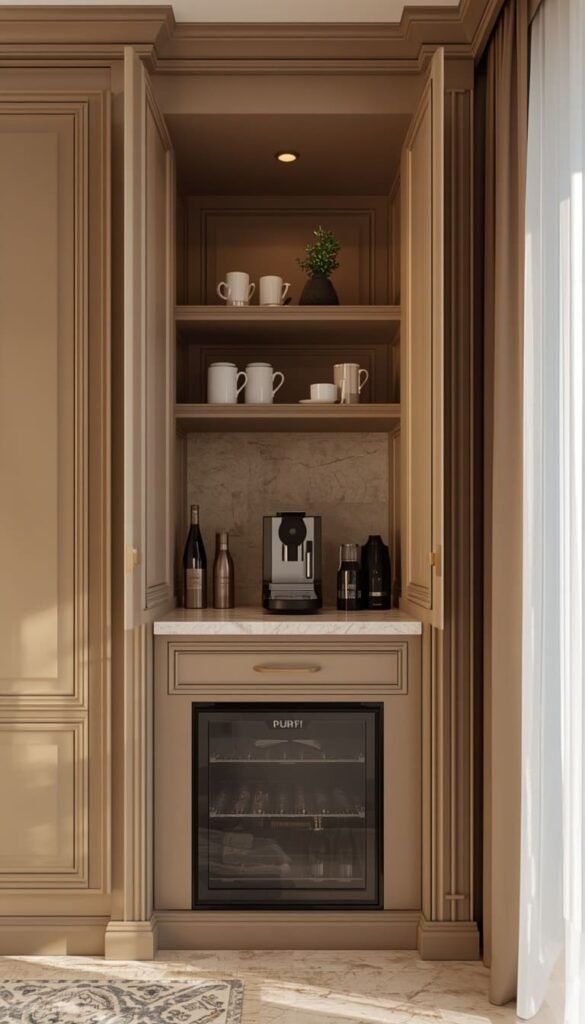
This is the one that clients are most skeptical about before they see it, and most obsessed with after they live with it for two weeks. A built-in coffee bar in the primary bedroom is not an indulgence it is a genuine quality of life upgrade that changes your entire morning routine in the best possible way.
The version I love most keeps things compact and intentional. A 36-inch wide built-in unit with cabinet doors that conceal a fully automatic espresso machine, a small refrigerator drawer below for milk and creamer, and two open shelves above for a curated selection of mugs. A small prep sink integrated into the countertop takes it from convenient to genuinely hotel-suite territory.
The design approach needs to shift when you move a coffee bar into a bedroom context. Kitchen-style cabinetry can feel jarring in a sleeping space. Instead:
- Choose furniture-style cabinet doors with inset panels and softer hardware think aged brass bin pulls rather than bar handles
- Use a warmer countertop material like unlacquered walnut or honed travertine rather than the quartz you’d specify in a kitchen
- Keep the color palette connected to the bedroom’s existing tones so the unit reads as a piece of furniture rather than a kitchen import
The plumbing question comes up immediately with every client considering this option. A prep sink in a bedroom built-in does require running a water line and a drain, which adds cost. If that feels like too much, a high-quality fully automatic machine with a large removable water tank is a completely functional alternative you fill the tank every couple of days rather than dealing with plumbing, and the setup costs significantly less.
Your 30 Second Coffee Bar Decision Map
By Budget
Starter ($800 to $3,000)
- Dead corner nook with open shelving
- Stock or semi-custom cabinets only
- Skip plumbing, use removable water tank
- Tile backsplash for maximum visual impact at low cost
Mid-Range ($3,000 to $8,000)
- Custom cabinet sizing with quality hardware
- Quartz countertop and zellige backsplash
- Appliance garage for clean-line look
- This tier delivers the best design-to-dollar ratio
Investment ($8,000 and above)
- Full custom with pot filler and prep sink
- Panel-ready refrigerator drawer built in
- Butler’s pantry full conversion
- Adds measurable resale value to your home
By Lifestyle
The Minimalist
- Flush cabinet built-in with pocket doors
- Appliance garage so counters stay completely clear
- Neutral finish that disappears into existing cabinetry
The Entertainer
- Open shelving with curated mug display
- Zellige backsplash and brass fixtures
- Undercabinet lighting for that after-dark wow factor
The Busy Family
- Butler’s pantry or hallway location
- Prep sink and deep drawers are non-negotiable
- Durable surfaces over decorative details every time
The Small Kitchen Owner
- Dead corner vertical built-in
- One dramatic backsplash material keeps it intentional
- Compact automatic machine with removable tank
Built-In Coffee Bar Ideas: Your Top Questions Answered
What is the average cost of a built-in coffee bar in a US kitchen?
Most built-in coffee bars run between $2,500 and $8,000 for a mid-range custom setup. Simple open-shelf nooks start around $800, while fully plumbed stations with pot fillers can reach $15,000.
Does a built-in coffee bar increase home resale value?
Yes, consistently especially in the $400,000 to $900,000 price range. Buyers notice dedicated coffee stations during showings and agents confirm it speeds up offers.
What is the best countertop for a coffee bar?
Honed quartz. It resists stains, needs zero sealing, and handles daily espresso drips without complaint.
Can a built-in coffee bar work in a small kitchen?
Absolutely a 24-inch dead corner niche is enough. Vertical shelving, a compact automatic machine, and one strong backsplash material make even tight spaces look completely intentional.
Do I need a plumber for a built-in coffee bar?
Only if you want a pot filler or prep sink which adds $300 to $700 in labor depending on existing pipe access. A machine with a removable water tank skips plumbing entirely and works just as well for most households.
Conclusion
Your morning routine deserves better than a Keurig sitting on a random stretch of counter with nowhere to belong. A built-in coffee bar even a simple $800 corner nook with open shelves and a good tile backsplash changes how you feel about your kitchen every single day. Start somewhere. Clear a shelf, measure that dead corner beside the fridge, or pull three cabinet samples this weekend. The version that fits your budget and your layout exists on this list. You just have to take the first step toward it.
So tell me are you starting from scratch with a full renovation, or are you sneaking a coffee bar into an existing kitchen layout? Drop your situation in the comments and let’s figure out exactly which direction makes the most sense for your space.